Malabar Spinach Care Guide: Trellis, Heat & Harvest
Basella alba
Grow Malabar spinach or poi saag on a trellis in full sun with warm-season sowing, steady moisture, and frequent leaf harvests through summer heat.
Malabar Spinach Care Guide: Trellis, Heat & Harvest
Start with wateringThe most common care mistake for Malabar SpinachWatering guide → →Malabar Spinach care essentials
Light
Water
Keep the root zone consistently moist through the warm growing season, but never waterlogged. Heat-loving vines transpire quickly in full sun, yet saturated soil encourages stress flowering and bitter leaves.
Soil
Humus-rich, moisture-retentive, well-drained loam or container mix. NC State Extension recommends fertile organic soil with good drainage; acid to near-neutral pH suits most plantings.
Humidity
Temperature
Fertilizer
About Malabar Spinach
Malabar Spinach is native to Tropical Asia (India, Indonesia, and surrounding regions), typically reaches Twining vine commonly 3–10 m long in one warm season; upright spread about 60–90 cm on a trellis indoors, with fast — growth accelerates once summer heat and nights stay warm growth. Malabar Spinach has a vine growth habit and part of the Basellaceae family. It is also known as Poi Saag, Basella, Indian Spinach, Vine Spinach, and Ceylon Spinach.
| Detail | Information |
|---|---|
| Also known as | Poi Saag, Basella, Indian Spinach, Vine Spinach, Ceylon Spinach |
| Native region | Tropical Asia (India, Indonesia, and surrounding regions) |
| Mature size | Twining vine commonly 3–10 m long in one warm season; upright spread about 60–90 cm on a trellis |
| Growth rate | Fast — growth accelerates once summer heat and nights stay warm |
| Growth habit | Vine |
| Scientific name | Basella alba |
| Family | Basellaceae |
Malabar Spinach Care Guide: Trellis, Heat & Harvest
Malabar spinach care starts with a mental shift: you are growing a fast twining vine for summer heat, not a low rosette of cool-season palak. Basella alba — poi saag, vine spinach, Ceylon spinach — belongs to the Basellaceae family and is unrelated to true spinach (Spinacia oleracea), which bolts when days lengthen and temperatures climb. Wisconsin Extension recommends Malabar spinach precisely because it thrives in hot weather when true spinach fails. The Malabar Spinach plant hub collects species traits for your climate; this page is the full-path overview before you open topic guides on light, watering, and soil.
Malabar spinach care at a glance
Give Malabar spinach full sun, a sturdy trellis, humus-rich moist but drained soil, and steady summer moisture. Sow or transplant only after frost risk has passed and soil has warmed; expect the vine to sit idle until nights stay mild, then grow rapidly once heat arrives. Harvest tender leaves and stem tips often; dry soil or stress flowering turns foliage bitter.
NC State Extension describes a vigorous frost-tender vine often six feet tall in a season (sometimes much longer), adapted to high temperatures into the 90s °F when soil stays moist, yet disappointing when temperatures remain below 80 °F. Those ranges explain why a March sowing in Pune can look “stuck” until May nights warm — patience is part of the crop, not a sign of bad seed.
What Malabar spinach is (and is not)
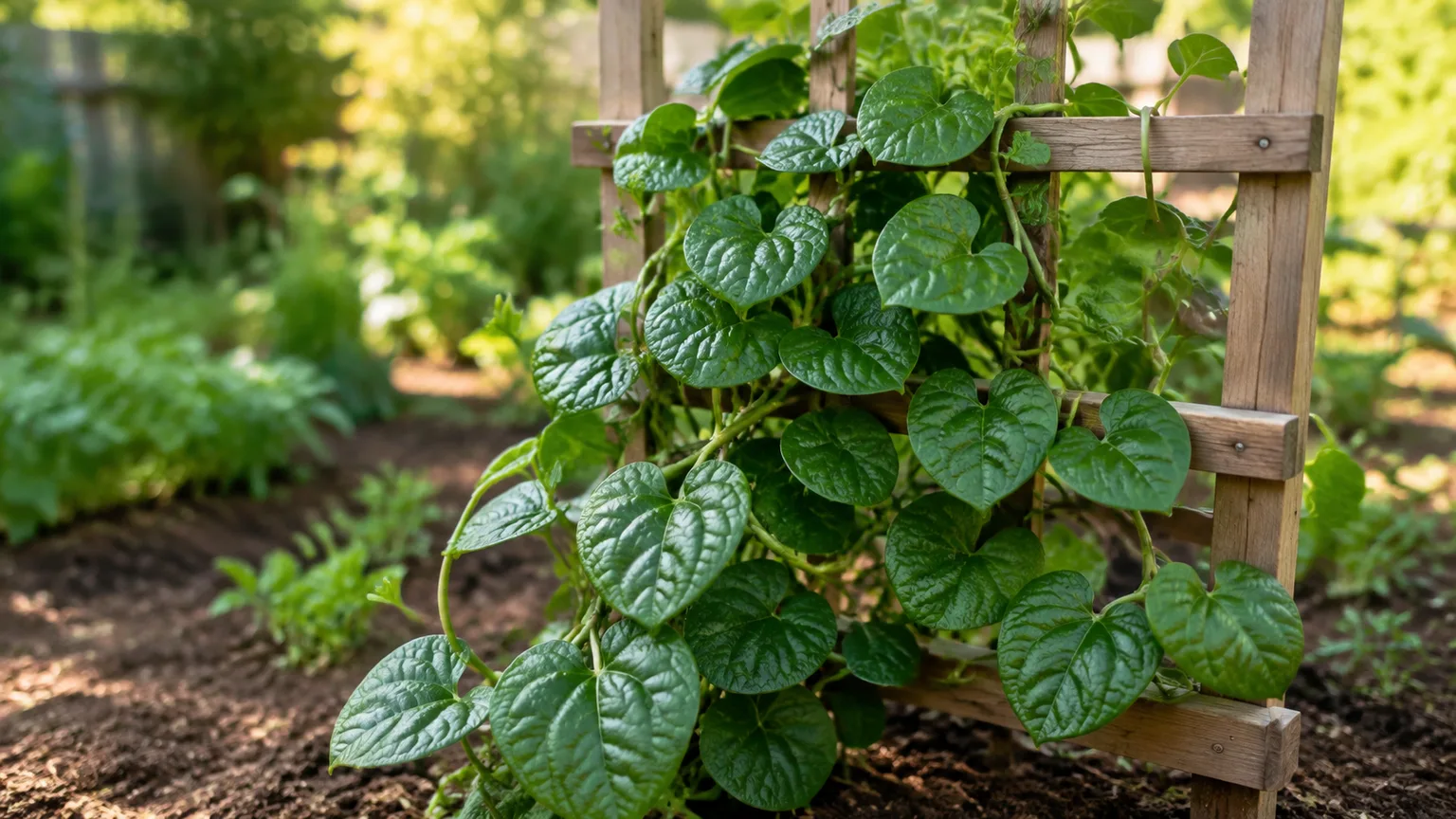
Malabar spinach is a leafy vegetable vine native to tropical Asia, widely eaten across South and Southeast Asia. Thick, glossy, semi-succulent leaves and young shoots are the crop — used raw in salads or cooked like spinach, with a mucilaginous texture that thickens soups and stews much like okra. It can also be grown purely as an ornamental climber, especially the red-stemmed types.
Basella alba vs true spinach and lookalikes
True spinach is a cool-season annual that favors mild days and short nights. Malabar spinach is a tender perennial hardy only to about zone 10a that gardeners elsewhere treat as a warm-season annual. Do not substitute it into winter palak recipes on the calendar alone — match the plant to summer kitchen gaps. Amaranth greens and other “summer spinach” labels are different species again; read seed packets for botanical names, not just the word “spinach.”
Twining habit, size, and growth rate
Wisconsin Extension notes a soft-stemmed twining vine that can reach up to 10 feet in one warm season as an annual, with oval to heart-shaped, thick leaves. NC State lists typical garden dimensions around 3–6 feet tall with a 2–3 foot spread when supported — but length on a trellis often exceeds height on the label. Growth is rapid once heat and moisture align; Brooklyn Botanic Garden reports red-stemmed types can grow a foot per day in tropical heat when conditions suit the species.
Warm-season timing in India and the tropics
India does not share one national sowing week. Coastal humid zones, interior dry heat, and hill stations differ in night temperature and drying speed. The transferable rule is to align active vine growth with warm soil and mild-to-hot nights, not with the palak season.
When to sow, transplant, and expect real growth
In frost-prone regions, Wisconsin Extension advises planting outdoors only a few weeks after the last frost and starting seed indoors 6–8 weeks before last frost where seasons are short. NC State recommends direct seeding in zone 7 and warmer 2–3 weeks after the last frost date. Practical guides often cite roughly 65 °F (18 °C) soil as a germination baseline, with best emergence in warm soil.
On a Bangalore terrace, late spring through early monsoon sowing often matches those soil temperatures naturally; in North Indian plains, post-frost late spring transplanting is safer than winter sowing. Wisconsin Extension is explicit that plants will not grow much until summer heat arrives and stall when nights stay below about 60 °F (16 °C). Watch local forecasts rather than copying a U.S. calendar.
Light, heat, and monsoon humidity
Malabar spinach wants bright light for vigorous, succulent leaves. NC State lists full sun — six or more hours of direct light daily and notes strong performance in heat and humidity when roots stay evenly moist. The species is well-adapted to high temperatures but not to chill — it is very sensitive to frost and cool temperatures.
Intense afternoon sun on a dark container can stress roots even when air humidity is high; some growers prefer morning sun with light afternoon shade on terraces. That trade-off can slow flowering slightly but is not a substitute for choosing a warm sowing month. Window placement, reflectivity, and supplemental light limits are covered in the dedicated Malabar Spinach light guide.
Water and even root-zone moisture
Leaf quality tracks steady root-zone moisture more than a fixed calendar. Wisconsin Extension warns that plants tend to flower if soil gets too dry, and NC State links dry soil or extreme heat to flowering and bitter leaves. Once flowering dominates, Wisconsin Extension notes leaves become bitter — harvest quality drops even if vines still climb.
Press a finger into the upper 2–3 cm of mix or bed soil; water deeply when it begins to feel dry rather than cool and damp. Morning watering at the soil line keeps dense foliage drier overnight than routine overhead spraying on tangled vines. Overwatering still matters in heavy clay — saturated soil invites stem rot and sour smells. The Malabar Spinach watering guide walks through over- and underwatering signs and the first fix when you are unsure.
Soil, trellis support, and spacing
Target fertile, moisture-retentive, well-drained soil. NC State recommends well-drained soil rich in organic matter in a warm sunny sheltered spot, with acid to neutral pH typical of vegetable beds. Wisconsin Extension adds fertile, moist, well-drained conditions for best growth.
Install a trellis, fence, or sturdy frame at planting, before stems lengthen. NC State advises a sturdy trellis or fence because the plant can grow rapidly, and Wisconsin Extension recommends a sturdy trellis when grown as a vegetable rather than letting vines sprawl on the ground. Supported vines keep glossy leaves cleaner, improve airflow, and make frequent picking easier. Space transplants at least about a foot apart per Wisconsin Extension guidance for warm soil transplanting. Mix recipes, compost rates, and drainage diagnosis live in the Malabar Spinach soil guide.
Rubra and other cultivars
Green-stemmed Basella alba is the standard edible type. The cultivar Rubra — often sold as red-stemmed Malabar spinach — adds burgundy stems and pink-veined leaves for ornamental trellises and edible borders. Brooklyn Botanic Garden highlights Rubra as a heat-season ornamental edible that pairs visually with dark-leaved beets and chard. NC State lists ‘Rubra’ with red leaves as a named form. Culture matches the green type: full sun, rich soil, trellis, and steady moisture.
Sowing, scarification, and early vine training
Malabar spinach seed coats are hard. Wisconsin Extension recommends mechanical scarification or overnight soaking to speed germination, with emergence often in 10 days to three weeks depending on warmth. NC State also advises scarifying seed to hasten germination.
Train stems upward as soon as they are long enough to twine — do not wait until the vine is heavy. Stems that touch moist soil can root in place, which helps fill a trellis quickly but can escape planned beds if you are not trimming edges. Step-by-step sowing, cuttings, and berry seed saving are in the Malabar Spinach propagation guide. The Malabar Spinach repotting guide explains why this crop is usually sown or transplanted once into a final bed, pot, or grow bag rather than repeatedly “repotted” like a houseplant.
Harvest, flavor, and kitchen use
Pick young leaves and tender stem tips regularly once vines are established. Wisconsin Extension describes a mild, slightly peppery flavor with a hint of citrus and notes the mucilaginous cooked texture some cooks love and others avoid. Frequent harvesting encourages branching and delays the shift toward flowering.
Purple-black berries follow inconspicuous flowers; juice stains badly and is used as a natural food colorant in Asia. Dried whole fruits can be saved for seed. Snipping vines for shape and leaf production — not hedge aesthetics — is covered in the Malabar Spinach pruning guide.
Containers, grow bags, and terrace culture
Malabar spinach suits large containers and grow bags if you provide depth for roots, drainage holes, and a trellis anchored to the pot or railing. Limited mix dries faster than in-ground beds; expect to check moisture daily in peak summer on sunny terraces. Wisconsin Extension notes the vine is easily grown from tip cuttings — useful if a container vine outgrows its first support mid-season.
Choose a pot wide enough that a trellis does not topple the assembly when wet soil and wind load combine. If the vine wilts every afternoon despite watering, the container may be too small or too exposed — fix placement and volume before increasing fertilizer.
Feeding without pushing early flowering
Rich compost at planting usually carries Malabar spinach through the season. If leaves pale after temperature and moisture look correct, feed lightly with balanced nutrition rather than heavy nitrogen alone — lush, weak growth still flowers under drought stress. Timing, products, and burn signs are detailed in the Malabar Spinach fertilizer guide.
Common Malabar spinach care mistakes
Sowing while soil is still cool produces weeks of idle seedlings that beginners mistake for dead plants. Warmth unlocks growth; cold nights below about 60 °F stall the vine.
Skipping trellis support until mid-season tramples succulent leaves, invites slug damage on damp ground, and makes harvest frustrating.
Boom-and-bust watering triggers flowering and bitter foliage faster than steady moisture — the most common harvest complaint.
Confusing it with true spinach leads to winter sowing failure and unfair comparisons to palak texture in cooked dishes.
Letting stems root outside the bed fills neighboring pots and drains with unintended volunteers unless you trim sprawling tips.
Pets, fences, and human food safety
Malabar spinach is cultivated as human food, but species-specific pet safety for Basella alba is not established in common poison-plant lists reviewed for the LeafyPixels hub. Prevent dogs and cats from grazing vines freely, especially if any pesticide was used, and ask a veterinarian before deliberately feeding leaves or stems to pets. Wash harvests and follow label restrictions on any crop protectants you apply in kitchen gardens.
When to use this page vs other Malabar Spinach guides
Use this overview to decide whether Malabar spinach fits your summer green slot, choose sowing month, and install trellis support before growth explodes. When one variable needs depth, open the matching topic page: light for sun, shade, and heat management; watering for moisture diagnostics; and soil for mix, pH, and drainage.
Use fertilizer when growth is pale after heat and water look correct. Use propagation for scarification, cuttings, and seed from berries, repotting for final container or bed setup, and pruning for harvest-driven vine management — not ornamental hedge shaping.
Related Malabar Spinach guides
Start at the Malabar Spinach plant hub for grower notes and aliases such as poi saag. Terrace growers should read Malabar Spinach watering next because pots dry faster than raised beds during pre-monsoon heat. Before your first sowing, pair Malabar Spinach soil with Malabar Spinach propagation — soil prep and warm seed handling are one continuous job for a twining vine.
Conclusion
Good Malabar spinach care is warm sowing, trellis support, even summer moisture, and frequent leaf picks before stress flowering. Treat Basella alba as a heat-season vine unrelated to palak; give it full sun, rich drained soil, and patience until nights warm. In India and similar climates, success usually means aligning sowing with rising soil temperature and monsoon rhythm rather than forcing the crop into a cool-season calendar.
When vines flower early or leaves turn bitter, fix watering swings and heat stress before chasing fertilizer. The cluster guides linked above carry step-by-step detail for each lever.
How to care for Malabar Spinach?
When should you water Malabar Spinach?
Keep the root zone consistently moist through the warm growing season, but never waterlogged. Heat-loving vines transpire quickly in full sun, yet saturated soil encourages stress flowering and bitter leaves.
- Press a finger 2–3 cm into the mix - Keep the root zone consistently moist through the warm growing season, but never waterlogged.
- water when it feels dry rather than cool and damp - Keep the root zone consistently moist through the warm growing season, but never waterlogged.
- Drain excess water - Keep the root zone consistently moist through the warm growing season, but never waterlogged.
What soil works best for Malabar Spinach?
Humus-rich, moisture-retentive, well-drained loam or container mix. NC State Extension recommends fertile organic soil with good drainage; acid to near-neutral pH suits most plantings.
- 50% quality potting mix or garden loam - Humus-rich, moisture-retentive, well-drained loam or container mix.
- 30% mature compost
- 20% perlite, coarse sand, or fine bark for aeration - Humus-rich, moisture-retentive, well-drained loam or container mix.
Grower notes for Malabar Spinach
It is a heat-season vine, not true spinach
Malabar spinach (Basella alba) belongs to the Basellaceae family and is unrelated to cool-season palak (Spinacia oleracea). University of Wisconsin Extension notes it thrives in summer heat when true spinach bolts. Treat it as a frost-tender twining vine grown as an annual in most climates, not a low rosette for mild winter beds.
Install a trellis before growth takes off
NC State Extension describes a vigorous climbing vine that can extend many feet in a warm season. Set a trellis, fence, or sturdy frame at planting so roots are not disturbed later. Supported vines keep succulent leaves off damp soil, improve airflow, and are far easier to harvest than a sprawling mat on the ground.
Wait for warmth before expecting growth
Seeds need warm soil to germinate, and Wisconsin Extension reports little progress while night temperatures stay below about 60°F (16°C). NC State notes disappointing growth when temperatures remain below 80°F (27°C). In short-season regions, start seed indoors 6–8 weeks before the last frost, scarify or soak hard seed coats, and transplant after the soil warms.
Keep moisture even to delay flowering
Dry soil or extreme heat can push Malabar spinach into flower, after which leaves turn bitter. Water for steady moisture through summer rather than boom-and-bust cycles. Morning watering at the soil line keeps semi-succulent foliage drier overnight than overhead sprinkling on dense vines.
Harvest tender leaves and tips often
Thick, glossy leaves and young stem tips are the edible crop, used raw in salads or cooked like spinach. Wisconsin Extension describes a mild, slightly peppery flavor and mucilaginous texture that thickens soups. Pick regularly to encourage new shoots; the red-stemmed cultivar Rubra adds ornamental color in edible plantings.
Propagate from seed or tip cuttings
Save dried fruit for seed or root stem cuttings in water or moist mix. Stems that touch damp soil often root in place, which helps fill a trellis quickly but can escape planned beds if not trimmed. In frost-free zones the plant may persist as a perennial; elsewhere plan on resowing each warm season.
Edible crop, but limit pet access
Malabar spinach is a human food crop, but the ASPCA plant database does not list Basella alba. Prevent unrestricted pet grazing and ask a veterinarian before offering vines or leaves.
Leaves and shoots are eaten as a vegetable. Pet-specific safety for Basella alba was not established in the ASPCA listings reviewed for this hub; do not assume human edibility makes the vine safe as pet forage.
Watering Malabar Spinach
For Malabar Spinach, press a finger 2–3 cm into the mix; water when it feels dry rather than cool and damp and water check every 1–2 days in containers or peak summer heat; water when the upper 2–3 cm begins to dry. Increase during hot, dry spells when vines are actively climbing; ease back only when cool weather slows growth or rain keeps beds wet.
| Detail | Information |
|---|---|
| How often | Check every 1–2 days in containers or peak summer heat; water when the upper 2–3 cm begins to dry |
| How to check | Press a finger 2–3 cm into the mix; water when it feels dry rather than cool and damp |
| Seasonal changes | Increase during hot, dry spells when vines are actively climbing; ease back only when cool weather slows growth or rain keeps beds wet |
Signs of overwatering
- persistently wet soil with sour smell
- yellowing lower leaves
- soft stems at the soil line
Signs of underwatering
- limp, dull leaves that do not recover by evening
- early flowering with smaller, bitter foliage
- dry soil pulling from container edges
Soil & potting for Malabar Spinach
Use a mix of 50% quality potting mix or garden loam, 30% mature compost, 20% perlite, coarse sand, or fine bark for aeration for Malabar Spinach. Moist but well-drained; drought or soggy, compacted mixes both stress the vine. Target soil pH around 5.5–7.5. Repot sow or transplant once into a final bed, large pot, or grow bag with trellis support; replace after frost or when the crop finishes, ideally in warm season, after frost risk has passed and soil and nights are steadily mild.
| Detail | Information |
|---|---|
| Recommended mix | 50% quality potting mix or garden loam, 30% mature compost, 20% perlite, coarse sand, or fine bark for aeration |
| Drainage | Moist but well-drained; drought or soggy, compacted mixes both stress the vine |
| Soil pH | 5.5–7.5 |
| Repotting frequency | Sow or transplant once into a final bed, large pot, or grow bag with trellis support; replace after frost or when the crop finishes |
| Best season to repot | Warm season, after frost risk has passed and soil and nights are steadily mild |
Signs it needs repotting
- seedlings are root-bound in small cells before transplant
- a container is too shallow to anchor a trellis and hold moisture
- the vine dries out severely between waterings in peak heat