Perennial Vegetables, Fruits, Herbs, and Nuts: What to Plant Once
Plan a perennial food garden with zone checks, harvest timelines, spreader warnings, and a crop table for vegetables, fruits, herbs, and nuts.
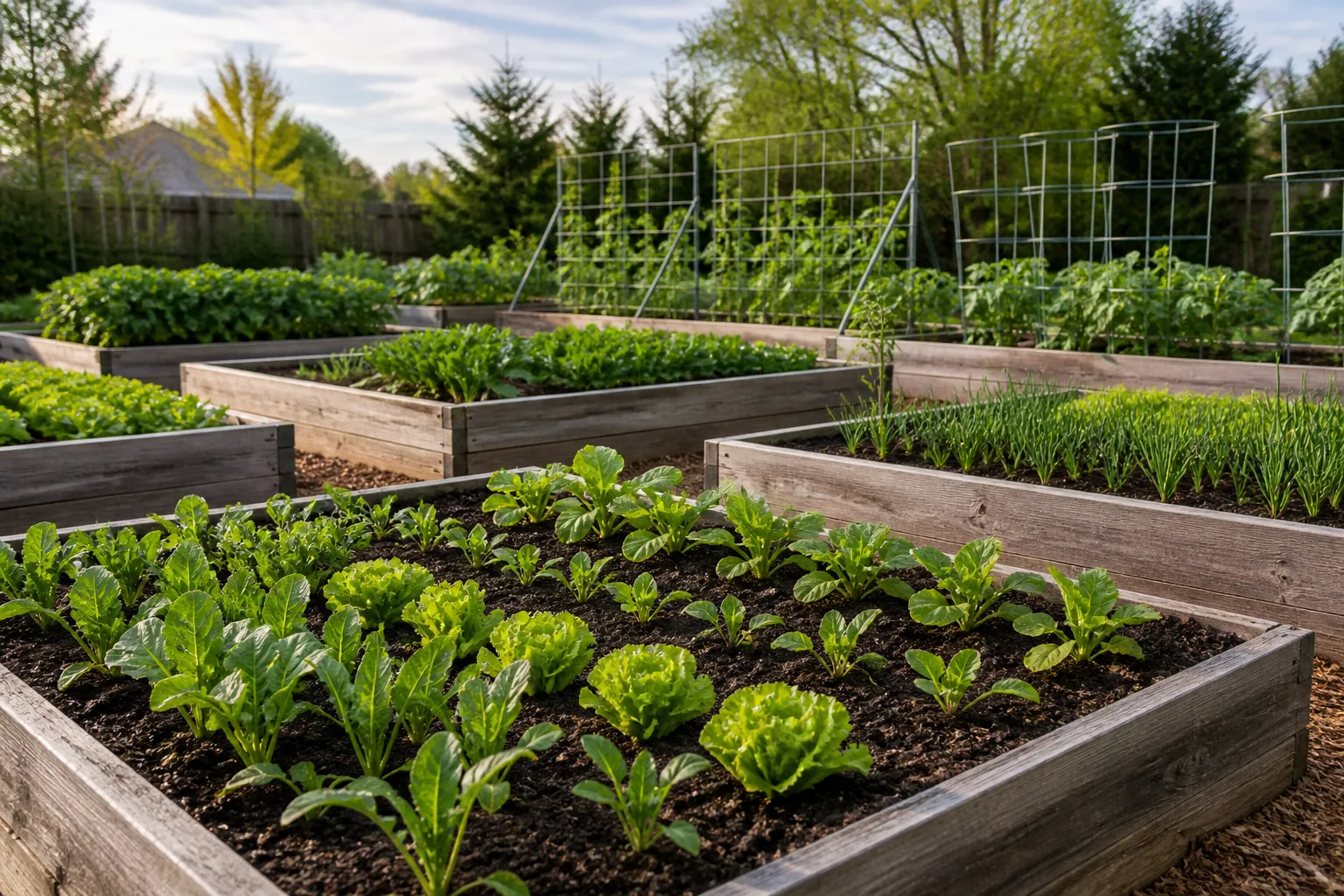
A perennial food garden is the opposite of starting from seed every spring. You invest once—in crowns, transplants, or young trees—and the plants return with less replanting labor each year. That sounds simple until you realize “perennial” depends on your climate, your patience, and whether you have room for a mint patch that never stays where you put it.
This guide covers edible perennials grouped the way gardeners actually shop: vegetables, fruits, herbs, and nuts. More importantly, it adds what most list posts skip—hardiness notes, first-harvest timelines, spreader warnings, and layout rules—so you can build a food garden that still makes sense five years from now. For deeper single-crop guidance, see the perennial vegetables guide, the perennial herbs guide, and nuts you can grow at home.
What Makes a Food Plant Perennial in Your Garden?
Botanically, a perennial lives three or more years. An annual completes its life cycle in one season. A biennial grows leaves the first year and flowers or dies the second. Colorado State University Extension notes that herbaceous perennials die back to the ground each winter but return from roots or crowns when conditions match their needs—unlike woody trees that keep above-ground structure year-round.
For food gardening, the useful question is not the dictionary definition but whether the plant will survive your winters and produce again without replanting.
Annual, biennial, and perennial in everyday garden terms
Annual vegetables—tomatoes, bush beans, standard broccoli—finish in one season. Biennial crops like common parsley often behave like short-lived perennials in mild climates but are usually replanted for reliable harvests. True perennial edibles—asparagus crowns, rhubarb clumps, mint rhizomes, fruit trees—persist from the same root system.
Several plants sit in a gray zone. Sweet potatoes are perennial in frost-free climates because the vine regrows from underground tubers, but most U.S. gardeners treat them as warm-season annuals and dig tubers before hard frost. Garlic is planted like an annual yet can persist and multiply if left in the ground. Strawberries are perennial plants that still need bed renewal every two to three years as older crowns weaken.
Start with your USDA hardiness zone
The USDA Plant Hardiness Zone Map is the first filter for woody fruits and nuts and for many vegetables. A plant labeled perennial in zone 8 may die to the ground or fail entirely in zone 4. Epic Gardening’s zone-organized perennial vegetable reference is a practical companion: it shows how the same crop list shrinks dramatically in zones 1–3 and expands in zones 7–9.
Before you fall in love with a citrus tree or wasabi patch, confirm three things on the label or nursery tag: minimum winter temperature, chill-hour needs (for many tree fruits), and days to first harvest.
The Three-Question Filter Before You Buy
Skip the impulse buy at the garden center. Run every candidate through three questions.
How many years you are willing to wait
Perennials trade instant gratification for longevity. RHS asparagus guidance recommends letting new crowns establish for about two years before the first small harvest, with full picking by year three—and harvests can continue for up to 20 years in a dedicated bed. Nut trees often need three to ten years before meaningful yields. Raspberries and blackberries may fruit the year after planting but reach peak production later.
If you need food this season, pair perennials with annuals rather than expecting both from the same bed in year one.
Space and containment you actually have
Aggressive perennials include mint, Jerusalem artichokes (sunchokes), horseradish, blackberries, and walking onions. Epic Gardening warns that several commonly listed “perennial vegetables” behave invasively in some regions; container growing or root barriers is not optional for these unless you have acreage to spare.
Dedicated beds matter for asparagus and rhubarb, which dislike root disturbance when you till annual crops nearby. If you mix annuals and perennials, keep them in separate zones so spring spinach planting does not slice through asparagus crowns.
Perennial Vegetable Crops Worth a Dedicated Bed
These vegetables anchor most temperate food gardens. Treat the list as a starting palette, not a mandatory planting plan. For planting and harvest timing, see how to plant and grow asparagus, transplanting asparagus, when to plant asparagus, how to harvest asparagus, tips for growing artichokes, how to grow organic Jerusalem artichokes, and growing rhubarb plus when to harvest rhubarb.
Asparagus (Asparagus officinalis) is the textbook long-term vegetable. Plant one-year-old crowns in a sunny, well-drained bed you can leave undisturbed. Expect spears for roughly eight weeks each spring, then let ferny foliage rebuild the roots until autumn cutback. Male-dominated modern cultivars produce more spears than older mixed plantings.
Rhubarb (Rheum rhabarbarum) is a cold-hardy perennial whose leaf stalks are edible when cooked—but leaves are toxic and must never be eaten. NC State Extension lists rhubarb as a perennial herb with medium-severity poison characteristics from anthraquinone glycosides and soluble oxalates in the foliage. Harvest stalks in spring; leave the plant to photosynthesize through summer. Rhubarb is forgiving only where winters are cold enough (roughly zones 3–7); in warmer zones, prefer chives or strawberries instead.
Globe artichoke (Cynara scolymus) is a true perennial in mild zones (roughly zones 7–10) with silvery foliage and edible flower buds. Do not confuse it with Jerusalem artichoke, a sunflower relative whose edible tubers grow on a completely different plant. Many quick-reference lists merge the two names; they are not interchangeable in the garden.
Nine Star or Purple Cape broccoli are rare perennial broccoli cultivars—not standard heading broccoli, which remains an annual. Expect smaller, recurring florets rather than one large head.
Jerusalem artichoke / sunchoke (Helianthus tuberosus) stores energy in knobby tubers harvested in fall or winter. Hardy into cold zones, it spreads aggressively from missed tubers—plant at the edge of the property or in a buried container.
Horseradish (Armoracia rusticana) delivers pungent roots from a deep taproot that is difficult to remove once established. One corner of the yard is enough.
Radicchio and tree collards / tree cabbage behave as perennials in mild climates, producing cut-and-come-again leaves for years when winters stay moderate.
Perpetual spinach, New Zealand spinach, and Ceylon spinach are heat-tolerant leafy greens—not the same as standard spring spinach (Spinacia oleracea), which bolts quickly and is usually grown as a cool-season annual.
Sweet potato vines return where frost does not kill tubers; elsewhere, treat them as annuals and cure harvested roots for storage.
Watercress and wasabi need cool, moist conditions—stream-side beds, shaded microclimates, or containers with constant moisture. Wasabi is notoriously finicky outside its preferred range.
Yams (Dioscorea species) are tropical tuber perennials in warm zones; do not confuse them with sweet potatoes despite grocery-store labeling in some regions.
Perennial Fruit Crops for Orchard and Berry Patch
These fruits range from cold-hardy apples to frost-tender citrus. First-year harvests are usually modest; production builds as roots and canopies mature. For strawberry specifics, see how to grow strawberry plants in pots, how to plant strawberry bare roots, growing with strawberry runners, how to winterize strawberry plants, strawberry companion plants, and wild strawberry care guide. For gooseberry and huckleberry, see gooseberry plant profile and huckleberry care guide.
Apples, pears, peaches, plums, cherries, nectarines, and apricots are woody perennials whose success depends on chill hours, disease-resistant cultivars, and often a pollination partner. Choose varieties matched to your zone and local extension recommendations rather than generic national lists.
Grapes and kiwi need trellises and annual pruning to stay productive. Figs and persimmons suit many warm-temperate gardens; figs may die back to the ground in cold winters and resprout.
Blackberries, raspberries, currants, and gooseberries are cane or bush fruits. Trailing blackberries and some raspberries spread; erect types are easier to confine with trellises. Goji berries and huckleberries fit niche edible-landscape roles with specific soil and sun needs.
Dates, olives, and avocados are true perennials only where winters stay mild—otherwise they belong in pots moved indoors or in greenhouse culture.
Lemons, limes, and oranges are evergreen perennials in zones 9–11. In colder regions, grow dwarf citrus in containers and overwinter them indoors or in a bright frost-free room—still “perennial” as long as you can protect them.
Strawberries (Fragaria × ananassa) are perennial plants whose beds should be renovated every two to three years by removing old crowns and keeping vigorous daughter plants. Without renewal, yields collapse even though the patch technically survived.
For timing context on filling gaps between perennial beds and quick crops, see the vegetable planting calendar guide.
Perennial Herbs for Kitchen and Pollinator Beds
These herbs keep flavor coming back, but they are not equally easy—or equally well behaved. For containment and care details, see the mint care guide and sage companion plants guide.
Mint, lemon balm, and chives return reliably and attract pollinators—but mint belongs in a pot or root-barrier bed unless you want it everywhere.
Oregano, thyme, sage, and chives are hardy Mediterranean-zone herbs that tolerate poor soil and drought once established. Rosemary needs full sun and sharp drainage; it is not a shade plant and often fails in cold, wet winters unless you choose a hardy cultivar and a sheltered spot.
Lavender is perennial where winters are dry and cold-hardy cultivars match your zone; wet clay kills it faster than frost.
Garlic and walking onions (Egyptian onions) multiply from bulbs or top-set bulblets. Potato onions, shallots, Welsh onions, and Japanese bunching onions blur the line between annual and perennial—all can persist if you leave part of the clump in the ground.
Fennel returns in mild climates and self-seeds generously; treat it as a potential volunteer crop.
Ginger and turmeric are tropical rhizome perennials outdoors only in frost-free zones; elsewhere, start rhizomes in pots and move them indoors for winter.
African Blue basil and East Indian basil are perennial in frost-free climates; standard sweet basil remains an annual outside the tropics.
Parsley is biennial, not a long-lived perennial—plan on replanting every year or two for steady leaves.
Horseradish appears in both vegetable and herb lists because the root is the crop; the same containment rules apply.
Perennial Nuts: Trees That Reward Patience
These nuts are the longest bet in the edible landscape—often decades of harvest once established. For crop-specific guidance, see hazelnut tree growing guide, english walnut growing guide, walnut tree species, black walnut identification and removal, and macadamia nut tree growing guide.
Almonds, walnuts, pecans, pistachios, and macadamias need compatible climates, deep soil, and usually cross-pollination from a second cultivar. Pecans and macadamias suit warm regions; walnuts need space because many release growth inhibitors that bother nearby plants.
Pistachio (Pistacia vera) is dioecious—separate male and female trees—and typically needs 7–12 years before the first crop, per NMSU Extension. Plant at least one male for every 8–10 females and confirm your region has long, hot, dry summers.
Hazelnuts (filberts) fit smaller yards with shrub-sized hybrids and can produce in roughly three to five years from good nursery stock.
Chestnuts require blight-resistant cultivars in North America and two trees for pollination in many cases.
Budget for years of watering and pest monitoring before the first meaningful crop. Nut trees are poor choices if you expect food within two seasons—pair them with faster herbs and berries while you wait.
Master Crop Table: Zone, Harvest, Spreader, Container
Use this table as the planning filter. Zones are typical ranges; confirm cultivar-specific hardiness locally.
| Crop | Group | USDA zones | Years to first harvest | Spreader risk | Container suitable |
|---|---|---|---|---|---|
| Asparagus | Vegetable | 3–8 | 2–3 | Low | No |
| Rhubarb | Vegetable | 3–7 | 2–3 | Low | Marginal |
| Globe artichoke | Vegetable | 7–10 | 2+ | Low | Yes |
| Jerusalem artichoke | Vegetable | 3–9 | 1–2 | High | Yes (buried) |
| Horseradish | Vegetable | 3–9 | 2+ | High | Yes |
| Radicchio | Vegetable | 5–9 | 1 | Low | Yes |
| Tree collards | Vegetable | 8–11 | 1 | Low | Yes |
| Perpetual spinach | Vegetable | 5–9 | 1 | Low | Yes |
| New Zealand spinach | Vegetable | 5–10 | 1 | Low | Yes |
| Ceylon spinach | Vegetable | 9–11 | 1 | Low | Yes |
| Sweet potato | Vegetable | 8–11 (annual elsewhere) | 1 | Low | Yes |
| Watercress | Vegetable | 3–9 (cool moist) | 1–2 | Moderate | Yes |
| Wasabi | Vegetable | 7–9 (cool moist) | 2+ | Low | Yes |
| Yams | Vegetable | 9–11 | 1–2 | Low | Marginal |
| Strawberry | Fruit | 3–10 | 1 | Low (renew bed) | Yes |
| Apple | Fruit | 3–8 | 3–6 | Low | Dwarf only |
| Pear | Fruit | 4–8 | 4–6 | Low | Dwarf only |
| Peach | Fruit | 5–8 | 3–4 | Low | Dwarf only |
| Plum | Fruit | 4–9 | 3–5 | Low | Some |
| Cherry | Fruit | 4–7 | 4–7 | Low | Dwarf only |
| Nectarine | Fruit | 5–8 | 3–4 | Low | Dwarf only |
| Apricot | Fruit | 5–8 | 3–4 | Low | Some |
| Grape | Fruit | 4–10 | 2–3 | Moderate | Yes (trellis) |
| Kiwi | Fruit | 7–9 | 3–5 | Moderate | Yes (trellis) |
| Fig | Fruit | 6–10 | 2–3 | Low | Yes |
| Persimmon | Fruit | 4–9 | 3–5 | Low | Some |
| Blackberry | Fruit | 4–9 | 1–2 | High | Yes |
| Raspberry | Fruit | 3–8 | 1–2 | Moderate | Yes |
| Currant | Fruit | 3–7 | 2–3 | Low | Yes |
| Gooseberry | Fruit | 3–7 | 2–3 | Low | Yes |
| Goji berry | Fruit | 3–7 | 2–3 | Moderate | Yes |
| Huckleberry | Fruit | 4–8 | 2–3 | Low | Some |
| Date palm | Fruit | 9–11 | 4–8 | Low | Marginal |
| Olive | Fruit | 8–10 | 3–6 | Low | Yes |
| Avocado | Fruit | 9–11 | 3–5 | Low | Yes (dwarf) |
| Lemon | Fruit | 9–11 | 2–3 | Low | Yes |
| Lime | Fruit | 9–11 | 2–3 | Low | Yes |
| Orange | Fruit | 9–11 | 2–4 | Low | Yes |
| Mint | Herb | 3–11 | 1 | High | Yes |
| Lemon balm | Herb | 3–9 | 1 | Moderate | Yes |
| Chives | Herb | 3–9 | 1 | Low | Yes |
| Oregano | Herb | 4–10 | 1 | Moderate | Yes |
| Thyme | Herb | 4–9 | 1 | Low | Yes |
| Sage | Herb | 4–8 | 1 | Low | Yes |
| Rosemary | Herb | 7–10 | 1 | Low | Yes |
| Lavender | Herb | 5–9 | 1 | Low | Yes |
| Garlic | Herb/bulb | 3–8 | 1 | Low | Yes |
| Walking onion | Herb | 3–9 | 1 | High | Yes |
| Potato onion | Herb | 3–9 | 1 | Low | Yes |
| Shallot | Herb | 3–9 | 1 | Low | Yes |
| Welsh onion | Herb | 3–9 | 1 | Low | Yes |
| Japanese bunching onion | Herb | 3–9 | 1 | Low | Yes |
| Fennel | Herb | 4–9 | 1 | Moderate (self-seeds) | Yes |
| Ginger | Herb | 8–12 | 1 | Low | Yes |
| Turmeric | Herb | 8–12 | 1 | Low | Yes |
| African Blue basil | Herb | 9–11 | 1 | Low | Yes |
| East Indian basil | Herb | 9–11 | 1 | Low | Yes |
| Parsley (biennial) | Herb | 4–9 | 1 | Low | Yes |
| Almond | Nut | 5–9 | 3–5 | Low | No |
| Walnut | Nut | 4–9 | 4–7 | Low | No |
| Pecan | Nut | 5–9 | 6–10 | Low | No |
| Pistachio | Nut | 7–11 | 7–12 | Low | No |
| Macadamia | Nut | 9–11 | 5–7 | Low | Marginal |
| Hazelnut | Nut | 4–8 | 3–5 | Low | Some |
| Chestnut | Nut | 4–8 | 5–8 | Low | No |
Pros, Cons, and Honest Trade-Offs of Edible Perennials
Less replanting labor is the headline benefit. Once asparagus, berries, or herbs are established, you skip repeated seed-starting and bed turnover for those crops. Stronger root systems often make perennials more drought-tolerant than annual vegetables, and their year-round or seasonal root presence can improve soil structure when managed well.
Lower long-term seed cost matters too—especially for herbs and berries you propagate by division or runners.
The trade-offs are real. Up-front cost for crowns, fruit trees, and nut stock exceeds a packet of lettuce seed. Establishment time delays gratification. Pest pressure accumulates when the same crop stays in one place—rotate what you can, and monitor perennial beds closely because you cannot simply move on after one bad year.
Invaders—mint, sunchokes, horseradish, blackberries—can outcompete neighbors. Fewer total crop rotations mean you must choose sites carefully the first time.
How to Layout a Perennial Food Garden That Stays Manageable
Use a simple zoning plan:
Zone A — Permanent beds: asparagus, rhubarb, artichoke (if hardy for you), and contained mint or horseradish.
Zone B — Orchard and cane fruit: tree fruits on north or east sides where they will not shade the whole garden; trellised grapes and kiwi on strong supports.
Zone C — Herb and pollinator edge: thyme, oregano, sage, chives, lavender—full sun, gravel or raised soil for drainage.
Zone D — Annual rotation nearby but separate: keep tomatoes, lettuce, and beans in beds you can till without disturbing asparagus crowns or berry roots.
Match bloom and harvest windows so something is always producing from spring rhubarb through fall berries and nut drops. Stagger early, mid, and late apple or peach cultivars if you have room for multiple trees.
When in doubt, ask your county extension office which cultivars perform locally—they will save you from planting a pistachio where winters kill flower buds every year.
Conclusion
Perennial vegetables, fruits, herbs, and nuts can shrink replanting work and build a more resilient backyard food supply—but only when you match plants to zone, patience, and containment. Start with one or two cold-hardy anchors like asparagus and rhubarb, add herbs you actually cook with, and expand into fruit and nut trees once you know where permanent beds will live.
What to plant first depends on your hardiness band: in cold zones (3–5), start with asparagus, rhubarb, and hardy herbs; in temperate zones (6–7), add apples, pears, and cane berries; in warm zones (8–11), prioritize figs, citrus, olives, and tropical herbs. Check the label, plan for the wait, and keep aggressive spreaders on a leash. Do that, and “plant once, harvest for years” becomes a realistic garden strategy—not just a catchy title.