Fungus Gnats on Neem: Causes, Root Checks & Organic Fixes
Quick answer
Fungus gnats on potted Neem indicate persistently damp, peat-rich soil that contradicts this dry-tropical tree's root biology. While adult flies are harmless fliers, subterranean Bradysia larvae feed on tender feeder root hairs, stalling growth and causing seedling wilt. First step: Let the top 2 inches of soil dry completely, position yellow sticky traps at the container rim to capture egg-laying adults, and apply a biological soil drench of Bacillus thuringiensis israelensis (BTI).
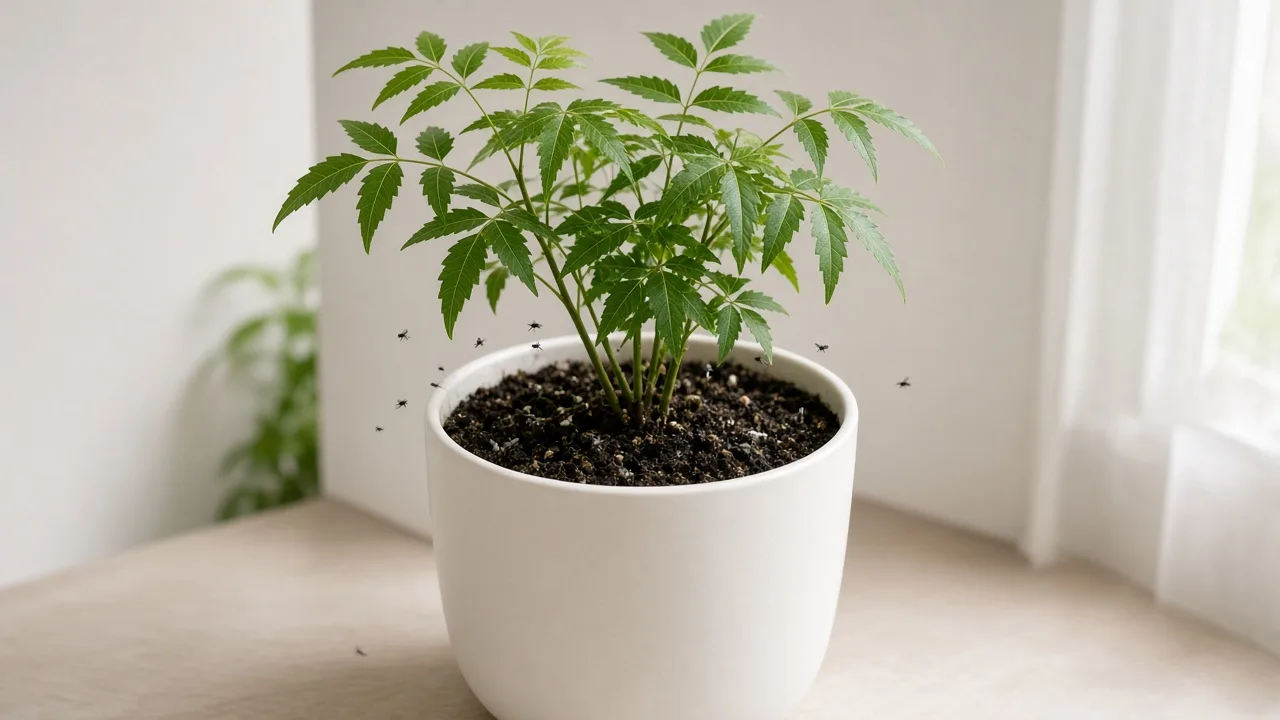
Fungus Gnats on Neem: Root Protection & Soil Fixes
This guide covers fungus gnats on Neem. See also the general Fungus Gnats guide, watering, and light pages for this plant.
Fungus Gnats on Neem: Root Protection & Soil Fixes
Quick answer
Fungus gnats on potted Neem (Azadirachta indica) are an unmistakable warning that your potting substrate is retaining too much surface moisture, directly conflicting with this drought-adapted tropical tree’s root physiology. Potted Neem trees thrive when their root zones dry significantly between waterings; when standard peat-heavy mixes remain soggy, adult female flies exploit the organic decay to lay eggs. While adult gnats cause zero foliage chewing, their subterranean Bradysia fungus gnat larvae actively strip the fragile lateral root hairs and mycorrhizal tips responsible for water absorption.
For how fungus gnat lifecycles progress in generic potting substrates, consult our comprehensive fungus gnats hub. On Neem, the diagnostic pattern centers on tiny, sluggish flies lifting from the base of a slow-draining pot, uncharacteristic lower leaflet yellowing, stalled terminal flushes, and seedlings that droop despite soaked potting mix.
First step: Withhold all irrigation until the top 2 inches (5 cm) of soil desiccate completely, place yellow sticky traps flush at the container rim to interrupt the adult mating cycle, and apply a biological drench of Bacillus thuringiensis israelensis (BTI). Do not spray chemical insecticides across the canopy or yank the plant out for emergency repotting on day one.
When to use this page vs other Neem guides
Fungus gnats represent a soil-line pest and potting moisture failure. Use this comparison table to ensure you are treating root-zone dipteran larvae rather than a separate cultural stress.
| Symptom or Observation | Primary Diagnosis | Guide to Consult |
|---|---|---|
| Tiny black flies fluttering near soil; damp potting mix | Fungus gnats (larval root grazing) | This guide |
| Fuzzy white or yellow fungal crust on soil surface with no flies | Surface saprophytic fungal bloom | Mold on soil |
| Collapsing black stem base, foul sour odor, mushy roots | Advanced anaerobic pathogen attack | Root rot |
| Lower leaflets yellowing and dropping; heavy waterlogged pot | Excessive watering frequency | Overwatering |
| Dry crispy leaf margins, desiccated lightweight pot | Prolonged drought deficit | Underwatering |
| Potting medium stays wet for weeks after watering | Dense, poorly aerated potting substrate | Soil guide |
| Determining proper soak-and-dry intervals for containers | Seasonal watering schedules | Watering guide |
What fungus gnats look like on Neem
Because Azadirachta indica is prized for producing azadirachtin—the very compound used in many commercial botanical insecticides—growers are often shocked to find insects thriving in their potted tree’s soil. Recognizing both adult and larval stages prevents misdiagnosing the infestation as an aerial pest attack.
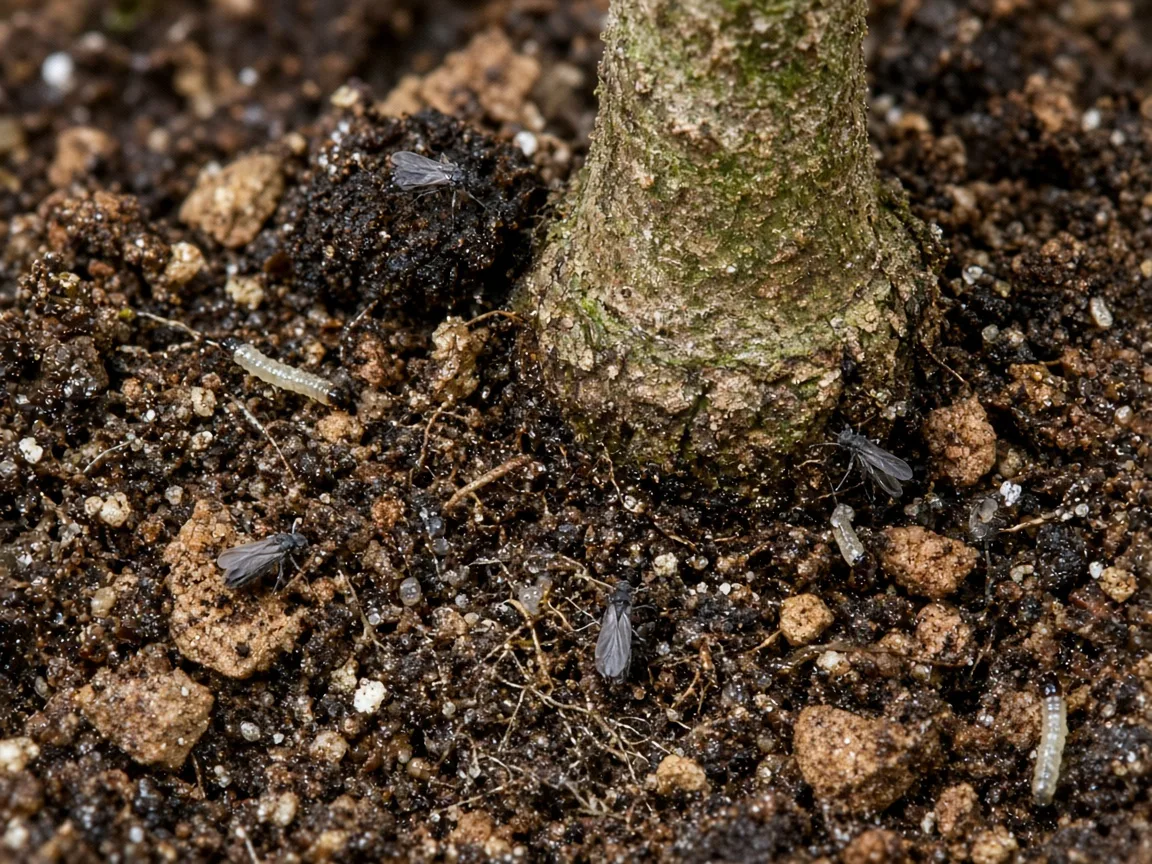
Bradysia fungus gnat larvae in moist potting substrate around Azadirachta indica roots—slender translucent bodies with distinctive black head capsules that feed on fungal mycelium and delicate root hairs in soggy media.
Physical identification of the pest stages
- Adults at the soil line: Slender, dark gray or black flies measuring approximately 1/16 to 1/8 inch (1.5 to 3 mm) in length with long, bead-like antennae. They are weak fliers that flutter erratically above the potting mix, hop along the container rim, or rest on lower woody stems rather than colonizing foliage.
- Larvae in the substrate: Legless, semi-translucent, worm-like maggots about 1/4 inch long featuring prominent, jet-black head capsules. Under magnification, you can observe them wriggling in the top 1 to 2 inches of damp soil.
- Pupae and eggs: Microscopic oval eggs deposited in clutches of 30 to 100 within rich, moist organic debris, hatching into active feeding larvae within 3 to 6 days under warm room temperatures.
How the Neem tree responds to larval pressure
- Seedling wilting despite wet soil: Young Neem saplings have succulent stems and establishing taproots. When larvae devour the microscopic root hairs, the seedling loses hydraulic conductivity, leading to midday wilting even while standing in drenched soil.
- Premature lower leaflet drop: Older compound leaves lose turgor, turn dull yellow, and abscise along the petiole as the root system fails to sustain full canopy transpiration.
- Stunted seasonal leaf flushes: Mature container trees may survive larval feeding without immediate collapse, but active spring and summer flushes emerge stunted, pale, or malformed due to compromised mineral uptake.
Fungus gnats vs other container flies
Tiny flies around container plants are frequently misidentified, leading to misdirected chemical treatments.
| Flying Insect | Body Shape & Size | Antennae & Flight | Primary Habitat / Food Source | Diagnostic Check |
|---|---|---|---|---|
| Fungus Gnat (Bradysia spp.) | Slender, mosquito-like; 2–3 mm; smoky wings with distinct Y-vein | Long, segmented antennae; weak, erratic fluttering | Decaying potting mix, fungal mycelium, tender plant root hairs | Potato disk test on soil surface reveals translucent larvae |
| Shore Fly (Scatella spp.) | Robust, stout, gnat-sized; 2–3 mm; spotted wings | Very short, bristle-like antennae; strong, rapid flight | Green algae growing on wet saucers or mineral crusts | Flies hover over standing saucer algae; larvae do not chew root hairs |
| Fruit Fly (Drosophila spp.) | Rounded, tan or yellowish-brown; prominent red eyes | Short, stubby antennae; hovering flight | Fermenting kitchen fruit, compost bins, decaying produce | Attracted to apple cider vinegar traps; absent from gritty root zones |
| Whitefly (Aleyrodidae) | Tiny, powdery white moth-like insects; 1–2 mm | Short antennae; flutter upward when canopy is brushed | Undersides of young foliage, sucking phloem sap | Found feeding on leaf undersides, producing sticky honeydew |
According to Colorado State University Extension, fungus gnats are distinguished from shore flies by their long, multi-segmented antennae and slender legs, whereas shore flies possess heavier bodies and feed almost exclusively on surface algae.
Why Neem gets fungus gnats
In its native habitat across the dry tropical forests of the Indian subcontinent, Azadirachta indica thrives in deep, well-draining sandy loam with marked seasonal dry periods. When cultivated in indoor containers or patio pots, however, environmental conditions often facilitate gnat proliferation:
- Water-retentive peat and coir substrates: Standard commercial potting mixes rely heavily on sphagnum peat moss or compressed coconut coir. While these components retain moisture for thirsty tropical foliage plants, they hold water far too long for Neem, creating the anaerobic, fungus-rich environment where gnats multiply.
- Calendar-based overwatering: Potted Neems require deep saturation followed by substantial dry-down. Watering on an arbitrary weekly schedule keeps the top layer permanently wet, ensuring continuous generations of larvae.
- Low-light indoor positioning: Neems kept in indoor living spaces or dim corners receive insufficient solar radiation to drive rapid transpiration. The root zone stays waterlogged for days or weeks, as highlighted in our Neem light guide.
- Undigested organic top-dressings: Applying rich, uncomposted kitchen scraps, raw manure, or heavy animal-based meal fertilizers to the soil surface provides an immediate buffet for saprophytic fungi, which directly fuels the gnat population. Cross-reference the fertilizer guide for clean feeding practices.
- Lack of surface air circulation: Enclosed grow areas and humid greenhouses without oscillating fans prevent the soil crust from drying out, allowing adult gnats to mate and oviposit undisturbed.
Neem root biology: Why Azadirachta indica suffers underground
Unlike fibrous-rooted aroids or rhizomatous succulents, Azadirachta indica develops a vigorous, deep-seeking taproot anchored by a network of delicate lateral feeder roots. Understanding this architecture illuminates why fungus gnat infestations represent more than just a cosmetic nuisance.
In well-aerated sandy soil, Neem taproots penetrate deeply while fine lateral roots forage through the upper soil horizon for dissolved minerals. These primary root tips are coated in fragile root hairs—single-cell epidermal extensions that perform the bulk of water and micronutrient uptake.
When container soil remains waterlogged, fungal populations surge, drawing female gnats to oviposit hundreds of eggs. As documented by University of Wisconsin-Madison Extension, when fungal food sources diminish or larval populations swell, gnat larvae chew directly on fine root hairs and lateral roots. For an establishing Neem seedling, this root pruning is catastrophic:
- Loss of water-absorbing surface area: With root hairs clipped, the plant cannot draw moisture up its woody vascular bundle, inducing drought-like wilting despite saturated soil.
- Entry points for secondary pathogens: Larval feeding wounds strip the root’s outer suberized protective layer, allowing water-mold pathogens like Pythium and Fusarium to invade and initiate fatal root rot.
- Stunted nutrient assimilation: Iron, nitrogen, and magnesium uptake halts, triggering interveinal chlorosis across new leaf flushes.
The Neem paradox: Why spraying neem oil fails (and how neem cake drenches work)
One of the most frequent points of confusion among gardeners is finding an aggressive insect infestation on a Neem tree—the very source of botanical neem oil!
Neem foliage naturally synthesizes triterpenoids, predominantly azadirachtin, meliantriol, and salannin. However, spraying cold-pressed neem oil onto the leaves does absolutely nothing to eliminate fungus gnats for three physiological reasons:
- Adult gnats do not consume leaf tissue: Adult Bradysia flies possess vestigial mouthparts; they feed minimally, if at all, on water or floral nectar and never chew or pierce Neem foliage. Spraying leaves leaves the reproductive population completely unharmed.
- The active lifecycle is subterranean: Eggs, four larval instars, and pupae dwell completely buried within the top 2 inches of the potting mix, sheltered from canopy misting.
- Foliar application stresses indoor Neem leaves: Dousing delicate compound leaflets with heavy horticultural oils can clog stomata and cause phytotoxic leaf drop under intense sunlight or grow lights.
How to use Neem’s natural defenses correctly: The root drench and neem cake
To exploit azadirachtin against fungus gnats, you must deliver it directly into the substrate where the larvae feed:
- Cold-pressed Neem seed cake top-dressing: Neem cake (the de-oiled residue remaining after cold-pressing neem seeds) is rich in residual triterpenoids and organic nitrogen. Scratching 1 to 2 tablespoons of powdered neem seed cake into the top inch of container soil releases natural ecdysone inhibitors. When larvae ingest the treated substrate, azadirachtin prevents them from successfully molting into pupae.
- Clarified hydrophobic neem extract drench: If using a liquid neem formulation, dilute pure cold-pressed neem oil (5 ml per liter of warm water with a drop of organic liquid castile soap as an emulsifier) and apply it as a root drench. Azadirachtin functions as an insect growth regulator and anti-feedant, starving subterranean larvae while remaining completely systemic and safe for Azadirachta indica roots.
Substrate realignment: Transitioning Neem to an arid, gnat-proof gritty mix
The permanent, long-term solution to fungus gnats on Neem is eradicating their breeding habitat: dense, water-retentive organic matter. In commercial production, growers frequently use standard greenhouse peat moss because it is lightweight for shipping. However, keeping Azadirachta indica in peat is an invitation for recurring pest cycles.
To build an optimal, gnat-resistant substrate that reflects the tree’s native ecology, prepare a gritty, fast-draining blend detailed in our Neem soil guide:
- 40% Coarse mineral grit: Equal parts coarse horticultural sand, pumice, and perlite (or volcanic scoria). This creates large macropores that drain instantly under gravity, preventing stagnant perched water tables.
- 40% Sandy loam or aged native topsoil: Provides physical ballast, micronutrients, and a stable pH buffer between 6.2 and 7.0.
- 20% High-quality well-aged compost: Supplies sustained organic nutrition without presenting spongy, raw peat fibers that gnats require for egg deposition.
By capping the container surface with a 1/2-inch layer of coarse quartzite sand, pumice, or fine volcanic grit, you create a dry, inhospitable barrier that prevents adult gnats from accessing moist soil to lay eggs.
How to confirm fungus gnats on your Neem tree
Before applying biological controls, confirm active larval colonization to ensure you are not dealing with harmless surface flies or non-biological root damage.
1. The soil disturbance check
Gently tap the rim of your container or blow across the soil surface. Fungus gnats will immediately take flight, fluttering in short, jerky arcs before settling back onto the soil or pot edges. If insects swarm up from the foliage canopy instead, inspect for whiteflies or winged aphids.
2. The raw potato disk assay
The potato slice method is the gold standard diagnostic check recommended by university extension services:
- Cut a fresh, raw baking potato into 1/2-inch thick slices.
- Press the flat cut surface firmly into the top 1/2 inch of moist potting mix near the base of the Neem stem.
- Leave the potato undisturbed for 48 hours.
- Lift the slice and examine the moist underside under bright light.
As University of Maryland Extension notes regarding organic matter breakdown in wet media, gnat larvae are strongly attracted to fresh starch and fungal growth. If larvae are present, you will see multiple slender translucent bodies with dark head capsules actively grazing on the potato surface. Finding more than 3 to 5 larvae per disk confirms an active, damaging infestation.
3. Root collar and drainage inspection
Slide a wooden moisture skewer to the bottom of the container. If the skewer emerges dark, damp, and smelling of anaerobic decay while the foliage wilts, inspect the root ball. Healthy Neem roots are creamy-white to light tan, pliable, and firm; roots subjected to heavy larval feeding show chewed, blunted tips lacking fine white lateral hairs.
The first fix for Neem
When you confirm fungus gnats, do not panic and do not apply multiple chemical pesticides at once. Follow this targeted first intervention:
Withhold all irrigation immediately, allow the top 2 inches (5 cm) of soil to dry bone-dry, and insert yellow sticky traps horizontally at the pot rim.
According to the UC Statewide IPM Program, yellow sticky traps placed near the soil surface capture adult female gnats before they can deposit additional egg clutches. Adult gnats are strongly attracted to bright yellow wavelengths; trapping them breaks the reproductive cycle while the surface dry-down desiccates fragile eggs and young first-instar larvae. Because Neem is naturally drought-tolerant once established, a brief dry-down will not harm your tree, whereas continuing to water guarantees gnat survival.
Step-by-step biological and cultural control
Once the immediate first fix is in place, execute this structured biological program to eliminate all life stages across 14 to 21 days.
Step 1: Physical adult trapping
Cut standard yellow sticky cards into 2-by-3-inch rectangles and mount them on small wooden skewers placed 1 inch above the soil surface. Position at least two cards per 10-inch container. Keep traps active throughout the treatment period to monitor population decline; replace them once they become crowded with trapped insects or dust.
Step 2: Biological larvicide drench with BTI
Biological control is vastly superior to synthetic soil drenches because it targets dipteran pests exclusively without harming earthworms, predatory mites, or delicate Neem roots.
- Source: Obtain a commercial formulation containing Bacillus thuringiensis subsp. israelensis (Bti), such as liquid Gnatrol or Mosquito Bits.
- Preparation: If using granular bits, soak 1 tablespoon of granules per quart of warm water for 30 minutes, then strain out the solid carrier grains.
- Application: Use the Bti-infused tea to water the Neem tree when its scheduled dry interval is complete.
- Mode of action: As outlined by the EPA, Bti contains selective endotoxins targeting dipteran larvae. When ingested by Bradysia larvae, the crystal proteins bind to alkaline receptors in the insect’s midgut, causing cell lysis and fatal gut paralysis within 24 to 48 hours.
- Cadence: Apply Bti drenches across three consecutive waterings (approximately 7 to 10 days apart) to eliminate newly emerging larvae that hatch from protected egg stages.
Step 3: Beneficial entomopathogenic nematodes (Optional secondary control)
For severe, persistent infestations in larger patio containers, introduce beneficial entomopathogenic nematodes (Steinernema feltiae):
- Mix the microscopic nematodes into room-temperature water and apply to lightly moist soil.
- S. feltiae actively hunt through soil pore spaces, enter fungus gnat larvae through natural body openings, and release symbiotic bacteria that consume the pest from within.
- Nematodes are completely safe for humans, pets, and plant tissues, functioning synergistically alongside Bti.
Step 4: Soil surface modification
Once larval counts drop to zero on potato tests:
- Gently scrape away the top 1/2 inch of old, decomposed organic matter from the container.
- Top-dress with 1 tablespoon of pure neem seed cake powder to provide long-term ecdysone inhibition.
- Top the container with a 1/2-inch barrier of coarse horticultural sand or fine volcanic pumice. This dry mineral mulch prevents adult gnats from making physical contact with damp soil below.
Recovery timeline
Tracking your Neem tree’s recovery requires monitoring both pest eradication in the soil and physiological renewal in the canopy.
| Milestone | Expected Timeline | Signs of Progress | What to Avoid |
|---|---|---|---|
| Stage 1: Adult Suppression | Days 3–7 | Adult gnat counts on yellow sticky traps decline by 70–80%; surface soil dries cleanly | Do not water on day 3 out of habit; let soil breathe |
| Stage 2: Larval Eradication | Days 8–14 | 48-hour potato slice test shows 0 larvae; no wriggling worms visible under surface | Do not apply harsh chemical synthetic soil flushes |
| Stage 3: Root Regeneration | Days 15–28 | Fine lateral feeder roots begin regenerating in aerated soil; canopy wilting stops | Do not fertilize with high-nitrogen salts; roots are fragile |
| Stage 4: Canopy Flush | Weeks 4–6 | Vibrant reddish-bronze terminal leaflets unfurl; growth resumes vigor | Do not revert to old peat-heavy watering schedules |
Lookalike symptoms
Because fungus gnat larvae feed underground, their damage manifests as secondary foliage stress that mimics other common container ailments.
| Observed Symptom | Fungus Gnat Damage | Overwatering (No Pests) | Root Rot Disease | Underwatering Deficit |
|---|---|---|---|---|
| Soil Observation | Damp, organic; adult flies hovering; larvae on potato | Heavy, wet; sour smell; no flying insects | Waterlogged; rotten sulfur odor; black roots | Extremely dry, pulled away from pot walls; featherweight |
| Foliage Reaction | Midday limpness; lower leaflets pale yellow; slow drop | Uniform lower leaf yellowing; oedema; general chlorosis | Rapid canopy collapse; black mushy stems at soil line | Dry, brittle leaflets; curled margins; rapid crisping |
| Root Health | Feeder root tips chewed; main taproot remains firm | Swollen, water-soaked roots; reduced aeration | Soft, mushy, black roots that slough off easily | Shrivelled, dry, brittle roots; lacking moisture |
| First Action | Dry soil; apply BTI drench and sticky traps | Extend dry interval; aerate pot; increase light | Unpot immediately; prune rotted tissue; fungicide | Deep, thorough bottom soak; rehydrate soil |
Mistakes to avoid
Avoid these common missteps when eradicating fungus gnats from potted Neem trees:
- Do not spray synthetic pyrethroids or insecticidal soaps across the foliage: Foliar chemical applications harm beneficial predatory insects and do not reach subterranean larvae. Keep treatments focused strictly on the soil profile.
- Do not repot a heavily stressed tree on day one: Uprooting an already weakened Neem tears surviving feeder roots and induces transplant shock. Only repot if the soil is severely rotted and sour.
- Do not soak the soil with household remedies like hydrogen peroxide or bleach: While 3% hydrogen peroxide provides short-term oxidation of larvae, it also strips delicate root hairs and sterilizes beneficial mycorrhizal fungi essential for Neem nutrient assimilation.
- Do not apply uncomposted manure or organic fertilizer teas: Liquid manure and fish emulsions flood the root zone with decomposing matter and volatile fatty acids, sparking massive secondary gnat explosions.
- Do not leave runoff standing in decorative cachepots: Empty the drainage saucer 15 minutes after watering every single time. Standing saucer water serves as an ideal nursery for both fungus gnats and shore flies.
How to prevent fungus gnats next time
Preventing future fungus gnat infestations on your Neem tree is straightforward once environmental and cultural parameters are aligned with the species’ natural biology:
- Strict adherence to the soak-and-dry watering rhythm: Water container Neems deeply until water flows freely from the drainage holes, but never water again until the top 3 to 5 cm (1 to 2 inches) of soil is completely dry to the touch. Check our dedicated Neem watering guide for seasonal volume adjustments.
- Maximize direct sun exposure: Azadirachta indica is an obligate sun-lover requiring at least 6 hours of unfiltered direct sunlight daily. Intense solar radiation rapidly dries the surface soil crust and fuels vigorous root metabolism, rendering the pot unlivable for moisture-loving gnats. Consult our Neem light guide for ideal terrace and windowsill orientations.
- Transition to a mineral-based gritty substrate: Replace standard peat-based potting soils with an open, gritty mixture containing 40% coarse sand, perlite, and pumice per the soil guide.
- Quarantine all newly purchased indoor plants: Fungus gnats frequently hitchhike into homes inside nursery pots of pothos, ferns, or calatheas. Isolate newly acquired plants for 14 days and inspect them with sticky traps before placing them near your Neem tree.
- Maintain clean pot hygiene: Periodically remove fallen, decomposing leaflets from the soil surface to deny adult gnats a food substrate for egg deposition.
When to worry
In most instances on established container trees, a mild fungus gnat population is an easily corrected cultural warning that causes no permanent harm once watering discipline is restored.
Escalate immediately if you observe:
- The base of the Neem stem at the soil line turns dark brown, soft, or spongy to the touch—indicating that larval feeding wounds have allowed pathogens to trigger root rot.
- Young seedlings collapse at the soil line with constricted, water-soaked stems (classic damping-off disease).
- Complete defoliation occurs despite active biological larvicide applications, signaling severe subterranean vascular collapse.
If the root collar softens, immediately remove the plant from its container, excise all decayed, discolored root tissue back to healthy white sapwood, dust the root ball with sulfur or powdered cinnamon, and repot into fresh, dry, gritty cactus-style potting soil.
Related Neem guides
- Neem Overview — Complete cultural profile, botanical history, and indoor care fundamentals
- Neem Watering Guide — Soak-and-dry intervals, container depth checks, and seasonal adjustments
- Neem Soil Guide — Gritty mineral mixes, aeration requirements, and drainage formulations
- Neem Light Guide — Direct sun exposure thresholds and seasonal indoor positioning
- Neem Fertilizer Guide — Organic feeding schedules, neem cake usage, and micronutrient balance
- Neem Root Rot Guide — Emergency triage for waterlogged, decaying root systems
- Neem Overwatering Guide — Recognizing early physiological signs of excess moisture
- Neem Mold on Soil Guide — Managing harmless surface mycelium versus pathogenic fungi
- Neem Problems Hub — Complete diagnostic index of common Neem pests and environmental disorders
Conclusion
Fungus gnats on potted Neem (Azadirachta indica) are fundamentally a symptom of substrate saturation and organic breakdown, not an aggressive leaf-destroying pest. While adult flies are harmless nuisances, subterranean Bradysia larvae chew delicate root hairs, threatening young seedlings and stalling mature tree growth. By combining an immediate surface dry-down with yellow sticky traps, applying targeted Bacillus thuringiensis israelensis (BTI) biological drenches, and transitioning the tree into an open, sandy loam substrate that honors its dry-tropical heritage, you eliminate the pest cycle permanently and restore vigorous, healthy growth.
Related tool
Use the Plant Watering Calculator to calculate custom watering intervals for Neem based on your container size, pot material, and local humidity before adjusting irrigation cycles.