Not Enough Light on Neem: Canopy Checks & Full-Sun Fixes
Quick answer
Neem (Azadirachta indica) is an obligate tropical heliophyte requiring full sun (>6 hours of direct sunlight or 600+ µmol/m²/s PPFD). Insufficient light triggers leaf chlorosis, premature compound leaf shedding along the rachis, and weak, spindly branches that fail to lignify into woody stems. First step: move the container to an unobstructed south- or west-facing outdoor location or install a high-output full-spectrum grow light 12–18 inches above the canopy before making watering or fertilizer changes.
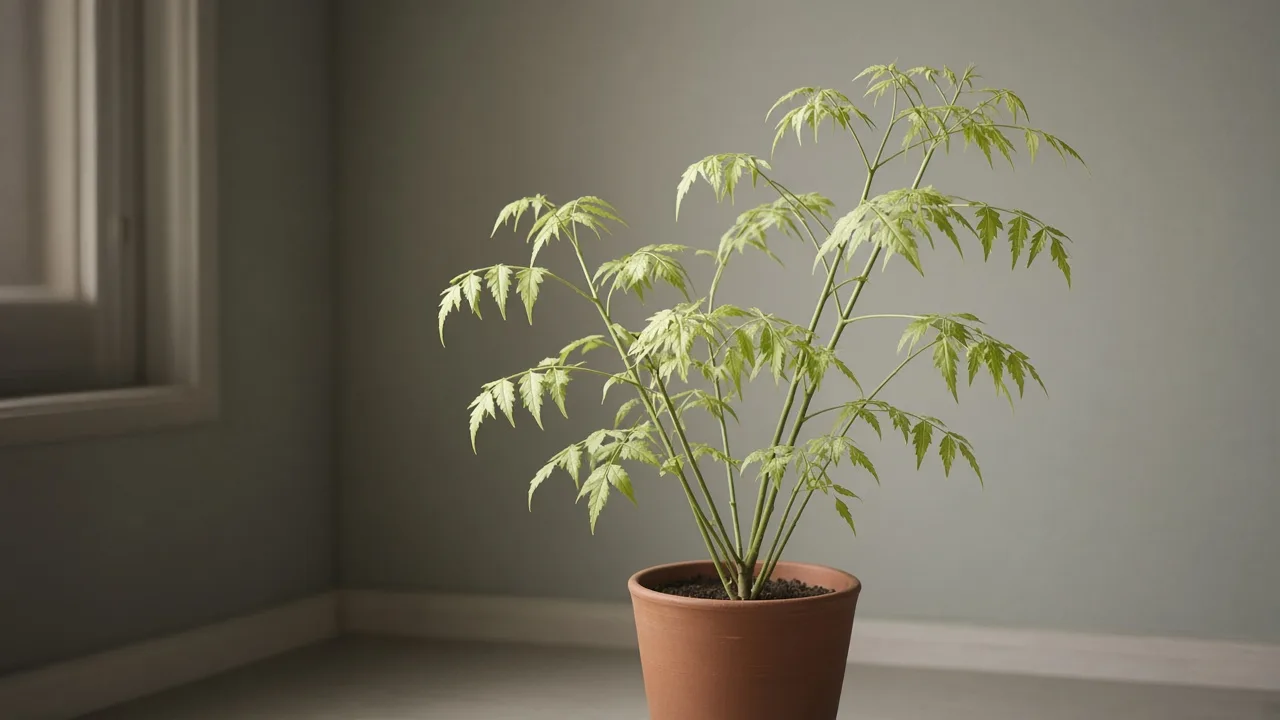
Not Enough Light on Neem: Causes, Checks & Fixes
This guide covers not enough light on Neem. See also the general Not Enough Light guide, watering, and light pages for this plant.
Not Enough Light on Neem: Causes, Checks & Fixes
Quick answer
Azadirachta indica (Neem) is a fast-growing, evergreen tree belonging to the mahogany family (Meliaceae). It is an obligate tropical heliophyte—a plant anatomically and biochemically engineered to thrive under relentless, high-intensity sunlight. When kept in dim rooms, covered balconies, or shaded patios, neem rapidly develops severe light starvation. The tree responds with widespread chlorosis of its pinnately compound leaves, premature leaflet and rachis drop, and weak, spindly branches that fail to lignify into sturdy woody timber.
For a broad overview of how chronic photon deficits impair plant metabolism across species, consult our not enough light hub. On neem, the decisive confirmation is structural: elongated internodes with soft, grass-green shoots that bend under their own weight rather than hardening into brown, fibrous bark.
First fix: Immediately evaluate your tree’s light exposure. Neem requires at least 6 hours of direct, unobstructed sunlight daily or an indoor supplemental photosynthetic photon flux density (PPFD) of 600+ µmol/m²/s delivered over a 12–14 hour photoperiod. Move the container to an open southern or western terrace, or set up a dedicated full-spectrum LED fixture 12–18 inches above the canopy. Do not fertilize or repot a light-starved tree until light levels and active transpiration have been restored.
When to use this page vs other Neem guides
Because low light lowers the tree’s metabolic rate and water consumption, shade stress frequently mimics or triggers other common container issues. Use this diagnostic table to determine whether you need this symptom guide or a related neem care resource:
| Symptom Pattern on Neem | Primary Diagnosis | Where to Go Next |
|---|---|---|
| Pale foliage, long internodes, soft green unlignified shoots | Light starvation (etiolation) | This guide |
| Extreme bare lower stems with tufts of foliage at the very tips | Chronic etiolation & lack of pruning | Leggy growth & Pruning guide |
| Stalled flush development, compact internodes, firm woody bark | Low temperature or seasonal rest | Slow growth |
| Lower compound leaves turning uniformly golden before falling | Nitrogen deficit or natural leaf exchange | Yellow leaves |
| Wilting leaves with persistently damp, sour-smelling potting mix | Root asphyxiation from low water uptake | Overwatering & Root rot |
| General placement, seasonal sunlight transitions, and lux targets | Baseline environmental planning | Neem light guide |
| Comprehensive cultural schedule (soil, watering, feeding) | Holistic care framework | Neem care overview & Neem overview |
| Full diagnostic problem index for container neem | Symptom cross-referencing | All neem problems |
What not enough light looks like on Neem
Under adequate sunlight, a healthy neem tree forms a dense, bushy crown of glossy, deep-green, once-pinnate compound leaves. Each leaf carries 7 to 17 paired serrated leaflets. Stems quickly mature from tender shoots into rigid, lignified twigs covered in grey-brown lenticellate bark.
When photons fall below the tree’s light compensation point, this robust architecture breaks down.
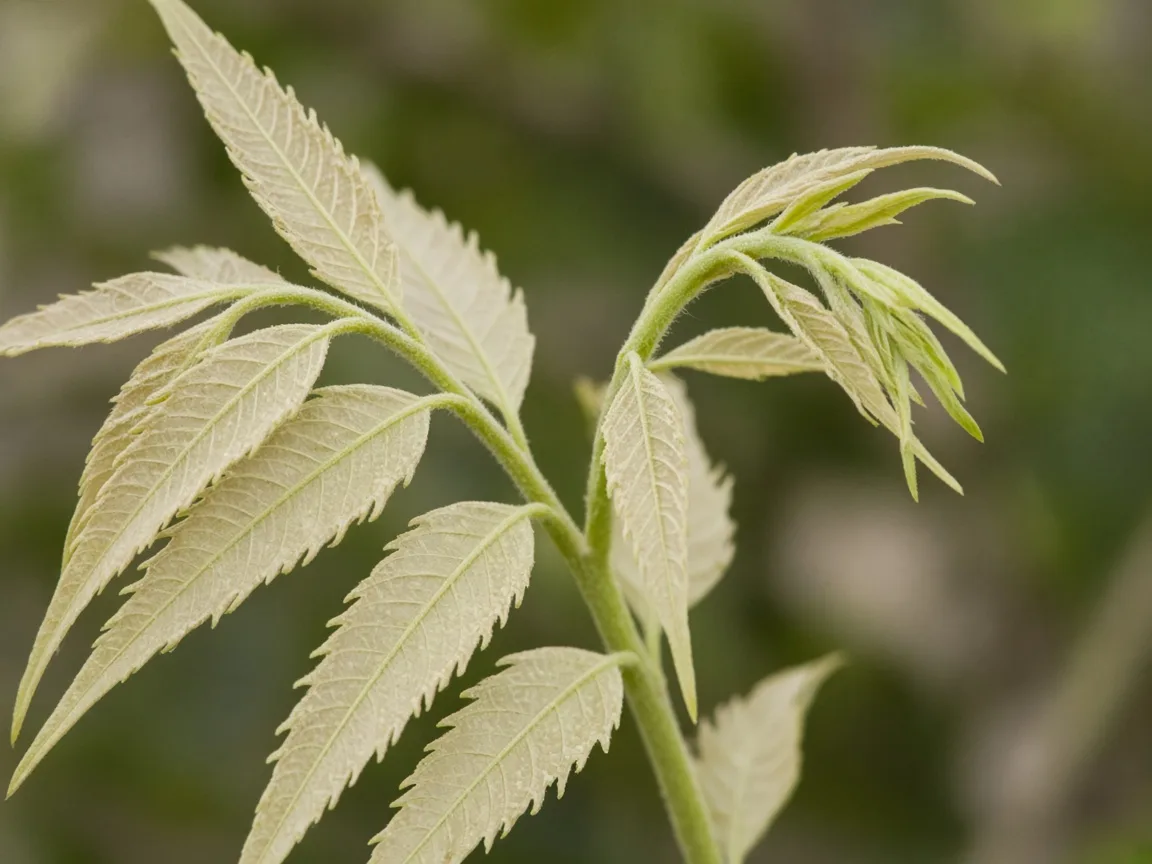
Chlorotic Neem compound leaves showing premature leaflet drop along the rachis and spindly, unlignified branch growth caused by inadequate light.
Key visual indicators of low-light stress on neem include:
- Canopy chlorosis: Leaflets lose their rich, dark forest-green hue and turn a washed-out lime-green or pale chartreuse. Photosynthetic pigments degrade as chloroplast efficiency collapses under shade.
- Premature compound leaf abscission (rachis shedding): Instead of leaflets persisting for a full growing cycle, older compound leaves drop their leaflets one by one from the base of the rachis outward. Eventually, the entire central leaf stalk (rachis) dries and snaps off at the branch node, leaving skeletal, bare branch sections.
- Weak, spindly shoots lacking lignification: New growth produces elongated, paper-thin stems with wide gaps between leaf nodes. Crucially, these branches remain soft, herbaceous, and grass-green for months. The cambium fails to deposit secondary xylem and lignin, preventing the development of sturdy woody bark.
- Extreme phototropism and leaning: The central trunk and dominant lateral shoots lean aggressively toward the nearest light source (such as an exterior window sill or a balcony railing gap), producing an asymmetrical, top-heavy tree prone to tipping.
- Limp, drooping compound foliage: Although turgid with water, compound leaf petiolules lose structural rigidity, causing the entire foliage spray to hang downward in a permanent droop.
- Micro-foliage flushes: When new flushes emerge in deep shade, the individual leaflets are often less than half their normal adult size and possess delicate, paper-thin cuticles that easily tear or scorch.
Botanical physiology: Why Neem demands intense sunlight
Understanding the evolutionary heritage of Azadirachta indica explains why it cannot adapt to dim indoor rooms or shaded outdoor courtyards.
Neem evolved in the dry, semi-arid tropical and subtropical regions of the Indian subcontinent, where open-canopy deciduous scrub and savannah woodlands dominate. Botanical authorities at Missouri Botanical Garden note that neem thrives in full sun to part shade in tropical conditions, exhibiting remarkable heat and drought tolerance once established. However, “part shade” in botanical terms refers to open tropical sky with scattered canopy cover—delivering far greater photon flux than any standard home interior.
Horticultural documentation from Oregon State University emphasizes that neem performs best in sun or partial shade on deep, sandy, well-drained soils in USDA hardiness zones 10 and above. In agroforestry assessments, Feedipedia categorizes neem as a full-sunlight species that tolerates slight shade only during its earliest juvenile seedling stage, rapidly becoming strictly heliophilic as it matures.
Agroforestry research by Winrock International confirms that mature neem trees are intensely light demanding. Similarly, landmark studies compiled by the National Academies Press / NCBI Bookshelf highlight that neem demands open sunlight for vigorous development, noting that while seedlings can persist temporarily beneath scrub, canopy emergence requires direct solar radiation.
When a mature neem receives insufficient light:
- Negative Carbon Balance: Photosynthesis drops below cellular respiration demands. The tree consumes more carbohydrates maintaining root and branch tissue than it manufactures in its leaves, forcing it to cannibalize stored starches and shed older foliage to survive.
- Failure of Lignification: Lignin biosynthesis is an energy-intensive metabolic pathway. Deprived of photosynthetic surplus, the plant cannot synthesize adequate lignin polymers in secondary cell walls. New stems remain weak, water-filled, and hollow-centered rather than hardening into structural wood.
- Impaired Water Transpiration: Light regulates stomatal conductance. In low light, stomata remain largely closed, drastically reducing transpiration. The root zone stays waterlogged for extended periods after standard waterings, leading directly to anaerobic soil conditions and root suffocation.
Canopy and branch audit: Confirming light starvation
Before initiating fixes, conduct a systematic five-step audit to confirm that insufficient light—and not a pathogen or root rot—is the root problem:
- Direct Sun Audit: On a cloudless day, track the exact number of hours direct, shadow-casting sunlight touches the upper foliage of the neem tree. If the total is under 4 to 5 hours, light deficiency is virtually guaranteed.
- Stem Lignification Flex Test: Gently bend a fresh shoot produced over the last 6 to 8 weeks. In healthy neem, new branches become stiff, woody, and resistant to bending within 4 to 6 weeks, developing a rough bark texture. If the shoot bends like a soft green herb and displays bright green bark down to its junction with older wood, the plant lacks the light energy needed to lignify.
- Compound Leaf Abscission Pattern: Inspect fallen leaves. In low-light stress, leaflets drop cleanly at their petiolule junctions without necrotic blighting, fungal spots, or sticky sap residue. The central rachis often remains attached to the branch for several days before dropping cleanly.
- Soil Dry-Down Cycle Check: Check the potting substrate. In high sun, container neem transpires rapidly, drying out the top 3–5 cm of sandy mix within 3 to 5 days. If the container remains heavy, damp, and cool for 10 to 14 days following a light watering, the tree’s vascular pump is idling due to lack of photons.
- Pest Cross-Check: Examine the undersides of chlorotic leaves with a 10x hand lens. Ensure the paleness is uniform physiological chlorosis and not stippling caused by spider mites or honeydew secretions from scale insects.
Step-by-step fix: Restoring light to Azadirachta indica
Resolving light stress on neem requires a deliberate transition plan to prevent secondary problems like thermal solar leaf burn.
Step 1: Relocate to an outdoor full-sun exposure
The most effective remedy for container neem is moving it outdoors to open sky.
- Ideal Placement: Position the pot on an open rooftop, south-facing terrace, or unshaded balcony railing where it receives a minimum of 6 to 8 hours of unobstructed direct sunlight.
- Acclimation Protocol: Do not move a tree directly from a dark interior room into intense, 35°C+ summer midday sun; shade-adapted leaves lack a thick, protective waxy cuticle and will scorch within hours. Place the tree in bright, dappled shade or morning sun (eastern exposure) for 4 to 6 days. Gradually slide the pot into direct midday sun over a 10 to 14 day period.
Step 2: Implement high-output grow lights indoors
If outdoor space is unavailable or you are overwintering neem in cooler climates:
- Fixture Type: Use a high-output, full-spectrum LED grow light (commercial horticultural bar or high-PAR quantum board). Standard 9-watt domestic LED bulbs or fluorescent tubes are entirely inadequate for a sun tree.
- Light Intensity (PPFD): Target a Photosynthetic Photon Flux Density of 600 to 900 µmol/m²/s at the canopy level, yielding a Daily Light Integral (DLI) of 25–35 mol/m²/day.
- Distance & Photoperiod: Hang the fixture 12 to 18 inches (30–45 cm) above the top branches. Run the fixture on an automatic timer for 12 to 14 hours daily.
Step 3: Recalibrate watering to match new transpiration rates
As light intensity increases, the tree’s metabolic engine restarts.
- Lift the pot before watering to feel its weight.
- Allow the top 3–5 cm (1–2 inches) of soil to dry out completely before saturating the root ball thoroughly, as detailed in our Neem watering guide.
- Ensure the potting substrate is a free-draining sandy mix that sheds standing water within seconds, following the recommendations in our Neem soil guide.
Step 4: Corrective pruning of etiolated growth
Do not prune immediately upon moving the tree into full light. Wait 3 to 4 weeks until the plant demonstrates vigor with new, compact flushes.
- Once healthy, deep green leaflets emerge at the branch tips, use sterile bypass pruners to cut back long, weak, floppy green branches by one-third to one-half.
- Cut just above an active dormant node. This stimulates robust, compact lateral branches that will lignify quickly under intense light. Follow our Neem pruning guide for detailed branch architecture tips.
Recovery timeline and expectations
Recovery on a sun-starved neem unfolds across distinct physiological phases:
| Recovery Stage | Timeframe | Visible Changes & Plant Response | Correct Grower Action |
|---|---|---|---|
| Stabilization | Days 1–10 | Premature leaflet abscission stops; water uptake through roots increases noticeably. | Monitor soil moisture; water only when the top 3–5 cm dries out. |
| Bud Break | Weeks 2–4 | Dormant apical and lateral nodes swell and burst with dense, reddish-purple new shoots that turn deep green. | Maintain consistent 6+ hours of sun; avoid high-nitrogen fertilizers. |
| Lignification | Months 1–2 | New shoots develop thick stems with short internodes; green bark begins developing rough corky lenticels. | Rotate container a quarter turn weekly for balanced canopy growth. |
| Canopy Reshaping | Months 3+ | The crown fills out with dense compound foliage; the trunk thickens substantially. | Prune back legacy etiolated stems that developed during the low-light period. |
[!NOTE] Old, stretched internodes formed during prolonged darkness will never shrink back together. Recovery is measured entirely by the density, color, and woody caliper of new growth flushes produced after lighting is corrected.
Lookalike symptoms and misdiagnosis risks
Misinterpreting low light for other physiological disorders is the primary reason container neem trees decline. Review these key differentiators:
- Low Light vs. Overwatering: Both cause yellowing lower leaves and leaf drop. However, overwatering causes leaflets to turn soft, watery, and dull yellow while the soil stays waterlogged, often accompanied by blackened stem bases. Low light causes leaflets to fade to pale chartreuse and drop while stems remain pliable and etiolated.
- Low Light vs. Nitrogen Deficiency: Nitrogen deficiency causes generalized leaf chlorosis across older leaves as the mobile nutrient is mobilized to new shoots. In nitrogen deficiency, stems still lignify properly and new growth remains compact, whereas light starvation produces severe elongation, wide internodes, and unlignified green shoots.
- Low Light vs. Normal Seasonal Leaf Exchange: In cooler subtropical winters or dry seasons, neem naturally drops a portion of its compound leaves before pushing fresh spring flushes. Seasonal leaf drop occurs on mature woody branches and is not accompanied by rapid, spindly shoot stretching.
Common mistakes to avoid
- Applying Fertilizer to “Boost” a Pale Tree: Feeding a light-starved neem with nitrogen fertilizer causes rapid chemical shock. Without photons to drive carbohydrate synthesis, excess nitrogen forces weak, succulent, hyper-etiolated vegetative growth that collapses under its own weight and attracts aphids.
- Shocking Shade-Adapted Foliage in Summer Sun: Abruptly shifting an indoor neem into 40°C searing midday heat without a 10-day acclimation buffer bleaches leaf tissue, causing irreversible photo-oxidation and extensive leaflet drop.
- Keeping Neem as a Permanent Indoor Decor Plant: Neem is an avenue and dry-forest tree with enormous energy demands. Expecting it to function as a low-light houseplant like a pothos or snake plant will always end in slow etiolation, pest infestation, and mortality.
- Repotting into an Oversized Pot: Moving a shade-stressed neem into a larger container traps excessive moisture around inactive roots, compounding light stress with root rot. Maintain the current pot until the root ball rebounds in strong sun.
Prevention: Maintaining ideal light year-round
- Year-Round Balcony Siting: Maintain your container neem outdoors on your sunniest exposure (south or west in the northern hemisphere). Keep the container clear of deep roof overhangs, tall walls, or shading privacy screens.
- Seasonal Sunlight Tracking: Be aware of seasonal solar angle shifts. A balcony that receives full sun in winter may be shaded by building cornices during midsummer. Move the container across your patio or terrace as sun paths shift.
- Acclimated Overwintering: In temperate climates where winter temperatures fall below 4°C (40°F), move neem indoors just before temperatures drop. Position the container directly flush against an unshaded south-facing window, supplemented by high-PAR LED grow lights running 12 hours daily.
- Regular Canopy Thinning: Once or twice a year, thin out crisscrossing interior branches to allow sunlight to penetrate the deep interior of the crown, preventing interior leaf drop.
Related Neem care guides
To support your tree’s recovery with balanced cultural care, explore these companion guides:
- Neem Overview — General species characteristics, growth rates, container sizing, and cultural expectations.
- Neem Light Requirements — Comprehensive guide to sunlight thresholds, window orientations, balcony angles, and artificial lighting setups.
- Neem Care Guide — Year-round maintenance schedules, seasonal feeding, temperature tolerances, and routine inspections.
- Neem Watering Guide — Soak-and-dry irrigation practices tailored to container neem in tropical and subtropical conditions.
- Neem Soil Guide — Gritty, well-draining sandy loam potting mixes that prevent root waterlogging when sunlight varies.
- Neem Pruning Guide — Structural pruning methods to correct leggy stems, maintain patio proportions, and encourage dense branching.
- Neem Problems Hub — Complete diagnostic directory for pest management, nutrient deficiencies, and environmental disorders.
Related tool
Calculate your indoor or balcony light levels with the Light Requirement Calculator to determine exact DLI and PPFD targets for your neem tree.