Houseplant Black Spots: Causes, Diagnosis and Fixes
Diagnose houseplant black spots: fungal vs bacterial vs cold vs edema. Isolate, prune, dry foliage, and stop reinfection.
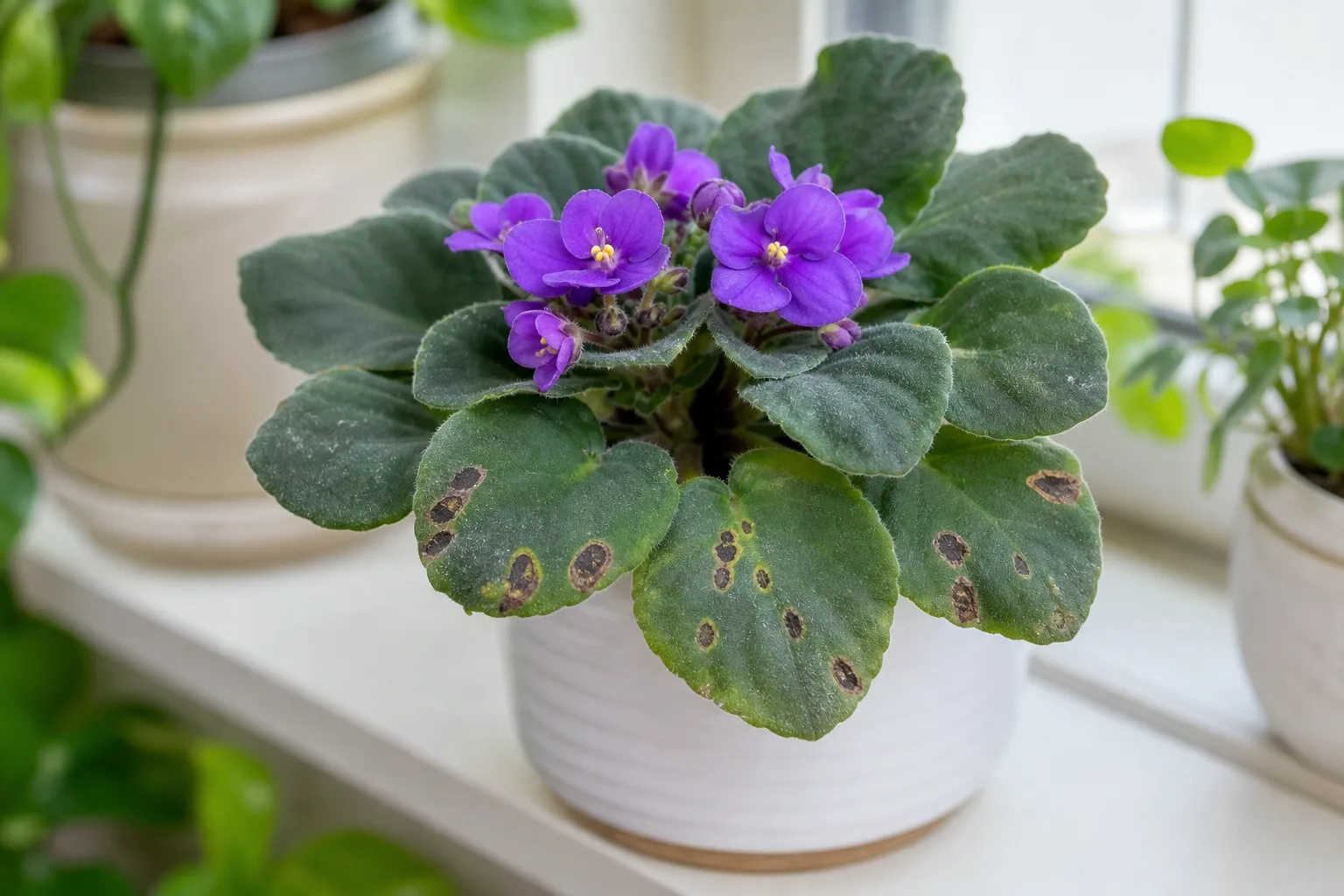
Dark circles on a Monstera. Greasy black patches on a Philodendron. Corky “scabs” on a jade that look stamped onto the leaf. Growers call all of these black spots, then reach for the same fungicide — and that is how a cold-damaged plant gets overwatered, an edema case gets stripped for cosmetics, and a bacterial soft rot sits next to healthy neighbors for another week.
Black spots are a symptom, not a diagnosis. Indoors they most often track back to fungal leaf spot, bacterial leaf spot, cold or chilling injury, or edema (oedema). Splashed cold water, salt burn, and physical bruises can mimic the same dark marks. This guide is the black-appearance triage: match the pattern, pick the category, then act. Spotted tissue does not heal into clean leaf again. Success means new growth stays clean and existing lesions stop enlarging.
If lesions already look clearly infectious and you need full fungal-versus-bacterial treatment depth, open houseplant leaf spot disease after you finish the category check here. This page stays focused on why the mark is black, whether cold or splash could explain it, and what to do in the next 14 days.
What Black Spots Actually Mean (and What Recovery Looks Like)
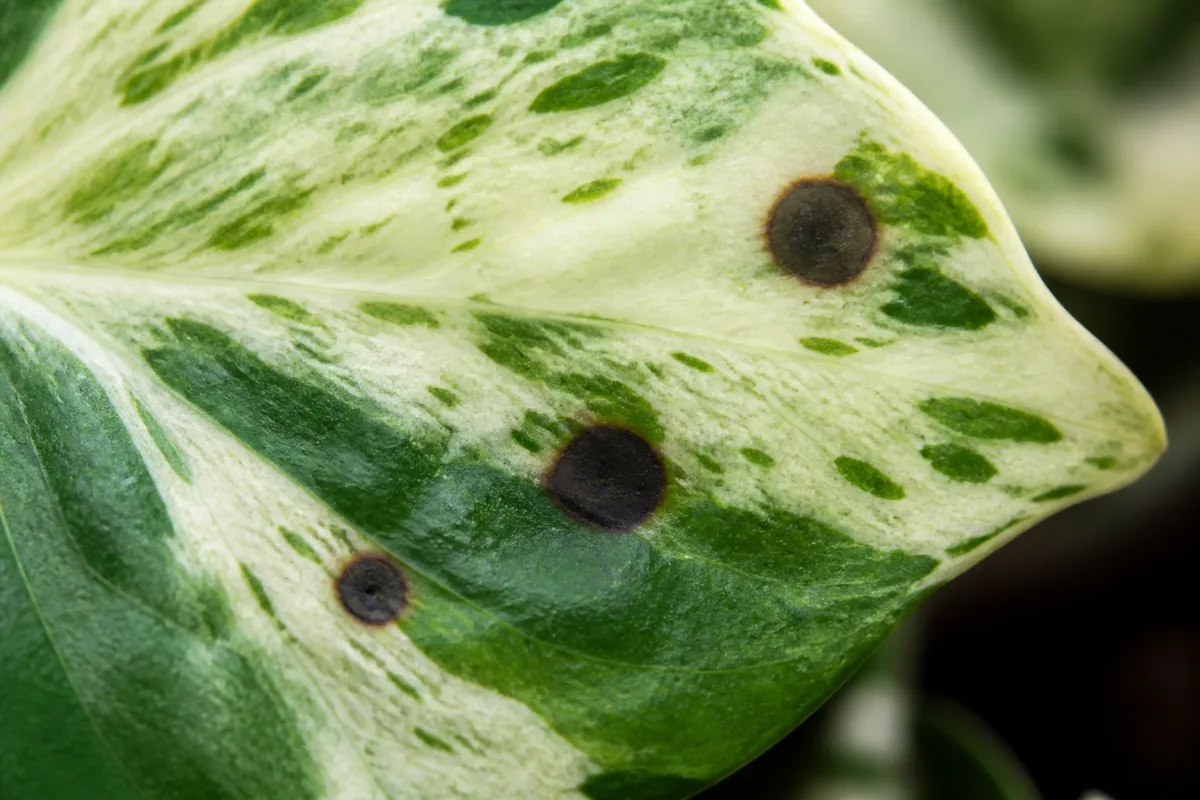
A black spot is localized dead or dying tissue. Cells collapse, pigments oxidize, and the mark reads dark brown to black against green leaf. Some lesions start water-soaked or translucent and only turn black as they dry. Others begin as tan circles with yellow halos and darken as a fungus or bacterium advances.
UC IPM notes that true foliar leaf spots and blights that thrive outdoors are usually uncommon in homes and offices because humidity is lower and there is less splashing water (UC IPM). That does not mean indoor spots are imaginary. It means many dark marks are cultural injuries, cold events, or edema — and the infectious cases almost always ride on wet leaves, poor airflow, or a plant that arrived already infected.
Measure progress by clean new leaves and stopped expansion, not by hoping old scars fade. If you only watch dead tissue, you will misread every recovery timeline.
Quick Differential: Fungal vs Bacterial vs Cold vs Edema
Getting the category right changes the next move. Fungal spots may respond to dry foliage plus a labeled protectant after you remove infected leaves. Bacterial spots need dry foliage, sanitation, and often discarding when stems soften. Cold injury needs warmth and patience before pruning. Edema needs watering and airflow changes, not a spray schedule.
| Feature | Fungal leaf spot | Bacterial leaf spot | Cold / chilling injury | Edema (lookalike) |
|---|---|---|---|---|
| Typical look | Circular tan/brown/black; yellow halo; sometimes target rings or tiny black dots in dead tissue | Water-soaked/greasy at first; may turn tan/black with yellow border; often angular between veins | Water-soaked wilt that turns black within hours to days after a chill; often sheet-like patches | Translucent blisters → raised corky tan/brown scars, often on undersides |
| Timeline clue | Multiplies after wet foliage, misting, or splash | Spreads fast on wet leaves; soft stem smell is a red flag | Clear cold exposure: draft, glass contact, shipping chill, cold car | After wet soil in low light / cool air; scars stay put |
| Contagious? | Often yes via splash, tools, debris | Often yes via splash, hands, tools | No — abiotic injury | No — physiological disorder |
| First fix | Isolate, prune infected leaves, dry canopy, airflow | Isolate, prune, keep dry; discard if soft/systemic | Move to stable warmth; wait before hard pruning | Water less in low light; empty saucers; improve airflow |
| Spray role | Labeled protectant fungicides may reduce new lesions after cleanup | Limited protectants; not a stem-rot cure | None | None — fungicides will not remove cork scars |
| Discard when | Canopy ruined and still spreading after dry culture | Soft petioles/stems, foul odor, systemic wilt | Crown/stems mushy and no firm live tissue | Rarely for scars alone |
Fungal Black Spots
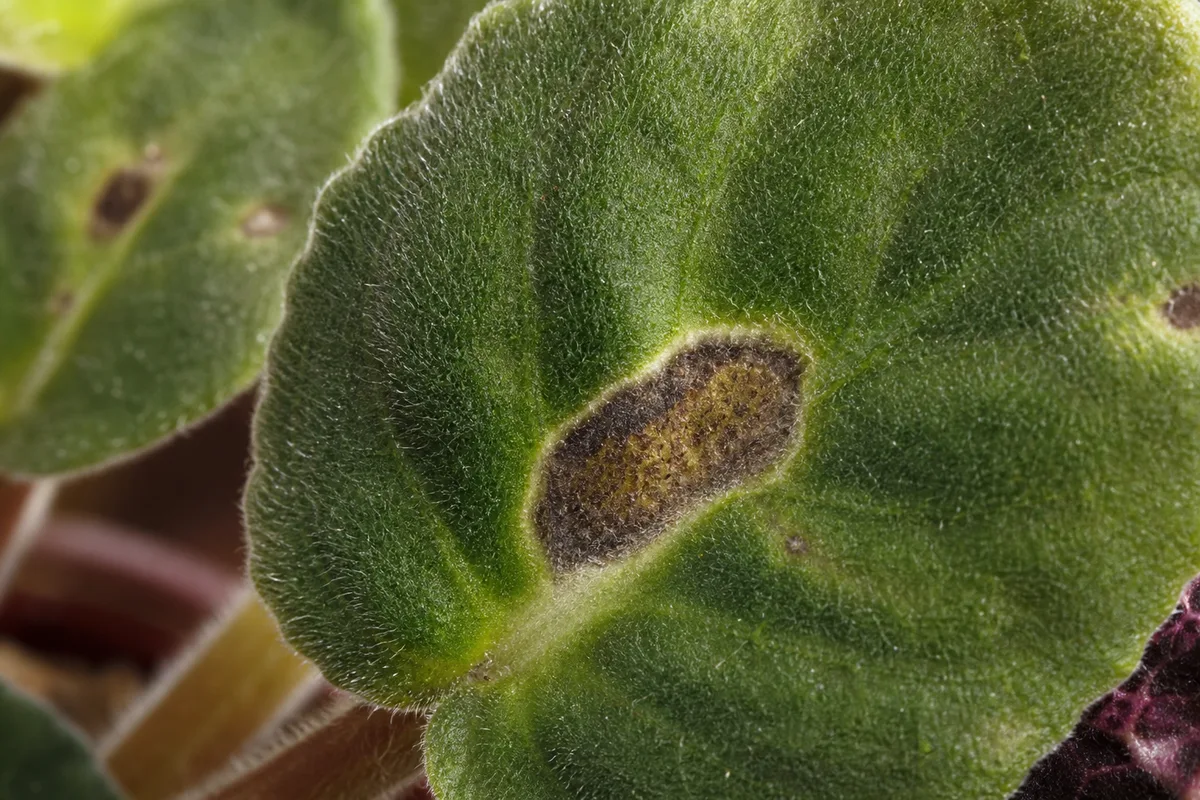
Several fungi cause discrete leaf lesions. Clemson HGIC describes fungal leaf spots as small brown spots with yellowish margins that may form concentric rings or a target pattern, with tiny black fruiting bodies sometimes visible in dead tissue (Clemson HGIC). UC IPM adds that lesions are often tan to reddish brown to black, roughly circular, and may run together into irregular blighting when leaf wetness persists for hours (UC IPM fungal leaf spots).
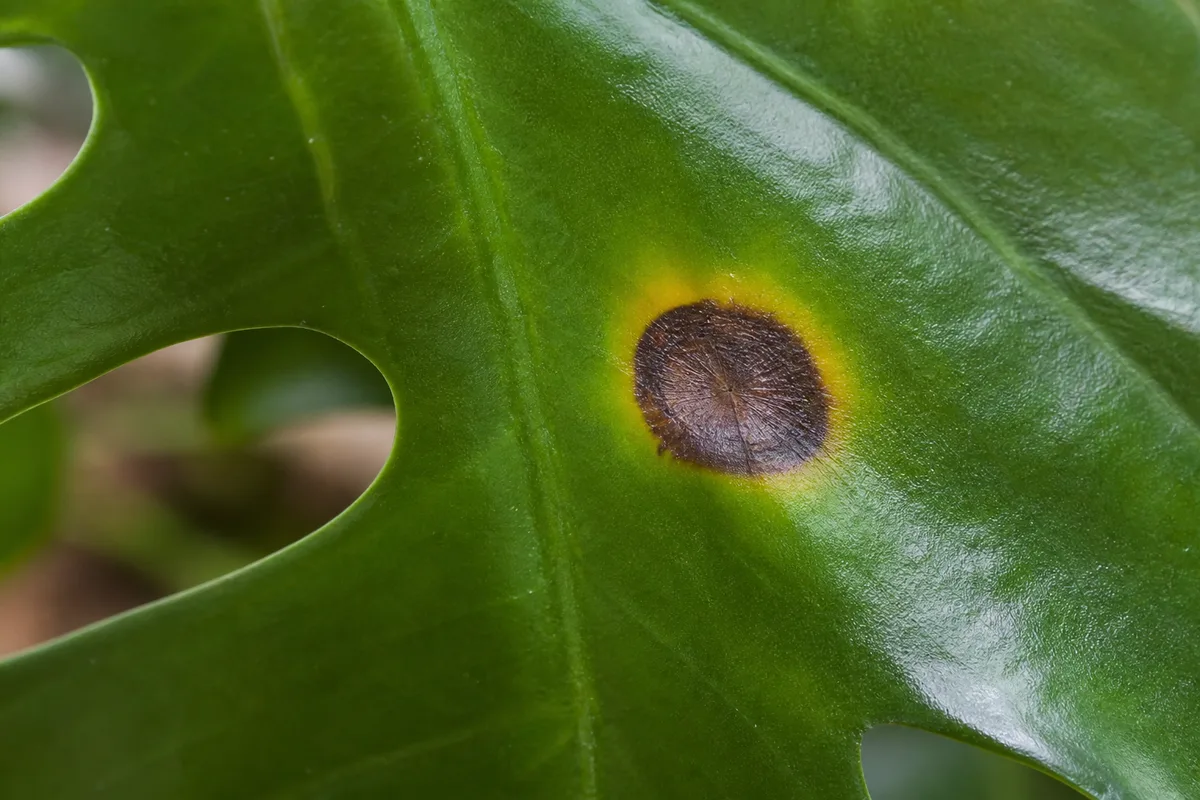
Indoors, splash from overhead watering, misting, crowded foliage, and trays of standing water create the infection window. Spores ride water films. Dry leaves overnight and you break most of that cycle before any bottle comes off the shelf. Host tendency: tropical aroids and other foliage that sit wet overnight after misting or crowded-shelf condensation show this pattern more often than dry-kept desert collections.
Bacterial Black Spots
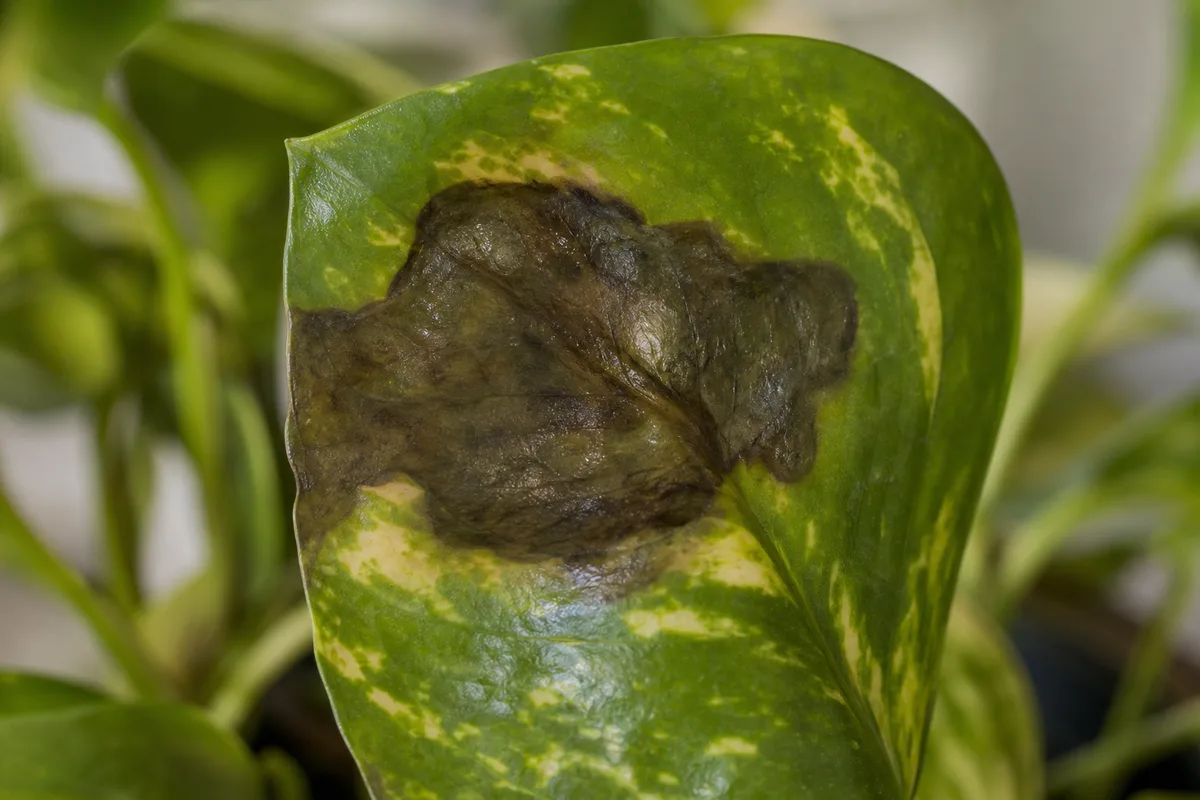
Bacterial spots usually start different. Clemson notes water-soaked spots, sometimes with a yellow halo, that enlarge and run together under wet conditions (Clemson HGIC). UC IPM describes localized bacterial diseases as oily, greasy, or water-soaked spots — often easier to see from the underside — that may turn tan, dark brown, or black with a yellow border (UC IPM). UF’s Carrie Harmon (UF-IFAS Plant Diagnostic Center) frames bacterial lesions as dark, wet, and angular because bacteria struggle to cross major veins, and she notes bacterial disease is actually quite rare on established indoor plants unless the plant arrived infected from a nursery (UF Emerging Pathogens Institute).
When petioles or stems go soft and foul-smelling, you are no longer in “spot management.” You are in discard-and-sanitize territory. Sprays do not reach pathogens distributed through vascular tissue (UC IPM).
Cold Damage Blackening
Cold and chilling injury can blacken leaves without any pathogen. Clemson’s cold-damage guidance explains that leaves and tender shoots subjected to freezing or chilling appear water-soaked and wilted, then usually turn black within a few hours or days (Clemson cold damage). Chilling injury can hit tropical houseplants even when temperatures stay above 32°F — drafts, glass contact on winter nights, open doors, and cold shipping all count. UC IPM also lists chilling injury (below about 50°F for many tropicals) among causes of leaf spots, blotches, and scabby marks (UC IPM).
The diagnostic tell is the timeline: a clear cold event, then limp or translucent tissue that darkens in sheets or large patches, often on the most exposed leaves. Infectious spots usually start as discrete lesions after wet foliage, not as overnight black collapse after a draft. Pair this differential with seasonal placement tips in winter houseplant care when glass contact and door drafts keep repeating, and use cold damage on houseplants when you already know a chill happened and need recovery depth.
Edema and Corky Lookalikes
Edema (also spelled oedema) is a physiological disorder, not an infection. Wisconsin Horticulture describes small translucent, fluid-filled blisters on the undersides of mostly older leaves that may scar tan and corky after they burst (Wisconsin Horticulture). Clemson ties oedema to excessive soil moisture, poor lighting, and low temperatures — common on succulents and in winter — and notes leaves showing oedema will not recover their smooth surface even after you correct watering (Clemson HGIC).
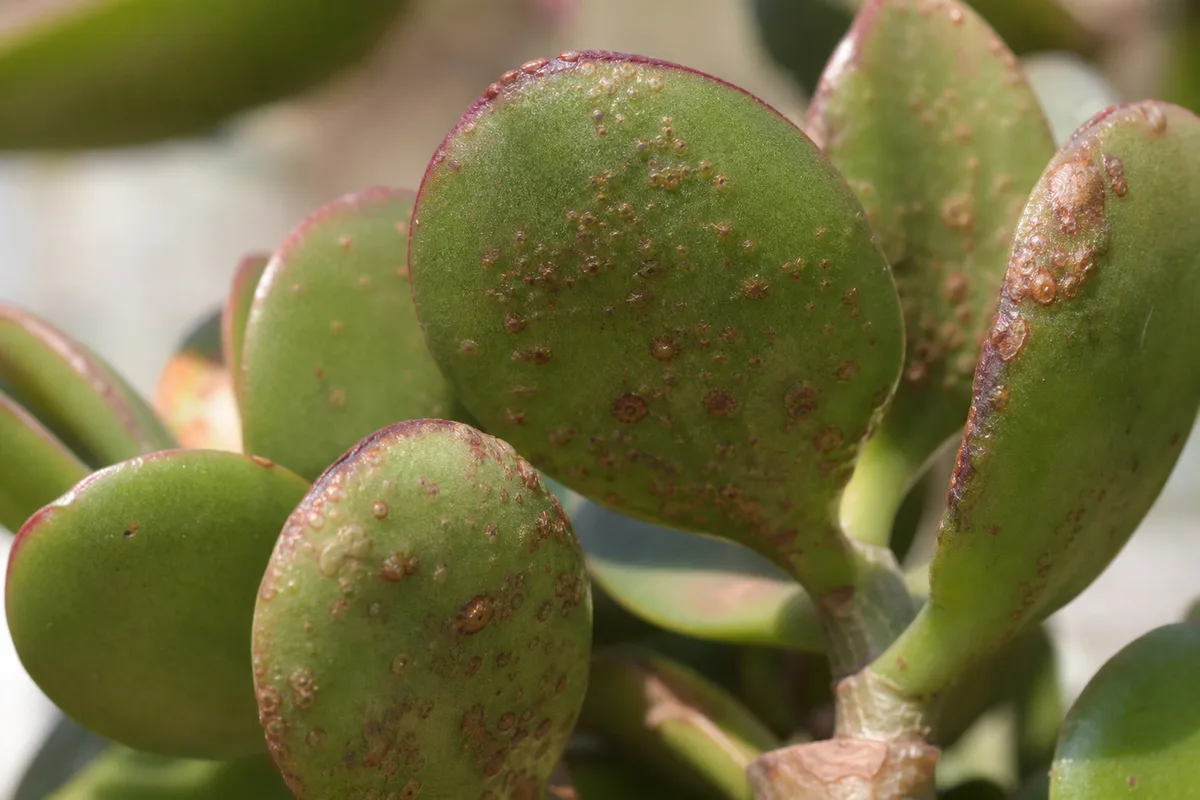
Purdue Extension warns that gardeners often blame pests or disease for these marks when the real driver is moisture extremes (Purdue Extension). Corky scars stay put. New blisters only appear if the wet-soil / low-transpiration imbalance continues. Fungicides do nothing useful here.
Cold-Water Splash Marks and Other Non-Disease Spots
Not every pale or dark mark is infection or chill. RHS notes that dark spots with yellow margins may be fungal leaf spot, while white or straw-coloured spots or rings are more likely cold-water splashes, aerosol damage, or watering with cold water (RHS). Clemson separately lists cold-water spots: watering with cold water or splashing water on leaves can cause white or straw-colored patches on sensitive species (Clemson HGIC). Clemson’s watering factsheet also recommends room-temperature water between about 62 and 72°F rather than hot or cold extremes (Clemson watering).
| Cue | Cold-water splash / aerosol | True black necrosis (disease or chill) |
|---|---|---|
| Color | Often white, straw, or pale rings | Dark brown to black; may start translucent then blacken |
| Edge | Soft pale margin; may look bleached | Sharp necrotic edge; fungal cases often yellow halo |
| Trigger | Cold water or splash on sensitive leaves | Wet-leaf infection window or known cold event |
| Contagion | No | Disease: possible; chill: no |
| First move | Room-temp water; avoid leaf splash | Category triage with the four-way table above |
African violets are the classic example. Purdue recommends room-temperature water and avoiding splash on the leaves; bottom watering helps prevent splash marks but needs occasional top flushing so salts do not crust on the mix (Purdue Extension). These marks are usually lighter than true black necrotic disease spots, but growers still file them under “spots” and overtreat. For species-level triage photos, see black spots on African violet.
Salt burn, sun scorch through glass, and physical bruises can also darken tissue. Check roots and recent fertilizer before you assume every dark circle is a pathogen. Broader browning without discrete lesions belongs on indoor plant brown leaves.
When Soil Mold Appears Alongside Leaf Spots
White or gray fuzz on the potting-mix surface is usually a saprophytic fungus feeding on dead organics in a persistently damp top layer — not the same organism causing leaf lesions. It is still a useful dashboard light. The same wet, stagnant conditions that grow surface mold also keep leaves wet longer and favor splash-driven leaf spots.
If you scrape mold while still misting the canopy every evening, you treat the dashboard and ignore the engine. Scrape the top centimeter once the surface is no longer soggy, empty saucers, stretch dry-down, and stop overhead wetting. Surface fuzz alone does not prove leaf-spot disease — diagnose leaf lesions with the table above while you fix dry-down with mold on houseplant soil.
A Practical Diagnosis Walkthrough
Skip the product aisle until you have a category. Ten minutes of questions beat two weeks of the wrong spray. Field patterns guide action; only a diagnostic lab can name the exact pathogen. Penn State Extension’s diagnosing framework starts with gathering site history and observing the pattern before jumping to a product (Penn State Extension).
Timeline and Environment Clues
Ask what changed in the last one to two weeks. Did you mist heavily, group plants tightly, or leave a tray full of runoff? Did the plant ride home in a cold car, sit against winter glass, or sit by an exterior door? Did you soak a low-light plant after it went bone-dry?
Wet-foliage timelines favor fungal or bacterial spots. Cold-event timelines favor chilling injury. Wet soil plus cool, dim rooms favor edema. Nursery-new plants with greasy angular lesions raise bacterial suspicion even when your home humidity is modest — UF notes many home bacterial cases arrived already infected (UF Emerging Pathogens Institute).
Also check the root zone. Clemson’s watering factsheet reminds growers that overwatering is the main cause of death in potted plants because roots need oxygen as well as water (Clemson watering). Soft brown roots and a sour smell point to root decline that can coexist with leaf marks — treat that track with overwatered plant and root rot on houseplants, not as proof that every leaf spot is “just overwatering.”
Lesion Texture and Pattern Checks
Look at one representative leaf in good light, top and underside.
Circular dry or papery lesions with yellow halos, target rings, or pinhead black dots in dead tissue lean fungal. Greasy, water-soaked, or angular lesions that darken and merge on wet leaves lean bacterial. Large water-soaked patches that blacken after a known chill lean cold injury. Raised corky scars, especially on undersides after wet-soil periods, lean edema.
UF’s diagnostic framing helps when you are torn between disease and culture: pathogens often start on a single leaf or stem and expand as they reproduce, while whole-plant mush or wilt with soggy soil more often tracks abiotic overwatering (UF Emerging Pathogens Institute).
When to pursue extension or lab ID: you do not need a lab for every home case. Field category is enough to choose dry-and-prune versus discard versus warm-and-wait. Contact your local cooperative extension or a plant diagnostic clinic if a valuable plant keeps spreading after two weeks of dry-canopy culture, lesions stay ambiguous between bacterial and fungal, or you need a named pathogen before discarding a rare specimen.
First Response: Isolate, Prune, Dry the Canopy
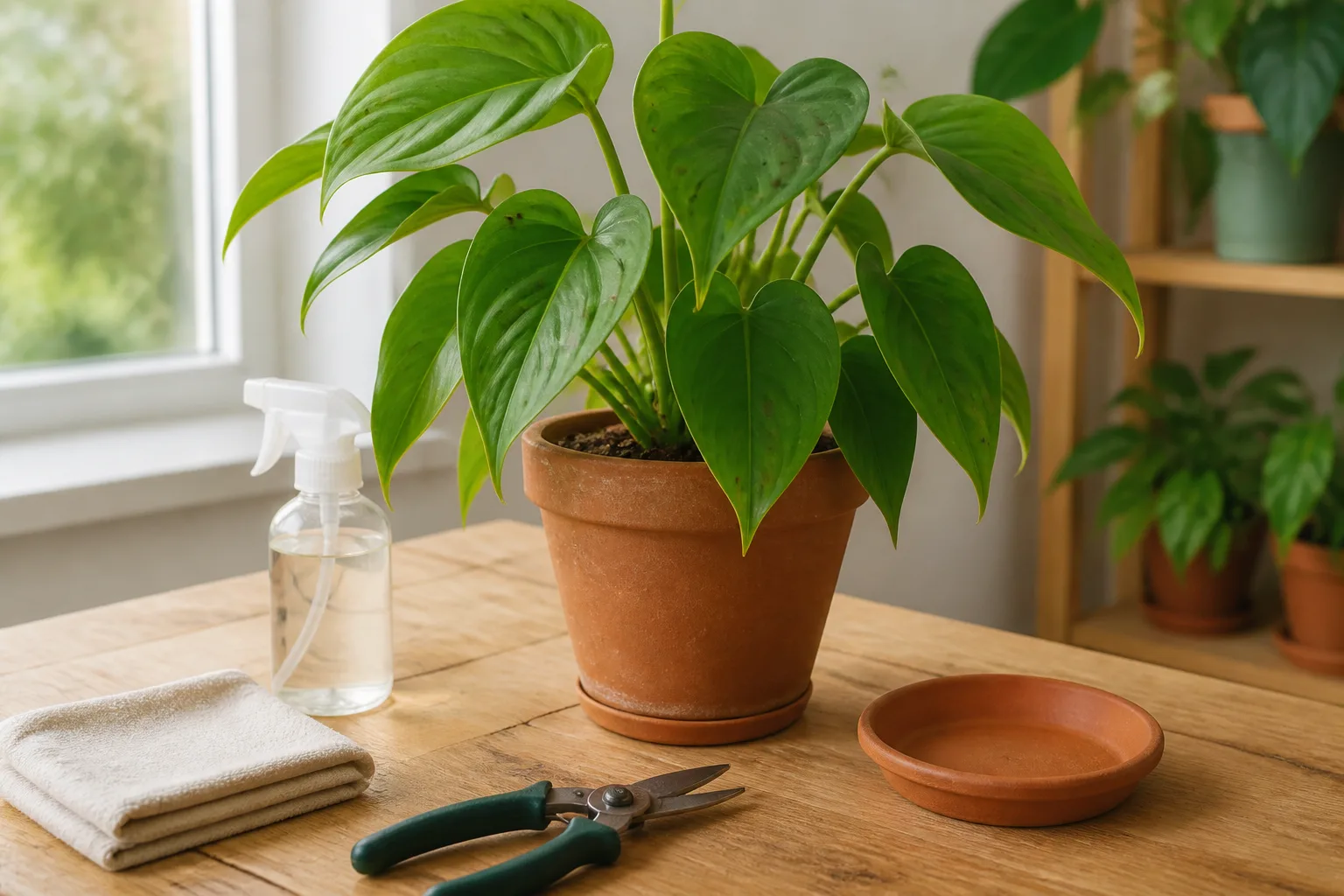
Whatever category you suspect, start with containment and canopy drying. Move the plant away from overlapping neighbors. Bag and trash heavily spotted leaves — do not compost infectious debris indoors. Water only at the soil line so foliage stays dry — how to water indoor plants the right way covers soil-line technique without wetting the canopy. Space plants so air can move between leaves. Empty saucers within about thirty minutes so pots are not sitting in runoff (Wisconsin Horticulture).
Disinfect blades between cuts. UC IPM recommends cleaning hands with soap and water and disinfecting pruning tools in 70% alcohol after removing diseased parts for bacterial leaf diseases (UC IPM). That same habit protects the rest of a mixed collection when fungal spots are active.
Do not strip a plant bare for cosmetics. Remove actively expanding or heavily necrotic leaves, then stop and watch clean tissue for seven to fourteen days. If new lesions still appear on previously clean leaves after you dry the canopy, escalate by category below.
Treatment by Cause Category
Buy a spray only if lesions look fungal (dry/papery or target-ring), you have already removed infected leaves, foliage will stay dry going forward, and stems are still firm. Skip the spray if spots are corky underside scars (edema), tissue blackened in sheets after a known chill, marks are pale splash rings from cold water, or petioles are soft and foul-smelling — those cases need culture change, patience, or discard, not a fungicide aisle trip.
Fungal Spot Recovery Steps
After isolation and pruning, keep leaves dry and improve airflow. Clemson lists protectant options such as copper soap, chlorothalonil, myclobutanil, tebuconazole, or Bacillus amyloliquefaciens products after infected parts are removed — always used outdoors if the label and footnote require it, and always exactly as labeled (Clemson HGIC). Prefer treating outdoors or in a well-ventilated area, keep pets and children away until sprays dry, and wear the PPE the label names. Chlorothalonil and other synthetics are not “indoor room sprays” — if you cannot ventilate or move the plant outside briefly, lean harder on cultural drying instead of forcing a chemical pass.
Expect old lesions to stay. Judge success by whether new leaves unfurl without spots. Species pages such as Monstera leaf spot disease, Philodendron Brasil leaf spot disease, or black spots on Manjula pothos help once the pattern is clear. For collection-wide disease ID beyond black lesions alone, use houseplant diseases identification and treatment.
Bacterial Cases and When to Discard
Keep surfaces dry, remove spotted leaves promptly, and sanitize tools. UC IPM is blunt on systemic bacterial diseases: control options are very limited, and discarding infected plants is often best because sprays cannot reach pathogens throughout the plant (UC IPM). Soft, mushy stems with an unpleasant odor, rapid canopy collapse, or lesions racing into petioles despite dry culture are discard signals. UF specialists give the same blunt advice for bacterial soft-rot patterns: throw it out and start over rather than stacking sprays (UF Emerging Pathogens Institute).
After discard, wash trays and shelf surfaces, and do not reuse contaminated mix on healthy plants. Nursery inspection matters more than home “cures”: reject plants with greasy spots and soft stems before they enter the collection (UC IPM).
Cold Injury Aftercare and Edema Fixes
For cold injury: move the plant to a stable, appropriate temperature away from glass and drafts. Do not flood a limp plant hoping water will revive killed cells — Clemson notes watering wilted cold-damaged plants will not help revive dead tissue (Clemson cold damage). Hold fertilizer until you see sustained new growth. Wait before hard pruning so the full extent of damage declares. Soft foliage may show in hours to days; stems can take longer. When tissue is clearly dry and dead, cut to firm green. If the crown is mush and no firm live tissue remains, discard. Species pages such as pothos cold damage help when you need plant-specific recovery photos after triage.
For edema: water less frequently in low light and cloudy periods. Wisconsin Horticulture recommends morning watering so the mix can drain before night humidity rises, plus better ventilation (Wisconsin Horticulture). Empty saucers. Improve light within the species’ comfort range so leaves can move water out. Do not strip every corky leaf for appearance if the plant still has enough canopy to function — RHS advises against removing oedema-affected leaves solely for cosmetics (RHS). Scars remain; prevention of new blisters is the win. Jade and other succulents often show this pattern first — see edema on jade plant when corky underside scars dominate and no greasy spread is underway.
First-Hand Notes From Diagnosing Black Spots Indoors
These are single-setup LeafyPixels observations from indoor shelves (Jan–May 2026), not controlled trials. Use them as pattern recognition, not as proof that your plant has the same cause.
Cold-car blackening on golden pothos (February 2026). A grocery-store pothos rode home in an unheated car on a near-freezing night. By morning the outer leaves looked water-soaked; within two days the same patches went black in sheets on the most exposed foliage. No misting history, no greasy angular spread to neighbors. We moved it to stable room temperature, held water until the mix lightened, and waited five days before pruning. Dead tissue stayed black; new leaves from the crown were clean by week three. Fungicide would have done nothing — the timeline matched chilling injury, not wet-leaf infection.
Edema mis-sprayed as fungus on jade (March 2026). A jade under a north window developed raised tan corky scars on leaf undersides after a stretch of cool, dim days and frequent saucer watering. The first instinct on the shelf was “leaf spot,” and a copper product was nearly applied. Underside texture (raised cork, not greasy film) plus wet-soil / low-light history flipped the call to edema. We emptied saucers, stretched dry-down, and improved morning light. Old scars stayed; no new blisters appeared after two weeks. Stripping every scarred leaf would have removed half the canopy for cosmetics alone.
Misting-triggered fungal spots on Monstera deliciosa (April 2026). Evening misting on a crowded aroid shelf produced new circular dark lesions with yellow halos on previously clean Monstera leaves over about five days. Neighboring leaves that stayed dry overnight stayed clean. We stopped misting, isolated the plant, removed the worst leaves, and kept soil-line watering only. Expansion stopped within a week; the next fenestrated leaf unfurled without spots. That case belongs on the infectious path — deeper treatment notes live on Monstera leaf spot disease.
Prevention That Actually Stops New Spots
Prevention is mostly leaf-wetness control and nursery discipline. Water at the soil line. Avoid evening misting on plants that already show spotting history. Space pots so leaves do not stay pressed together. Use room-temperature water on splash-sensitive species. Keep tropicals off cold glass in winter and away from exterior-door blasts.
Inspect new plants before they join the shelf. UC IPM advises rejecting plants with leaf spots and discolored stems or roots — those blemishes are not going to disappear after you bring them home (UC IPM). Match pot size and mix drainage to the species so you are not forced into chronic sogginess that invites both root decline and edema.
If you need a guided symptom checklist while you work, the black spots on leaves checker can help you log pattern clues before you choose a treatment path. For a species-indexed starting point across many plants, use the black spots symptom hub.
When to use this guide
- Houseplant leaf spot disease — open when lesions look infectious (halos, target rings, greasy angular spots) and you need full fungal-vs-bacterial treatment detail
- Cold damage on houseplants — open after a known chill, draft, glass contact, or cold shipment when tissue blackens in sheets
- Mold on houseplant soil — open when white/gray fuzz on the mix appears with the same wet stretch as leaf marks
- Root rot on houseplants / overwatered plant — open when soft brown roots and sour soil smell dominate over discrete leaf lesions
- Black spots symptom hub — open for a species-indexed starting point across many plants
Related guides
- How to water indoor plants the right way — soil-line watering without wetting the canopy
- Winter houseplant care — glass contact, drafts, and chill prevention indoors
- Houseplant diseases identification and treatment — collection-wide disease ID beyond black lesions alone
- Indoor plant brown leaves — broader browning without discrete black spots
Conclusion
Use this as a day-0 → day-14 checklist, not a restatement of the four causes.
Day 0: Photograph one spotted leaf and one clean leaf. Note any cold event, misting, or wet-soil history. Isolate. Bag heavily necrotic leaves. Switch to soil-line watering. Empty the saucer within ~30 minutes. Disinfect tools with 70% alcohol after cuts.
Days 1–3: Watch for expansion on previously clean tissue. Sheet-like blackening after a known chill → warm and wait; do not spray. Corky underside scars → water less in low light; do not strip for cosmetics. Greasy angular spread or soft foul petioles → discard and sanitize. Dry circular halos after wet foliage → keep dry; consider a labeled protectant only after cleanup.
Days 7–14: Success = no new lesions on previously clean leaves and new growth unfurling clean. Old black tissue will not turn green again. If infectious patterns keep racing despite dry culture, escalate to discard or extension/lab ID rather than stacking random products.
Dead spots stay dead. Clean new growth is the only honest recovery metric.