Can You Start Seeds Without Grow Lights? Yes—With Limits
Can you start seeds without grow lights? Yes—if you choose suitable crops, use a bright window, and time sowing well. Learn how to prevent weak, leggy growth.
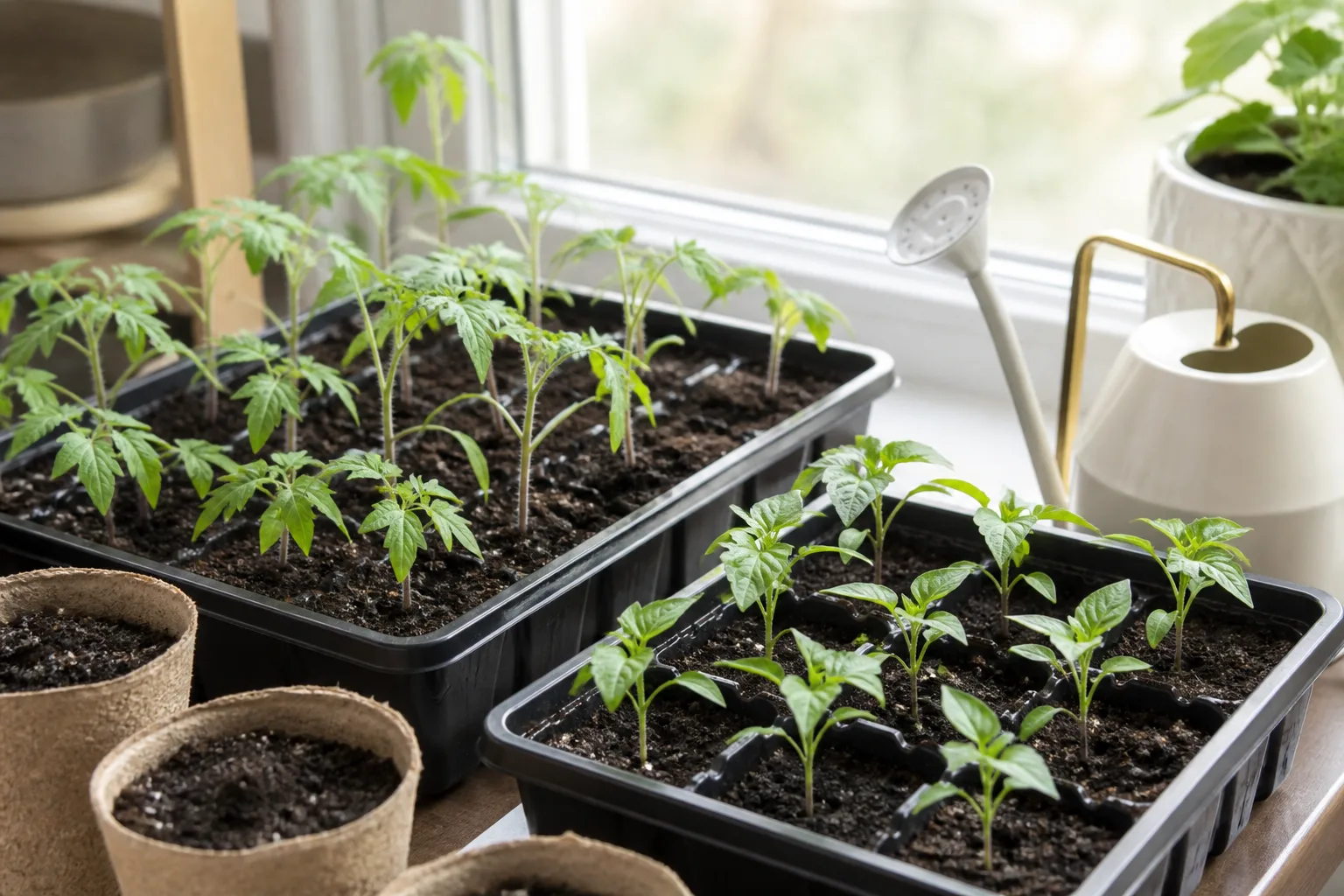
Yes. You can start seeds without grow lights, but the deciding factor is not whether a seed can sprout on a windowsill. It is whether the seedling will receive enough usable light, for long enough, to grow sturdy before it is time to plant outside.
A bright window can work for a small, well-timed batch. It is a poor substitute for a grow-light rack when you sow weeks early, use a dim or shaded room, or try to raise many warm-season crops through a long indoor period. The most reliable no-light plan is to start fewer seeds later, choose crops that fit your outdoor schedule, and move seedlings into safe natural daylight as soon as conditions allow.
You do not need to buy a lamp just because you own seed packets. You do need a backup plan if the seedlings stretch: direct-sow when the crop permits, borrow a brighter location, use protected outdoor space, or buy transplants for the plants that need a long, bright start.
The short answer: yes, if light and timing line up
Seeds often germinate without a grow light. Many stay underground until they have used stored energy to send up a shoot, so a warm place can be more important than bright light during that short stage. Once a seedling emerges, however, it quickly needs enough light to develop leaves and a compact stem. A seed sprouting successfully is not proof that your room can raise a healthy transplant.
The practical question is how long the seedling must live indoors before it can go outside. A tray that spends a week or two at a bright window during lengthening spring days has a better chance than one started in midwinter and held there for two months. The window, your latitude, cloud cover, nearby buildings, and the crop’s tolerance for cool weather all change that equation.
Use this quick decision rule:
- If the seed packet recommends direct sowing and the soil is ready, sow outdoors instead of raising an indoor transplant.
- If a crop needs only a short indoor start and you have a genuinely bright, unobstructed window, try a small batch and inspect it daily.
- If the crop needs many weeks indoors, your room is dim, or you cannot move seedlings outdoors safely, choose a nursery start or arrange supplemental light.
That is a more useful distinction than “grow lights are essential” or “a sunny window is always enough.” Natural light can work in the right setup, but no single window direction or fixed number of daylight hours guarantees success.
Seeds and seedlings need light at different stages
Germination and seedling growth are related but not identical jobs. A seed absorbs water, activates its embryo, and uses stored food as the root and shoot begin to develop. Many common garden seeds can do this in darkness, although some species respond to light during germination and must be sown on the surface or covered only lightly.
After the shoot breaks the surface, the plant’s needs change. Light supplies energy for photosynthesis and also acts as a developmental signal. A peer-reviewed review of early seedling development describes how seedlings grown in darkness can elongate their hypocotyls—the stem section below the seed leaves—while their cotyledons remain folded. That response helps a buried shoot reach the surface, but aboveground it produces a tall, pale seedling that can lean or collapse. The review on light’s role in early seedling development explains this transition.
This is why advice to keep seeds warm before sprouting should not be carried over to seedlings after they emerge. A covered tray on top of a refrigerator may help some seeds germinate, but leaving the dome on or keeping the tray on bottom heat after most seeds have sprouted can leave the seedlings warm, damp, and reaching for light. As soon as green shoots appear, remove the cover and move the tray to its brightest suitable spot.
Check the seed packet before you cover seeds
Read the sowing depth and light instructions for each crop before planting. Some seeds need exposure to light to germinate; others germinate better when covered. Lettuce is a familiar example of a seed often sown very shallowly, but packet instructions for the variety in your hand should take priority over a general rule.
“Needs light to germinate” does not mean the seedling can remain in a dim room once it sprouts. Likewise, “germinates in darkness” does not mean a seed can grow without light after emergence. If you sow several crops in one tray, label each cell and follow the depth instructions separately rather than burying every seed at the same depth.
Does your window provide enough useful light?
In the Northern Hemisphere, a clear, south-facing window usually receives the strongest direct sun, while an east- or west-facing window gets a shorter period and a north-facing window is often the weakest choice. In the Southern Hemisphere, the seasonal pattern reverses, so a north-facing window may be brighter. These are starting points, not guarantees: a nearby building, deep eaves, trees, tinted glass, curtains, or a porch roof can change what reaches the tray.
Season matters as much as compass direction. In late winter, the sun is lower, days are shorter, and cloudy stretches reduce both brightness and duration. The University of Maine Cooperative Extension notes that even a sunny window can produce thin seedlings in its region because late-winter days are short and often overcast; it also warns that cold nighttime temperatures at the glass can stress seedlings. That guidance is especially relevant in northern climates, but the general lesson applies anywhere a window is dim or cold. University of Maine Cooperative Extension’s seed-starting guide explains why a window that looks bright to us may still fall short for seedlings.
Do not judge a window by how pleasant the room feels or by the number of hours between sunrise and sunset. Human eyes adjust to indoor brightness, and “daylight hours” include dawn, dusk, and cloudy periods when the tray may receive little useful light. Instead, observe the actual spot where the leaves will sit: note when direct sun reaches it, whether nearby structures shade it, and whether the plants lean toward one side over several days.
A workable window is bright for much of the day, has no heavy obstruction, and stays warm enough for the crop at night. It does not need to bake the tray in hot afternoon sun. If the sill becomes cold after dark or heats sharply in direct sun, use a small table near the window where temperature is steadier, while keeping seedlings close enough to receive the available light.
Which seeds make sense without grow lights?
Choose the growing route before you choose the seed. Some crops are best planted directly in the garden; some can be raised as short-term transplants if outdoor planting is close; and others benefit from a long indoor start that is difficult to provide on a windowsill. The University of Maine Cooperative Extension lists beans, beets, carrots, corn, peas, spinach, lettuce, turnips, and zucchini among vegetables commonly direct-sown, while noting that crop and season affect the choice. Its seed-starting guidance is a useful reminder that indoor sowing is optional for many plants.
| Your situation | Better no-light route | Why it fits |
|---|---|---|
| The crop is normally direct-sown and outdoor soil is ready | Sow outdoors by packet directions | The plant gets natural light from emergence and avoids transplant stress |
| Spring is near and you want a small batch of quick seedlings | Try a bright window, then move plants out when weather allows | A short indoor stay limits the time seedlings can stretch |
| You want early peppers, eggplants, or other slow-growing transplants | Buy starts or find a brighter growing setup | These crops may spend many weeks indoors before outdoor conditions suit them |
| The only available window is shaded or north-facing in the Northern Hemisphere | Direct-sow later or buy starts | Rotation cannot make a low-light room bright |
| The seedlings will need to stay indoors after the garden is ready | Use supplemental light or choose another crop | A window may not sustain compact growth for a long wait |
Favor quick starts and crops suited to direct sowing
For a no-light indoor start, favor seeds whose indoor period can be brief rather than looking for a universal “low-light seed.” Leafy greens and some herbs can be convenient in a bright spring window, but seedlings still need enough light after they emerge. Their mature plants may tolerate partial shade in the garden; that does not mean a young seedling can thrive on weak indoor light.
Crops with large seeds and quick germination are not automatically better windowsill seedlings. Beans, peas, squash, and corn often establish readily, but many are normally sown outdoors once soil and weather are suitable, and their roots can be disturbed by transplanting. For these, direct sowing is often the simpler no-grow-light solution. Follow the packet for soil temperature and planting depth rather than using a calendar date alone.
If you want greens before outdoor sowing is possible, plant a modest number in individual cells or small pots so you can move them without tearing a crowded root mat. Start only as many as you can place in the brightest part of the window. A tray packed with seedlings creates competition for light and airflow, and thinning later does not undo weeks of stretching.
Skip long indoor starts when seedlings must wait
Peppers, eggplants, celery, onions, and many slow-growing flowers may need a longer head start than a window can reliably provide in a short-day season. That does not make them impossible without a grow light, but it raises the cost of a weak setup: you may have to nurse them for weeks while they stretch, become crowded, or outgrow their cells before the garden is ready.
For those crops, compare the packet’s suggested indoor-start interval with your actual planting window. If that interval is long and your window is mediocre, buying a healthy transplant can be more successful and less wasteful than sowing early and hoping the light improves. Another option is to wait until the outdoor season is closer, then choose a faster-maturing variety or a later crop that can be sown directly.
Be cautious with lists that label a crop “shade tolerant” and imply that it is suitable for a dim windowsill. Shade tolerance describes how an established plant performs in outdoor conditions; it is not a promise that newly emerged seedlings can grow well without adequate light. For young plants, brightness at the leaf surface and time spent indoors matter more than the eventual garden’s shade rating.
Build a no-grow-light windowsill setup
Start with a clean, draining container and a fine seed-starting mix that is evenly moist, not saturated. Use individual pots or cells when you only need a few plants; shallow flats make more sense when sowing many seeds of one crop, but they will need thinning or transplanting as seedlings grow. Avoid garden soil in small containers because it can compact and may carry weed seeds or disease organisms.
Choose the brightest stable location available and make a little room for the tray before sowing. A windowsill is convenient, but a low table immediately beside the window may be warmer and easier to rotate. Keep the tray away from cold drafts, heaters, and cooking appliances; a sudden hot-cold cycle can stress seedlings even when the room’s average temperature seems comfortable.
Place, rotate, and observe the tray
Put the seedling leaves close to the bright window without pressing them against the glass. Clean glass and open curtains before sowing, and remove objects that cast shade across the tray. Gardening Know How’s windowsill seed-starting advice similarly recommends positioning trays near the glass, rotating them to even out one-sided growth, and moving them away from cold nighttime glass. These small adjustments improve the use of existing daylight, but they cannot turn a shaded window into a high-light growing area. Gardening Know How’s windowsill guide offers practical placement tips.
Turn the tray a half-turn each day if seedlings consistently lean toward the window. Rotation redistributes the direction of growth; it does not increase the total light reaching the plant. If the stems keep stretching even after rotation, move the tray to a brighter window or shorten the indoor growing period instead of rotating more often and expecting the problem to disappear.
Inspect the seedlings at the same time each day. Look for upright stems, green leaves, and new growth that is not dramatically longer than the previous set. If the plants all angle toward the glass, the source is directional; if they remain upright but become thin and elongated, the overall light may be inadequate or the room may be too warm. These are early warnings, so act while the seedlings are still small.
Adjust warmth and moisture after emergence
Warmth helps many seeds germinate, but seedlings usually do not need a heated mat once they are up. The University of Maine Cooperative Extension recommends removing bottom heat and the humidity cover when about half the seeds have sprouted. Check your crop’s preferred growing temperature, and avoid placing young plants on top of a radiator or in a hot window where their stems can elongate faster than their leaves develop.
Remove a humidity dome or plastic cover as soon as seedlings emerge. Trapped moisture and still air can encourage damping-off, a disease that makes stems dark and pinched at the soil line before seedlings topple. Give seedlings space and gentle room airflow; do not aim a strong fan at them or keep the mix constantly wet to compensate for a dry room.
Water according to the mix, not a fixed daily schedule. Low-light seedlings may use water more slowly than plants under intense lamps or direct sun, so check the surface and container weight before watering. Keep the mix lightly and evenly moist, then let excess water drain; a permanently soggy tray can damage roots and make it harder to distinguish watering stress from a light problem.
Time sowing around your outdoor planting window
A no-grow-light plan works best when indoor time is short. Begin with the seed packet’s recommended number of weeks before transplanting, then count back from the date the crop can safely go outside in your location. That date is not always the last frost date: tomatoes, peppers, and other tender crops also need warm nights and suitable soil, while cool-season crops may go out earlier if their specific temperature needs are met.
If the packet says to start a crop six to eight weeks before transplanting, but your window is dim and the outdoor date is still far away, starting on schedule may produce oversized, weak seedlings. Consider buying transplants, using a light source, or shifting to a crop that can be direct-sown later. Starting a few weeks later can be a better trade than starting early and asking a plant to wait in poor conditions.
Do not compensate by sowing every seed in the packet. Start a small test batch, record the sowing date, and note how many days the seedlings stay compact before they begin leaning. If the test succeeds, sow another small batch; if it stretches, you have lost a few seeds rather than an entire tray. This simple trial is especially useful because window conditions vary from one home to another.
If a window is your only light source, avoid starting seeds far earlier than necessary “for a head start.” A head start only helps when seedlings remain healthy until planting time. A compact seedling raised later can catch up quickly outdoors, while a very early leggy one may struggle through transplanting and weather changes.
Move seedlings outside without shock
Outdoor daylight can be much stronger than indoor window light, but a sudden move into direct sun is not a safe fix for a seedling that has never been outside. Leaves adapted to indoor conditions can scorch, while wind and a large temperature swing can dehydrate or damage tender stems. Use outdoor exposure as a gradual transition, not as an all-day rescue treatment.
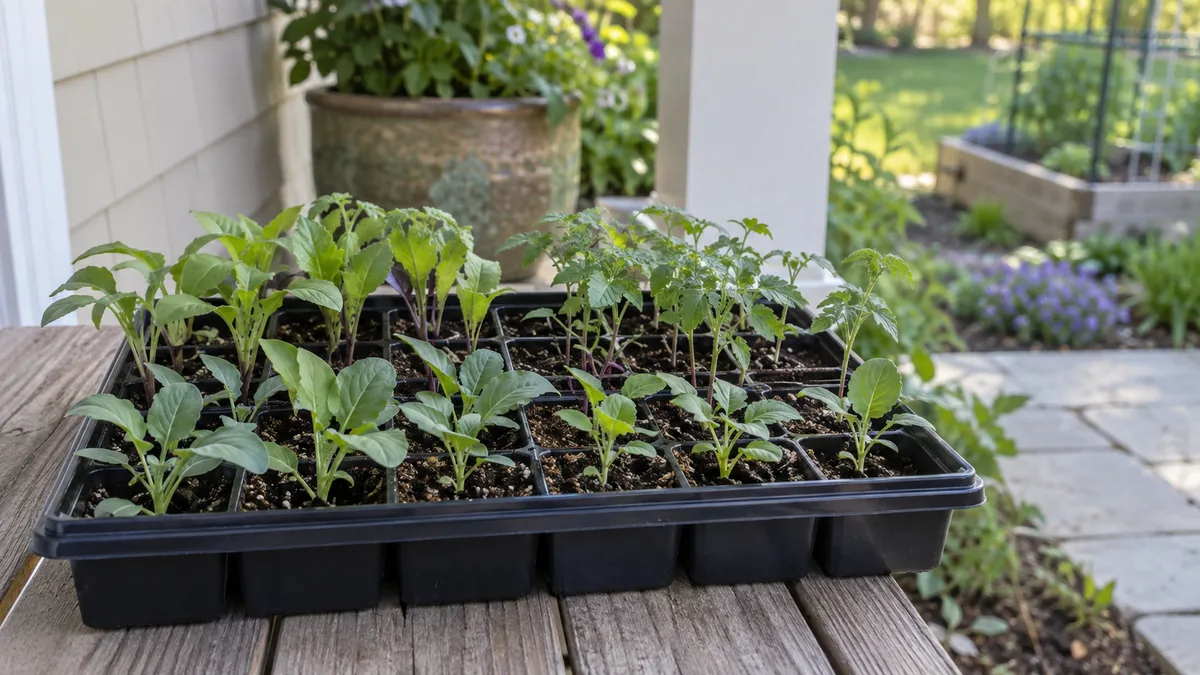
On mild days, seedlings can spend a short period outside in a sheltered, bright-shade spot if the crop’s temperature needs are met. Bring them in before cold nights, strong wind, heavy rain, or intense midday sun. If the weather is not suitable, keep the tray at the brightest indoor location and wait; a cold snap can set plants back more than a few cloudy days.
Use a gradual hardening-off schedule
Hardening off means gradually acclimating indoor-grown seedlings to sun, wind, and outdoor temperature changes before transplanting them. University of Maine Cooperative Extension recommends allowing one to two weeks, starting with a few hours in a protected, semi-shaded spot and increasing outdoor time and sun exposure progressively. Its temperature guidance varies by crop, so use the seed packet or a local extension recommendation before leaving tender seedlings out overnight. The extension’s transplanting advice describes the gradual approach.
A practical sequence is:
- On the first day, set plants outside for a few hours in bright shade, sheltered from wind.
- Over the next several days, lengthen the outdoor period and introduce gentle morning sun.
- Gradually increase sun and airflow, watching for wilting, bleaching, or scorched patches.
- Bring tender crops inside whenever nights are too cold or the forecast calls for damaging weather.
- Transplant only after the plant is acclimated and outdoor conditions suit that crop.
The schedule is a guide, not a race. Slow down if seedlings wilt and do not recover after moving back to shade, or if the leaves show pale, dry patches after sun exposure. Water before plants become badly wilted, but do not leave pots standing in water. If you only have a balcony or patio, a shaded wall or open-sided porch can serve as the first protected stop before the seedlings receive more direct sun.
Diagnose stretching before seedlings weaken
Leggy seedlings are taller and thinner than expected, often with long gaps between leaves, pale stems, or a noticeable lean toward the window. A close look at young seedlings makes the problem easier to recognize before their stems fold over. 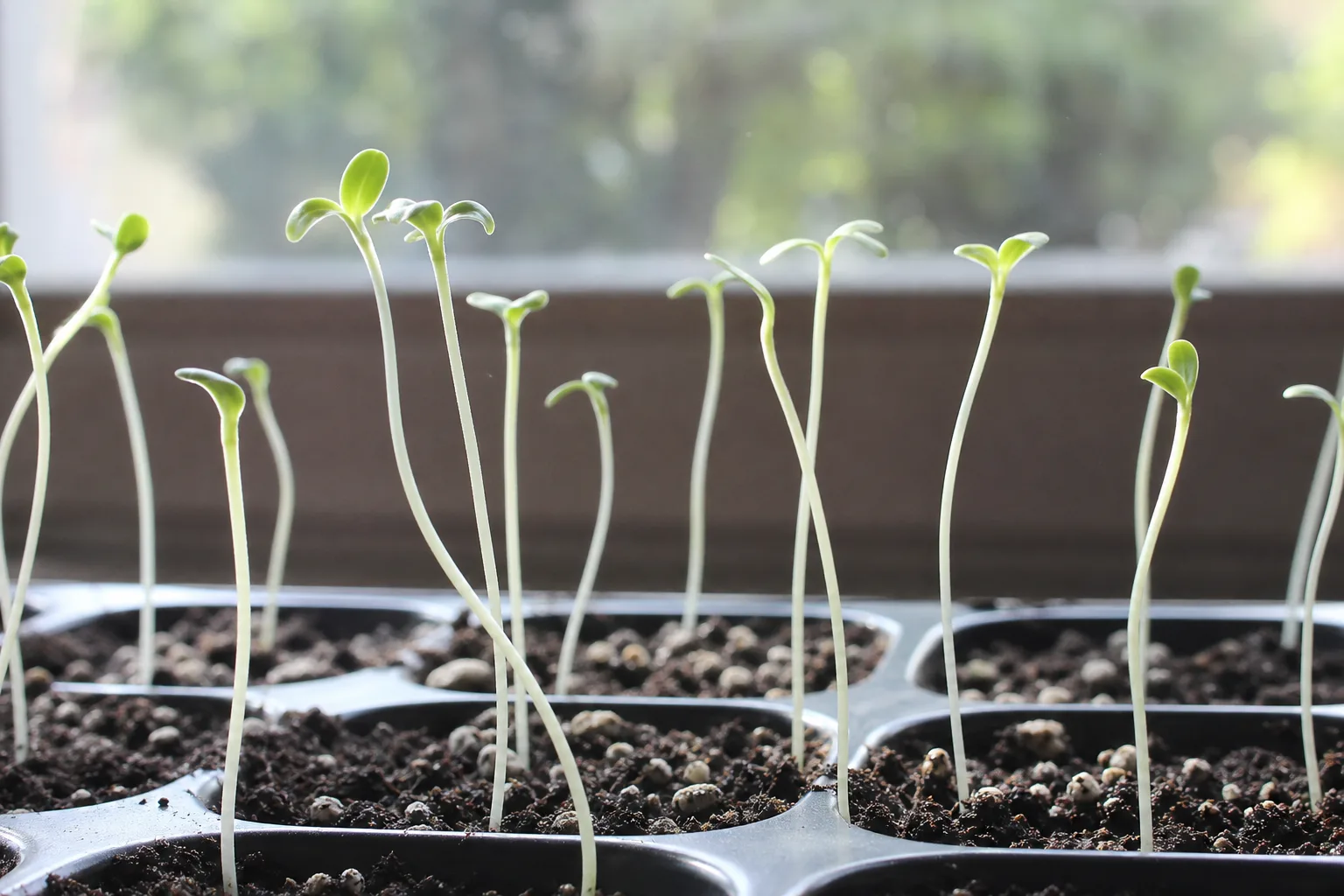
Light is a common cause, but it is not the only one. Seedlings can stretch when warmth is high relative to light, when they are crowded, or when a tray’s single window-facing side gets much more illumination. Horticulturist Stephen Albert’s practical guide at Harvest to Table also flags warmth and crowding as contributors to spindly growth. The point is to check the growing conditions together rather than treating every weak stem as a cue to water or fertilize. Harvest to Table’s leggy-seedling guidance discusses these related factors.
Correct the conditions first: move the tray to the brightest available spot, rotate it daily, remove any remaining cover, separate crowded seedlings, and keep temperatures within the range recommended for the crop. Do not fertilize a seedling simply because it looks small; extra nutrients cannot replace missing light and can make tender roots more sensitive. Likewise, more water will not strengthen a stem that is stretching toward a brighter location.
Compare new growth after the change rather than expecting the existing stem to shrink. A seedling may produce sturdier leaves above the stretched section once conditions improve, but its old stem will remain elongated. If several seedlings in the tray continue to lean or grow pale after you improve placement, your window is probably not bright enough for that crop at that time of year.
Know what can and cannot be rescued
A seedling that is mildly stretched but still green and upright may be worth keeping if you can give it better light and transplant it soon. Handle it gently, give it room, and harden it off before moving it outdoors. When transplanting, follow crop-specific depth guidance; do not bury the stems of every seedling in an attempt to compensate for legginess.
Discard or replace seedlings that have collapsed, have a pinched or dark stem at the soil line, or continue declining after you correct the conditions. A weak transplant is not automatically doomed, but keeping every one can consume space and attention that would be better spent on a fresh sowing or healthy nursery start. If the outdoor season is near, direct-sow a crop that tolerates it rather than restarting a long-season plant too late.
If you are unsure whether a seedling is simply leaning or has a disease problem, inspect the stem where it meets the soil. A healthy but stretched plant has a continuous stem; a dark, constricted, soft, or rotting base suggests damping-off or another issue, not just insufficient light. Remove affected seedlings and let the remaining plants dry slightly between waterings while keeping air moving.
When natural light is not enough
Switch plans when seedlings are stretching despite your best window, when the crop needs many more weeks indoors, or when you cannot give it suitable outdoor conditions after transplanting. You can move the tray to a brighter room, use a protected outdoor space when weather permits, direct-sow, or buy starts. A simple, correctly positioned grow light is another option, but it is not the only way to garden from seed.
If you do use a household fixture as supplemental light, remember that ordinary room lighting is designed for people at room distance, not seedlings. A fixture may help only when it delivers enough light at close range and can be adjusted as plants grow; follow crop-specific and fixture guidance rather than assuming that any bulb over the tray is equivalent to daylight. University of Maine Cooperative Extension notes that inexpensive shop-light setups can raise seedlings, while higher-quality grow lights are more useful when the goal is continued growth or harvest indoors. Its guide to seedling lighting explains the tradeoffs.
A grow-light setup can be a useful fallback for long indoor starts, but it is not a prerequisite for every seed. 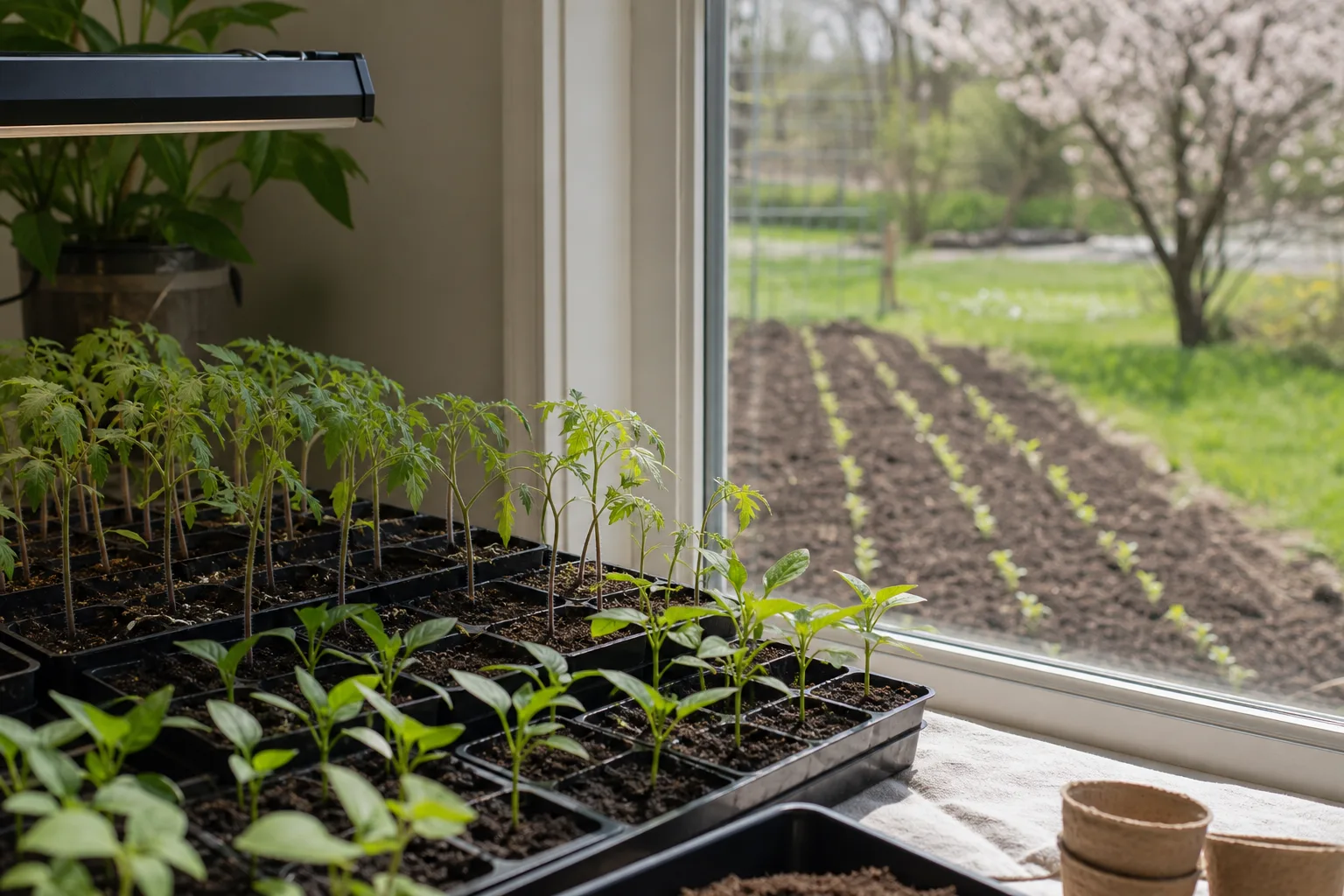
Conclusion
You can start seeds without grow lights when the crop, window, season, and planting date line up. Let the seed packet guide sowing depth and timing, move sprouts into the brightest available natural light immediately, and treat leaning or elongated growth as a signal to act rather than a cosmetic flaw.
For the best odds, keep indoor starts short, direct-sow crops that do not need transplanting, and harden seedlings off gradually before planting them outside. If the window cannot keep new growth compact, change the plan early—use a brighter location, buy starts, or add supplemental light. The seed packet and the seedlings’ response will tell you which route makes sense.