Philodendron Lemon Lime Care: Light, Water & Soil
Grow Philodendron Lemon Lime with light that holds yellow-green color, soil-check watering, Neon pothos ID tips, and pet safety.
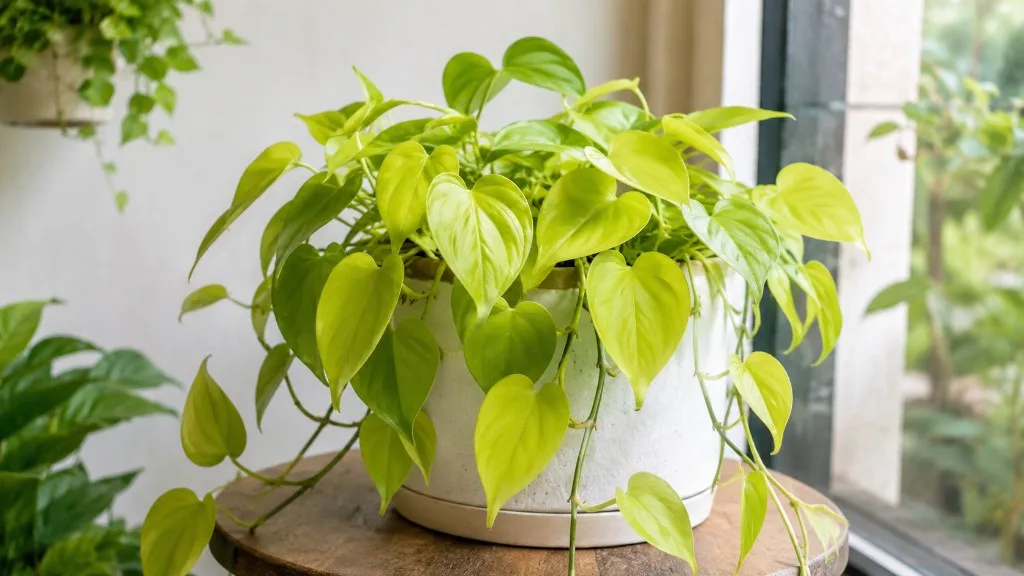
Philodendron Lemon Lime looks easy until the newest leaves go muddy olive and the vines stretch toward the window like they are late for something. That is not a mysterious cultivar quirk. It is a chartreuse heartleaf telling you the room is dimmer than the color needs. Get light, dry-downs, and drainage right, and this plant is as forgiving as classic heartleaf — just louder about mistakes because pale foliage shows every brown tip and fade.
Written by Sai Ananth (B.Pharmacy, pharmacognosy background; LeafyPixels lead writer and indoor grower) and reviewed by Dr. Priya Menon (botanist and indoor plant specialist) on the LeafyPixels Review Board. Notes below reflect editorial Lemon Lime plants grown in a north-central Ohio apartment (USDA zone 6a): one 6-inch hanging basket within about 18 inches of an east window, and one shelf trailer two feet back from a sheer-filtered south exposure. Your rooms will differ — treat intervals as lived-in benchmarks, not calendar law.
What Philodendron Lemon Lime Is (and Why Chartreuse Changes Care)
Philodendron Lemon Lime is a cultivar of Philodendron hederaceum, the heartleaf philodendron — a tropical trailing or climbing aroid in the Araceae family. NC State Extension lists ‘Lemon Lime’ among named cultivars and describes its foliage as bright yellow to chartreuse. The species itself is a cascading or climbing vine with glossy heart-shaped leaves, adventitious roots along the stems, and a rapid indoor growth rate when warmth and moisture are steady.
When newest leaves lose that lemon glow, start with placement and dry-downs on this page first. If a single symptom already needs its own workflow later — yellowing, root rot, leggy vines — open the matching topic on the Philodendron Lemon Lime hub.
Botanical identity and growth habit
Heartleaf philodendron is native to tropical Americas and grown indoors as a foliage vine that either trails from a basket or climbs if you give it a pole or trellis. Missouri Botanical Garden describes P. hederaceum as an easy indoor plant for bright indirect light, with regular watering in the growing season and reduced water from fall through late winter. UF/IFAS notes that indoor size depends on support, training, and pruning — and that outdoor climbing plants in warm climates can produce much larger leaves than the juvenile 2–4 inch houseplant look.
Lemon Lime is not a separate species. Tags may say “Neon philodendron,” “Lemon Lime,” or simply “chartreuse heartleaf.” If the botanical name is Philodendron hederaceum, the care in this guide applies. Clemson HGIC discusses a related chartreuse heartleaf selection as ‘Aureum’ with showy chartreuse leaves — useful context that solid yellow-green heartleaf forms have been in the trade under more than one cultivar name. (Clemson HGIC)
In our Ohio apartment, retail tags have mislabeled Neon pothos as “Neon philodendron” more than once. Petiole groove and free stipules settle the argument faster than the sticker.
Why chartreuse foliage needs brighter indirect light
Chartreuse leaves carry less chlorophyll density than dark green heartleaf foliage. In weak light the plant responds by greening up new growth and stretching internodes so each leaf can reach usable brightness. That is adaptation, not disease — but it is exactly what makes people think Lemon Lime “lost its color” or “reverted.” Solid-green heartleaf can look merely slow in the same dim corner; Lemon Lime looks like a different plant.
Pale tissue also shows stress faster. Brown tips, sun bleaching, and mite stippling read clearly on yellow-green leaves. That visibility is useful for diagnosis even when it feels unforgiving aesthetically.
What we see indoors: on our east-window basket, newest leaves held a clean lemon-lime tone when the pot stayed within about 18 inches of the glass. After we moved a cutting three feet into the room for three weeks (same watering habit), two successive leaves arrived greener and smaller before we moved it back. Fertilizer did not restore the glow; brighter placement did. After returning the cutting to the east basket, the next two leaves (about four weeks later) regained a clear chartreuse tone — older greened leaves stayed olive.
Lemon Lime vs Heartleaf, Brasil, and Neon Pothos
Three plants share the “bright green trailer” aisle, and mixing them up wastes light placement.
Solid-green heartleaf (P. hederaceum) tolerates lower light longer and stays darker. Care overlaps, but Lemon Lime needs more usable brightness to keep chartreuse.
Philodendron Brasil (P. hederaceum ‘Brasil’) has a lime center stripe on darker green borders — patterned variegation, not solid chartreuse. NCSU notes Brasil’s unstable variegation separately from Lemon Lime’s solid yellow-to-chartreuse look. (NC State Extension)
Neon pothos (Epipremnum aureum ‘Neon’) is the closest look-alike from a different genus. Both trail, both glow yellow-green, both are toxic via calcium oxalates. Tell them apart before you copy care notes: NC State separates heartleaf philodendron from pothos by conspicuous free stipules on new philodendron growth and non-grooved petioles, while pothos petioles are grooved and lack those free stipules. Clemson HGIC makes the same petiole and leaf-sheath distinction. NC State’s pothos page confirms the reverse: no free stipules, grooved petioles.
Philodendron Lemon Lime — solid chartreuse hearts; check new growth for free stipules and non-grooved petioles.
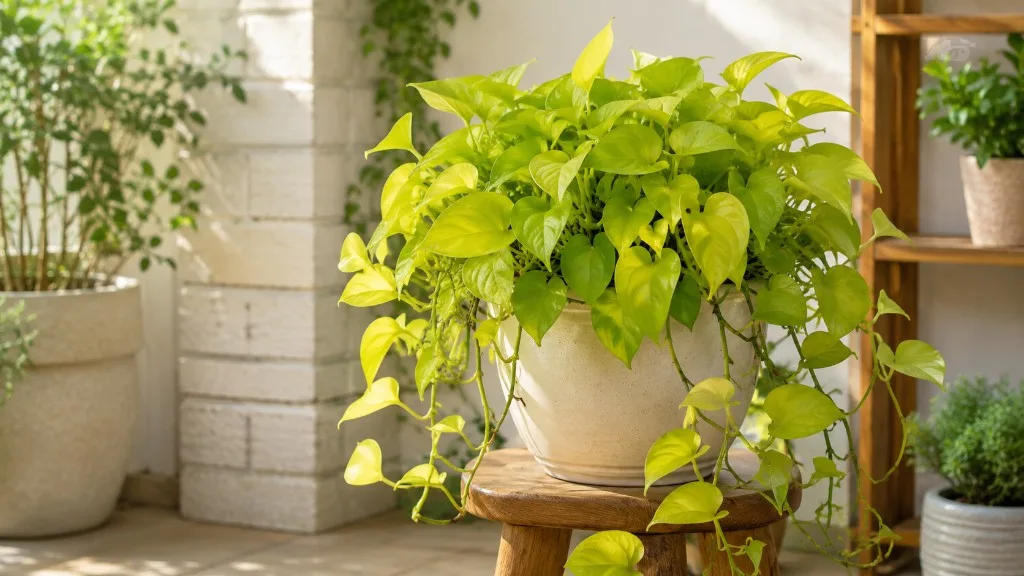
Neon pothos (Epipremnum) — similar glow, but petioles are grooved and free stipules like philodendron are absent.
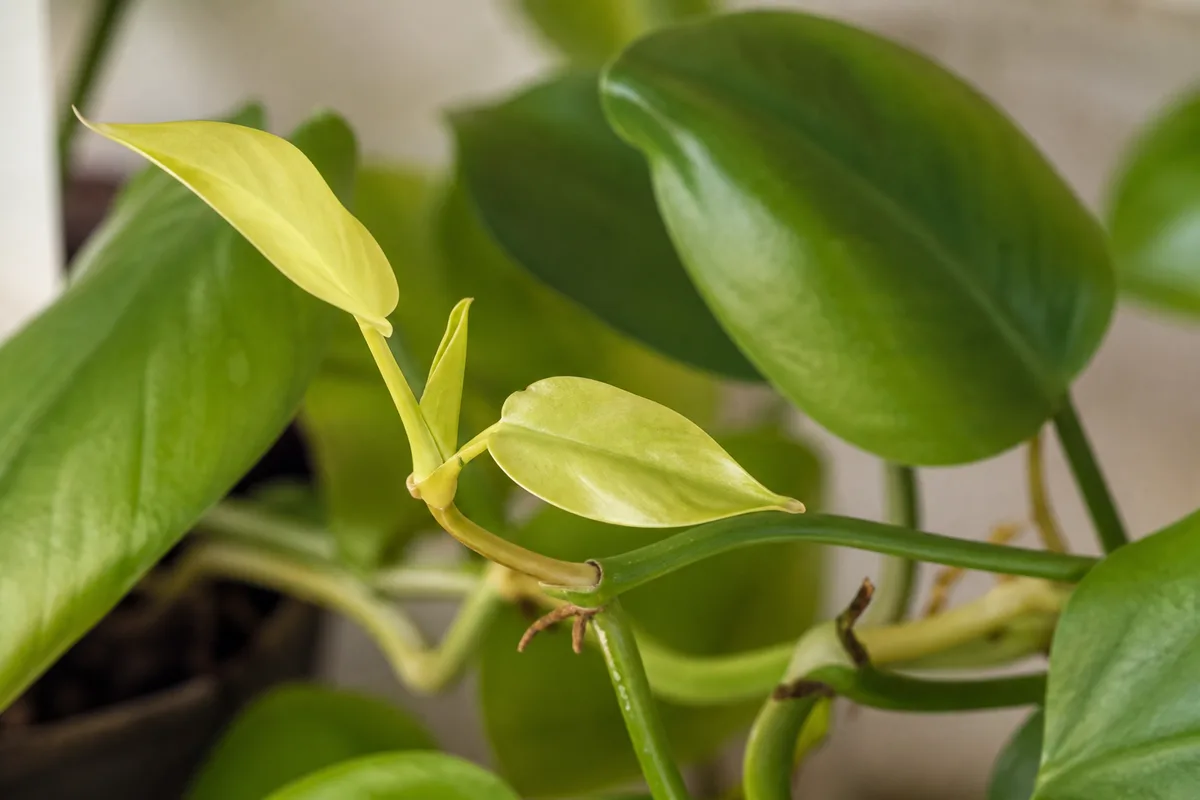
Newest leaves greening and stretching — the chartreuse “fade” that usually means the pot sits too far from usable light.
| Trait | Lemon Lime philodendron | Solid-green heartleaf | Neon pothos |
|---|---|---|---|
| Pattern | Solid yellow to chartreuse | Solid dark green | Solid neon chartreuse |
| Petiole | Non-grooved | Non-grooved | Grooved |
| New growth | Free stipules present | Free stipules present | No free stipules like philodendron |
| Light for best look | Bright indirect (holds color) | Tolerates lower light longer | Bright indirect for neon tone |
| Low-light outcome | Greener, leggier new leaves | Survives; may stretch | Greener, longer internodes |
If you want genus-wide pothos routines after you confirm ID, see pothos care — and remember neither plant is a pet-safe swap. For the striped heartleaf cousin, use the Philodendron Brasil care guide.
Quick Care Snapshot
For healthy indoor Lemon Lime, place the plant in bright indirect light, water when the upper 2.5–5 cm (about 1–2 inches) of potting mix have dried, use a well-draining pot with drainage holes, and fertilize lightly during active growth. It handles occasional dryness better than constant wet soil. Watering by soil condition beats watering by calendar. (RHS) (UF/IFAS)
| Care factor | Baseline target | Deeper guide |
|---|---|---|
| Light | Bright indirect; protect from hot midday sun | Light guide |
| Water | Top 1–2 in dry, then soak and drain | Watering guide |
| Soil | Airy, well-draining aroid-friendly mix | Soil guide |
| Temperature | Roughly 65–85°F (18–29°C); keep above ~50–59°F | Hub overview |
| Humidity | Moderate preferred; typical homes OK with good light/water | Problem: low humidity |
| Feeding | Dilute feed in active growth; ease off in winter | Fertilizer guide |
| Pets | Toxic — keep out of reach | See toxicity section |
Light for Holding Yellow-Green Color
Bright indirect light is the non-negotiable for Lemon Lime’s reason-to-buy look. UConn recommends bright, indirect sunlight and notes that full sun can yellow leaves or cause sunburn spots. RHS positions philodendrons in bright but indirect light, out of direct summer sun that scorches leaves, and warns that insufficient light produces leggy growth with fewer, smaller leaves. UF/IFAS says heartleaf enjoys bright diffuse light and tolerates shade ranges — but asks you to avoid direct sun. Missouri Botanical Garden adds that shade is tolerated, yet stems become spindly if conditions are too dark.
For Lemon Lime specifically, “tolerates low light” is survival language, not color language. Green heartleaf can sit in a north room and look acceptable for months. Lemon Lime in the same spot slowly trades chartreuse for olive and stretches.
Window placements that work
Practical placements that usually work:
- East window: morning sun is gentle; hang or shelf within about 1–2 feet of the glass for dense chartreuse growth.
- South or west: pull back a few feet or use a sheer curtain so midday beams do not bleach or crisp pale leaves.
- North: possible with a very close placement or a supplemental grow light; expect greener tone if the plant sits deep in the room.
- Grow light: useful in windowless offices — keep intensity moderate and watch for leaf warmth/bleaching. In our north hallway trial, a modest full-spectrum bar about 12–18 inches above a trailing cutting held yellower new leaves than the same cutting three feet from a north window with no supplemental light.
Wipe dust off leaves occasionally so the pale surface can actually capture light. (RHS)
What we see indoors on harsh light: when we briefly hung a spare tip too close to an unfiltered west pane in late June, the sun-facing leaf edges bleached tan within a few days. Sheer cloth or an extra foot of distance fixed it; fertilizer did not.
Greener newest leaves: decision checklist
Before you buy a stronger fertilizer or assume the plant “reverted,” score the last two or three newest leaves:
- Color: clean lemon-chartreuse vs muddy olive or mid-green.
- Internode length: tight nodes vs long gaps between leaves.
- Pot distance from glass: within about 1–2 feet of a bright east exposure (or sheer-filtered south/west) vs deep into the room.
- Leaf size trend: shrinking new leaves plus greening usually means light, not hunger.
If color and spacing both worsened after a move farther from the window, move closer before changing anything else. Judge success on new leaves, not on old ones that already faded. See not enough light and leggy growth.
Winter light drop and color fade
From November through February in our Ohio apartment, the east basket still stays chartreuse, but growth slows and internodes lengthen slightly even at the same distance from the glass. Dry-downs stretch longer (see watering section). If you leave Lemon Lime where summer light was “just enough,” winter often tips newest leaves greener. Slide the pot closer to the window, clean the glass side of dust, or add a modest grow light for the darkest months. Do not compensate for winter fade with heavier fertilizer — low light plus rich feed is a classic tip-burn setup.
Watering Without Root Rot
Clemson HGIC is blunt: over-watering is the main cause of death for potted plants because roots need oxygen as well as water. Symptoms of over- and underwatering can look similar because both damage roots. The fix is not a fixed schedule — it is checking the mix, watering thoroughly when needed, and never leaving the pot sitting in runoff.
For heartleaf types, UF/IFAS recommends watering when the top inch of soil feels dry, using lightweight, well-drained media. RHS prefers letting compost dry out slightly between waterings and avoiding standing water. Colorado State PlantTalk advises watering enough to keep soil moist but not soggy, wetting thoroughly and discarding drainage.
Soil-check method and basket vs shelf dry-downs
- Finger or chopstick into the top 2.5–5 cm (1–2 inches). If it still feels cool and damp, wait.
- Lift the pot. A recently watered pot is heavier; learn that “light” feel for your container.
- Water until runoff appears from drainage holes, then empty the saucer within 10–15 minutes. (Clemson watering)
- Prefer room-temperature water. Clemson advises roughly 62–72°F and avoiding softened water that adds sodium and chloride.
If peat-heavy mix goes bone dry and sheds water, soak the pot in a basin until the surface rewets, then drain fully — do not respond by leaving it in a permanent water tray. (Clemson watering)
Lived-in dry-down log (north-central Ohio, 6-inch pots, same bark-perlite-amended mix):
| Setup | Bright warm months | Cooler darker months |
|---|---|---|
| East hanging basket (~18 in from glass) | Often ready in 5–8 days | Often 9–12 days |
| South shelf trailer (2 ft back, sheer) | Often 7–10 days | Often 10–14 days |
Baskets dry faster because more surface area meets air. If your Lemon Lime sits in a squat nursery pot inside a decorative cachepot, expect the longer end of each band — and empty the cachepot after every soak.
Overwatering vs underwatering on pale leaves
On Lemon Lime, yellowing lower leaves can mean chronic wet mix or low light — often both at once if the plant sits far from a window in a water-retentive pot. Clemson’s philodendron page notes yellowing lower leaves and death of growing tips from too little light or overwatering, and root rot from poorly draining mix or overly frequent watering.
Missouri Botanical Garden’s overwatering overview explains the physiology: waterlogged roots cannot get oxygen, then decay, then fail to supply the top growth — so the plant wilts even though the soil is wet. Dig into the root zone or slip the plant from the pot; sour-smelling, mushy brown roots mean rot, not thirst.
Underwatering usually shows as limp leaves that perk after a thorough soak, crispy tips on the oldest growth, and a pot that feels feather-light. Pale Lemon Lime margins also crisp from dry winter air even when the root ball is fine — check humidity next if the mix is not bone-dry. If leaves still droop after watering and the mix stays wet, stop watering and check roots. Use the dedicated pages for overwatering, underwatering, drooping leaves, and yellow leaves.
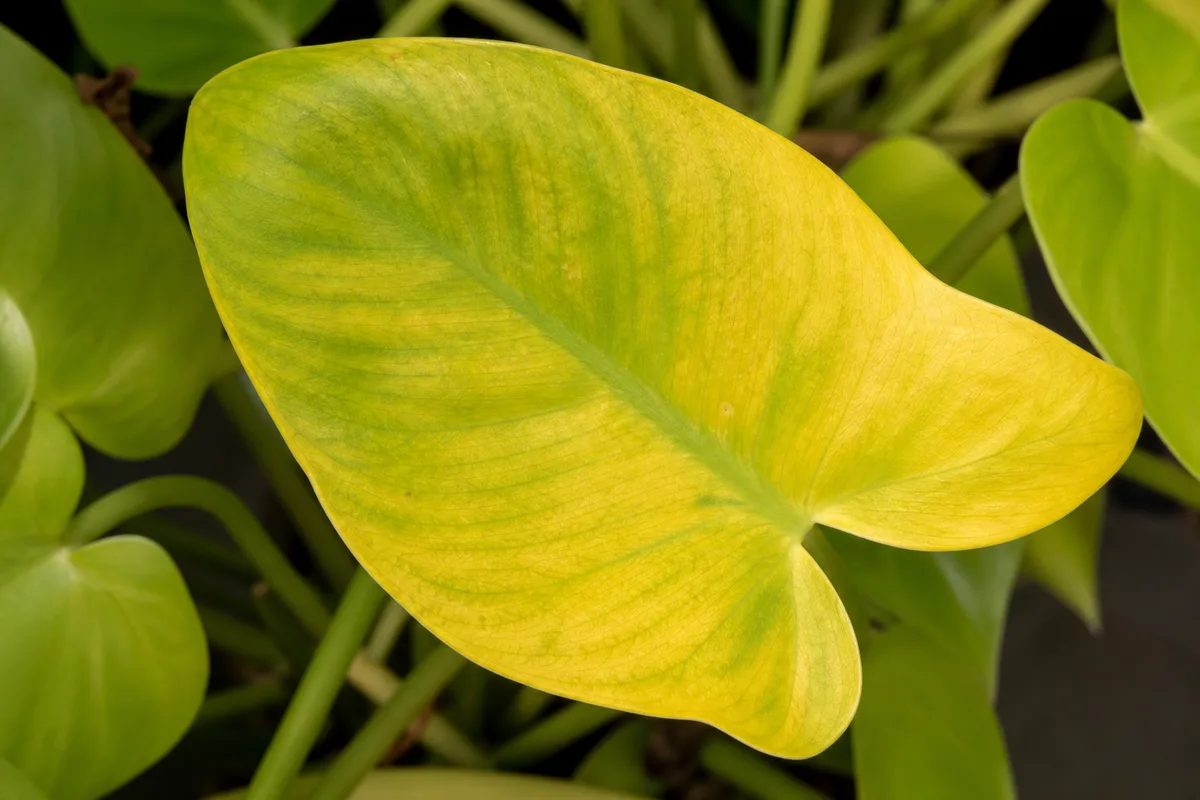
Yellowing on chartreuse tissue — check moisture and light before fertilizing.
Soil, Pot, and Drainage
Philodendrons want loose, well-drained media with organic matter. UConn lists peat-vermiculite or peat-perlite mixes and notes they will grow in sphagnum peat — still with drainage. RHS prefers free-draining, slightly acidic compost around pH 5–6, suggesting a mix along the lines of two parts orchid compost to one part peat-free ericaceous compost. Missouri Botanical Garden simply recommends a soil-based potting mix.
A practical home mix that matches those principles: quality potting mix amended with about 20–25% perlite (or a chunky aroid blend with bark + perlite + coco coir). Our east basket uses roughly two parts potting mix to one part fine bark and perlite combined; in plastic nursery pots we push closer to 25% perlite so winter wet periods do not linger. Dense garden soil and pots without holes are the fastest path to root rot.
Pot notes:
- Always use drainage holes.
- Terracotta dries faster than plastic or glazed ceramic — useful if you overwater; plastic holds moisture longer in bright heat.
- Upsize only one pot diameter when roots circle or the plant dries out in 3–4 days despite normal light. Oversizing a wet mix is a common Lemon Lime failure mode. See repotting.
Temperature, Humidity, and Feeding
Temperature: Keep Lemon Lime in typical indoor comfort. Clemson suggests roughly 75–85°F days and 65–70°F nights for philodendrons generally, with heartleaf happy in warm home ranges. (Clemson HGIC) Colorado State echoes similar day/night targets and notes some varieties may survive short dips toward 50–55°F. (PlantTalk) UF/IFAS says temperatures below 50°F are too cool for heartleaf. (UF/IFAS) RHS keeps philodendrons above about 15°C / 59°F, away from hot radiators and cold drafts. (RHS)
Humidity: Philodendrons prefer moderate to high humidity but tolerate average homes when light and watering are sound. (Clemson) (RHS) (UF/IFAS) Penn State Extension explains why winter heated homes often drop below 30% RH, why misting only raises humidity for minutes, and why pebble trays rarely change room-scale RH — a humidifier near the plant is the realistic tool if crispy edges persist after watering is correct. On our south shelf trailer, pale tip browning spiked in January when forced-air heat ran daily; stabilizing watering and running a small cool-mist humidifier nearby reduced new tip burn within a few weeks. See brown tips and low humidity.
Feeding: Clemson recommends dilute water-soluble houseplant fertilizer or a time-release product. (Clemson HGIC) UConn treats philodendrons as relatively heavy feeders but prefers more frequent half-strength applications over one strong dose, on already-moist soil, with less feed in low light. (UConn) Too much fertilizer can curl and brown tips. (Clemson) (UF/IFAS) In practice: light monthly feed in spring–summer for a brightly lit Lemon Lime; pause or cut hard in winter. Fertilizer will not paint faded leaves chartreuse again — only better light does that on new growth. Details: fertilizer guide.
Trailing, Climbing, Pruning, and Propagation
Lemon Lime is a vine. Trailing from a shelf or hanging basket shows off the color cascade. Climbing a moss pole or trellis can produce larger leaves over time and keeps vines higher — useful in pet homes. UF/IFAS notes leaf size scales with support outdoors; indoors you still get denser columns when vines attach and stay lit. (UF/IFAS)
On our plants, the hanging basket produces smaller, denser chartreuse leaves; a vine we trained up a short coco pole near the same east window grew slightly larger blades after a few months of attachment, with color holding as long as the top nodes stayed bright. Trailing tips that wandered behind a bookshelf greened within two nodes.
Pruning: Pinch or cut just above a node to branch and shorten. Missouri recommends pinching trailing stems for bushier growth. (Missouri Botanical Garden) Wear gloves if sap irritates your skin — philodendrons can cause mild contact irritation for some people. (UF/IFAS) Remove fully greened, weak vines if low light produced a long run of dull growth, then improve light so replacement shoots stay chartreuse. Full pruning workflow: pruning guide.
Propagation: Stem cuttings root readily. Clemson and UF/IFAS both endorse stem cuttings in clean media; Missouri lists stem cuttings in spring. (Clemson) (UF/IFAS) (Missouri) Practical home method:
- Take a 10–15 cm (4–6 inch) tip with at least one node and one or two healthy leaves.
- Cut just below a node; remove the leaf that would sit underwater or buried.
- Root in water (node submerged, leaves above) or in moist airy mix.
- Provide bright indirect light; pot up when roots are about 2.5–5 cm (1–2 inches).
Only propagate healthy vines — not stems with soft rot or active pests. Step-by-step: propagation guide.
Common Problems and Fast Triage
Work the environment before stacking products. Chartreuse leaves make diagnosis easier if you look at newest growth and soil moisture together.
| What you see | Likely cause | First move |
|---|---|---|
| Newest leaves greener, longer gaps | Low light | Move closer to bright indirect light |
| Yellow lower leaves, wet heavy pot | Overwatering / poor drainage | Dry down; check roots; improve mix |
| Limp leaves, bone-dry mix | Underwatering | Soak thoroughly; adjust interval |
| Crispy tips, dry winter air | Low RH + uneven water | Stabilize watering; humidifier if RH stays very low |
| Bleached patches facing window | Direct sun | Sheer curtain or pull back |
| Sticky residue, cottony fluff, webbing | Aphids, mealybugs, mites | Isolate; treat; inspect undersides |
| Fungus gnats | Persistently wet surface | Let top dry; fix watering |
Pests to watch: aphids, spider mites, mealybugs, and scale are the usual suspects on philodendrons. (NC State) (Missouri) (UF/IFAS) Pale Lemon Lime foliage shows stippling and webbing early — check leaf undersides weekly when growth is soft.
Deep dives live on the hub: yellow leaves, leggy growth, spider mites, mealybugs, fungus gnats, root rot.
Pet Safety and Toxicity
Lemon Lime is not pet-safe. It is a Philodendron hederaceum cultivar. The ASPCA lists heartleaf philodendron as toxic to dogs, cats, and horses, with insoluble calcium oxalates as the toxic principle. Clemson HGIC warns that all parts of philodendrons are toxic if eaten — calcium oxalate crystals cause burning and irritation of the mouth, lips, and tongue, with drooling, vomiting, and difficulty swallowing. UF/IFAS adds oral pain, foaming, and swelling risk for pets, plus possible mild skin irritation from sap in people.
Practical placement: hanging baskets and high shelves beat floor pots. Trailing vines grow into reach over months — prune or train upward. If ingestion is suspected, contact a veterinarian or ASPCA Animal Poison Control at (888) 426-4435. For genus-wide context, see philodendron toxicity.
First 30 Days Checklist
- Quarantine the new plant away from your collection for 1–2 weeks; inspect leaf undersides for pests.
- Do not repot on day one unless the nursery mix is soggy, sour, or compacted — learn the dry-down first.
- Place in bright indirect light where you want the chartreuse to stay vivid (east window or sheer-filtered south/west).
- Water only when the top inch (or so) of mix is dry; empty the saucer every time. Expect hanging baskets to need water sooner than heavy plastic pots.
- Note your first two dry-down intervals in a phone reminder — that becomes your real schedule for your room.
- Skip fertilizer for the first 3–4 weeks unless the plant arrived clearly starved and is in strong light.
- Decide trail vs climb before vines hit the floor — especially in pet homes.
- After 30 days, judge success on new leaf color and internodal spacing, not on older transit-stressed leaves.
- If newest leaves are greener after a move, give brighter indirect light for 3–5 new leaves before changing fertilizer or soil.
Related guides
- Philodendron Lemon Lime care hub — topic pages and symptom-first fixes for this cultivar (light, watering, propagation)
- Philodendron Brasil care guide — striped heartleaf cousin with different variegation rules
- Philodendron Micans care guide — velvet heartleaf with different light/finish expectations
- Pothos care — Neon and other Epipremnum lookalikes after you confirm ID
- Philodendron toxicity — calcium oxalate risks across the genus
- How to water indoor plants the right way — soil-check watering habit that prevents Lemon Lime root rot
Conclusion
Do these next seven days: confirm you have Lemon Lime philodendron (free stipules, non-grooved petiole) rather than Neon pothos; place the pot in bright indirect light where newest leaves can stay chartreuse; finger-check the mix before the next soak and empty the saucer; and hang or shelf the plant out of pet reach. When newest leaves green up or stretch, move the plant before you reach for fertilizer. When leaves yellow and the pot stays heavy, fix moisture and roots before you prune for aesthetics.
For symptom-by-symptom depth, start at the Philodendron Lemon Lime hub. For nearby cultivars and lookalikes, compare with the Brasil care guide and pothos care, read philodendron toxicity before you hang vines in a pet household, and use how to water indoor plants the right way if you want the soil-check habit that prevents Lemon Lime root rot.