Philodendron Micans Care: Velvet Light, Water & Soil
Grow Philodendron Micans indoors: bright indirect light for bronze tones, soil-check watering, airy mix, trail vs climb tips, and common problem fixes.
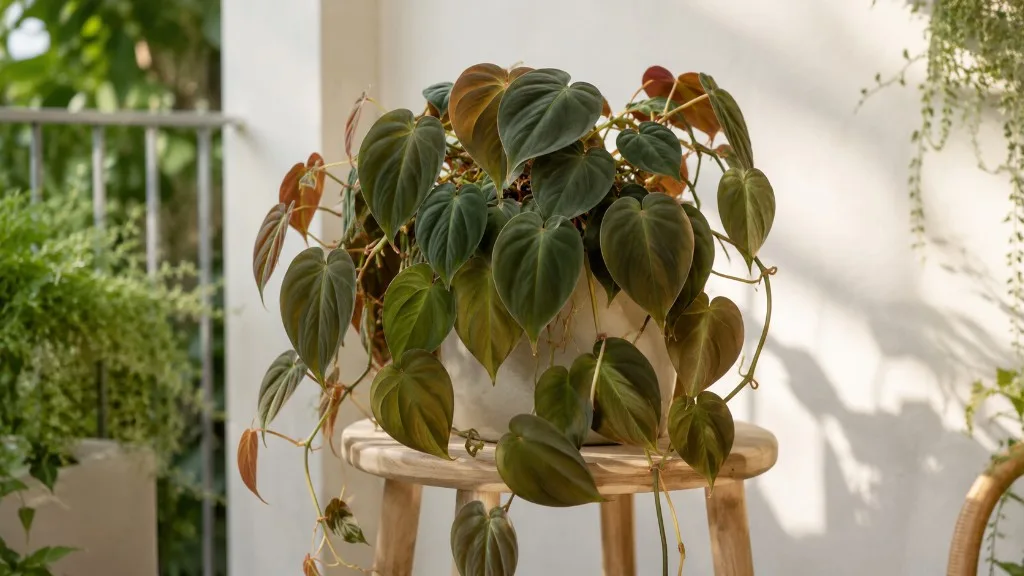
Philodendron Micans is the trailing aroid people buy for soft bronze-to-purple velvet — then lose when newest leaves arrive flat green, vines stretch, or a hanging basket stays wet in a dim corner. Good care is not a rigid calendar. It is bright indirect light that keeps copper and purple in the new growth, watering only after the mix partly dries, an airy pot that drains, gentle handling of fuzzy blades, and a clear call on whether you want vines to cascade or climb a slim support.
Written by Sai Ananth (B.Pharmacy, pharmacognosy background; LeafyPixels lead writer and indoor grower) and reviewed by Dr. Priya Menon (botanist and indoor plant specialist) on the LeafyPixels Review Board. Notes below come from three editorial Philodendron hederaceum velvet-form plants in a north-central Ohio apartment (USDA zone 6a): a coir-lined 6-inch hanging basket about 12 inches from a northeast kitchen window (morning light only); a glazed 5.5-inch ceramic trailer on a bookshelf five feet from a north window, with a 20W clip-on full-spectrum light November through February; and a nursery-plastic plant trained on a 24-inch moist sphagnum pole about 28 inches from a sheer-filtered south patio door. Your rooms will differ — treat intervals as lived-in benchmarks, not rules.
Philodendron Micans — look for velvet texture, bronze-to-purple shifts, and reddish undersides on many leaves.
What Philodendron Micans Is (Velvet Heartleaf Identity)
Philodendron Micans is the houseplant trade name for the velvet-leaf form of Philodendron hederaceum — a tropical trailing or climbing aroid in the Araceae family. Kew’s Plants of the World Online treats Philodendron micans as a synonym of Philodendron hederaceum var. hederaceum. The Royal Horticultural Society lists Philodendron micans and Philodendron scandens f. micans among synonyms for ivy-leaved philodendron, describing heart-shaped bronze-green leaves with red-tinted undersides on a fast-growing climbing or trailing plant.
Clemson HGIC names this plant Velvet Philodendron (Philodendron scandens f. micans) and notes velvet-textured heart-shaped leaves that are usually bronze with reddish-brown undersides. NC State Extension describes P. hederaceum as a cascading or climbing vine with adventitious roots along the stems, medium-light preference with strong low-light tolerance, and leaves that often emerge bronze before greening — with free stipules on new growth and non-grooved petioles that help separate it from pothos.
That velvet surface is why Micans care feels different from glossy heartleaf in practice. Fine leaf hairs scatter light, so foliage can look copper, sage, or deep purple as you walk past — the color is partly angle and partly light quality. The same texture marks easily from fingerprints, splashy watering, and rough shelf traffic. Newest leaves are the quality signal: clean unfurls with strong bronze or purple tones mean light and moisture are roughly right; small, dull, or stretched new growth means the environment needs a reset before fertilizer will help.
Retail tags that say only “velvet philodendron” are not always Micans. In big-box aisles we have seen satin pothos (Scindapsus pictus) sold under fuzzy marketing language. Check the underside color and stipules before you copy care notes from a random blog post.
Micans vs Glossy Heartleaf and Lookalikes
Micans shares a species complex with glossy green heartleaf philodendron and variegated cultivars such as Brasil. Care overlaps — bright indirect light, partial dry-down, draining pots — but expectations differ. Glossy heartleaf is famous for surviving very low light for long stretches. Micans will survive those same corners, yet bronze and purple tones flatten toward uniform green and internodes stretch sooner when usable light drops. If you bought Micans for the velvet color shift, treat medium-to-bright indirect light as part of the product, not an optional upgrade.
Nursery tags also blur Micans with other matte trailers. Satin pothos (Scindapsus pictus) shows silver spotting on thicker matte leaves and belongs to a different genus. Classic pothos (Epipremnum aureum) has grooved petioles and lacks the conspicuous free stipules of heartleaf philodendron — a distinction NC State Extension uses to separate the two. University of Connecticut likewise notes that pothos is commonly confused with P. hederaceum. Check stipules and petioles before copying care advice wholesale.
| Trait | Philodendron Micans | Glossy heartleaf | Satin pothos (Scindapsus) |
|---|---|---|---|
| Leaf surface | Soft velvet / iridescent | Glossy | Matte with silver flecks |
| Underside cue | Often reddish-brown | Green or lightly tinted | Usually green |
| Petiole / stipules | Non-grooved; free stipules | Non-grooved; free stipules | Different genus cues |
| Light for best look | Bright indirect for bronze/purple | Tolerates lower light longer | Bright indirect for silver contrast |
| Habit indoors | Trail-first; climb optional | Trail or climb | Mostly trailing |
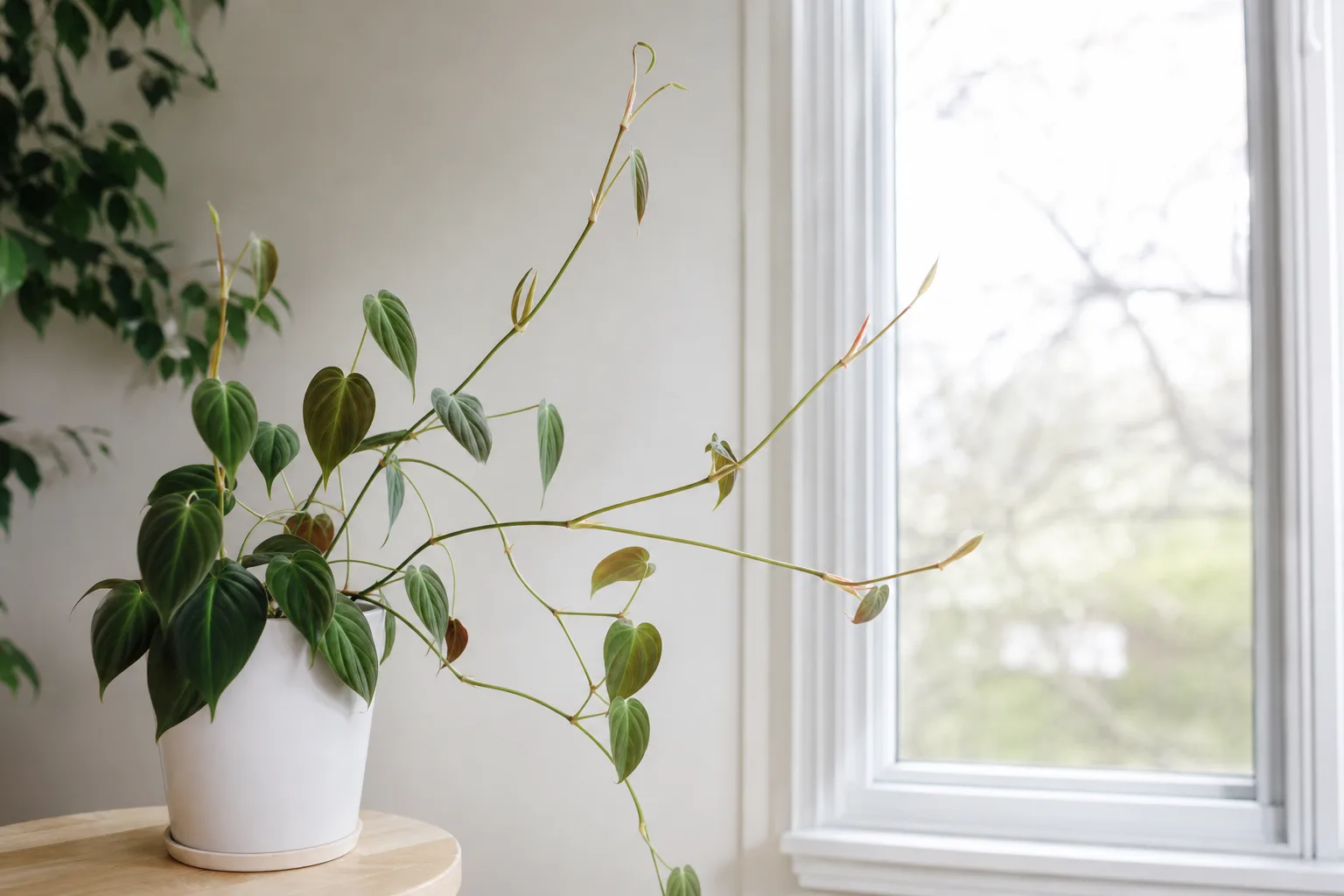
Low light: longer gaps between nodes and greener, flatter new leaves — the opposite of the bronze “product” you bought.
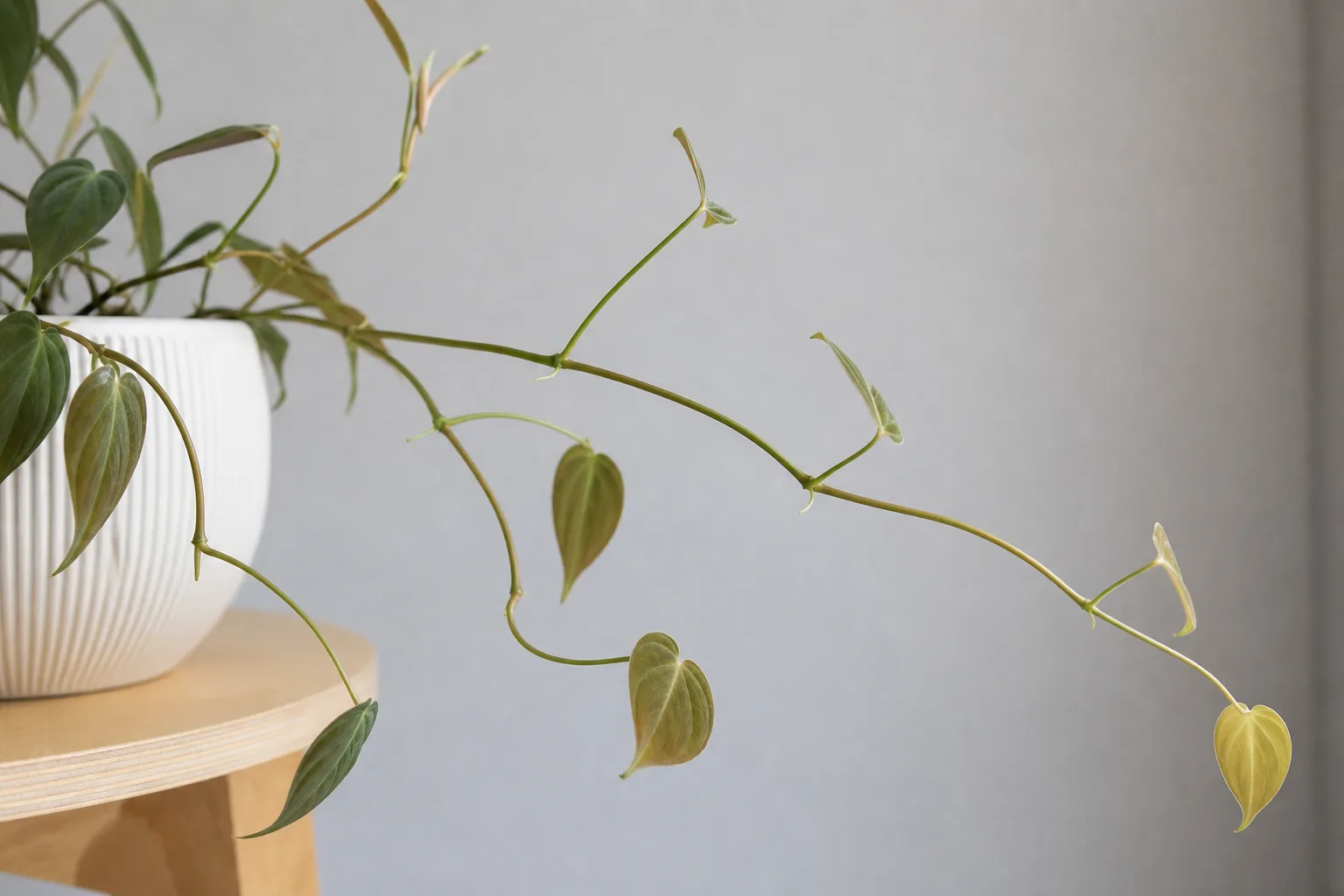
Newest leaves going muddy green while older foliage still holds some copper is a placement problem, not a fertilizer shortage.
Quick Care Snapshot
For healthy indoor Micans, place the plant in bright indirect light, water when the upper 3–5 cm (about 1–2 inches) of potting mix have dried, use a well-draining pot with drainage holes, and fertilize lightly during active growth. Micans tolerates medium light for a while, but color and compactness fade when the plant sits too far from usable brightness. It handles occasional dryness better than constant wet soil — watering by soil condition beats watering by calendar every time. (RHS) (UF/IFAS)
| Care factor | Baseline target | Deeper guide |
|---|---|---|
| Light | Bright indirect; no hot direct afternoon sun | Light |
| Water | Top 3–5 cm dry, then soak and drain | Watering |
| Soil | Indoor mix + 20–25% perlite; optional bark | Soil |
| Feed | Half-strength liquid monthly in active growth | Fertilizer |
| Support | Trail from a shelf/hanger; moss pole optional | Pruning |
| Repot | Every 1–2 years, or when roots circle and mix stays wet too long | Repotting |
A Micans in a bright northeast window, a dim hallway, and a humid bathroom will not dry at the same speed. Pot material, root mass, trailing leaf area, and season all change the interval.
Light for Bronze Color and Compact Growth
Philodendron Micans does best in bright but indirect light — strong ambient brightness without long stretches of harsh afternoon sun on leaves that formed in softer conditions. The Royal Horticultural Society positions philodendrons in bright indirect light, out of direct summer sun that can scorch leaves, and notes that insufficient light produces leggy growth with fewer, smaller leaves. Missouri Botanical Garden recommends bright indirect light for P. hederaceum, warns that full sun should be avoided, and notes that stems become spindly if conditions are too dark. Colorado State Extension PlantTalk likewise places philodendrons in bright, indirect light while acknowledging low-light survival.
Velvet tissue shows scorch and fade more obviously than glossy heartleaf. Hot west or south glass can bleach or crisp the soft upper surface faster than you expect from “tough philodendron” reputation. At the other extreme, a deep north shelf keeps plants alive with almost no burn risk — and steadily greener, longer internodes until you move them or add light.
Window placements that protect velvet leaves
Practical placement often means a northeast or east window, a few feet back from a bright south or west window, or behind a sheer curtain. UF/IFAS describes heartleaf philodendron as enjoying bright diffuse light while tolerating a range from diffused light to shade — with a hard no on direct sun that burns leaves. Artificial light works when intensity and duration are real; a plant across the room from a weak lamp is not receiving the same usable light as one under a proper full-spectrum fixture.
What we see on Micans specifically: the northeast coir basket kept the strongest copper-to-purple shift when tips faced the glass within about 12 inches — especially October through March when the sun sits lower and morning light is softer. The south sheer-pole plant produced larger leaves but needed a quarter-turn every week so the back vines did not go olive. The north bookshelf plant five feet from glass stayed alive with almost no scorch risk; before we added the winter clip light, three successive leaves arrived greener and farther apart. Dig into window-by-window detail on the Philodendron Micans light guide when you need more placement bands.
Newest-leaf color and internode checklist
Ignore old foliage when you judge light. Read the last two or three leaves plus pot position:
- Newest leaf color: Strong bronze, copper, or purple on unfurling blades = usable light is roughly right. Flat sage/olive with little iridescence = move closer to brightness or add a grow light.
- Internode length: Gaps that keep lengthening on new growth mean the plant is reaching. Short, even spacing usually tracks with better light.
- Distance from glass: Measure once. Our bronze-heavy basket lived ~12 inches from northeast glass; the dull north trailer sat ~5 feet back before we corrected it.
- Pot weight and mix moisture: A heavy, wet pot in a dark spot compounds stretch — fix light and dry-down together, not fertilizer alone.
Fertilizer will not restore bronze contrast in a dark hallway. Brighten placement first, wait for a few new leaves, then decide whether pruning for fullness is still needed.
Winter light drop and color flatten
In north-central Ohio winters, short days and cloudy weeks flatten Micans color even when the pot has not moved. Penn State Extension notes that indoor relative humidity often falls below 30% in the heating season and that concentrating on controllable factors — light and watering — matters more than chasing perfect humidity theater. (Penn State Extension)
Bronze recovery we logged: in late November we moved the dull north trailer from five feet back to about 30 inches from the north glass and ran a 20W clip grow light 10–12 hours daily. The next leaf (about 12 days later) was only slightly warmer; the third new leaf (~5 weeks after the move) showed clear copper again on the upper surface. Older greened leaves did not recolor. Expect several new leaves — often a few weeks to a couple of months depending on growth rate — before you judge a light change. In deep winter, slide Micans closer to the brightest window or add a modest grow light rather than waiting for spring — the grow lights complete guide covers fixture choice and placement if you need more than a clip light.
Watering by Soil Check With Micans Dry-Down Cues
Extension guidance for heartleaf philodendrons clusters around moist but never soggy media. UF/IFAS says to water when the top inch of soil becomes dry. The RHS waits until the top of the compost dries before watering and warns against leaving plants standing in water. Clemson HGIC recommends keeping soil evenly moist but not soggy and never letting plants stand in water. PlantTalk Colorado uses the same moist-not-soggy framing and tells growers to discard drainage. UConn stresses consistent moisture for even leaf size while warning that sitting water injures roots and yellows leaves. Clemson’s indoor watering factsheet is blunt: overwatering is a leading cause of container plant death, and the accurate gauge is a finger check — water when the mix feels dry to the touch, soak until runoff, then empty the saucer. (Clemson HGIC)
Those sources agree more than they disagree: wet roots are the failure mode. In real homes, “keep evenly moist” becomes overwatering when light is low and plastic nursery pots hold water for a week. For Micans, water thoroughly when the top 3–5 cm feel dry, then empty the saucer. Always confirm with a finger or pot weight rather than a phone reminder. Use the Philodendron Micans watering guide for seasonal edge cases.
Push a finger into the mix to the second knuckle. If it feels cool and damp, wait. If the top layer is dry and the pot feels lighter than after the last watering, soak until water exits the drainage holes. Lift the pot on a wet day and a dry day once so you learn the weight difference for that container. Micans in chunky mix under bright light will call for water sooner than the same cultivar in dense peat on a north shelf — the plant did not change; the dry-down did.
Velvet color is a secondary watering cue, not a calendar. When our northeast basket was underwatered in midsummer, newest leaves unfurled smaller and the iridescence looked dusty rather than copper; after a thorough soak and a return to the usual dry-down, the following leaf looked normal. Do not chase “thirsty velvet” with daily sips — that keeps the core wet while the surface fools you.
Basket vs shelf seasonal dry-downs
Our three Micans pots do not share a schedule. Log your own; use this as a starting map for similar setups:
| Setup (Ohio apartment) | Active-growth dry-down (approx.) | Cooler / darker months | Notes |
|---|---|---|---|
| NE coir-lined 6” hanging basket | Often 6–8 days | Often 9–12 days | Air around basket + morning light = fastest dry-down |
| N glazed ceramic 5.5” shelf trailer | Often 9–12 days | Often 12–16 days | Dense ceramic + lower light = slower; winter clip light shortened some cycles |
| S sheer moss-pole (nursery plastic) | Often 7–10 days | Often 10–14 days | Moist pole adds humidity at the stem but pot still needs finger checks |
If newest leaves are dull and the pot stays heavy past these bands, fix light and drainage before you add water on a habit.
Overwatering, root rot, and saucer mistakes
Missouri Botanical Garden explains the mechanism plainly: roots in waterlogged soil cannot absorb the oxygen they need, and dying roots then fail to supply water and nutrients — so an overwatered plant can look thirsty while the mix is still wet. Clemson notes root rot usually follows poor drainage or overly frequent watering, and yellowing lower leaves can come from too little light or overwatering. (Clemson HGIC)
If leaves yellow while the pot stays heavy, stop watering on schedule, improve light or airflow, and check roots if decline continues. Do not “fix thirst” with more water while the core of the pot is still saturated. Symptom workflows live on overwatering and root rot.
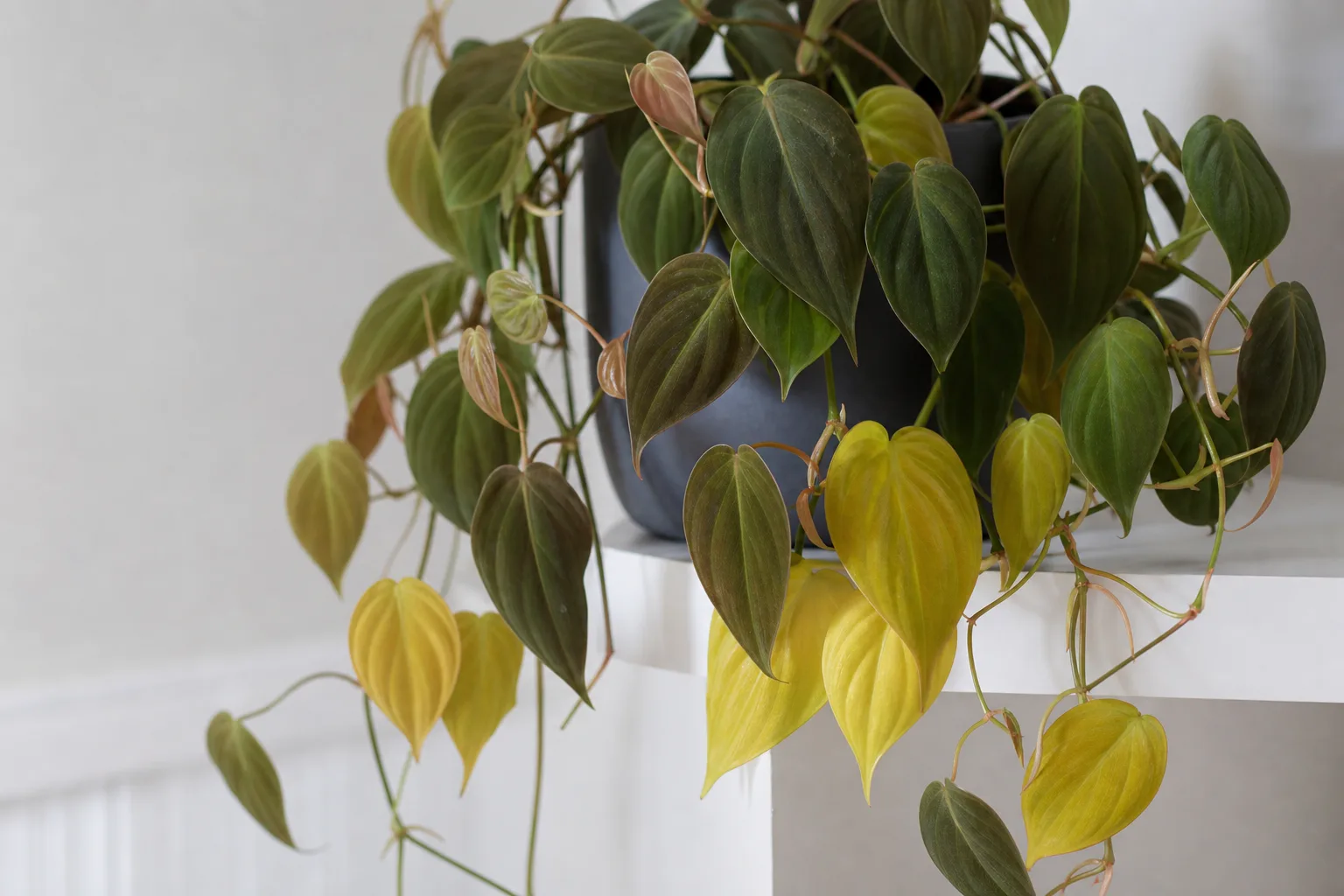
Yellowing with a still-heavy pot points to wet roots or poor light — not a reason to water again.
Soil, Pot, and Drainage Setup
Philodendrons want loose, free-draining media with organic matter. RHS prefers a slightly acidic mix and warns that oversized pots keep compost wet too long. UConn recommends loose, well-drained soil high in organic matter and notes peat-perlite or peat-vermiculite mixes work well. UF/IFAS specifically calls for lightweight, well-drained potting media so plants do not stay waterlogged.
A practical indoor recipe for Micans is a quality houseplant mix amended with about 20–25% perlite, plus optional orchid bark for extra air around roots. Use a pot with real drainage holes. Decorative cachepots are fine if you lift the nursery pot out to water and never leave runoff pooled in the outer container.
Pot material matters for hanging baskets. Our coir-lined basket dried faster than glazed ceramic on the shelf; if you hang Micans in solid plastic with little bark, expect longer wet periods and reduce watering frequency. Upsize only one step when roots circle heavily or the mix stays wet for more than about 10–14 days in conditions that used to dry sooner — details on the soil and repotting hub pages.
Humidity, Temperature, and Velvet Leaf Handling
Philodendrons prefer moderately humid air but tolerate typical home humidity. (RHS) Clemson lists ideal nights around 65–70°F and days 75–85°F, while noting plants still cope with lower household humidity. (Clemson HGIC) PlantTalk targets similar day/night bands and notes short dips toward the low 50s°F are possible for some varieties. (PlantTalk Colorado) UF/IFAS warns temperatures below 50°F are too cool for heartleaf philodendron. (UF/IFAS) Keep Micans away from cold drafts and hot radiator blasts.
Velvet leaves change the humidity conversation. Do not mist Micans as a humidity fix. Penn State Extension explains that misting raises humidity only until droplets evaporate — often minutes — and does little for lasting RH. (Penn State Extension) On fuzzy blades, misting also leaves mineral spots and prolonged wet patches. Prefer grouping plants or a room humidifier if new leaves stick or crisp at the edges; pebble trays help only marginally once moisture diffuses into the whole room.
Handle vines by the stem when training or pruning; repeated thumb pressure on soft blades leaves lasting marks. Wipe dust gently with a soft dry cloth rather than scrubbing — RHS recommends occasional leaf cleaning so plants can absorb light, but Micans needs a lighter touch than glossy philodendrons. (RHS) Hard water splash from overhead watering shows as pale spots on velvet more than on shiny heartleaf; water the soil, not the canopy.
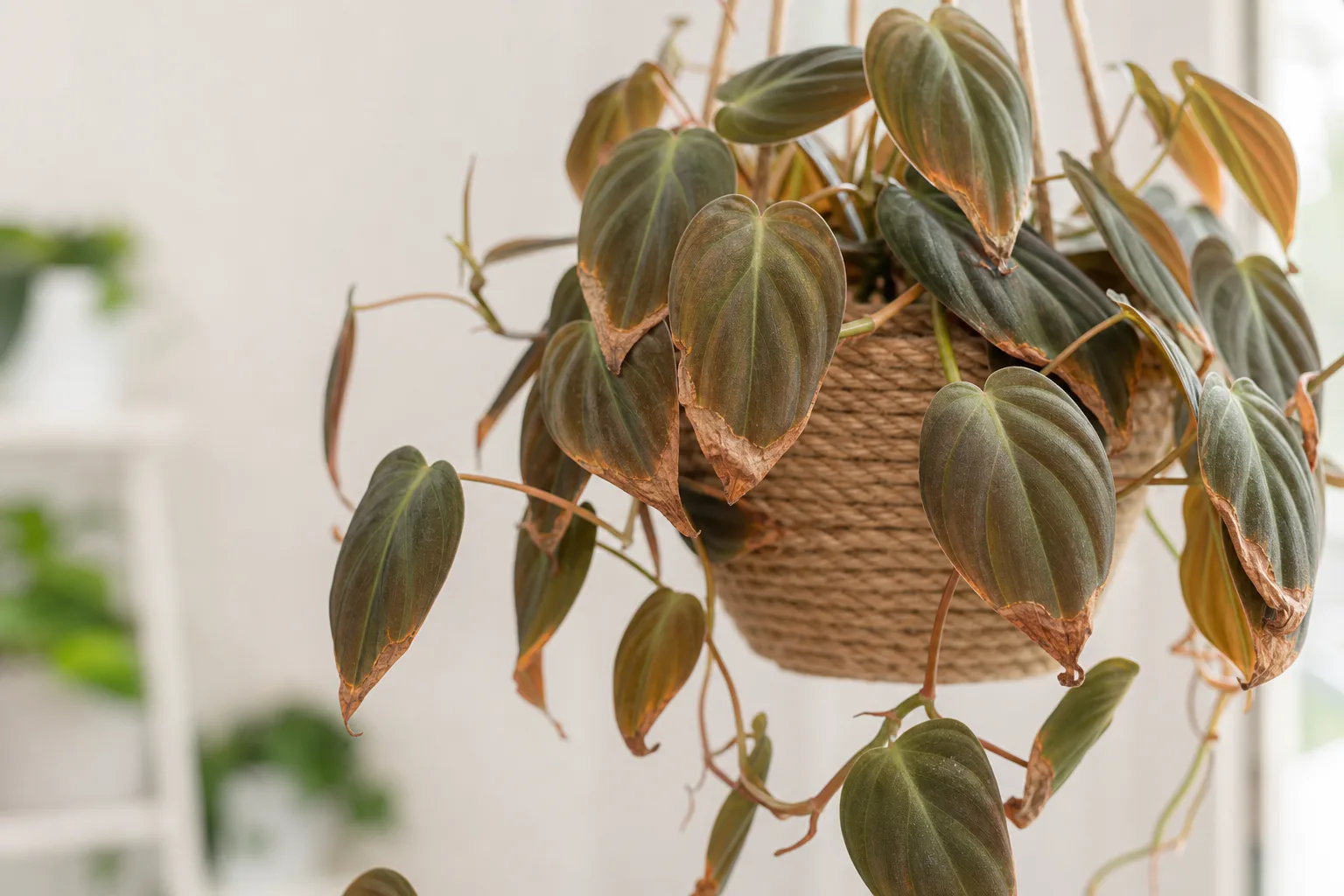
Tip crisping on velvet tissue often tracks winter dry air, salt buildup, or a mix that swings from bone-dry to soaked — not a reason to mist the leaves.
Trail vs Climb: When a Moss Pole Helps
Indoors, Micans is usually grown as a trailer — hanging basket, high shelf, or wall bracket — which matches how UF/IFAS describes heartleaf display. (UF/IFAS) RHS notes smaller-leaved climbing forms of P. hederaceum are ideal for high shelves or hanging containers where stems cascade. (RHS) Trailing is the low-effort default and shows the velvet cascade people shop for.
A moss pole or slim coir support is optional, not required. Climbing philodendrons can be trained onto a moist moss pole so aerial roots attach, and climbing often produces larger leaves over time. (RHS) Choose a pole when you want a vertical column, slightly larger blades, or vines kept higher away from pets. Choose trailing when you want soft drapes with less hardware. Light and watering still matter more than display style. If you build a support, the DIY moss pole guide covers stability and materials.
What we see: the northeast basket stayed the showiest velvet curtain with smaller leaves. The south sphagnum-pole plant sized up mid-vine leaves by roughly 1 cm in width after about four months of attachment — but only after we kept the pole lightly moist. A dry pole is just a stick. Neither habit rescued the north shelf plant until light improved. For variegated heartleaf cousins with different light priorities, see the Philodendron Brasil care guide.
Fertilizer, Pruning, and Propagation Basics
Feed during active growth rather than year-round on autopilot. RHS suggests a general houseplant fertilizer from about April to September. (RHS) Clemson recommends dilute water-soluble fertilizer or time-release product. (Clemson HGIC) UConn frames philodendrons as relatively heavy feeders but prefers more frequent half-strength applications on already moist soil, with less fertilizer in low light. (UConn) UF/IFAS’s every-3–4-months cadence is a conservative baseline for average homes. (UF/IFAS) Too much fertilizer can brown and curl leaf tips. (Clemson HGIC) (UF/IFAS)
Prune in spring as growth resumes if vines are sparse or too long; cut just after a node to encourage branching. (RHS) Wear gloves if sap irritates your skin — RHS notes philodendron sap can be a skin irritant. Propagate trailing stems easily: take nodal cuttings, root in water for a couple of weeks, then pot into free-draining mix. (RHS) Clemson likewise lists stem cuttings as a standard method. Deeper steps live on the propagation, pruning, and fertilizer hub pages.
Common Problems and First Fixes
Most Micans complaints compress into light, water, drainage, dry air, or pests. Start with newest leaves and pot weight before changing three variables at once.
Yellow leaves, leggy vines, and dull new growth
Yellowing with a heavy, wet pot points to overwatering or poor drainage; yellowing with bone-dry mix and crispy edges points the other way. (Clemson HGIC) (MOBOT overwatering) Leggy vines with small, greener leaves usually mean insufficient light — brighten placement and prune after growth resumes. Dull new growth without rot signs often improves after you move the plant closer to an east or northeast window, or sheer-filtered south exposure, for a few leaf cycles. Use yellow leaves and leggy growth when you need a full triage.
Brown tips can follow fertilizer salt buildup, underwatering, or very dry air — confirm recent feeding strength and whether the mix ever fully dries to the root ball. (Clemson HGIC) Monitor for aphids, spider mites, mealybugs, and scale; NC State and UF/IFAS both list those as the usual suspects. (NC State Extension) (UF/IFAS) Check leaf undersides on velvet plants carefully; mites love dry indoor air. Symptom pages for brown tips, spider mites, and mealybugs go deeper than this overview.
Pet Toxicity and Safe Placement
Philodendron Micans is not pet-safe. The ASPCA lists heartleaf philodendron (Philodendron hederaceum) as toxic to dogs, cats, and horses due to insoluble calcium oxalates, with clinical signs including oral irritation, drooling, vomiting, and difficulty swallowing. Clemson and UF/IFAS echo calcium-oxalate warnings for philodendrons and advise keeping plants away from pets and children who may chew foliage. (Clemson HGIC) (UF/IFAS)
Placement matters as much as purchase for a trailing vine. Shelf tips grow downward into chew range over months — our northeast basket needed a July trim after vines reached the kitchen floor beside a cat’s preferred nap spot. Prefer a high hanger, a closed room, or train vines up a pole. If a pet bites or eats Micans and shows symptoms, call ASPCA Animal Poison Control at (888) 426-4435 (a consultation fee may apply) and contact your veterinarian promptly. For a broader genus safety overview, see philodendron toxicity.
7-Day Micans Setup Checklist
Use this as a first-week action list after you bring a plant home or after a light/water reset:
- Day 1: Confirm velvet heartleaf ID (stipules/petioles; reddish undersides). Quarantine if nursery pests are possible. Skip day-one repotting unless the mix is failing.
- Day 1–2: Place in bright indirect light (northeast/east window or sheer-filtered south/west). Note distance from glass in inches.
- Day 2–3: Learn wet vs dry pot weight for this pot; water only if the top 3–5 cm are dry.
- Day 3–4: Decide trail vs optional climb; raise vines if pets or kids share the room.
- Day 5–7: Photograph newest leaves. If dull and stretched, move closer to usable brightness (or add a winter grow light) before changing fertilizer.
- Ongoing: Handle leaves by the stem; empty saucers; do not mist velvet surfaces.
- Week 2+: Feed only after new growth is steady, at half strength on moist soil. Re-check color after two to three new leaves.
When a single symptom already needs its own workflow — light, watering, soil, propagation, repotting, fertilizer, pruning, or problems such as yellow leaves, overwatering, root rot, and leggy growth — use the canonical Philodendron Micans care hub.
Related Guides
- Philodendron Micans care hub — topic pages and problem index
- How to water indoor plants the right way — the dry-check habit that prevents rot
- Houseplant humidity guide — when dry air limits growth
- DIY moss pole — optional support if you choose to climb Micans
- Philodendron toxicity — pet and human safety across the genus
- Philodendron Brasil care guide — variegated heartleaf cousin with different light priorities
- Pothos vs philodendron — ID cues before you copy care advice
Conclusion
Do these next, in order:
- Put Micans in bright indirect light and measure distance from the glass.
- Water only after a finger or weight check says the top 3–5 cm are dry; empty the saucer.
- Keep the mix airy (perlite/bark) in a pot with real drainage.
- Decide trail vs moist moss pole based on space and pets — not as a cure for dull color.
- Handle velvet by the stem; skip misting; raise vines out of chew range.
- Judge success on the next two to three new leaves, not on old greened foliage.
Once those fundamentals are stable, most “mystery” Micans problems resolve into light, water, or drainage — and the Philodendron Micans hub is ready when one symptom needs its own page.