Philodendron Melanochrysum Care: Light, Water, Soil
Philodendron melanochrysum care: bright filtered light, check-based watering, chunky soil, moss-pole support for velvet leaves, and fixes when growth stays small.
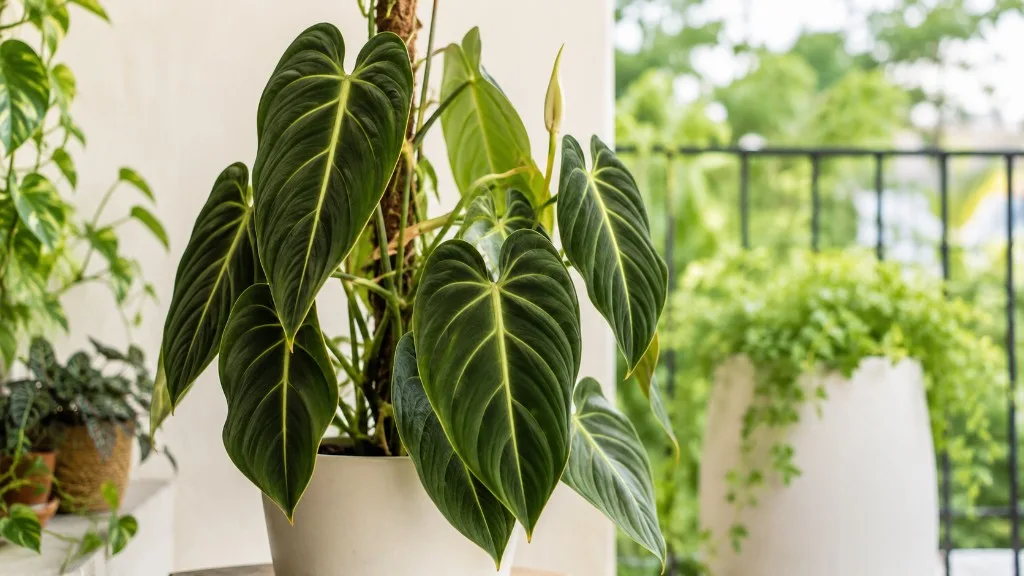
Buy Philodendron melanochrysum for near-black velvet leaves with golden veins, then leave it dangling from a hook, and you will wait a long time for the specimen look in the photos. The plant usually stays alive. The leaves just stay small, the stem tangles, and the newest blade never hardens into that deep Black Gold finish. Melanochrysum is a true climber. Vertical support, bright filtered light, and humidity above dry-office levels are not “advanced extras” — they are the difference between a juvenile vine and the plant people screenshot.
This guide is the indoor Philodendron melanochrysum care routine with habit first: climbing support for leaf size, velvet-safe light and handling, check-based watering, chunky soil, humidity, feeding, propagation readiness, pet toxicity, and the problems that show up in real rooms.
On LeafyPixels shelves we treat Melanochrysum as a climber from day one. One plant trailed under an east window for about four months with successive new leaves stuck around 12–15 cm long and soft matte color. After we tied the same stem to a 90 cm moist moss pole with aerial roots facing the support — light and fertilizer unchanged — the next two hardened leaves reached about 22–25 cm with clearer vein contrast. That is one plant in one room, not a guarantee, but it matches the extension rule that vertical training unlocks leaf size better than any calendar feed schedule.
Quick Philodendron Melanochrysum Care Snapshot
For a healthy indoor Melanochrysum, give bright, filtered indirect light, water when the top 3–5 cm (1–2 inches) of mix feel dry, use a chunky aroid mix in a pot with drainage, keep temperatures roughly 18–29°C (65–85°F) with humidity ideally near 60–70%, install a textured moss or coco pole early, and fertilize lightly only during active growth. Protect velvet blades from harsh sun and hard-water wiping. Keep the plant out of reach of pets and children.
| Care factor | Baseline target | Deeper guide |
|---|---|---|
| Habit / support | Climbing pole; aerial roots facing the support | Pruning / training |
| Light | Bright filtered; protect velvet from direct sun | Light guide |
| Water | Top 3–5 cm dry, then soak and drain | Watering guide |
| Soil | Equal parts potting mix, perlite, medium orchid bark | Soil guide |
| Humidity | Aim 60–70%; humidifier beats misting | Low humidity fixes |
| Feed | Half-strength liquid monthly in active growth | Fertilizer guide |
LeafyPixels Melanochrysum after pole training: dark velvet blades and pale golden veins on a textured support — the visual target when aerial roots face a moist pole instead of a hanging vine.
For topic-by-topic depth after you lock habit and light, use the Philodendron Melanochrysum hub.
Velvet Climber, Not a Trailer
Philodendron melanochrysum Linden & André belongs to the arum family (Araceae). Kew’s Plants of the World Online accepts the name, lists the native range as Colombia, and describes the plant as a climber of the wet tropical biome. That botanical label is the operating manual indoors: energy goes into attaching and ascending, not into cascading from a basket.
NC State Extension places Philodendron melanochrysum among climbing philodendrons sold as Black-Gold or Melano Plant: a vining habit with large, deep green, velvet-like leaves, light veins, and burgundy undersides. Clemson HGIC lists it as Velour Philodendron, notes heart-shaped velvety blades that can grow up to about 3 feet long in ideal culture, and states the line most retail tags bury: leaves will not reach full size unless the plant is trained vertically for several years.
Young leaves often emerge bronze, salmon, or reddish before hardening to the dark adult color. A new blade can take one to three weeks to unfurl from its cataphyll in warm, humid rooms — longer when air is dry. Judge the plant by the newest leaf and the stem’s attachment to support, not by shipping scars on older velvet that never heal green.
Black Gold Naming and Native Range
Retail tags may say Black Gold philodendron, Melano, Velour Philodendron, or recycle vague “velvet philodendron” labels. The accepted species name is Philodendron melanochrysum. The common name tracks the mature look: dark velvet blades with luminous pale or golden veins. Inflorescences are rare indoors and are a poor health benchmark; steady leaf progression up a support is the better signal.
Colombian wet-forest understory is warm, humid, and bright where climbers ascend trunks. Bark does not hold water like peat-heavy potting mix, and air still moves when humidity is high. Translate that indoors as four non-negotiables: bright but filtered light, moisture without waterlogging, humidity above average household air, and a vertical surface aerial roots can grip.
Melanochrysum vs Micans vs Gloriosum
Juvenile Melanochrysum is easy to confuse with velvet Philodendron hederaceum forms sold as Micans. Micans stays smaller, trails more willingly, and keeps subtler venation. Melanochrysum develops thicker stems, bolder pale veins, and much larger blades once it climbs. If your “Melano” never sizes up after a year of trailing, check the ID and the support — not just fertilizer. Full Micans routines live on the Philodendron Micans care guide.
Do not train Melanochrysum like Philodendron gloriosum. Gloriosum is a terrestrial crawler that needs a wide shallow pot and open rhizome runway; a moss pole solves little. Melanochrysum is the opposite: without a pole, leaves stay juvenile-scale and vines tangle. Habit mismatch is the most expensive care mistake in the velvet philodendron aisle.
| Habit type | Example | What the plant needs | What fails |
|---|---|---|---|
| Climber | Melanochrysum | Textured vertical support; aerial roots facing the pole | Hanging basket; dry decorative stake |
| Trailer | Micans (often) | Can cascade; still likes a pole for tidier growth | Expecting Melano-sized leaves while trailing |
| Crawler | Gloriosum | Wide shallow pot; rhizome runway | Tall moss pole as the main “fix” |
Climbing Support: Why Velvet Leaves Stay Small Without a Pole
Climbing philodendrons produce longer internodes and attach as they reach filtered light. RHS philodendron guidance notes that climbing forms are best given support and can be trained or tied onto a moss pole, into which they eventually root if the pole stays moist. Clemson’s species note is sharper for Melanochrysum specifically: vertical training over years is what unlocks mature leaf length.
A hanging basket will keep the plant alive. It will not reliably deliver the long, dark, gold-veined blades people buy this species for. Internodes stretch, aerial roots dry into brittle threads, and watering becomes uneven along a dangling vine. Install support while the plant is still manageable — before the stem is brittle and the pot is a knotted mess.
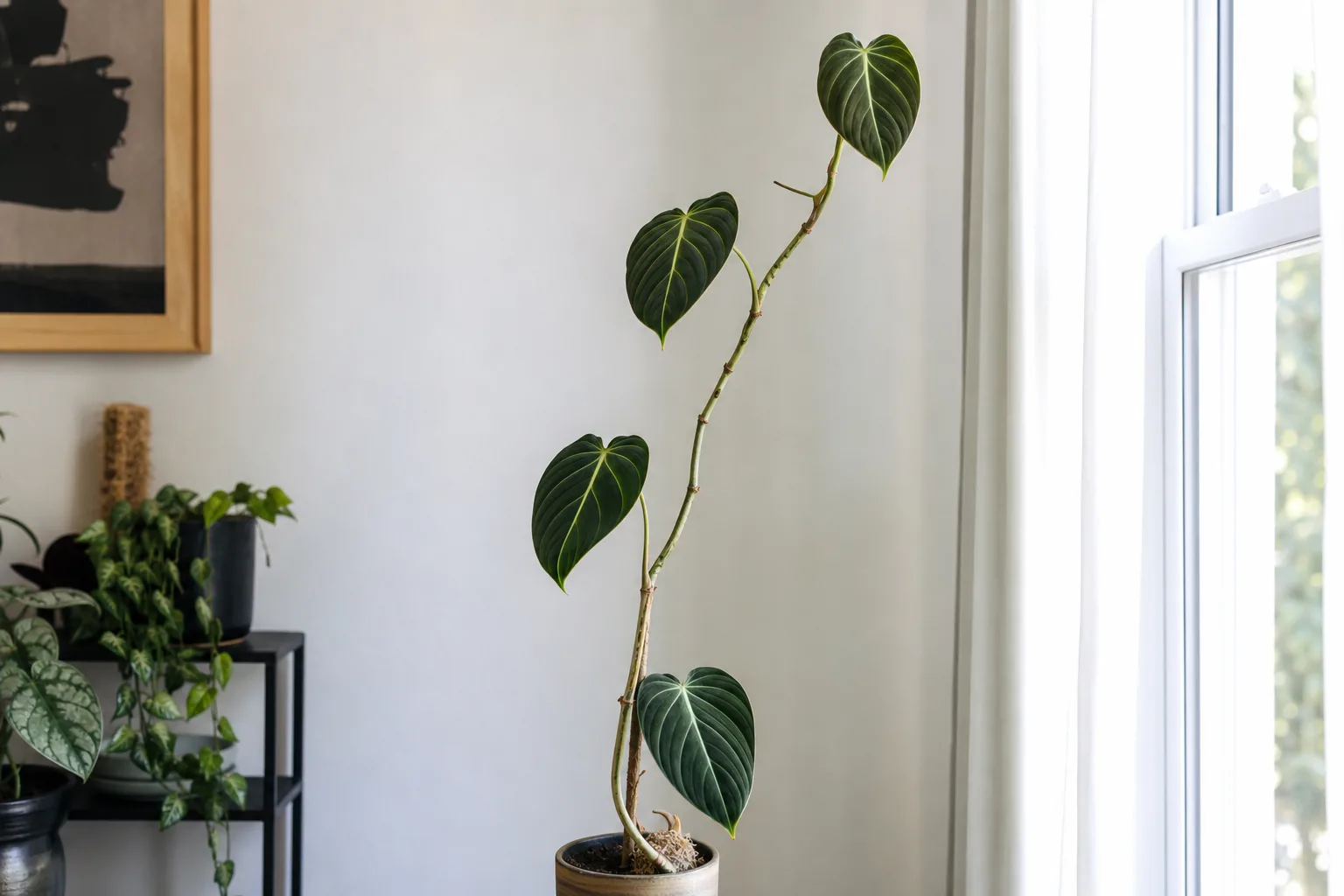
Trailing Melanochrysum without a moist grip surface: stretched internodes and persistently small new leaves — the failure mode the pole observation above is meant to reverse.
Grower Evidence: Trail vs Moist Pole
LeafyPixels observation (pole vs trail): Same Melanochrysum, same east-window light, fertilizer unchanged. Trailing for ~4 months: new leaves ~12–15 cm, soft color. After tying to a 90 cm moist moss pole with aerial roots facing the support: next two hardened leaves ~22–25 cm with clearer vein contrast. Hedge: one plant, one room, one season — useful as a decision check, not a growth-rate promise. Clemson’s years-of-vertical-training rule still applies for full ~3 ft potential; expect stepwise gains over successive leaves, not overnight.
A bone-dry decorative stake only shapes the silhouette. If you want aerial roots to enter the support the way RHS describes, keep the pole lightly moist — not dripping into the mix every day.
How to Install and Train on a Moss Pole
- Choose a firm, textured pole (moss, coco, or wood plank) tall enough for at least one season of growth.
- Seat it at the back of the pot at repot time when possible so roots are not stabbed later.
- Orient the stem so nodes and aerial roots face the support.
- Tie loosely with soft plant tie or stretchy tape at nodes — never crush the petiole or scrape velvet blades against the pole.
- Keep the pole lightly moist if you want roots to enter it; water the mix on its own dry-down schedule.
- If internodes stretch after training, fix light before adding fertilizer. Fertilizer will not compact a weak vine.
Prune only to remove dead tissue or to restart a congested tip — cut just after a node in spring growth, per RHS climbing-philodendron practice, and wear gloves if sap irritates your skin. Training details also live on the pruning guide.
Light for Dark Velvet and Golden Veins
Melanochrysum wants the light quality of forest understory: bright, filtered, and consistent. RHS places philodendrons in bright but indirect light and warns that direct summer sun can scorch leaves. NC State likewise recommends bright indirect sunlight and notes that direct sun can scorch foliage. Clemson adds that most philodendrons prefer indirect or curtain-filtered sunlight.
Vein contrast and leaf size respond to usable light at the newest leaf, not to how bright the living room feels from the sofa. Stand where the newest blade sits and look toward the window. If you cannot see sky brightness or a clear light source from the plant’s perspective, placement is too far, too low, or blocked by the pole’s shadow. Progressively smaller, paler new leaves and long internodes mean too little light. Bleached or crisp patches on the velvet upper surface mean too much direct sun.
Windows, Scorch Risk, and Grow Lights
East-facing glass is the safest default for velvet tissue: morning sun is gentler. South and west windows work when the pot sits farther back or behind a sheer curtain so midday beams never sit on the leaf for long. North windows can maintain an established plant in bright rooms but often need a grow light in winter.
When natural light is weak, run a full-spectrum LED for about 12–14 hours on a timer, centered over the climbing tip rather than the oldest leaves at the base. Keep fixtures roughly 30–45 cm above the canopy unless leaf-surface heat tells you to raise the lamp — treat those distances as practical starting points, then watch the emerging leaf for bleach before pushing closer. Acclimate gradually if moving from a dim shelf over about two weeks. Full placement tables live on the Melanochrysum light guide.
Light also drives watering. A brighter climber transpires faster and dries the mix more predictably. A dim plant keeps wet mix longer around roots, which is why “same calendar, different room” fails so often on Melanochrysum.
Watering Without Softening Roots or Stalling Unfurls
Water when the top 3–5 cm of mix feel dry, then soak until water drains freely and empty the saucer. In many homes that lands around every 7–14 days in active growth and less often in winter, but large leaves, pot size, pole moisture, and light change drying speed. Finger depth or pot weight beats any fixed schedule. RHS advises waiting until the top of the compost dries before watering and warns against leaving plants standing in water. Clemson keeps the soil evenly moist, not soggy, and never standing in water. UConn stresses ample moisture for even leaf size while draining excess — sitting water causes root injury and yellow drop.
Overwatering is the silent killer on collector aroids because velvet foliage still looks dramatic while roots are drowning. Missouri Botanical Garden notes that waterlogged soil can kill roots by depriving them of oxygen. If the pot stays heavy for more than about two weeks after a soak, improve light, check drainage, or refresh a compacted mix before watering again. Symptom walkthroughs: overwatering and root rot.
Seasonal Dry-Down and Hard Water Spots on Velvet
In winter, growth slows and dry-down stretches. Reduce frequency; do not reduce soak quality into timid sips that wet only the top crust. Prefer room-temperature water. RHS suggests rainwater or filtered water in hard-water areas to help keep compost acidity. On velvet leaves, mineral spots and wipe damage show more than on glossy philodendrons — avoid misting as a humidity strategy and dust with a soft dry brush rather than a wet cloth when possible.
If a cataphyll stalls mid-unfurl, check humidity and moisture together before peeling it open. Forced peeling often tears the soft new blade. Details and seasonal intervals live on the watering guide.
Soil, Pot, and Drainage Setup
Use a chunky, free-draining aroid mix — a practical LeafyPixels starting ratio is roughly equal parts quality indoor potting mix, perlite, and medium orchid bark. NC State wants moist, well-drained soil high in organic matter. UConn favors loose, well-drained organic-rich mixes and notes soilless peat-perlite style blends can work. RHS prefers loose, free-draining, slightly acidic compost and warns that an oversized pot keeps mix wet too long.
Choose a pot with drainage holes sized to the current root mass, not “for future growth.” Tall nursery cylinders packed with peat hold stagnant moisture against roots while the vine dries at the tips. When you install a pole, leave room so the stem is not jammed against the pot wall. Repot in spring when roots circle densely or the mix collapses into sludge — RHS notes many philodendrons can stay in the same container for a couple of years if the mix still drains. Deeper mix recipes live on the soil guide.
Humidity, Temperature, and Airflow
Aim for about 60–70% relative humidity if you want clean unfurls and strong velvet. The plant may tolerate the mid-40s to low-50s in bright light with careful watering, but low humidity commonly shows as stuck cataphylls, torn new leaves, brown tips, and dried aerial roots. NC State says philodendrons prefer high humidity yet often adapt to average homes; in very dry climates, use a humidifier or pebble tray. RHS notes philodendrons prefer moderately humid air but can cope with lower home humidity — Melanochrysum’s velvet texture is less forgiving than heartleaf types, so treat “average home humidity” as survival, not peak performance. Room-level tactics: houseplant humidity guide.
Keep temperatures roughly 18–29°C (65–85°F). NC State cites an ideal band near 65–85°F and cold sensitivity to drafts. RHS wants plants kept above 15°C (59°F), away from hot radiators and cold draughts. Clemson’s general philodendron band of warm days and nights in the mid-60s to mid-80s °F fits Melanochrysum well. Pair humidity with gentle airflow so velvet surfaces do not sit in stagnant damp — still air plus wet leaves invites spotting. A humidifier near the plant beats occasional misting.
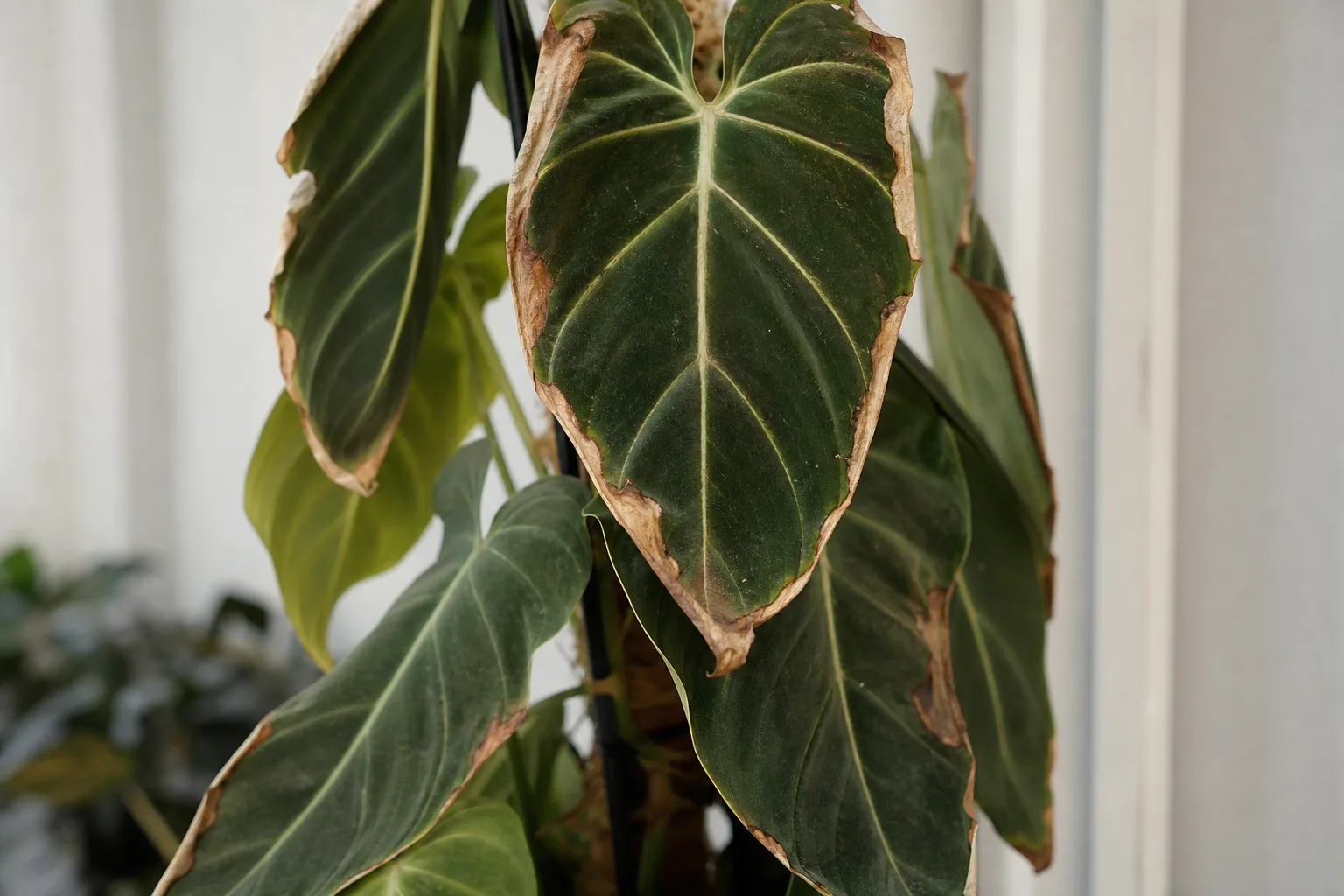
Dry-air stress on Melanochrysum: tip browning and stalled unfurls — raise humidity before peeling a stuck cataphyll open.
Fertilizer, Repotting, and Propagation Readiness
Feed lightly during active growth only — a half-strength balanced liquid about monthly is a sane start. UConn calls philodendrons relatively heavy feeders but recommends more frequent dilute applications over one strong dose, applied to already moist soil. Skip fertilizer on a plant that is not making new leaves, sitting in dim light, or recovering from root damage.
What success looks like on the next leaf: after a correct feed (moist soil, active growth, decent light), the next new blade should unfurl on a firm petiole with vein contrast at least as clear as the previous leaf — not a thinner, paler leaf with longer internodes. Brown tips after feeding often mean salts, not “needs more food.” Flush the pot with water occasionally if crust builds on the mix surface. Full schedules: fertilizer guide.
Repot when root-bound or when the mix no longer drains — spring is best (repotting guide).
Propagation readiness checklist (cutting ready when):
- At least one healthy node with a visible aerial root facing a future support
- Firm stem tissue (not soft or yellowing)
- Parent plant in active growth, not mid-root-recovery
- Bright filtered light and warm, humid air ready for the cutting
RHS notes climbing philodendrons root readily in water, then move to a free-draining mix once roots establish. Keep cuttings warm and humid; juvenile leaves on a cutting are normal. Step-by-step technique: propagation guide.
Pet Toxicity and Climbing Placement
Philodendrons are toxic if chewed. Clemson states that all parts contain calcium oxalate crystals that cause burning and irritation of the mouth, lips, and tongue, with drooling, vomiting, and difficulty swallowing. The ASPCA lists philodendron as toxic to dogs and cats, with insoluble calcium oxalates and clinical signs including oral irritation, swelling of mouth and tongue, excessive drooling, vomiting, and difficulty swallowing. NC State likewise flags calcium oxalate as the toxic principle and tags the genus as a problem for cats and dogs.
Keep Melanochrysum elevated and out of reach. Climbing poles make foliage more accessible to curious pets, so place the whole support away from shelves cats use as highways. If ingestion is suspected, contact a veterinarian or ASPCA Animal Poison Control at (888) 426-4435. For genus-level safety context, see the philodendron toxicity guide. For households that need floor-level foliage, start with pet-safe houseplants instead.
Common Problems and How to Fix Them
Most Melanochrysum problems collapse into five causes: wrong habit (no support), wrong light, wet feet, dry air, or pests hiding on dark matte foliage. Change one variable at a time and watch the next leaf — not the oldest shipping damage.
| Symptom | Likely cause | First move |
|---|---|---|
| Persistently small new leaves | No vertical support and/or low light | Install moist pole; brighten filtered light |
| Stuck / torn unfurls | Low humidity or dry mid-depth mix | Raise RH; check moisture; wait — don’t force sheath |
| Yellow lower leaves + heavy pot | Overwatering / poor drainage | Pause water; check roots — yellow leaves |
| Brown tips | Dry air, uneven water, or salts | Humidity + flush if crusted — brown tips |
| Leggy stretch after pole | Light still too low | Move closer to bright filtered light — leggy growth |
| Webbing, cottony clumps, sticky residue | Mites, mealybugs, aphids | Isolate; treat early — check undersides with a flashlight |
Stuck Cataphylls, Brown Tips, and Small New Leaves
Stuck or torn unfurls usually track low humidity, underwatering at the wrong moment, or rough handling of the cataphyll. Raise humidity toward 60%+, confirm the mix is not bone-dry at mid-depth, and wait rather than forcing the sheath open. Brown tips often mean dry air, inconsistent watering, or fertilizer salts. Persistently small new leaves after months of growth almost always mean missing vertical support, insufficient light, or both — not a missing “growth hormone” product. See also slow growth and not enough light.
Yellowing lower leaves with a heavy pot point to overwatering or poor drainage; soft foul roots confirm root rot. Clemson notes yellowing lower leaves and dying growing tips can follow too little light or overwatering. Unpot, trim mushy roots with clean tools, and repot into fresh chunky mix only after the plant has light and airflow that can dry the new medium.
NC State monitors philodendrons for mealybugs, aphids, scale, thrips, and spider mites. Dark velvet hides pests — check undersides and petiole joints with a flashlight during quarantine. Isolate new plants. Treat early with mechanical removal and appropriate horticultural controls; do not soak velvet in harsh sprays that leave residue burns. Spider mites love dry indoor air; raising humidity and cleaning leaves carefully helps prevention.
Related Guides
Use this guide when you want the full Melanochrysum picture and the climbing rules in one read. Open a topic page when you need procedural depth on a single decision.
- Philodendron Melanochrysum care hub — overview, topic pages, and problem index
- Philodendron Melanochrysum watering — moisture checks and seasonal intervals
- Philodendron Melanochrysum light — windows, grow lights, and vein contrast
- Philodendron Melanochrysum soil — chunky mix ratios and pot sizing
- Philodendron Melanochrysum propagation — node cuttings and readiness checks
- Philodendron Micans care guide — trailer ID contrast
- Philodendron Gloriosum care guide — crawler habit contrast (wide pot, not a pole)
- How to water indoor plants the right way — soil-check habits that prevent overwatering
- Houseplant humidity guide — when dry air limits velvet growth
- Philodendron toxicity — pet-safety overview for the genus
Conclusion
First 30 days with a new Melanochrysum
- Quarantine and leave the plant in its pot unless the mix is failing or pests are obvious.
- Confirm habit setup: textured pole installed, stem tied loosely, aerial roots facing the support.
- Kneel at the newest leaf and fix bright filtered light before changing fertilizer.
- Water only when the top 3–5 cm feel dry; empty saucers; note how many days the pot takes to lighten.
- Leaf-size milestone: after the pole is installed, expect the next one or two new leaves to show the first size gain if light is already adequate — not an instant jump on already-hardened blades.
- Watch unfurls, tip firmness, and pet access on climbing foliage — then open a single hub topic page only when one symptom needs its own depth.
Good Philodendron melanochrysum care is habit-first: a Colombian climber needs a pole, filtered light for velvet contrast, moisture checks that match dry-down, and humidity that lets cataphylls finish cleanly. Keep those decisions honest and the rest of the routine stays boring — which is exactly what this plant wants.