Philodendron White Knight Care Guide: Light, Watering, Soil and Common Problems
Grow Philodendron White Knight indoors with variegation light balance, watering when the top mix dries, aroid soil, and Pink Princess differences.
Philodendron White Knight fails in two predictable ways in real homes: white leaf sectors brown and crisp while the green still looks fine, or new leaves arrive greener and greener until the plant looks like a plain burgundy-stem climber. Both failures track the same biology. White Knight is a climbing Philodendron erubescens-type with chimeric white variegation. The white tissue that makes it desirable has little chlorophyll, so it needs brighter filtered light than a solid-green philodendron — and that same pale tissue scorches first in hot sun and greens out first in a dim corner.
This guide is the indoor routine for keeping white contrast stable: light balance, check-based watering, chunky soil, humidity, a moss pole, fertilizer restraint, reversion pruning, toxicity, and the problems that show up most often. If you bought it thinking it was a Pink Princess, jump to the comparison section before you copy pink-focused light advice.
Written by Sai Ananth (B.Pharmacy, pharmacognosy background; LeafyPixels lead writer and indoor grower of variegated aroids) and reviewed by Dr. Priya Menon (botanist and indoor plant specialist) on the LeafyPixels Review Board. Observations below come from two White Knight climbers in a north-central Ohio apartment (USDA zone 6a): one on a moist coir pole about two feet from a sheer-filtered south window, and one recovery plant moved from a north shelf back to east light. Your rooms will differ — treat intervals as lived-in benchmarks, not rules.
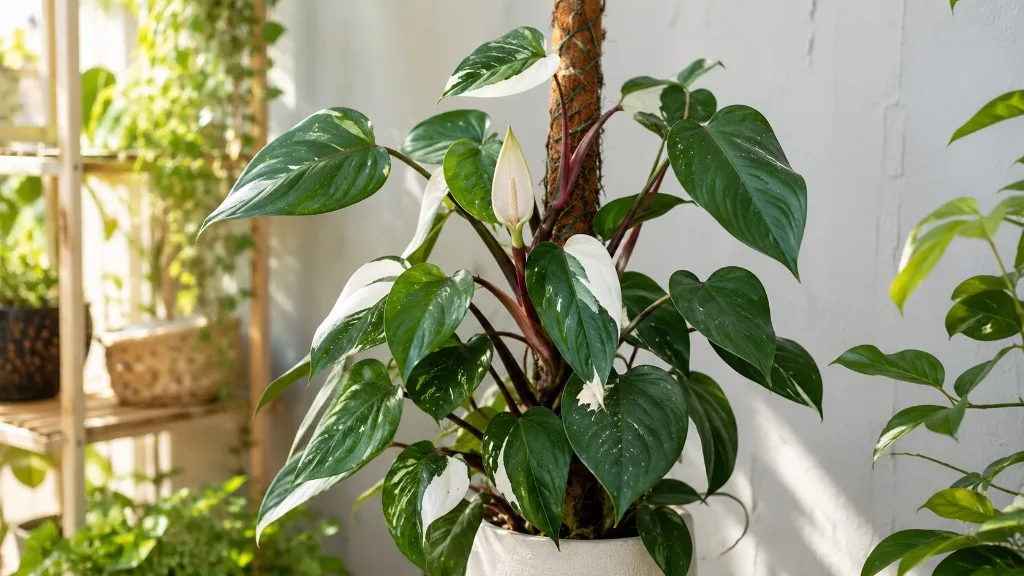
Healthy White Knight — green-and-white sectoral variegation on glossy leaves with deep burgundy to purple-dark stems. Use stem color first when you ID this plant in a shop or a nursery photo.
Quick Care Snapshot
For a healthy indoor White Knight, place the plant in bright, filtered indirect light, water when the top 3–5 cm (1–2 inches) of mix have dried, use a chunky aroid mix in a pot with drainage holes, keep temperatures roughly 18–29°C (65–85°F) with about 55–70% humidity when you can, give it a moss pole or trellis, and fertilize lightly only during active growth. Protect white sectors from both dim corners and harsh afternoon sun. Keep the plant out of reach of pets and children.
| Care factor | Baseline target | Deeper guide |
|---|---|---|
| Light | Bright filtered / dappled; avoid harsh direct sun | White Knight light |
| Water | Top 3–5 cm dry, then soak and drain | White Knight watering |
| Soil | Potting mix + perlite + orchid bark; never soggy | White Knight soil |
| Feed | Half-strength liquid every 4–6 weeks in growth | White Knight fertilizer |
| Support | Moss pole or trellis for larger leaves | White Knight pruning |
| Repot | Every 1–2 years, or when mix stays wet too long | White Knight repotting |
North Carolina Extension describes Philodendron erubescens as a climbing tropical perennial that typically stays around 3 feet tall and 16 inches wide indoors, preferring partial shade / dappled light, warm temperatures, high humidity, and moist, well-drained organic soil — with direct sunlight avoided indoors. (NC State Extension) White Knight inherits that climber skeleton, then adds fragile white sectors that tighten the light band further. For single-symptom workflows after you set the routine, use the Philodendron White Knight care hub.
What White Knight Is
Philodendron White Knight is a variegated collector cultivar associated with the Philodendron erubescens group in the Araceae (arum) family — the same species complex that includes Red Emerald, Pink Princess, and White Princess in trade. NC State places P. erubescens as a Colombian rainforest climber that can scramble tens of feet outdoors, while houseplants stay compact by comparison. (NC State Extension) Indoors, White Knight is an upright climbing vine, not a self-heading tabletop clump like Birkin.
What makes White Knight visually distinct is the combination of white-to-cream sectoral variegation on green cordate leaves and deep burgundy to purple-dark stems and petioles, often with white striping along the cataphylls. Leaves are glossy and somewhat leathery. Growth is deliberate: heavily variegated plants produce less energy than all-green climbers, so they drink slower, recover slower, and punish wet mix in low light faster.
Clemson Extension draws the genus line clearly: most common philodendrons are vining and limited by the height of their support, while self-heading types form a heavy basal clump. (Clemson HGIC) White Knight is firmly in the climbing camp. University of Connecticut notes that many philodendrons climb tree trunks in nature and do best warm, moderately moist, and out of direct sun. (UConn) That is the care skeleton; variegation is the constraint that makes White Knight fussier than plain heartleaf.
Stem-First ID: White Knight vs White Wizard vs White Princess
The three “white philodendrons” get mislabeled constantly because leaf variegation alone is unreliable. All three can produce green-and-white leaves in sectoral or marbled patterns. Check stem and petiole pigmentation first.
| Cultivar | Stem / petiole cue | Leaf cue (secondary) |
|---|---|---|
| White Knight | Deep burgundy to purple-dark, often with white striping | White/cream sectors on green |
| White Wizard | Clean green stems; no burgundy-dark pigmentation | Broader green-and-white leaves |
| White Princess | Green stems with pink/rosy striping alongside white | Often narrower juvenile leaves |
If the stem is clearly burgundy-dark, you are most likely looking at White Knight. NC State lists ‘White Princess’ and ‘Pink Princess’ among P. erubescens cultivars; White Knight circulates in the same collector group even when labels lag taxonomic pages. (NC State Extension) Two White Knights can show wildly different white coverage on the same flush — stem color is the feature that stays consistent node to node. Compare sibling hubs for White Wizard and White Princess when a nursery tag is ambiguous.
White Knight vs Pink Princess
Both are variegated erubescens-type climbers that want bright indirect light, chunky free-draining mix, and a support. Day-to-day, the difference that matters is which fragile tissue you are protecting.
| Trait | White Knight | Pink Princess |
|---|---|---|
| Signature color | White/cream sectors; burgundy-dark stems | Pink splash/marbling on dark leaves |
| Fragile tissue risk | White sectors brown first in hot sun or salt stress | Pink sectors scorch or collapse first |
| Low-light response | Greener new leaves; white contrast fades | Greener new leaves; pink fades |
| Growth feel | Often slower when heavily white | Moderate climber when well lit |
| Buying check | Burgundy stem + repeatable white on new nodes | Pink on newest leaves and stem streaking |
NC State describes Pink Princess as upright-vining with heart-shaped dark purplish-green leaves and pink variegation. (NC State Extension) White Knight’s cool white sectors are not “unripe pink.” If you want bubblegum contrast, grow Pink Princess; if you want cooler white panels on a dark stem, grow White Knight. Care overlaps, but you cannot turn one into the other with fertilizer. For pink-focused pruning and light notes, use the Philodendron Pink Princess care guide and the Pink Princess hub.
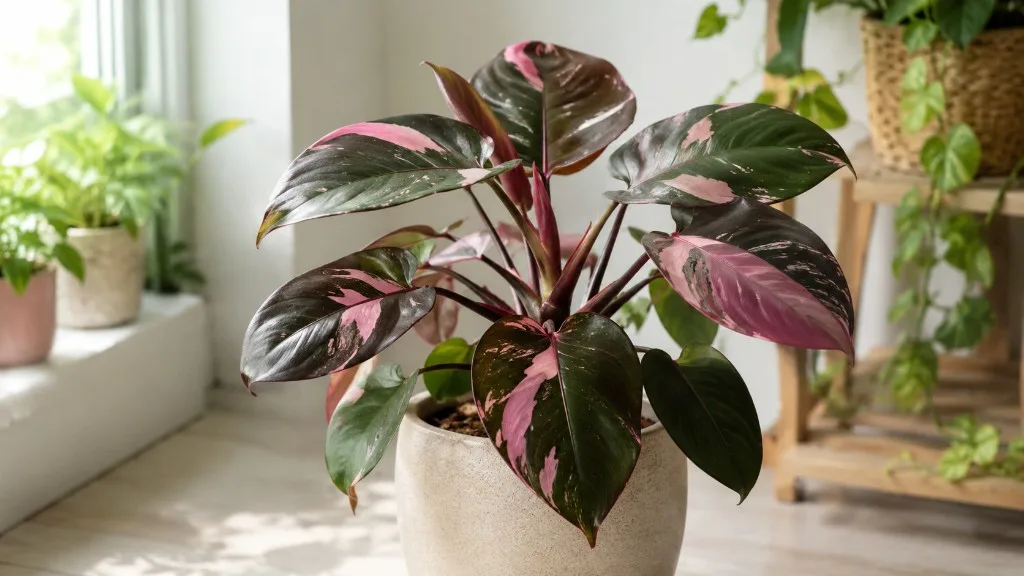
Pink Princess — same bright-indirect climber care skeleton, warm pink tissue instead of cool white. Stem and newest-leaf color still beat a single show leaf for buying checks.
Variegation Light Balance
Action first: put White Knight where the canopy gets strong ambient brightness without prolonged midday beams — then protect white sectors from hot glass and hot LEDs. Light is the highest-leverage variable because it controls both structure and white expression.
NC State recommends dappled sunlight to partial shade and says direct sunlight should be avoided indoors. (NC State Extension) The Royal Horticultural Society matches the indoor target: bright but indirect light, kept out of harsh summer sun that scorches leaves. (RHS) Survival in low light is not the same as keeping white contrast — Colorado State Extension PlantTalk notes philodendrons grow best in bright, indirect light but will survive dimmer rooms. (Colorado State Extension PlantTalk)
Variegated tissue has less chlorophyll. In a dim room, White Knight often responds by producing greener leaves and longer internodes. In harsh west-window sun, white sectors bleach and crisp before the green tissue looks fully stressed. The workable band is strong ambient brightness at the leaf surface without prolonged midday beams. Fertilizer does not restore white; brighter filtered light does.
Window Placement and Grow Lights
Start with an east window about 30–60 cm (1–2 feet) back, or a south or west window behind a sheer curtain three to five feet from the glass. North windows can hold a plant through bright summer weeks if it sits close to the pane, but winter north light often fails the new-growth test. Rotate the pot a quarter turn every week or two so the vine does not permanently twist toward one side.
If natural light is weak — interior offices, light wells, deep winter — a full-spectrum LED grow light 30–45 cm (12–18 inches) above the canopy for roughly 10–14 hours daily is a practical substitute. Keep fixtures far enough that leaves stay cool to the touch; white tissue crisps under hot LEDs the same way it does under hot glass. Acclimate gradually when you increase light. A week of shifting the plant closer in small steps prevents afternoon scorch on a leaf that looked perfect that morning. For placement diagrams, use the dedicated White Knight light guide.
What we see (conditions attached):
| Plant | Window / support | Distance / pot | Observation window | Result |
|---|---|---|---|---|
| Pole plant | Sheer-filtered south + moist coir pole | ~60 cm (2 ft) from glass; chunky mix | Ongoing active growth | White sectors held clean |
| Recovery plant | North shelf → east window | 14 cm (5.5 in) pot, chunky mix | ~6 weeks on north shelf | Three successive greener, longer-internode leaves before the move |
Low-Light Fade vs Sun Scorch on White Tissue
Too little light looks like weaker or missing white on new leaves, smaller blades, stretch between nodes, and burgundy stems that read flatter. The pot also stays wet longer than you expect — the classic path into not enough light plus chronic wet mix.
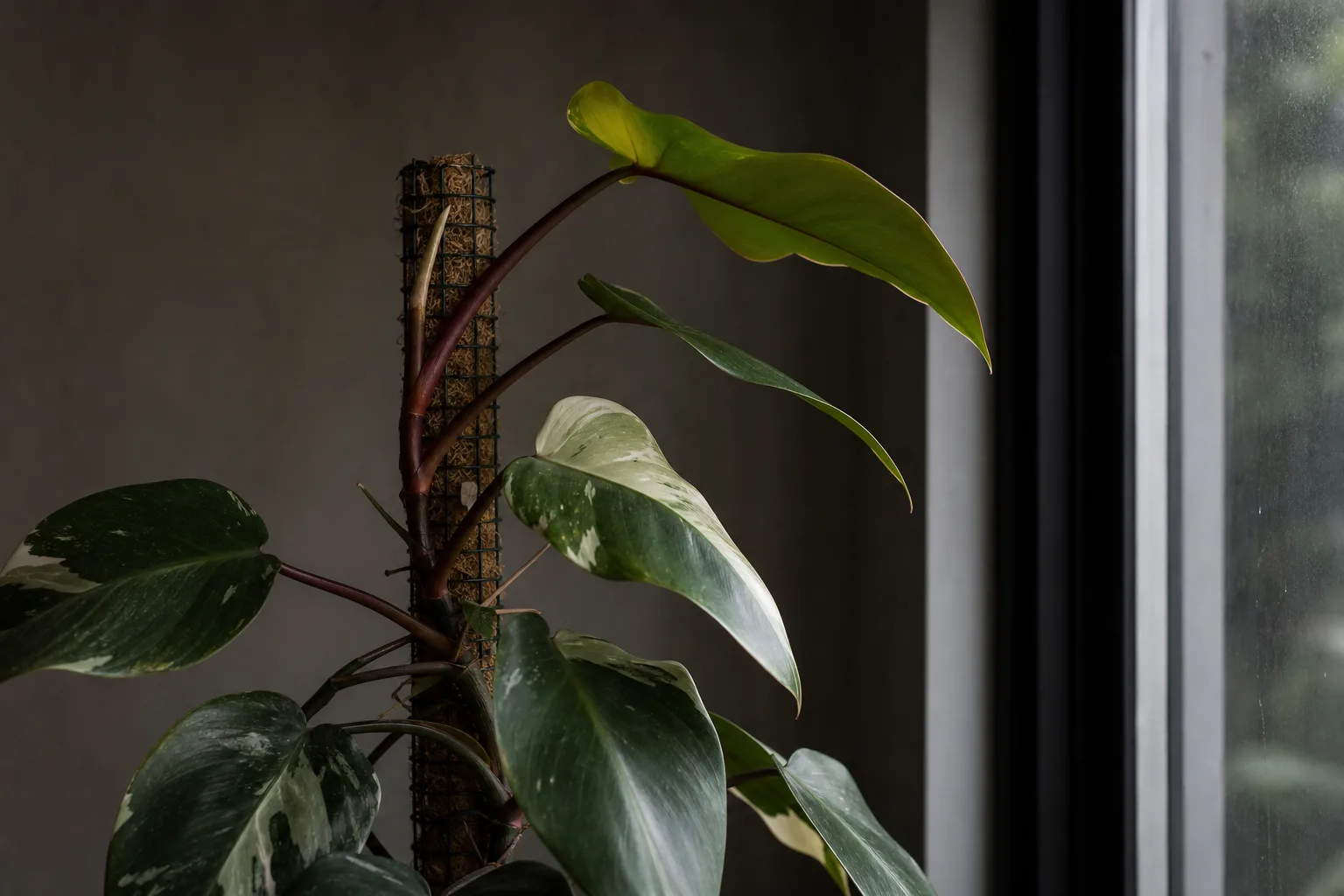
Low-light White Knight pattern — greener successive leaves and longer internodes. Match this look against your newest flush before you change fertilizer.
Too much direct sun looks like tan, parchment, or brown patches that appear first on white sectors, sometimes with a greasy translucent stage. Those patches will not turn white again. Move the plant back, sheer the window, and wait for the next flush before judging recovery.
Do not chase all-white leaves. Fully white blades look stunning in photos and often stall or collapse because they cannot feed themselves. The best long-term White Knight is not the whitest specimen; it is the one that keeps producing balanced green-and-white leaves on a burgundy stem with active nodes. Do not prune every slightly greener immature leaf before you have watched two to three new leaves after a light move — juvenile leaves can look greener before they finish expanding.
Watering by Soil Check
Action first: water when the top 3–5 cm (1–2 inches) of potting mix feel dry, then soak until water runs from the drainage holes and empty the saucer within 15–30 minutes. In many bright rooms that works out to roughly every 7–10 days in active growth and every 10–14 days in cooler or dimmer months — but always verify with a finger or chopstick. Heavily variegated White Knights often drink slower than green climbers of the same size.
Clemson advises watering frequently enough to keep soil evenly moist but not soggy, and never letting plants stand in water. (Clemson HGIC) The RHS tells growers to let compost dry slightly between waterings, avoid standing water, and prefer rainwater or filtered water in hard-water areas. (RHS) Clemson’s indoor watering factsheet reinforces the same principle: match water to the plant and pot, not a fixed calendar. (Clemson HGIC watering)
Seasonal Dry-Down Conditions We Measured
Insert your index finger to the second knuckle — about 3–5 cm — or push a dry bamboo chopstick into the mix and leave it ten seconds. Cool, damp stick means wait. When you water, soak until excess runs out, then empty the saucer.
What we see on the east-window recovery plant (chunky aroid mix in a 14 cm / ~5.5 inch pot):
| Conditions | Warm bright stretch | After ~1 week of cloudy weather |
|---|---|---|
| Finger-test dry-down | Often day 8–9 | Still cool/damp on day 11 |
| Risk if you ignore checks | Mild underwatering | Stacked wet mix under slow growth |
Winter, north rooms, and fresh cuttings all slow uptake. If new leaves are smaller and greener, cut watering frequency before you add fertilizer. Soft stems, persistently wet mix, fungus gnats, and a sour smell are overwatering signals — see overwatering and root rot before you “love” the plant with another soak. Underwatering shows as dull, curling leaves and crispy edges that often hit white sectors first. Rehydrate thoroughly once, then return to the finger test rather than misting the canopy as a substitute for root water. Deeper dry-down matrix: White Knight watering. Broader habit: how to water indoor plants the right way.
Hard-water / salt note: if white tips crisp even when light and watering look right, flush the pot with a thorough runoff of distilled, rain, or filtered water every few months and stretch fertilizer. Salt burn shows early on white tissue.
Soil, Pot, and Drainage
White Knight needs an airy, well-draining aroid mix — typically high-quality potting mix amended with perlite and orchid bark (coco chips also work). Target a slightly acidic range around pH 5.5–6.5. Dense peat-only nursery plugs hold water against variegated roots that already photosynthesize less and recover slowly from oxygen stress.
NC State calls for moist, well-drained soil rich in organic matter. (NC State Extension) UConn prefers loose, well-drained media high in organic matter and notes peat-perlite mixes work well. (UConn) The RHS suggests a slightly acidic mix and warns that saturated compost leads to root rot. (RHS)
Use a pot with real drainage holes. Terracotta speeds dry-down; plastic holds moisture longer — useful in dry apartments, risky in dim ones. Do not upsize more than one pot diameter at a time; excess unused mix stays wet around a slow climber. Full recipes: White Knight soil.
Humidity, Temperature, and Climbing Support
Aim for roughly 18–29°C (65–85°F). NC State lists 65–85°F and protection from cold drafts. (NC State Extension) Clemson prefers nights about 65–70°F and days 75–85°F. (Clemson HGIC) The RHS wants plants kept above 15°C (59°F), away from hot radiators and cold draughts. (RHS)
White Knight prefers moderate to high humidity (about 55–70%) for cleaner new leaves, but it will survive average home air if light and watering are right. RHS notes philodendrons prefer moderately humid air yet tolerate lower home humidity. (RHS) Brown tips on white sectors in winter often track dry air plus inconsistent watering — fix both, not misting alone. Troubleshooting: low humidity and our houseplant humidity guide.
A moss pole, coco totem, or trellis is strongly worth it. RHS says climbing philodendrons are best given support and can root into a moist moss pole. (RHS) NC State notes indoor plants can climb a moss pole or trellis or sprawl and demand more floor space. (NC State Extension) Without support, White Knight often looks leggier with smaller leaves even when watering is correct. Keep the pole lightly moist so aerial roots can attach; a bone-dry stick is décor, not a rooting surface. Build one with our DIY moss pole guide.
Fertilizer, Repotting, and First-Month Quarantine
Feed lightly during active growth — a balanced liquid houseplant fertilizer at half strength every 4–6 weeks is enough for most variegated White Knights. Skip or stretch feeding in winter, low light, or after root stress. Clemson recommends dilute water-soluble or time-release fertilizer. (Clemson HGIC) UConn prefers more frequent half-strength feeding over one strong dose and notes low-light plants need less. (UConn) Salt burn shows as crispy edges that often appear first on white tissue — flush the pot if that is suspected. Details: White Knight fertilizer.
Shipping and quarantine aftercare: keep a new plant isolated from the rest of your collection for two to three weeks. Unpack immediately, inspect leaf undersides and nodes for mealybugs, scale, and webbing, and wipe dust or packing debris before it joins other pots. Water only when the mix needs it — shipping stress plus a wet, dark box is a common start for fungus gnats and soft roots. Do not repot on day one unless the mix is failing, pests are obvious, or the plant is still in a dense propagation plug that stays wet for weeks. Quarantine, learn dry-down, and keep care boring for the first month. Repot every 1–2 years in spring when roots circle or the mix collapses into sludge. Pot-size rules: White Knight repotting.
Pruning Reversion and Propagating Balanced Nodes
Reversion — successive leaves emerging mostly or entirely green — is a genetics-plus-light issue, not a nitrogen deficiency. First improve bright filtered light for two to three new leaves. If the tip keeps producing solid green from a green node, prune back to the last node that still shows white striping on the stem or a clearly variegated leaf. Sterilize shears, cut just above that node, and leave enough green tissue for the plant to photosynthesize.
There is no guarantee pruning restores white. Propagation works from stem cuttings with at least one node — water or chunky mix both work if humidity and warmth stay steady. Choose cuttings that still show white on the stem or leaf; an all-green cutting grows an all-green plant. Step-by-step: White Knight propagation. Shape cuts: White Knight pruning.
Fully Green Vine: Keep, Prune, or Replace
Use this decision tree after light has already been improved for several weeks:
- Keep as a burgundy-stem climber if you like the foliage, the plant is healthy, and you do not need white contrast. Train it on a pole; it will often grow faster than a heavily white plant.
- Prune if any nodes still show white striping on the stem or a clearly variegated leaf — cut just above that node and wait for a lateral shoot.
- Replace or restart from a variegated cutting if the entire vine is green node-to-tip and you specifically bought White Knight for white sectors. Fertilizer will not paint white back onto a green chimera.
Common Problems with Visual Cues
Most White Knight drama is cultural: light too low, water too frequent for the light, or heat on white tissue. Diagnose the white sectors first — they are the early warning system.
Browning White Sectors
White tissue browns from hot direct sun, low humidity with dry roots, salt buildup, overwatering stress, or pests. Move out of harsh beams, correct watering, flush if salts are likely, and raise humidity modestly. Old brown patches will not heal white again; judge success on the next leaves.
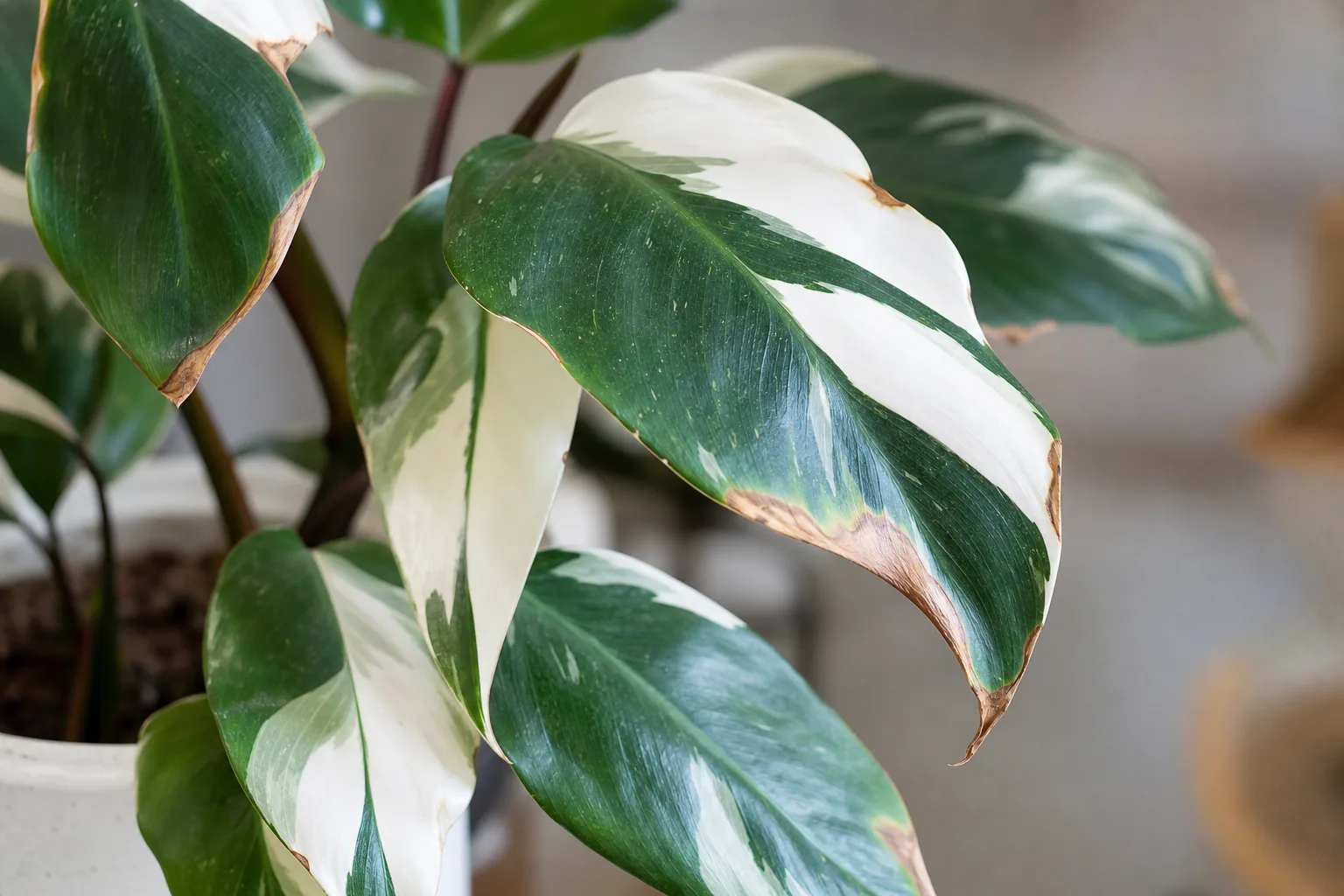
Browning on white sectors — common after hot sun, dry air with dry roots, or salt stress. These patches will not revert to white; fix conditions and watch the next flush.
Deep dive: brown tips.
Yellow leaves, soft stems, and root rot: yellowing lower leaves with a wet pot often means overwatering or poor drainage. Missouri Botanical Garden links overwatering to yellowing and decline when roots lack oxygen. (Missouri Botanical Garden) Soft nodes, sour soil, and collapse are emergencies: unpot, trim black roots, and repot into fresh airy mix only if firm white or tan roots remain. Guides: yellow leaves, wilting, root rot.
Pests: NC State lists spider mites, mealybugs, aphids, and scale among common pests, plus leaf spot when water sits on foliage. (NC State Extension) Check undersides weekly. Isolate, wipe, and treat with insecticidal soap or neem as labeled. Fungus gnats track chronically wet media — dry the top layer and fix watering before chasing adult flies. Start with spider mites, mealybugs, and fungus gnats.
If white sectors are browning or new leaves are greener, jump to the matching problem guide linked above rather than stacking fertilizer, repotting, and pruning in one weekend.
Pet Toxicity and Safe Placement
Philodendrons contain insoluble calcium oxalate crystals and are toxic to cats and dogs if chewed. ASPCA lists philodendron as toxic; expect oral pain, drooling, vomiting, and difficulty swallowing. (ASPCA) UF/IFAS likewise flags philodendron toxicity for pets and people. (UF/IFAS) Keep White Knight on a high shelf or trained up a pole out of reach. If ingestion is suspected, contact a veterinarian or ASPCA Animal Poison Control at (888) 426-4435. Genus-wide context: philodendron toxicity. For households that need non-toxic options instead, start with our pet-safe houseplants guide.
Related Guides
- Philodendron White Knight care hub — topic pages and problem index when a single symptom needs its own workflow
- Philodendron Pink Princess care guide — pink variegation on a similar climber
- Philodendron Brasil care guide — trailing lime-stripe philodendron with different habit cues
- Philodendron Birkin care guide — self-heading pinstripe philodendron (no moss pole)
- How to water indoor plants the right way — the dry-check habit that prevents rot
- Houseplant humidity guide — when dry air browns white sectors
- DIY moss pole — support for climbing White Knight
- Philodendron toxicity — pet and human safety across the genus
- Indoor plant yellow leaves — genus-wide yellowing triage when the issue is not species-specific
Conclusion
White Knight care is a narrow band done consistently: bright filtered light that holds white without scorching it, watering only after the top mix dries, chunky draining soil, warm steady temperatures, optional humidity help, and a climbing support. Differentiate it from Pink Princess by stem color and white versus pink tissue, and from White Wizard or White Princess the same way. When problems appear, change one major variable at a time and read the newest leaves — not the Instagram leaf that sold you the plant. If white sectors are browning or new leaves are greener, jump to the matching problem guide linked in Common Problems.