Houseplant Thin Stems: Causes, Diagnosis and Fixes
Thin stems can mean etiolation, soft root stress, or natural habit. Diagnose the pattern, raise light, then prune.
Thin stems on a houseplant are easy to misread. One plant is stretching for light. Another is soft from root stress. A third was never built to look thick and upright. Those three problems share the same complaint — “my stems look skinny” — and they need different fixes.
Start with light. Most indoor thin-stem cases are etiolation: elongated, spindly growth produced when intensity is too low for compact tissue. University of Maine Cooperative Extension defines etiolation as elongated, spindly stems and pale leaves from low-light conditions, and notes it is common in houseplants grown in near-constant shade. (University of Maine Cooperative Extension) Only after you sort etiolation from soft collapse and natural habit should you prune, stake, feed, or repot.
Quick Answer: Three Thin-Stem Patterns
Classify the plant in under a minute before you change fertilizer or buy a stake.
1. Etiolation (light stretch) — new stems thinner than older ones, longer gaps between leaves, smaller or paler new foliage, often a lean toward the window. Fix intensity first. Pair this with not enough light when you need the full light-diagnosis playbook.
2. Weak growth (stress) — stems feel soft, limp, or mushy; growth is thin and stalled; soil may stay wet or bone dry. Check roots and watering before you chase light alone. Soft collapse is not the same as a firm directional lean toward a window. See root rot and overwatered plant if tissue feels soft at the soil line.
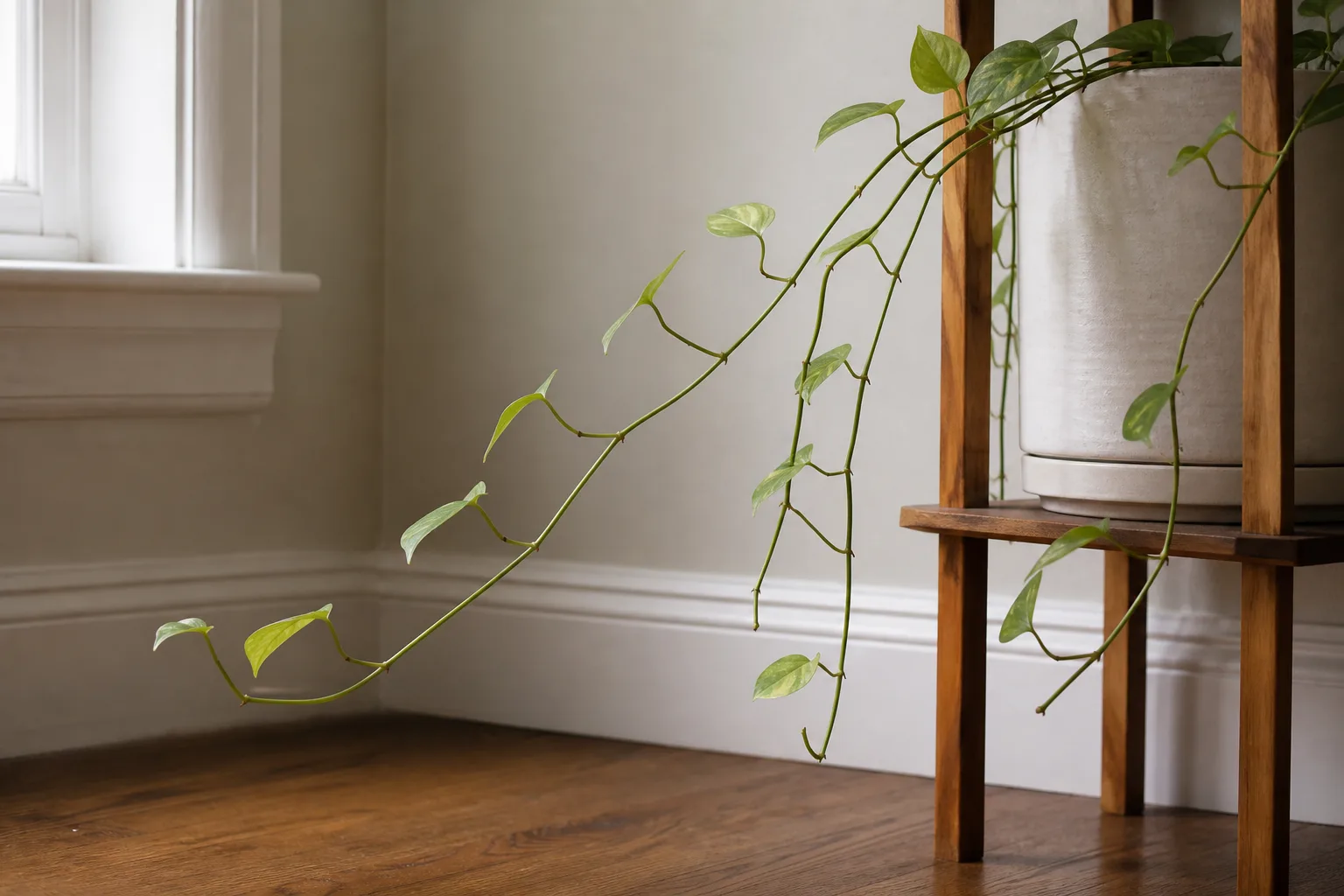
3. Genetics / habit — stems have always been slender, internodes look consistent with older growth, leaves are normal size and color for the species. Trailing pothos, philodendron vines, and many ferns look “thin” by design. Do not treat healthy habit as a disease.
Missouri Botanical Garden notes that indoors the usual problem is too little light, and plants in that condition turn pale and stretch toward whatever light they can find. (Missouri Botanical Garden) If your plant matches pattern one, skip the fertilizer aisle and measure light at leaf height.
| Feel / look | Firm skinny + longer new gaps | Soft, limp, or mushy | Firm, evenly slender |
|---|---|---|---|
| Best first label | Etiolation | Weak / root stress | Genetics / habit |
| First move | Raise light | Inspect roots and watering | Match care to habit |
What Thin Stems Look Like on the Same Plant
“Thin” only means something when you compare new growth with older growth on the same plant. A stem that looks skinny next to a greenhouse photo may be normal for a shade-tolerant vine. A stem that is thinner than last season’s wood on your own plant, with longer internodes and smaller leaves, is a change worth diagnosing.
University of Georgia Extension lists inadequate-light signs that stack with thin stems: little or no growth, much longer internodes on new growth than on older parts, smaller new leaves, lighter green new foliage, and death of older leaves. (University of Georgia Extension) RHS similarly flags weak, spindly growth, pale leaves, poor flowering, and lower leaves yellowing and falling as low-light clues. (RHS)
Measuring Internodes and Stem Firmness
Pick one stem and measure the last three internodes — the stem segments between leaf nodes. Compare them with three mature internodes lower on the same stem. If the new run is consistently longer and the associated leaves are smaller or paler, you are looking at stretch, not a one-off leaf.
Also note firmness. Firm thin tissue that points at a window is usually phototropism plus low intensity. Soft thin tissue that collapses even when the pot is wet points to watering or root failure first. Directional lean with solid tissue belongs in the plant leaning guide; stalled, undersized growth without long internodes may fit stunted growth better than etiolation.
Etiolation vs Weak Growth vs Genetics
Mixing these up is how people fertilize a dark corner plant, stake a rotting stem, or prune a vine that was never meant to be a trunk. Use the differential below as a decision filter, not a quiz.
| Pattern | Stem feel | Internodes | Leaves | First move |
|---|---|---|---|---|
| Etiolation | Firm but skinny | Longer on new growth | Smaller/paler new leaves | Raise light |
| Weak growth | Soft, limp, or mushy | Often short and stalled | Dull, wilted, or yellowing | Check roots/water |
| Genetics/habit | Firm, consistently slender | Similar along the stem | Normal size/color for species | Match care to habit |
Etiolation From Low Light
Etiolation is an adaptive stretch response, not a pathogen. Maine Extension notes that genetics and overwatering do not appear to drive true etiolation — low light does. (University of Maine Cooperative Extension) The plant reallocates energy into longer, thinner stems to search for brighter conditions. Indoors, that search often never ends, so you get a ladder of sparse nodes instead of a compact canopy.
If thin stems come with a hard lean, long gaps, and pale new leaves, treat it as a light problem first. The leggy plants guide covers the same stretch pattern when “leggy” is the word you searched; this page stays focused on stem thickness as the complaint — including cases that are soft or simply genetic rather than stretched.
Weak Growth From Roots and Stress
Not every skinny stem is etiolation. Root rot, chronic underwatering, cold drafts, and severe nutrient imbalance can produce weak, underbuilt tissue that looks thin without long internodes. Penn State Extension lists low light among environmental causes of poor plant health, including long internodes — but also flags nutrient and moisture problems that stall growth without classic stretch. (Penn State Extension)
UConn Extension notes that winter plants may bend toward light with pale leaves and spindly stems from lack of light, yet also warns that overwatering damages roots and leaves plants unable to support themselves. (UConn Home & Garden Education Center) If the stem feels soft, tip the plant out and inspect roots before you move it into a brighter window or hang a grow light over failing tissue.
Genetics, Habit, and the Species Cheat Sheet
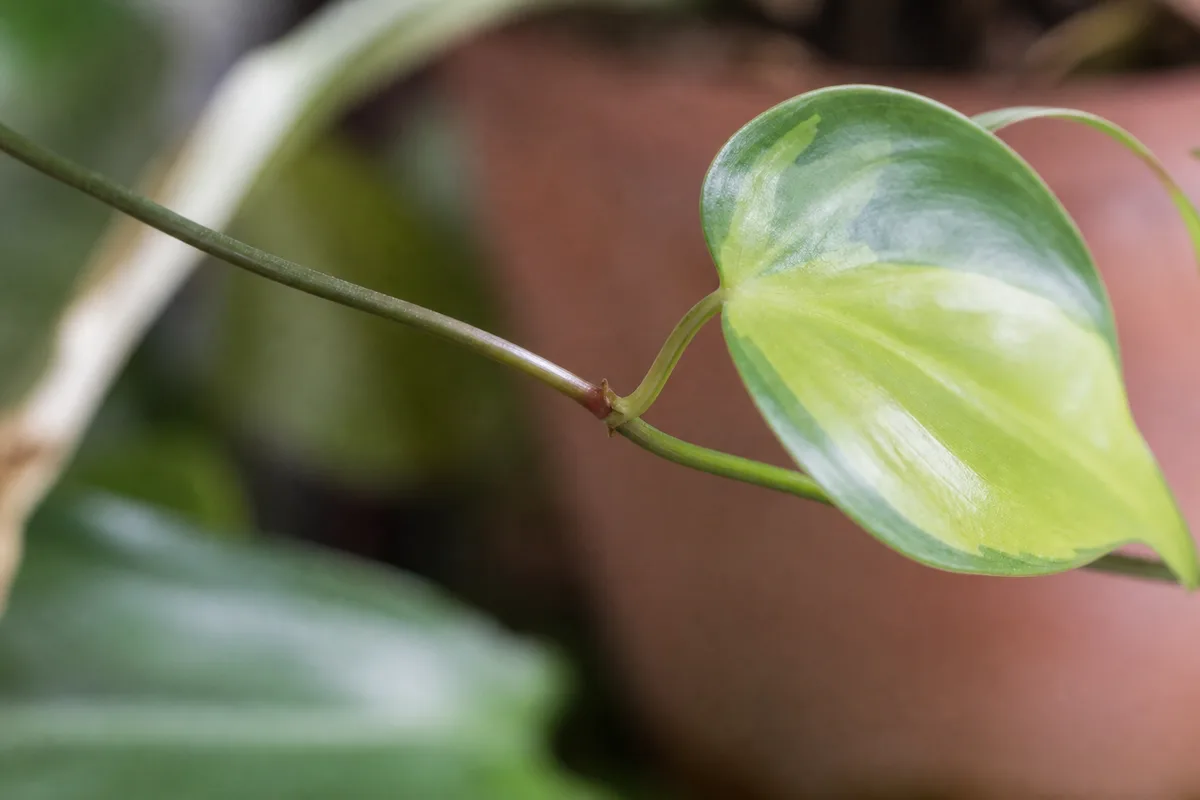
Some plants are built thin. A healthy pothos trailer with even node spacing and full-sized leaves is not “failing to thicken.” Heartleaf philodendron, string-of plants, and many ferns keep slender petioles or stems as normal architecture. Genetics sets the baseline diameter; light and culture decide whether new growth matches that baseline or collapses into stretch.
Use this quick habit map before you panic:
| Plant type | What “normal thin” looks like | What stretch looks like instead |
|---|---|---|
| Trailing vines (pothos, heartleaf philodendron) | Even slender stems, leaves full-sized for the plant | Sudden longer gaps + smaller/paler new leaves after a darker move |
| Self-heading / upright aroids | Thicker petiole bases, denser canopy | Tall skinny petioles reaching a window with sparse leaves |
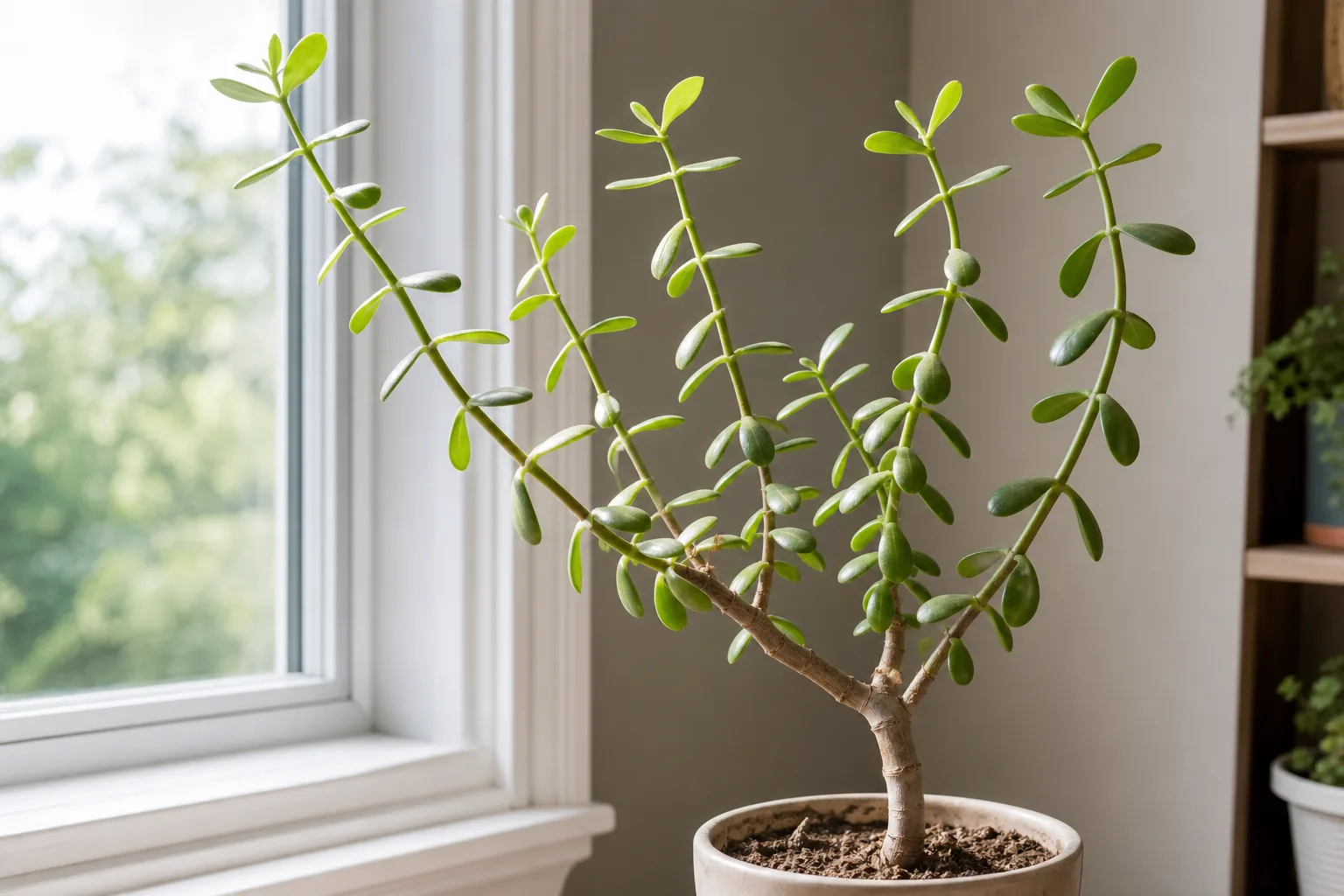
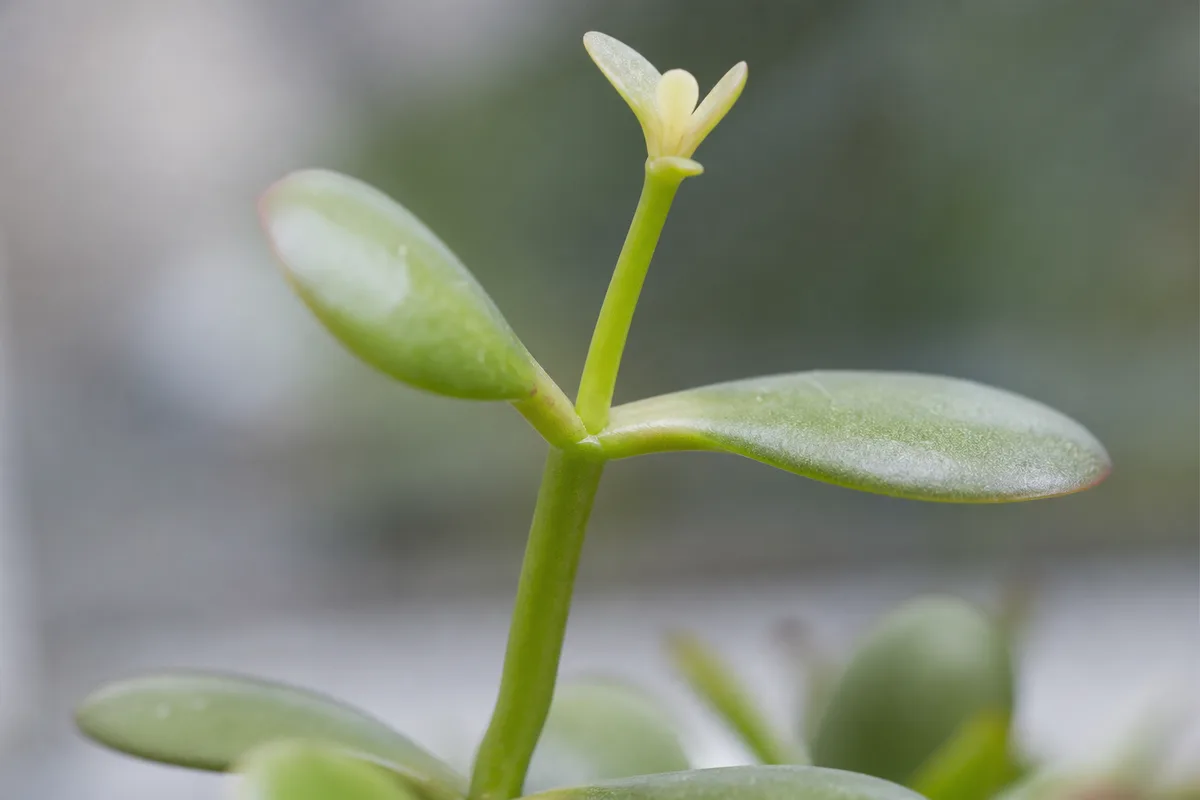
| Succulents (jade and similar) | Firm, proportioned stems for the cultivar | Elongated, weaker stems with widely spaced leaves after low light |
The tell is consistency. If older and newer stems match in thickness and leaf size, and the plant is growing on schedule for the season, you are looking at habit. If only the newest growth thinned out after a move to a darker room, habit is not the explanation. For cultivar norms on jade plant or Philodendron Brasil, check the plant hub before you prune “for thickness.”
Why Light Comes First
Light is the energy budget for every cell wall the plant builds. Without enough usable light, fertilizer, fancy soil, and humidity gadgets cannot invent thick stems. UGA Extension states that of all factors affecting indoor plant growth, adequate light is by far the most important. (University of Georgia Extension) Clemson HGIC likewise calls adequate light the most important environmental factor for indoor plants and notes that a well-lighted home is often under 100 foot-candles while outdoor sun can exceed 10,000. (Clemson HGIC)
That gap explains why a plant that “looks fine” on a bookshelf slowly produces thinner stems. The room feels bright to you. The leaf is still energy-starved.
Your Eyes Misjudge Indoor Intensity
UF/IFAS Gardening Solutions explains that human eyes adapt so well that a desk by a window can be many times brighter than a workspace across the hall, yet both may look like “bright indirect light” after a few minutes. (UF/IFAS Gardening Solutions) Plants do not get that adaptation. Measuring at leaf height — with a handheld meter when you can, or a phone app for relative comparisons — beats guessing from how the room feels.
UF/IFAS midday ranges are a practical map: about 25–100 foot-candles for low, 100–500 for medium, 500–1000 for high, and over 1000 for direct sun exposures. (UF/IFAS Gardening Solutions) Match the reading to the species, not to your furniture layout. Phone apps are useful for ranking spots in the same room; handheld meters are better when you need absolute foot-candle bands.
Distance, Windows, and Winter Stretch
Intensity falls off fast as you pull a pot away from glass. A plant two meters back from a bright window may sit in a different light class than the sill plant that looks “in the same room.” Window aspect, outdoor trees, curtains, and season all change the reading. RHS notes that in winter, when sunlight is weaker, many houseplants benefit from moving closer to south- or west-facing windows, and that wiping dust off leaves lets more light reach the surface. (RHS)
UGA also links temperature to the light problem: high temperatures speed respiration, so under low light the plant may burn through sugars with little left for growth. (University of Georgia Extension) Warm, dim rooms are a classic recipe for thin, stretched winter stems.
Soft Tissue and Root Checks
Soft thin stems need a root look before a light upgrade. Slide the plant out, check for brown mushy roots versus firm white or tan roots, and note whether the mix smells sour. Overwatered plants with damaged roots cannot support even modest canopies, so staking them upright only hides the failure. UConn describes the overwater-wilt cycle clearly: dead roots cannot take up water, the plant still looks wilted, and more water makes it worse. (UConn Home & Garden Education Center)
If roots are compromised, trim dead tissue, repot into a porous mix with drainage, and correct watering before you expect thicker new stems from brighter light. For the full salvage path, use the root rot guide and how to water indoor plants the right way.
Step-by-Step Diagnosis Order
Work in this order so you do not prune soft tissue or feed a plant that cannot use the nutrients.
- Compare new vs old internodes and leaf size on the same stem.
- Squeeze the newest stem gently — firm stretch vs soft collapse.
- Note lean direction and whether the pot/root ball is stable.
- Measure light at leaf height midday.
- Check soil moisture and root color if tissue is soft or growth is stalled.
- Only then decide: more light, watering correction, support, or accept habit.
If light is the clear limit, keep working the intensity checks in this guide before you fertilize. If the plant is firm but tipping toward glass, use plant leaning triage. If growth is undersized and stuck without long internodes, compare with stunted growth and plant not growing.
Fix Path: Move Closer, Then Grow Lights
Existing etiolated stems will not thicken or shorten. Recovery shows in the next leaves and internodes. Your job is to stop the next round of stretch, then reshape what you no longer want.
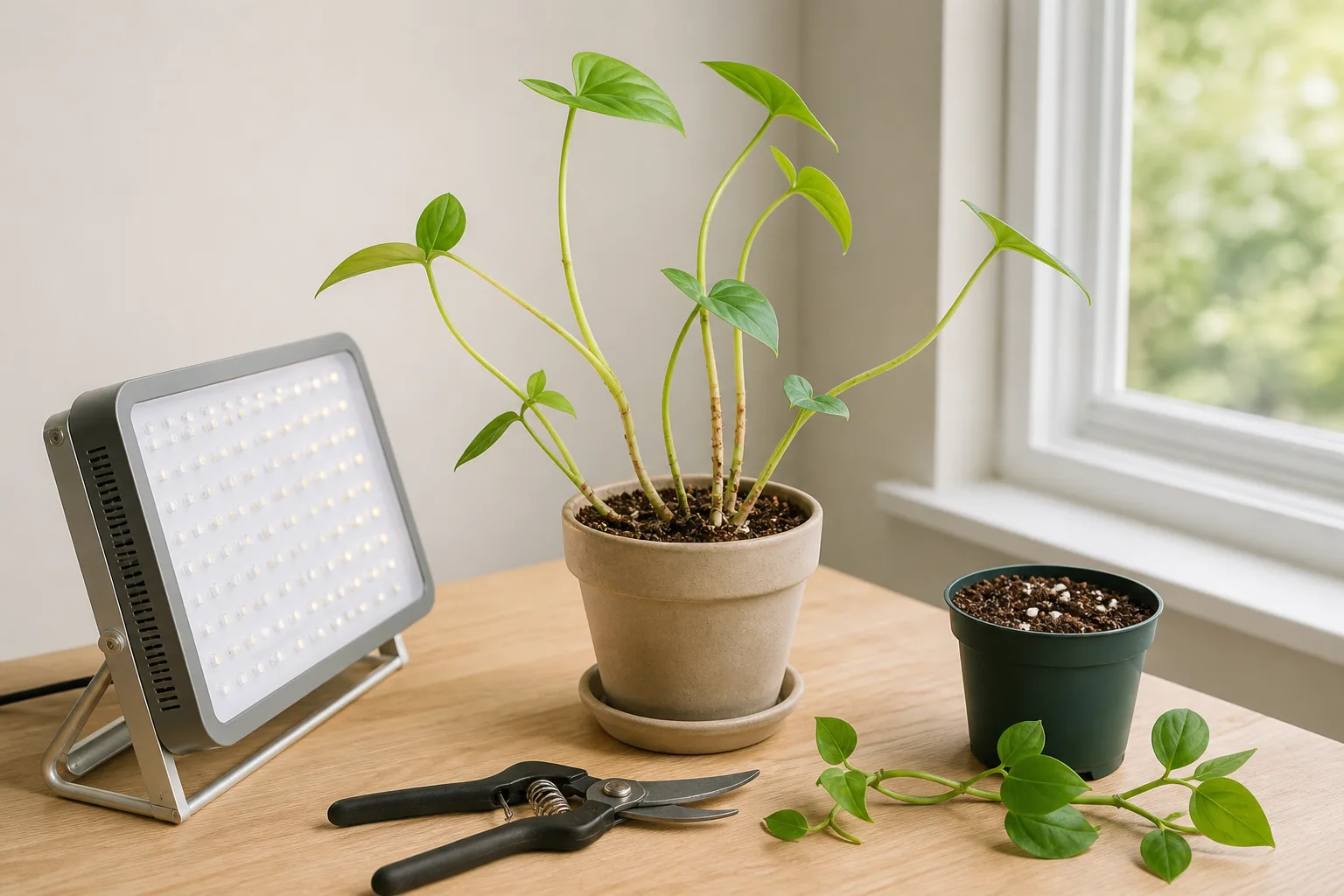
Move the plant gradually into stronger appropriate light. Maine Extension advises acclimating etiolated plants to brighter conditions over several days to avoid sun scald. (University of Maine Cooperative Extension) Missouri Botanical Garden gives the same caution: a sudden jump from shade to harsh sun can burn leaves even when the plant needs more light overall. (Missouri Botanical Garden)
If the brightest safe window still reads too low for the species, add a full-spectrum grow light. Clemson notes that ordinary incandescent lamps are a poor choice because plants under them tend to stretch or become leggy, while fluorescent or special plant lamps work better, and about 16 hours of light with 8 hours of dark suits most plants. (Clemson HGIC) UConn suggests placing a plant within about three feet of a lamp for evening hours when no brighter spot exists, preferably with a wide-spectrum or grow bulb. (UConn Home & Garden Education Center) For fixture distance, timers, and PPFD basics, use the grow lights guide.
Rotate the pot a quarter turn every week or two so new growth does not permanently thin out on the shaded side.
Prune and Propagate After Light Improves
Once new growth starts coming in shorter and thicker, prune the worst stretched stems back to a node that still has healthy leaves or latent buds. UConn notes that after you move a plant to a brighter spot and new growth appears, some of the more spindly stems can usually be pruned out. (UConn Home & Garden Education Center) On vines such as pothos and philodendron, tip cuttings from healthy nodes can refill the pot while you discard the bare ladder of stretch.
Do not prune first in a dark corner and expect bushiness. New shoots in the same dim spot will thin out again. Light first, then cut. Wait for two to four better leaves before a major reshape so you can confirm the new internodes are actually shorter.
What Will Not Fix Thin Stems
Fertilizer does not replace photons. UGA notes that without new growth, a plant has limited need for more fertilizer, and that small leaves with longer internodes on new growth are a cue to decrease fertilizer rate — a pattern that often rides with low light rather than hunger alone. (University of Georgia Extension) Clemson adds that indoor plants in low light have reduced fertilizer needs, and winter rest periods should mean little or no feeding. (Clemson HGIC)
Staking will not thicken soft or etiolated tissue. It can support a top-heavy canopy after roots and light are sound, but it will not reverse stretch. Bigger pots, “growth hormone” sprays, and constant misting likewise will not turn etiolated internodes into compact wood. Fix the energy supply, then reshape.
Recovery Timeline and First-Hand Notes
Track the next two to four new leaves, not the old stems. Success looks like shorter internodes than the stretched run, leaf size that stabilizes or increases, firmer stem tissue, and less desperate lean toward the window. Pale stretch that continues after a move means intensity is still too low or the plant needs more hours under a grow light.
Old thin sections stay thin. That is normal. Prune them when the plant is producing better growth, or propagate and restart if the whole canopy is a bare stem with a tuft at the tip. If new leaves stay tiny without long internodes, shift diagnosis toward small new leaves rather than pure etiolation.
LeafyPixels notes from indoor cases we tracked:
- Firm etiolation (bookshelf pothos): After moving a golden pothos from a north bookshelf to an east sill plus a 12-hour grow light, the next three leaves showed shorter internodes within about five weeks. The old ladder of stretch stayed skinny; tip cuttings filled the pot after week six.
- Soft weak growth (wet philodendron): A heartleaf philodendron with limp thin stems had brown mushy roots after chronic saucer water. Brighter light alone did nothing until roots were trimmed and the mix was replaced. New firm growth returned only after watering corrected.
- Genetics false alarm (jade): A jade that “looked thin” matched older stem diameter and leaf size along the same branch. No internode jump after a room change — habit/cultivar form, not etiolation. We left it alone and only confirmed light was still adequate for compact succulent growth.
How This Differs From Leggy and Not-Enough-Light Guides
Search often lumps “thin,” “leggy,” and “not enough light” together. On LeafyPixels they are related but not interchangeable:
- This guide answers “why are the stems skinny?” with a three-way filter: firm etiolation, soft stress, or genetics/habit.
- Leggy plants focuses on stretch/legginess as the shape complaint and the prune-after-light reshape path.
- Not enough light is the full intensity diagnosis hub — meters, window classes, and recovery scoreboard when light itself is the topic.
Use this page when stem diameter and firmness are the confusing part. Jump to the siblings when your main word is “leggy” or you already know light is the bottleneck and need deeper intensity troubleshooting.
Related Guides
- Not enough light — meter checks and recovery scoreboard when intensity is the limit.
- Plant leaning — firm phototropism vs soft collapse vs unstable pots.
- Leggy plants — stretch-focused fix order overlapping thin-stem etiolation.
- Root rot — soft thin stems tied to damaged roots.
- Grow lights — fixtures, distance, and photoperiod when windows cannot deliver enough light.
Conclusion
Use this recovery checklist once you have labeled the pattern:
- Confirm firm stretch vs soft collapse vs consistent habit on the same plant.
- Raise light gradually (or fix roots first if tissue is soft).
- Score the next 2–4 leaves: shorter internodes, better leaf size, firmer tissue.
- Prune or propagate old skinny sections only after new growth improves.
- Skip fertilizer and stakes until the energy or root problem is solved.
New growth is the scoreboard. Old thin stems stay thin — and that is expected — while shorter, stronger internodes tell you the fix is working.