Low Humidity on Amla: Causes, Checks & Fixes
Quick answer
Amla (Phyllanthus emblica) is a drought-tolerant subtropical fruit tree that prefers dry climates and rarely needs a humidifier outdoors. Crispy leaflet tips, wilting, or bare branchlets usually trace to underwatering, dry terrace wind on young pots, winter dormancy, or spider mites in hot dry corners—not room humidity alone. First step: read a hygrometer near the pot; if you are already in the 30–50% range, check soil moisture at 3–5 cm depth and wind exposure before raising humidity.
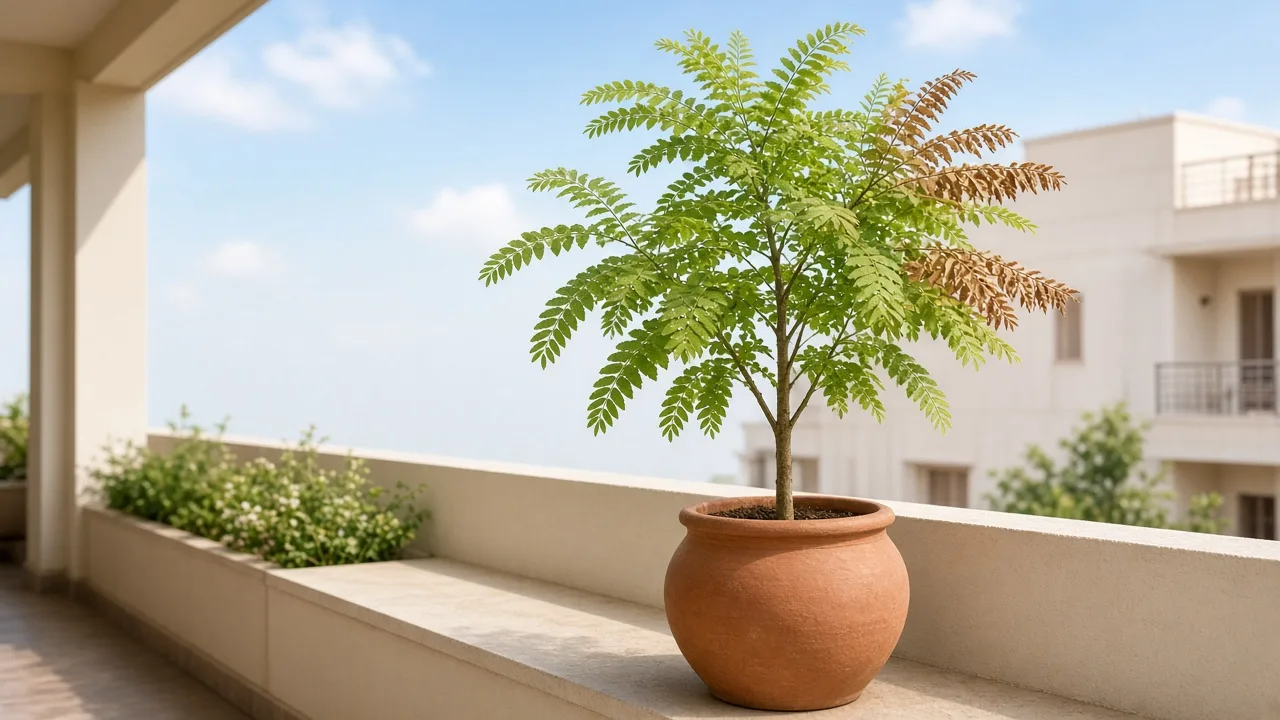
Low Humidity on Amla: Causes, Checks & Fixes
This guide covers low humidity on Amla. See also the general Low Humidity guide, watering, and light pages for this plant.
Low Humidity on Amla: Causes, Checks & Fixes
Quick answer
Amla (Phyllanthus emblica, Indian gooseberry) is a subtropical fruit tree that prefers dry climate and is drought tolerant once established. It grows in both humid and semi-arid regions across tropical Asia—not a fern or calathea that needs steamy rooms. For how dry winter air crisp leaf edges on houseplants in general, see our low humidity hub. On amla, low humidity is usually a misdiagnosis—papery leaflet tips, wilting branchlets, or a suddenly bare canopy more often trace to underwatering on a sunny terrace, dry wind on young grafts, normal winter deciduous rest, or spider mites in hot dry micro-climates.
First step: place a hygrometer near the pot for two to three days. If readings sit in the 30–50% range most homes already provide, move the pot out of heating-vent paths or dry wind corridors and check whether the top 3–5 cm of mix is dry before buying a humidifier.
When to use this page vs other Amla guides
| Your question | Best page |
|---|---|
| Crispy leaflet tips in dry indoor overwintering | This page |
| Whole canopy wilting on a light pot in summer | Underwatering |
| Tan dry tips after weeks without water | Brown tips |
| Bare branchlets in January–February with no lesions | This page (winter rest section) |
| Fine stippling on feathery leaflets in a hot window | Spider mites |
| Yellowing on wet soil after monsoon | Overwatering |
| Sparse stretched growth in shade | Not enough light |
What low humidity looks like on Amla
Healthy amla carries feathery pinnate leaves on slender branchlets—dozens of small light-green leaflets per stem on a sun-loving terrace tree, not one broad tropical blade. Dry-air stress shows on those tiny leaflets, not as the classic “crispy fern frond” pattern.
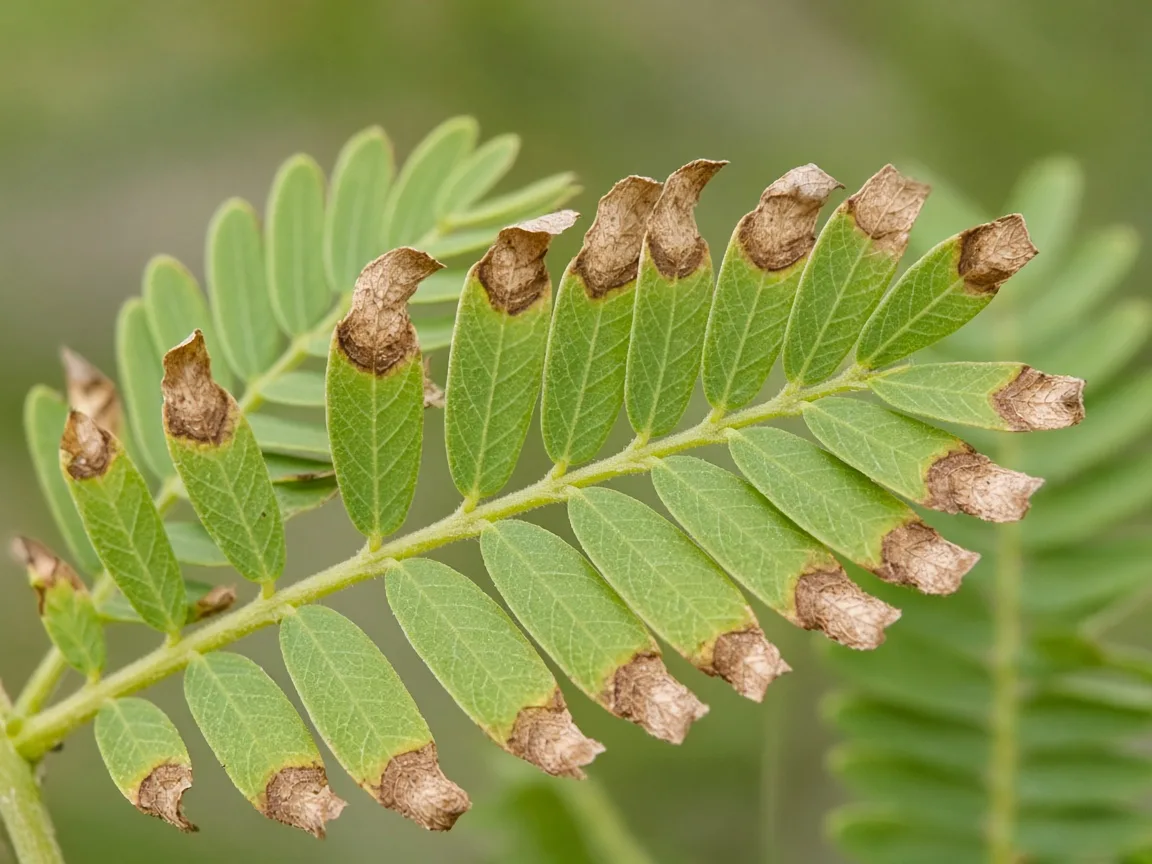
Papery brown tips on individual amla leaflets along a feathery branchlet—compare wind-side crisping with uniform winter dormancy drop.
Typical signs when dry air is actually involved:
- Papery brown tips on the smallest leaflets along new branchlet flush
- Crisp edges on one wind-exposed side of a terrace pot while the leeward face stays green
- Slow leaflet tip burn over weeks beside a heating vent or AC return during indoor overwintering
- Young graft stress in small nursery pots that dry within a day on a roof—often drought plus dry wind, not whole-room humidity
Usually not low humidity:
- Uniform leaflet drop on bare wood in late winter — normal deciduous rest before the March flush
- Wilting with a very light pot and dry mix to 3–5 cm depth — underwatering
- Premature fruit drop after a heat spell without deep watering — drought during flowering and fruit set, not humidity limits
- Stippling and fine webbing on leaflet undersides — spider mites in hot dry corners
Winter leaflet drop vs dry air: a pattern only deciduous amla shows
This distinction is mandatory for amla and wrong for evergreen houseplants.
Amla is a slow-growing deciduous tree that sheds leaflets seasonally. Useful Tropical Plants notes that while it is deciduous and sheds branchlets as well as leaves, it is seldom entirely bare—which is why growers panic when January–February leaflets fall and blame dry air.
| What you see | More likely cause |
|---|---|
| Uniform leaflet drop, bare branchlets, firm wood, cool season | Normal winter dormancy |
| Crisp tips on new flush only, stems still firm | Localized dry air or dry wind |
| Many leaflets drop off-season + light pot + dry mix | Underwatering |
| Wilting branchlets on wet sour mix | Root rot — never humidify first |
| Stippling on tender winter shoots | Aphids or spider mites in dry indoor air |
Judge health by firm branchlets and clean new flush in spring, not by every lower leaflet staying attached through winter.
Why terrace amla rarely struggles with low humidity outdoors
Prefers dry subtropical climate. TNAU lists amla as subtropical and preferring dry climate—the opposite of humidity-demanding understory plants. Orchard practice in India often needs irrigation timing, not misting canopies.
Drought-tolerant architecture. PFAF describes emblic as tolerant to drought and forest fire, with deep roots that handle short dry spells once established. Chronic wet roots kill amla faster than dry winter air on a sunny terrace.
Wide humidity tolerance in native range. The species succeeds in both humid and semi-arid areas with annual rainfall from roughly 700–4,200 mm. Moderate humidity around 40–60% matches the Amla hub comfort band—ordinary North Indian plains air is usually adequate outdoors.
Dry wind on young pots is the real outdoor enemy. A newly grafted tree in a small polybag on an exposed roof dries out from wind plus evaporation in full sun, not from atmospheric humidity alone. That looks like crispy leaflet tips but fixes with deeper watering rhythm and wind shelter, not a humidifier.
Spider mites in hot dry micro-climates. Colorado State Extension reports dry weather greatly favors spider mites on houseplants. Amla beside sunny glass during indoor overwintering creates the same hot, dry pocket—inspect spider mites before raising humidity.
The branchlet-and-pot-weight check (feathery leaflets, not frond turgor)
On ferns you watch frond tips. On amla you watch slender branchlets and pot weight.
- Pinch a mid-canopy branchlet. Flexible green wood with firm leaflets means the tree is hydrated.
- Finger-test the top 3–5 cm of mix per the watering guide. Dry depth plus light pot weight overrides any humidity reading.
- Map wind exposure — one-sided crisping on the terrace railing side points to dry wind, not whole-room dry air.
- Inspect new flush at branch tips — clean emerging leaflets confirm recovery; uniform winter bare wood without lesions is rest.
Soft stems at the soil line on wet mix are never humidity issues—switch to overwatering diagnosis immediately.
How to confirm the cause
Work through checks in this order:
- Measure humidity with a hygrometer at pot height for two to three days. Penn State Extension notes ASHRAE recommends 30–60% indoor relative humidity; readings in that band mean normal home air is adequate.
- Map placement — heating vents, AC returns, fireplace drafts, and exposed roof edges that amplify dry air on one canopy face.
- Soil moisture at 3–5 cm depth — dry mix plus wilting branchlets point to underwatering, not humidity.
- Season calendar — bare branchlets in January–February on firm wood likely mean dormancy, not dry air stress.
- Pest check — magnify leaflet undersides and tender winter shoots for stippling or webbing.
- Fruit and flower timing — premature drop during heat without deep watering tracks drought during fruit set, not humidity alone.
If humidity is normal, watering rhythm is steady, and branchlets stay firm, low humidity is unlikely to be the main driver.
First fix for Amla
If humidity readings stay below about 30% near an indoor overwintering pot: move the tree away from heating vents and draft paths, then group it with other plants or run a small room humidifier until readings stabilize around 40–60%. Do not mist feathery foliage—wet leaflets in stagnant balcony corners invite fungal spotting after monsoon-style damp nights.
If humidity is already 30–50% outdoors or indoors: skip the humidifier. Shelter young grafts from dry terrace wind, confirm the deep-when-dry watering rhythm, and rinse leaflet undersides with a strong water jet if spider mites are suspected.
Make one correction at a time. Do not repot, fertilize, and humidify on the same day.
Step-by-step recovery
If leaflet crisping continues after placement is fixed:
- Deep soak when dry — water only after the top 3–5 cm of well-draining loam is dry
- Wind shelter for young pots — move small grafts off exposed railing corners until the canopy fills out
- Treat spider mites if stippling is confirmed — see spider mites on amla
- Hold fertilizer until new branchlet flush emerges clean
- Trim only fully dead leaflet tissue — crisp tips will not regreen; wait for new pairs on upper branchlets
During flowering and fruit set, keep moisture steady through the pot—not mist on foliage—per the watering guide.
Recovery timeline
- 1–2 weeks: Localized tip crisping from a heat vent or wind corridor often stops once the pot is moved
- 2–4 weeks: New branchlet flush with clean leaflets confirms watering and placement fixes are working
- One season: Lower stem sections may stay sparse between natural leaf cycles—that is normal tree architecture, not failed recovery
Crisp leaflet tips do not reattach. Judge success by firm branchlets and clean new flush on spring extension, not by old nodes refoliating overnight.
Lookalike symptoms
| What you see | More likely cause than low humidity |
|---|---|
| Light pot, dry mix, wilting branchlets | Underwatering |
| Soft base, sour soil, off-season drop | Overwatering / root rot |
| Bare wood in late winter, firm branchlets | Normal deciduous rest |
| Stippling + fine webbing on leaflets | Spider mites in hot dry air |
| Whole canopy pale and stretched | Not enough light |
| Premature fruit drop in heat without watering | Drought during fruit set |
Low humidity vs. spider mites: Mites leave stippling and webbing on feathery leaflets—common in hot dry overwintering spots but a pest issue. Humidifying without treating mites lets populations explode while soil stays wet too long.
Low humidity vs. brown tips: Brown tips from salt or drought often follow visible underwatering history; dry-air crisping is more localized beside vents or wind paths.
What not to do
- Do not mist feathery amla canopies to raise humidity—wet leaflets plus poor airflow worsen leaf-spot fungi after rains.
- Do not keep outdoor terrace trees in steamy bathrooms for humidity—they need full sun, not saturated rooms.
- Do not overwater because leaflets look dry. Waterlogged roots fail faster than dry winter air on established trees.
- Do not fertilize a stressed tree to speed recovery—salt burn worsens tip browning on sensitive new flush.
- Do not panic during January–February leaflet drop on firm wood—that is seasonal rest, not a humidifier emergency.
How to prevent low-humidity stress next time
Keep amla in ordinary humidity without special equipment outdoors:
- Run a hygrometer once each heating season if you overwinter container trees indoors.
- Pull pots back from radiator ledges, heat registers, and exposed roof wind tunnels.
- Maintain full sun, sharp drainage, and deep-when-dry watering so the tree is not drought-stressed while air is dry.
- Shelter newly grafted nursery pots until roots fill the container.
- Inspect tender winter shoots for mites when indoor air is driest.
Penn State Extension suggests that if humidity is comfortable for you, most houseplants tolerate winter levels—and drought-tolerant fruit trees like amla need even less intervention outdoors.
Amla care cross-check
Align humidity work with this species’ baseline needs:
- Light: Six or more hours of direct sun on a terrace; weak light slows drying and invites overwatering mistakes read as humidity stress
- Water: Deep soak when the top 3–5 cm dries; established trees tolerate short drought better than wet feet
- Soil: Sandy loam with excellent drainage—chronic wet mix plus humid stagnant corners is worse than dry air
- Temperature: Comfortable growth near 20–35°C; protect young pots from frost and dry cold wind together
When air is dry and soil stays wet too long, fix drainage and watering before humidifying.
Practical checks
Urgency check
Low humidity alone is a slow-moving, medium-severity issue on amla outdoors. Escalate immediately if branchlets soften at the base, the mix smells sour, or the tree wilts on wet soil—that is root-zone failure, not dry air.
Best inspection order
For amla, check hygrometer readings, soil moisture at 3–5 cm depth and pot weight, wind and vent placement, seasonal winter rest pattern, then leaflet undersides for pests—in that order—before adding humidity.
When the first fix fails
If leaflet crisping continues after four to six weeks with humidity in range and steady watering, flush the pot to remove salt buildup and revisit light levels for trees kept too long indoors. Persistent problems with wet soil point to repotting into sharper mix—not higher humidity.
Related Amla guides
Related tool
Use the Humidity Calculator to narrow causes for low humidity on this plant before changing multiple variables at once.