Holes in Leaves on Ashwagandha: Causes, Checks & Fixes
Quick answer
Holes in Ashwagandha leaves mean something removed tissue—hadda beetles, caterpillars, leaf miners, or mechanical tears—not a natural leaf pattern. First step: look at the hole edge, then inspect branch tips and hairy leaf undersides under bright light before you change watering or spray.
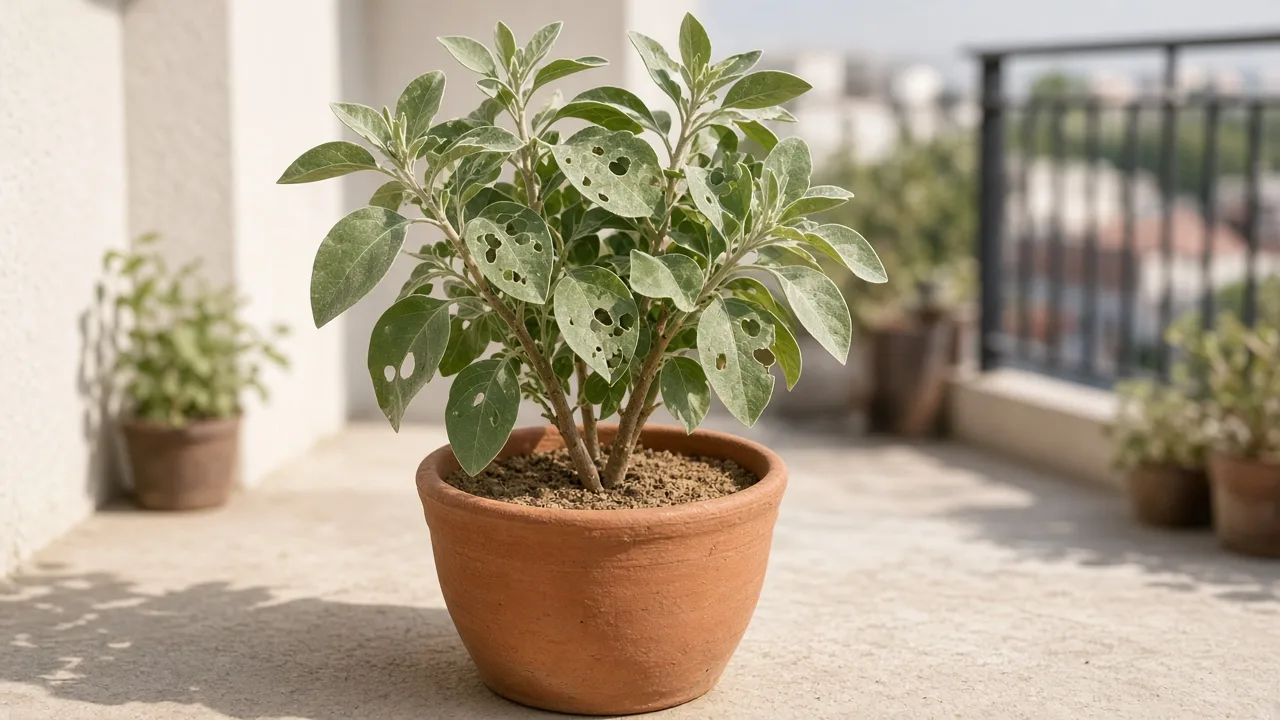
Holes in Leaves on Ashwagandha: Causes, Checks & Fixes
This guide covers holes in leaves on Ashwagandha. See also the general Holes in Leaves guide, watering, and light pages for this plant.
Holes in Leaves on Ashwagandha: Causes, Checks & Fixes
Quick answer
Holes in Ashwagandha (Withania somnifera) leaves mean something removed or tore tissue—chewing beetles, caterpillars, leaf miners, physical snags on a sunny terrace, or dried fungal spots that drop out. Unlike fenestrated monsteras, Ashwagandha keeps whole ovate blades covered in fine silver-gray hairs. Any open hole is damage, not a natural leaf pattern.
For how chewing pests and mechanical tears work in general, see our holes in leaves guide. On Ashwagandha, the diagnostic clue is usually on silvery-haired branch tips in full sun—where hadda beetles skeletonize foliage, cutworms chew ragged margins, and leaf miners leave bordered trails inside the blade.
First step: look at the hole edge, then inspect the newest leaves and hairy undersides along branch tips under bright light. Ragged chew marks with frass need a different fix than a clean tear on one leaf that brushes a balcony rail.
When to use this page vs other Ashwagandha guides
| Pattern | Start here | Or route to… |
|---|---|---|
| Ragged holes with frass on branch tips | This page | Caterpillars |
| Orange-and-black beetles skeletonizing leaves | This page | Scale insects if bumps are stationary |
| Serpentine tunnels inside the blade | Leaf miners | This page if holes are full-thickness |
| Silver streaks, scarred buds, deformed new tips | Thrips | — |
| Brown halos before tissue drops out | Black spots | — |
| Soft mushy stems at the crown on wet mix | Root rot | Firm stems with holed foliage only |
What holes in leaves look like on Ashwagandha
Ashwagandha leaves are dull green to silvery, ovate, and covered in fine branched hairs. They grow alternately along erect woody stems, often opposite pale green flower shoots at the nodes. When you see a hole, sort it by pattern:
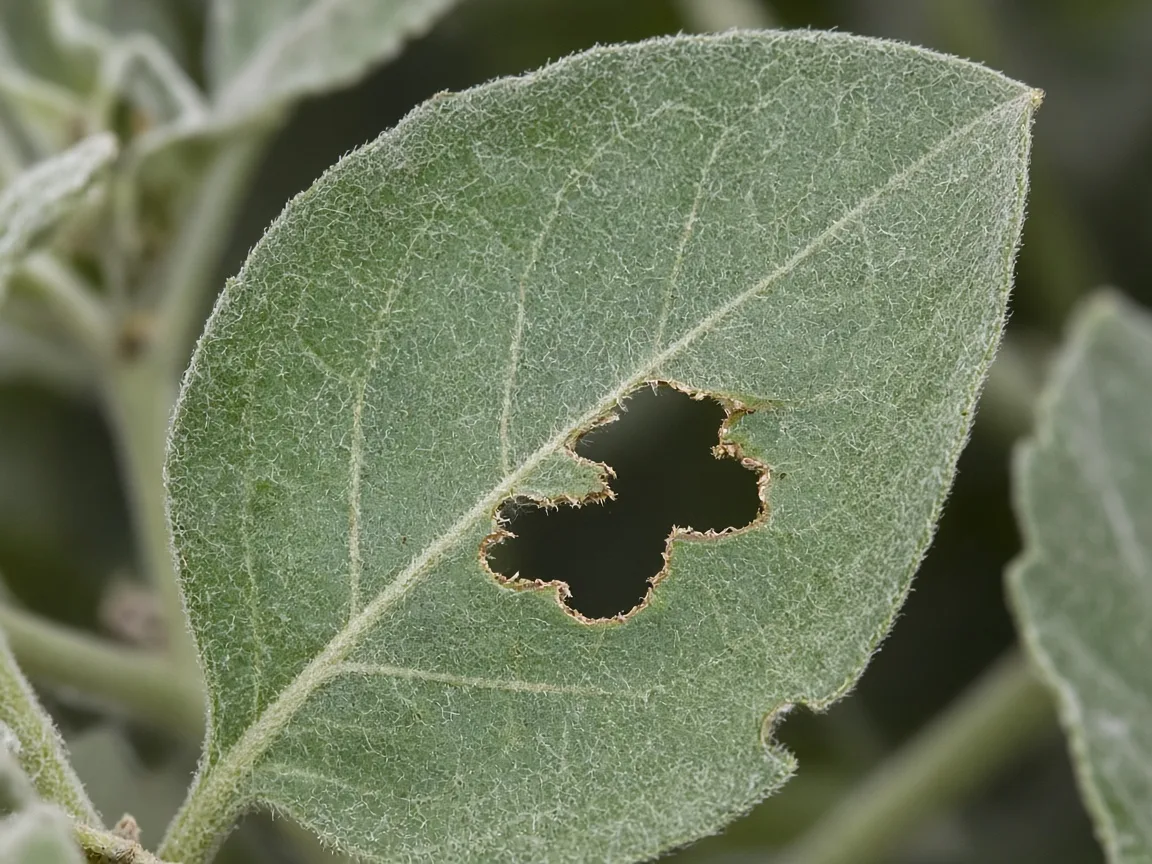
Ragged chew holes through Ashwagandha’s hairy leaf blade—compare hole edges with healthy silvery tissue on the same plant.
Hadda beetle skeletonization — Round to irregular holes and window-pane feeding where only the upper epidermis remains. Orange-and-black spotted beetles (Henosepilachna vigintioctopunctata) feed on the leaf surface, often in groups on sunny terrace plants and field-grown Ashwagandha. Heavy attacks can strip most foliage in late summer.
Caterpillar chewing — Irregular holes and notched margins on soft new leaves at branch tips. Dark frass pellets on leaves, stems, or the pot rim below. Cutworms and other moth larvae can consume several leaves per day per caterpillar on young shrubs. See caterpillars on Ashwagandha.
Leaf miner trails — Winding pale or brown tunnels inside the hairy blade with only a small exit hole—not a large ragged chew. Hold the leaf to light to see a bordered trail. See leaf miners.
Thrips rasping — Tiny scrape marks, silvery streaks, and black varnish-like specks; full-thickness holes are less common than stippling on new tips. See thrips.
Terrace mechanical tears — Clean linear splits or one-time holes on outer leaves that brush balcony rails, shelf lips, or neighboring pots. Damage stays on the same leaf after you reposition the stem; no frass, no internal trails.
Shot holes from old leaf spots — Small round holes where necrotic tissue dropped out after black spots or fungal lesions dried—usually with preceding brown halos, unlike clean mechanical tears.
Reading hole edges on hairy Ashwagandha blades (Ashwagandha only)
The fine silver tomentum on Ashwagandha leaves can hide frass and small beetles until you brush the surface with a finger or rinse the blade. Ragged, irregular margins with torn hair tufts point to chewing insects. A clean straight break through the blade with no surrounding discoloration usually means the stiff leaf caught on a railing or pot edge—not a pathogen. If the hole edge is bordered by a pale internal trail visible when backlit, suspect leaf miners inside the tissue, not surface beetles.
Hadda beetle on solanaceous terrace plants (Ashwagandha only)
Ashwagandha is in the nightshade family, and hadda beetles are a documented polyphagous pest on field-grown Ashwagandha in India—often moving from eggplant and other solanaceous crops to medicinal plantings. On home terraces, the same orange-spotted beetles may appear on sunny pots grouped near peppers or tomatoes. They feed on the leaf surface in daylight, skeletonizing tissue between veins. That daytime, group-feeding pattern is unlike nocturnal cutworms and unlike aphids, which pierce sap without chewing full-thickness holes.
Root-harvest caution before you spray (Ashwagandha only)
Many growers keep Ashwagandha for roots, not ornamental foliage. Before reaching for broad-spectrum insecticides on holed leaves, remember that all parts are poisonous if eaten and systemic chemicals can move into harvested tissue. Hand-picking beetles and caterpillars, pruning mined leaves, and rinsing foliage usually fit medicinal use better than heavy sprays—especially within weeks of a planned root dig per the Ashwagandha repotting guide.
Why Ashwagandha gets holes in leaves
Chewing pests are the most common cause of true holes on sun-grown Ashwagandha. Field guides list leaf-eating caterpillars among common Ashwagandha pests, and hadda beetle outbreaks can cause severe defoliation on outdoor plantings. Container plants on sunny balconies pick up the same insects from neighboring nightshades, open windows, or nursery stock.
Soft new shoots at branch tips are the first target. Ashwagandha pushes its tenderest tissue at stem tips and at nodes opposite flowering shoots during warm active growth. Caterpillars and beetles concentrate there while older silvery leaves lower on the stem stay intact until populations build.
Outdoor summer placement brings eggs indoors. Terrace pots grouped near peppers, tomatoes, or eggplant share solanaceous pests. Damage often appears weeks after a plant returns to a windowsill—one beetle or caterpillar can open several holes on sequential new leaves because growth concentrates at each branch tip.
Leaf miners tunnel inside hairy blades. Leaf miner larvae feed between leaf surfaces for about two weeks in warm conditions before exiting to pupate. On Ashwagandha’s relatively thin ovate leaves, trails show clearly when you backlight the blade—uncommon indoors but common after outdoor summer time.
Mechanical damage on terrace rails. Erect woody stems with stiff leaves catch on balcony corners, hanging basket chains, and crowded shelf edges. A single clean tear on one accessible outer leaf that never spreads is often placement, not pests.
Fungal spots can fall out. Chronic wet foliage in dim rooms can precede black spots; dried centers sometimes drop, leaving small shot-hole appearance—usually with preceding brown halos, unlike clean mechanical tears.
Ashwagandha does not develop natural perforations. If someone suggests holes are normal fenestration, that advice applies to different species—not this medicinal shrub.
How to confirm the cause
Work through these checks in order:
- Edge test — Ragged, irregular margin with chew marks → insects. Clean linear tear → mechanical snag. Serpentine trail visible when you backlight the leaf → leaf miner.
- Frass or beetles — Dark pellets on leaves or below the pot → caterpillars. Orange-and-black spotted beetles on the leaf surface → hadda beetle. Neither → consider mechanical tears or old fungal shot holes.
- Branch tips first — Inspect the backs of the newest leaves and nodes opposite flower shoots. Active feeding usually hits soft tissue at tips before older hairy blades lower on the stem.
- Night patrol — Check leaf axils and soil line with a flashlight after dark. Cutworms feed when room lights are low.
- Daylight beetle scan — Hadda beetles feed in daylight on the leaf surface; tap a suspect leaf over white paper and look for falling beetles.
- Timeline — New holes on different leaves weekly signal active feeding. One unchanged tear for a month suggests past snag or contact damage.
- Stem-base press — Firm erect stems with holes only on foliage point to pests. Soft mushy tissue at the crown on damp mix means rot—see root rot before you spray.
- Neighbor check — Holes on Ashwagandha plus similar damage on nearby peppers or tomatoes strongly suggest solanaceous beetles or caterpillars shared across pots.
First fix for Ashwagandha
Photograph the holed leaf, examine the hole edge, then inspect every branch tip and hairy leaf underside before you spray or change watering.
| Confirmed pattern | First fix |
|---|---|
| Hadda beetle on leaf surface | Isolate and hand-pick beetles into soapy water; repeat daily at dusk and dawn |
| Caterpillar or frass found | Hand-pick larvae from tips and soil line; see caterpillars |
| Serpentine trail inside leaf | Pinch off and bag affected blades; see leaf miners |
| Clean tear on one leaf along a rail path | Reposition the pot or trim the snagged leaf—no pesticide |
| Shot holes with old brown halos | Improve airflow and dry-down watering; see black spots |
Do not change watering or fertilize a holed Ashwagandha before you know whether insects are active. Extra nitrogen pushes soft new growth that chewers prefer. Do not compost mined or beetle-stripped leaves where insects can disperse.
Isolate infested plants away from other nightshades on the same terrace shelf immediately when you confirm live feeders.
Step-by-step recovery
After the first targeted fix:
- Re-inspect every three to five days for two weeks—one missed beetle or caterpillar can open new holes on the next branch-tip flush.
- Hold isolation until no new damage appears on emerging tips.
- Rinse dusty hairy leaves monthly on terrace plants to dislodge early colonizers and improve your view of new damage.
- Prune only when necessary — Remove leaves more than half destroyed after pests are gone. Partial holes on green blades still photosynthesize and feed root development.
- Adjust placement — Route erect stems away from railings and heating vents; keep full sun without constant leaf scrape.
- Scout after outdoor time — Rinse and quarantine patio Ashwagandha before mixing it back into your collection.
Recovery timeline
| Phase | Timing | Good sign | Bad sign |
|---|---|---|---|
| After first fix | Days 1–5 | No new holes on branch tips | Fresh chew marks on new leaves |
| New growth | Weeks 2–4 | Clean silvery leaves at tips | Beetles return daily or trails spread |
| Cosmetic | Ongoing | Old holed leaves stable | Canopy skeletonized despite picking |
Holed tissue does not fill in. Judge recovery by clean new leaves at branch tips, not by old perforated blades. Ashwagandha in bright full sun with stable dry-down watering often outgrows light damage within two to four weeks once the cause is removed.
Lookalike symptoms to rule out
Yellow lower leaves without holes point to overwatering or not enough light—not chewing.
Brown crispy tips without open holes suggest brown tips from dry air or salt—not caterpillars.
Sticky honeydew without ragged holes suggests aphids, mealybugs, or whiteflies—sap feeders, not chewers.
Fine stippling and webbing suggest spider mites in dry rooms—not large irregular holes.
Curling without holes routes to curling leaves or drought stress—not this page.
Mistakes to avoid
Do not spray insecticide before confirming live pests—mechanical tears and old shot holes do not need chemical treatment.
Do not assume one holed leaf means the problem is solved. Follow every branch tip and check the soil line for cutworms.
Do not use heavy systemic insecticides on plants you plan to harvest for roots within the same season.
Do not keep Ashwagandha in shade to “reduce pest stress”—it cannot grow in shade and weak light changes the diagnosis without fixing holes.
Wear gloves when handling damaged Ashwagandha; all parts are poisonous if eaten, including leaves you prune away.
How to prevent holes next time
- Quarantine new Ashwagandha two weeks before mixing terrace collections.
- Scout branch tips weekly during warm active growth—beetles and caterpillars are easiest to catch early.
- Separate from eggplant and tomato pots when possible to limit solanaceous pest sharing.
- Rinse patio plants before winter bring-in; inspect hairy undersides on long stems.
- Route stems away from railings, shelf lips, and door frames they scrape daily.
- Keep full sun and dry-down watering per the soil and watering guides—stressed plants in wet mix are more vulnerable to secondary problems.
- Remove mined or heavily chewed leaves during weekly care before larvae pupate in soil debris beneath the pot.
When to worry
Escalate when:
- Fresh holes appear on multiple branch sections within a week
- Hadda beetles skeletonize most of the canopy despite daily hand-picking
- Leaf-miner trails spread through several new leaves
- Frass accumulates across the shrub while stems stay firm
- New tips stop expanding because tissue is stripped or mined
A single old tear on one outer leaf, with firm erect stems and clean new growth elsewhere, is usually not an emergency. Discard and restart from a stem cutting only when every leaf is mined or stripped, repeated treatment failed, and the plant has no clean tips left to salvage per the propagation guide.
Pet and child safety: Orange winter-cherry berries and all foliage are toxic if eaten. Keep pruned debris out of reach and contact your veterinarian or poison control if ingestion is suspected.
Conclusion
Holes in Ashwagandha leaves always mean damage—beetle skeletonization, caterpillar chewing, mining, tearing, or old spot drop-out—not a natural leaf pattern. Read the hole edge, inspect silvery branch tips and hairy undersides, and match the pattern before you spray or repot. Ashwagandha recovers quickly from light hits once the cause is gone; focus on clean new tips, quarantine discipline, and keeping terrace stems away from snags and shared solanaceous pests.
Related Ashwagandha guides
- Ashwagandha overview — placement, growth habit, and care baseline
- Ashwagandha watering — dry-down rhythm when holes are not the issue
- Ashwagandha light — full sun without weak, pest-prone growth
- Ashwagandha soil — sandy mix that protects roots
- Caterpillars on Ashwagandha — ragged holes with frass
- Leaf miners on Ashwagandha — internal trails and exit holes
- Aphids on Ashwagandha — sticky tips without chew holes
- Ashwagandha problems — browse all common issues
Related tool
Use the Plant Problem Diagnosis Tool to narrow causes for holes in leaves on this plant before changing multiple variables at once.