Brown Tips on Calathea Warscewiczii: Velvet Margins
Quick answer
Brown tips on Calathea Warscewiczii usually show up on the thin margin of a large velvety leaf—often while a new spear is opening—when dry air, fluoride-heavy tap water, or stressed roots cannot keep the fuzzy edge hydrated. First step: look at the newest rolled leaf and note whether you water with straight tap, filtered, or rainwater.
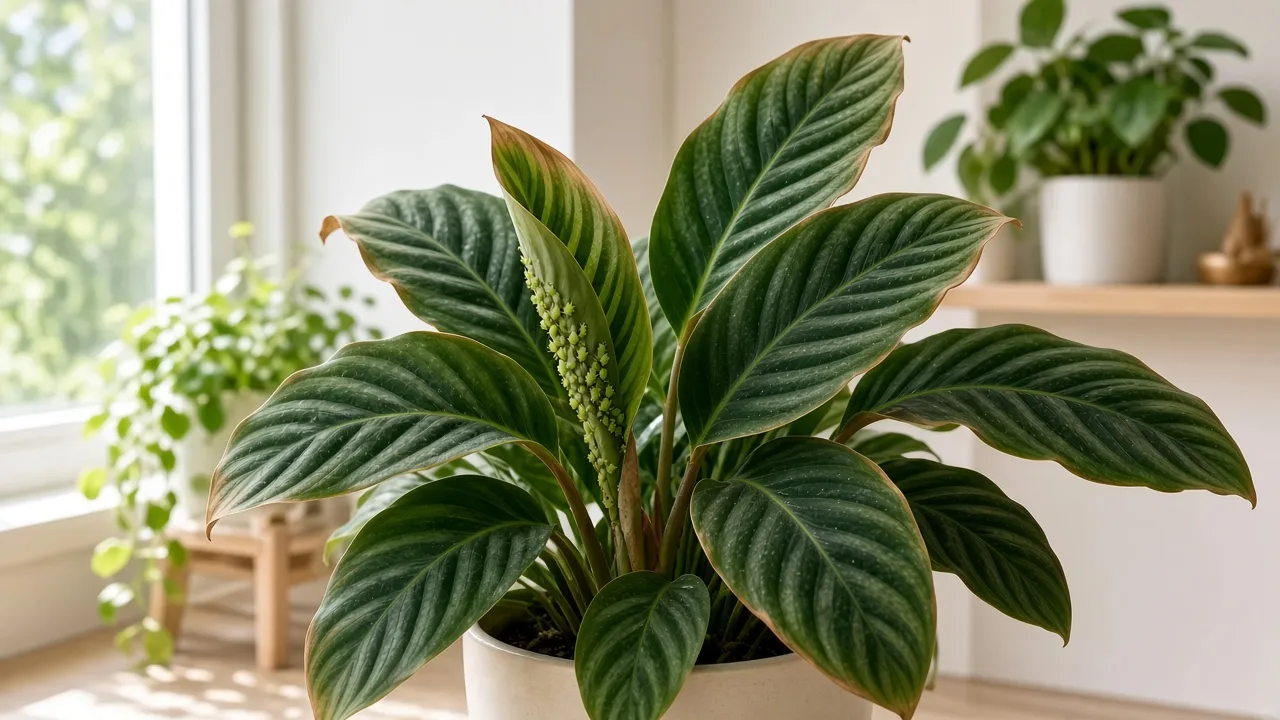
Brown Tips on Calathea Warscewiczii: Velvet Margins, Unfurls, or Water Quality?
This guide covers brown tips on Calathea Warscewiczii. See also the general Brown Tips guide, watering, and light pages for this plant.
Brown Tips on Calathea Warscewiczii: Velvet Margins, Unfurls, or Water Quality?
Quick answer
Calathea Warscewiczii (Goeppertia warszewiczii, Jungle Velvet) is a large-leaved prayer plant with velvety, lance-shaped foliage and burgundy-purple undersides—not the narrow zebra stripes of Freddie or the fishnet mosaic of Musaica. That size and texture change how brown tips look: damage often starts as dry tan tissue on the long thin margin of the newest spear, sometimes with the fuzzy pile looking dull or slightly curled before the blade fully opens. For how tip burn works on houseplants in general, see our brown tips hub. On Jungle Velvet, the first fork is the newest unfurl plus your water source—not a generic “water more” guess.
First step: inspect the newest rolled or half-open leaf before trimming anything. If the velvety edge is sticking, tearing, or already tan as it opens, treat humidity and water quality as the lead suspects. If only the oldest outer blades are crisp while new spears open clean, look at placement, salts, or normal aging instead.
NC State notes that distilled or rainwater is best for G. warszewiczii because fluoride in tap water can brown leaf edges and tips, and that low humidity can do the same (NC State Extension — G. warszewiczii). The RHS links browning of leaf tips and edges on calatheas to dry air (RHS calathea growing guide).
When to use this page vs other Calathea Warscewiczii guides
This page is for crispy tan tips and margins on Jungle Velvet’s large velvety leaves. Use sibling guides when the main story is different:
| What you see | Start here instead |
|---|---|
| Leaves hanging limp with wet mix | Overwatering on Calathea Warscewiczii or root rot |
| Whole plant drooping in dry mix | Underwatering or drooping leaves |
| Faded patterns, no crisp tips | Not enough light |
| Room air feels dry everywhere | Low humidity |
| Stippling or webbing on undersides | Spider mites |
| Routine moisture rhythm | Calathea Warscewiczii watering |
What brown tips look like on Jungle Velvet’s velvety lance leaves
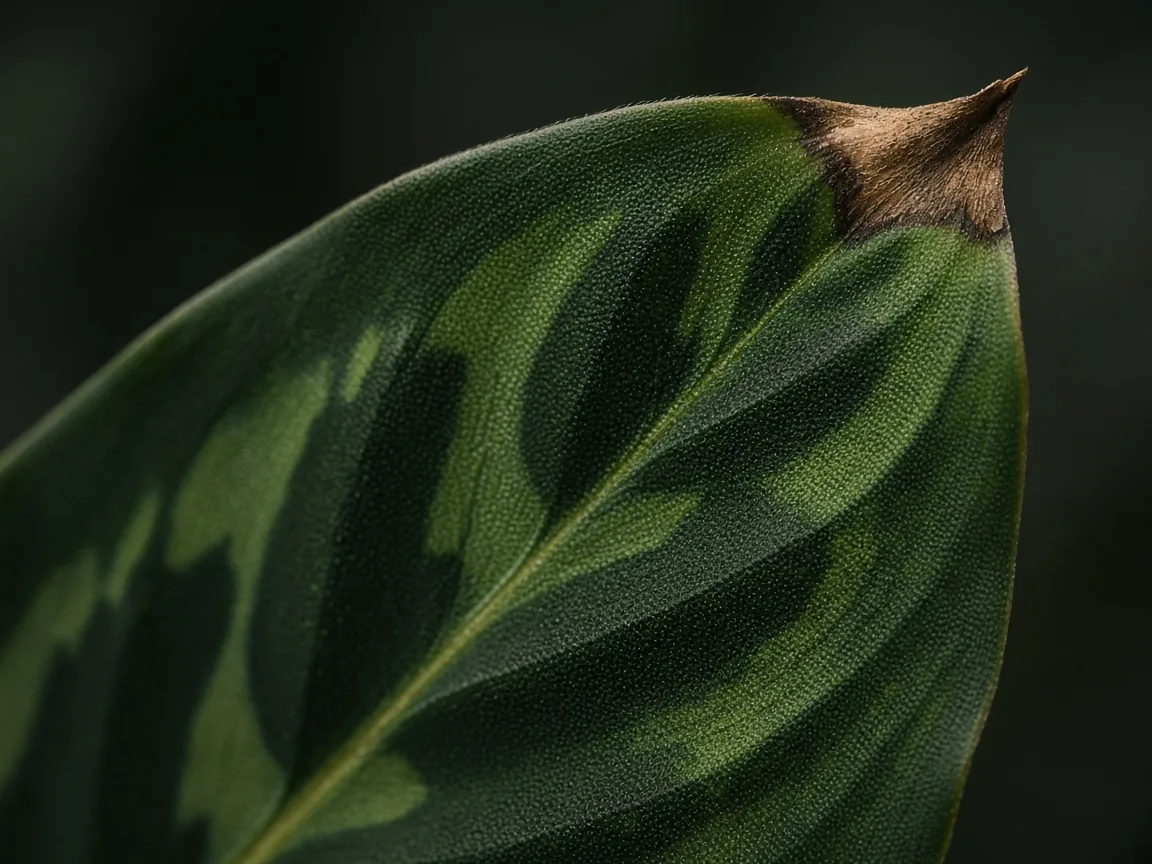
Brown tips on Jungle Velvet—papery tan tissue at the long velvety leaf margin.
Warscewiczii leaves are thick, soft, and fuzzy on top, with a long pointed tip that loses water fast in dry air. Brown tips here are usually dry, papery, and tan to dark brown at the very end of the blade or along one side of an unfurling spear—not a wet patch in the middle of the leaf.
Typical Jungle Velvet patterns:
- Newest spear — thin brown seam, stuck unfurl, or a torn velvety rim that never smooths out
- Dull pile plus crisp tip — the fuzzy surface looks flat or slightly gray, and the point browns (often dry air or water stress)
- One-sided crisping — the margin nearest a vent, AC register, or bright window browns first while the burgundy underside on the opposite side still looks healthy
- Lower outer leaves only — oldest wide blades tan at the tip while new growth stays clean (often placement, salts, or normal aging)
- Chalky white film with edge burn — mineral residue on the velvet from hard tap water, with tan tips on new growth (NC State — G. warszewiczii)
When brown tips suggest a bigger problem:
- New spears keep opening burned after you fixed water and air
- Brown tips plus yellow lower leaves and a heavy wet pot
- Daytime leaf curl that does not relax at night (thirst or root stress — see wilting)
- Fine stippling with edge damage (spider mites)
Velvet pile vs chalky minerals vs true tip burn
Jungle Velvet’s fuzzy surface holds moisture differently from smooth calatheas. A healthy leaf has an even, soft pile. Stress can show up in three ways that are easy to mix up:
| What you see | Likely meaning | Next check |
|---|---|---|
| Tan tip only, pile still even | Dry air or watering rhythm | Humidity at leaf height, pot weight |
| White crust on the pile near the margin | Hard water or fertilizer salts | Water source, rim crust on the pot |
| Dull, flattened velvet with brown edge | Low humidity during unfurl | Newest spear, room humidity above ~60% when possible |
| Wet brown spot in the leaf center | Leaf spot or splash damage while watering | Air flow, avoid wetting foliage (NC State — G. warszewiczii) |
True tip burn on Warscewiczii is dry margin tissue; it will not re-green. Chalky minerals can sometimes be wiped gently once you fix the water source, but already-dead brown tips stay brown.
Reading Jungle Velvet’s night fold vs margin burn
Warscewiczii is a prayer plant: large leaves stand more upright at night and lower by day. That nyctinastic movement is normal. Tip burn is not.
| Signal | Normal Jungle Velvet behavior | Tip burn or stress |
|---|---|---|
| Leaf position | Upright at night, more horizontal by day | Stuck half-rolled spear with a dry brown rim |
| Margin texture | Smooth velvety edge on open leaves | Crispy tan tissue that does not rehydrate |
| Pattern | Whole plant moves together on schedule | One wide blade or one side of a new unfurl scars |
| Soil | Top 2 cm drying on your usual rhythm | Same curl plus wet mix for days |
If the plant folds on schedule but only the opening edge is brown, focus on humidity at leaf height and water quality—not on forcing more water into an already wet pot.
Why Calathea Warscewiczii gets brown tips
Dry air on a large velvety margin
Each Warscewiczii leaf has a long exposed edge relative to its width. While a new spear opens, that rim transpires faster than the rest of the blade if room humidity drops—common in heated winter air. NC State lists low humidity among causes of brown leaf edges and tips on this species (NC State — G. warszewiczii). The RHS ties browning of leaf tips and edges on calatheas to dry air (RHS).
Velvety prayer plants often show edge damage before the whole plant looks wilted, because the pile dries at the margin first.
Tap-water fluoride and minerals
NC State recommends distilled or rainwater for watering G. warszewiczii because tap water contains fluoride and can cause brown edges and tips (NC State — G. warszewiczii). If humidity is reasonable but every new spear opens with a burned rim, switch the water source before you change anything else.
The RHS notes that calatheas prefer rainwater; tap may be used if left to stand so chlorine can dissipate, though that does not address all minerals (RHS).
Watering rhythm mistakes
Jungle Velvet wants evenly moist peat-based soil, not bone-dry swings and not a soggy pot. Letting the root zone collapse while a large new leaf forms can crisp the farthest tip. Keeping roots too wet stops them from delivering water to the margin—the damage can still look like “dry tips.” Cross-check watering and pot weight before you only raise humidity.
Salt buildup and heavy feeding
Excess fertilizer and minerals from hard water can accumulate in the mix and scorch margins, especially on a plant already stressed by dry air or tap water. White crust on the pot rim or soil surface is a clue.
Light and heat at the wide blade edge
Warscewiczii needs bright indirect light per the light guide. Direct sun or hot drafts bleach the velvety surface and dry the long tip fast. Brown tips on the side facing glass or a heater are often placement, not disease. NC State warns that leaf scorch can follow too much direct sun (NC State — G. warszewiczii).
How to confirm the cause on Jungle Velvet
Run these checks in order:
- Newest spear — stuck, torn, or brown as it opens?
- Humidity at leaf height — not across the room from a meter on the floor.
- Water source — straight tap, overnight tap, filtered, distilled, or rainwater.
- Pot weight — heavy and wet days after watering points to overwatering, not simple dry air.
- Velvet texture on the last two leaves — dull pile plus crisp tips often mean environment or water, not pests.
- Leaf undersides — stippling or webbing changes the diagnosis to mites.
- Dust and film — heavy dust or mineral crust on the pile can slow recovery; note before you scrub.
Quick pattern fork:
- New leaves damaged → humidity or water quality first
- Oldest leaves only → placement, aging, or salts
- Many leaves declining with tips → roots and crown firmness
First fix
Do not trim yet. Water the next cycle with rain, distilled, or filtered water and change nothing else long enough to judge the next spear.
That single test targets a high-probability Jungle Velvet failure mode without stacking repotting, fertilizer, and pruning on the same day. If the plant sits in a dry draft or within a metre of a heating vent, move it now—but keep the main experiment readable.
If the pot is clearly waterlogged, skip extra water and follow dry-down steps in overwatering instead of chasing tips with more moisture.
Gentle cleaning on velvety leaves (without making it worse)
Dust can collect on Warscewiczii’s wide blades and slow photosynthesis; NC State suggests wiping leaves gently with a damp clean cloth (NC State — G. warszewiczii). For brown-tip diagnosis, use that only after you have a water and humidity plan:
- Wipe one leaf at a time with lukewarm water on a soft cloth—no leaf shine products.
- Support the blade from underneath so you do not crease the margin.
- Do not mist heavily onto half-open spears; wet velvet in dry air can mark the tissue (NC State — G. warszewiczii).
Cleaning does not fix dead tip tissue, but it helps you see whether new growth is staying clean.
Recovery by cause
If dry air drove the burn
- Run a humidifier near the plant, or use a pebble tray with the pot above the water line—not occasional mist alone (RHS humidity guidance).
- Watch the next unfurl, not old trimmed leaves.
- Pair with low humidity if the whole room runs dry in winter.
If water quality drove the burn
- Switch to rain, distilled, or filtered water; avoid softened water high in salts.
- Flush the pot only when drainage is good and roots are firm—not as a day-one repot reflex.
If the mix dried too far
- Water when the top 2 cm begins to dry, per Jungle Velvet’s usual rhythm—do not wait for every leaf to droop.
- Pay extra attention while a large spear is forming.
If roots are too wet
- Pause watering until the pot lightens.
- Inspect the crown; if stems soften, use root rot steps rather than more humidity.
What not to do
- Do not trim first and diagnose later.
- Do not water more when the pot is already heavy and wet.
- Do not assume daily misting replaces stable humidity around the spears.
- Do not fertilize a plant that is still burning at the margins.
- Do not judge success by old brown tissue turning green.
- Do not scrub velvety leaves with harsh cleaners or rough sponges.
Recovery timeline
Crispy tips stay crispy. On Warscewiczii, measure recovery by the next one or two large spears:
Good signs
- New leaf opens without a stuck brown rim
- Velvet pile looks even on fresh growth
- No new crisping after the water-source change
- Night folding stays regular without chronic daytime curl
Bad signs
- Two consecutive spears open burned after water and placement fixes
- Tips spread while the pot stays soggy
- Crown softness or widespread yellowing
If two clean unfurls do not follow your fixes, recheck humidity, salts, and roots before repeating the same guess.
How to prevent brown tips on Jungle Velvet
- Keep filtered or rainwater on hand for regular watering (NC State — G. warszewiczii).
- Target humidity above roughly 60% when you can measure it, especially in heated winter air (NC State — G. warszewiczii).
- Follow the watering guide dry-down check—top 2 cm, not calendar dates.
- Keep Warscewiczii in bright indirect light per the light guide; avoid sun on the velvety surface.
- Feed lightly in active growth only; skip fertilizer on a stressed plant.
- Dust gently when the pile looks dull, per NC State’s cloth-wipe guidance.
Related Calathea Warscewiczii guides
- Calathea Warscewiczii overview
- Calathea Warscewiczii watering
- Calathea Warscewiczii light
- Calathea Warscewiczii soil
- Low humidity on Calathea Warscewiczii
- Overwatering on Calathea Warscewiczii
- Spider mites on Calathea Warscewiczii
- Calathea Warscewiczii problems hub
Related tool
Use the Plant Problem Diagnosis Tool to narrow causes for brown tips on this plant before changing multiple variables at once.