Calathea Warscewiczii Care Guide: Complete Overview
Goeppertia warszewiczii
Jungle velvet calathea care: bright indirect light, 60–75% humidity, filtered water, evenly moist soil, and warm stable temperatures. Pet safe.
Calathea Warscewiczii Care Guide: Complete Overview
Start with wateringThe most common care mistake for Calathea WarscewicziiWatering guide →Calathea Warscewiczii care essentials
Light
medium to bright indirect light, low indirect light
Water
Every 5–7 days spring and summer (top 2 cm beginning to dry). 7–10 days winter. filtered or rainwater.
Soil
Well-draining but moisture-retentive mix. pH 6.0–7.5. Peat or coco coir base with perlite.
Humidity
60–75% RH; velvety leaves crisp faster than smooth calatheas in dry air
Temperature
18–24°C (65–75°F)
Fertilizer
Feed lightly during active growth.
About Calathea Warscewiczii
Calathea Warscewiczii has a upright growth habit.
| Detail | Information |
|---|---|
| Growth habit | Upright |
| Scientific name | Goeppertia warszewiczii |
Calathea Warscewiczii Care Guide: Complete Overview
What Is Calathea Warscewiczii (Goeppertia warszewiczii)
Calathea Warscewiczii — sold as Jungle Velvet Calathea or Velvet Calathea — is a large tropical prayer plant botanically classified as Goeppertia warszewiczii. NC State Extension describes it as an evergreen Marantaceae perennial native to warm, humid forests of Central America, especially Costa Rica and Nicaragua, with a mature indoor footprint of roughly 1 foot 8 inches to 4 feet tall and wide. Unlike many smaller retail calatheas, Warscewiczii is grown as a statement foliage plant with soft, velvety leaves that can dominate a room corner when conditions are right.
The plant belongs to the Marantaceae family alongside Maranta, Stromanthe, and Ctenanthe. All share nyctinastic leaf movement, but Warscewiczii stands out for fuzzy leaf texture, larger leaf size, and a reputation for reacting visibly to humidity dips and tap-water minerals before roots show obvious distress. That biology — not a mysterious “black thumb” — is why Jungle Velvet can look dramatic while still being recoverable.
The specific epithet warszewiczii honors Józef Warszewicz, a 19th-century Polish plant collector who introduced the species into European cultivation. Retail labels still say Calathea; authoritative references increasingly use Goeppertia. Both names point to the same plant in your pot.
Recognizing Jungle Velvet by Leaf Texture and Pattern
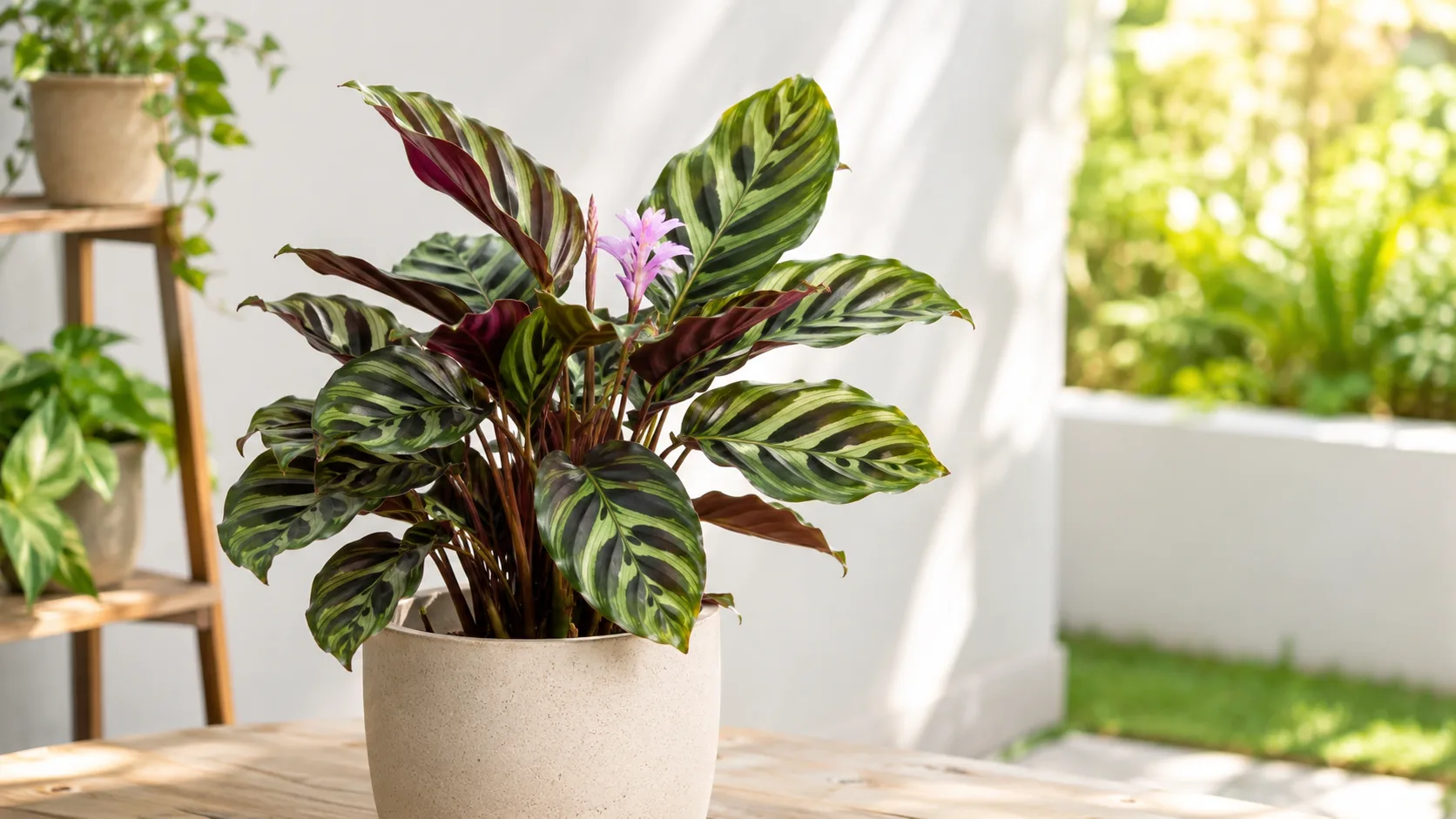
Warscewiczii leaves are large, ovate to lance-shaped, and unmistakably velvety on the upper surface. NC State notes deep green blades with a feathery light-green pattern radiating from the midrib toward wavy margins — a peacock-feather effect rather than the bold zebra bands of Goeppertia zebrina or the round silver plates of G. orbifolia. Basal leaves can reach 7 to 18 inches long indoors; the underside is vibrant purple and covered in dense woolly hairs.
That velvet surface holds a thin moisture film and loses it quickly in dry air. Smooth-leaved calatheas also crisp at edges, but Warscewiczii often shows stress earlier because the fuzzy cuticle cannot buffer humidity swings as smoothly. When you evaluate plant health, read newest unfolding leaves first; old edge damage on lower foliage is often historical.
Unusually for the genus, Warscewiczii can produce flowers indoors. NC State describes tubular blooms that emerge creamy white, turn yellow, then pinkish — a bonus when the foliage is already the main event.
Warscewiczii vs. Smooth-Leaved Calatheas and Lookalikes
Jungle Velvet is frequently grouped with other striped calatheas, but species-specific expectations matter. Goeppertia zebrina shows alternating light-and-dark green bands on velvety but narrower, more vertical leaves on a somewhat more forgiving plant. Goeppertia orbifolia pushes round, silver-striped leaves on a wide clump and needs strong indirect light to hold leaf size. Goeppertia makoyana (peacock) has feathery translucent windows; G. ornata has fine pinstripes on dark green.
Warscewiczii is the tallest and leafiest of these for many growers — closer to a floor accent than a windowsill specimen once established. It also sits in the moderate-to-high difficulty band: not as volatile as White Fusion, but less forgiving than zebrina when humidity drops below 50 percent or tap water carries heavy fluoride. If you already keep a rattlesnake plant (G. lancifolia) stable, Warscewiczii is a reasonable next step if you can add a humidifier or a consistently humid room. If your home runs dry all winter, start with zebrina or improve humidity infrastructure first.
Do not confuse Warscewiczii with Maranta leuconeura, the trailing herringbone prayer plant. Maranta roots from stem cuttings and tolerates slightly sloppier watering. Warscewiczii grows upright from rhizomes and is propagated almost exclusively by division — swapping their routines causes predictable failure.
Goeppertia warszewiczii and the Calathea Name Change
Retail pots still say Calathea Warscewiczii, and the ASPCA lists Calathea spp. as non-toxic — but botanists moved most houseplant calatheas into Goeppertia after a 2012 molecular phylogeny in Systematic Botany. Goeppertia warszewiczii was formerly Calathea warszewiczii and Maranta warszewiczii per NC State synonyms.
For practical care, the rename changes search terms, not routines. Water, light, humidity, and propagation advice stay the same whether the label says Calathea or Goeppertia. When researching pests or sourcing care sheets, search both names to avoid incomplete results.
Light: Medium to Bright Indirect for Velvet Foliage
Calathea Warscewiczii performs best in medium to bright indirect light — strong ambient illumination without sunbeams on the leaves. The RHS calathea growing guide recommends a bright spot out of direct sunlight, with an east-facing window ideal in summer and a filtered south exposure workable in winter when intensity drops. NC State classifies the species as partial-shade tolerant — roughly two to six hours of gentle direct sun at most, never hot midday beams on velvet tissue.
Direct sun bleaches the feathery pattern, scorches fuzzy leaves, and causes midday curling even when soil moisture is adequate. Deep shade produces smaller leaves, weaker contrast, and slower soil drying — a combination that raises overwatering risk because the pot stays wet while the plant uses less water. If pattern contrast fades on new growth, inch the pot toward brighter indirect light over two weeks and read new leaves, not old damaged ones, as the verdict.
Grow lights help in dark apartments. A full-spectrum LED 12 to 18 inches above the canopy for 10 to 12 hours daily supplements weak winter windows. See the dedicated Calathea Warscewiczii light guide for window-by-window placement and recovery after sun stress.
Warscewiczii-specific humidity and water quality
Calathea Warscewiczii is a velvet Marantaceae prayer plant, so target 60 to 75 percent relative humidity when you can measure it — higher than the 50 percent floor that smooth-leaved types sometimes tolerate. NC State recommends humidity above 60 percent via humidifier or pebble tray. The fuzzy leaf surface crisp faster than smooth calatheas in dry air; edge curl on new growth is often humidity stress before it is a watering-frequency problem.
Use filtered, rainwater, or overnight-stood tap water to reduce tip browning from fluoride and chlorine. NC State advises distilled or rainwater because fluoride in tap water causes brown leaf edges and tips even when timing and drainage are correct. Misting alone rarely holds humidity long enough — a humidifier, pebble tray, or grouped tropical placement works better. If new leaves open with brown edges while soil moisture looks correct, switch water sources before changing your watering schedule.
Watering, Water Quality, and Seasonal Rhythm
Warscewiczii watering is about a moisture band, not a calendar. Water when the top 2 cm (roughly the top inch) of mix is beginning to dry and the pot feels noticeably lighter, then soak until excess runs from drainage holes and empty the saucer. In active spring and summer growth, that often means checking every 5 to 7 days. In cooler, slower winter months, stretch toward every 7 to 10 days or longer when growth pauses.
The RHS advises keeping compost evenly moist during the growing season and allowing the surface to dry before rewetting in autumn and winter, while never letting the mix dry out completely. Warscewiczii hates wet feet and hard drought cycles alike. The rhythm is full drink, partial dry-down, full drink — not perpetual dampness and not desert intervals.
Water quality matters as much as timing on velvet leaves. Municipal tap with chlorine and fluoride frequently produces brown tips even when drainage is sound. The RHS notes calatheas prefer rainwater and tolerate tap left to stand 24 hours for chlorine dissipation; filtered or distilled water is safer in hard-water regions. Overnight standing helps chlorine but not fluoride — chronic edge burn with otherwise sound care is a water-chemistry signal.
Seasonal adjustment is non-optional. The same weekly summer schedule overwaters Warscewiczii in dim, cool winter conditions. Reduce frequency when new growth slows, pause fertilizer, and resume the faster rhythm only when fresh leaves are clearly emerging. Full detail lives in the Calathea Warscewiczii watering guide.
Soil Mix, Drainage, and Pot Choice
Warscewiczii roots need a well-draining but moisture-retentive mix — airy enough to breathe, spongy enough to hold a steady moisture buffer. NC State recommends a moist, well-drained, peat-based potting mix with perlite and vermiculite to prevent soggy stagnation. Target pH 6.0 to 7.5 with a peat or coco coir base plus perlite. A reliable home recipe:
- 3 parts coco coir or peat-based potting mix
- 1 part perlite
- 1 part orchid bark or coarse horticultural charcoal (optional)
Water should percolate through in seconds, not pool on top for minutes, and the mix should not compact into a brick after six months indoors. Heavy, all-purpose indoor soil without amendment is a common reason velvet calatheas fail after the first repot.
Every pot needs a drainage hole. Decorative cachepots work only if you lift the grow pot to empty runoff. Oversized pots are especially dangerous on a plant that can reach 3 to 4 feet — extra mix holds water the root system cannot use. Upsize only one size at repotting — typically 1 to 2 inches wider — when roots circle the pot or water runs straight through without absorbing. See the Calathea Warscewiczii soil guide for mix troubleshooting.
Humidity and Temperature for Indoor Success
Warscewiczii is humidity-sensitive relative to pothos or ZZ plants. Target 60 to 75 percent relative humidity; NC State sets a floor of above 60 percent. Many homes run 30 to 40 percent in heated or air-conditioned seasons, which is why velvet edges crisp while the plant otherwise looks alive. The RHS recommends high humidity and suggests bathrooms, kitchens, damp gravel trays, and grouping plants to raise ambient moisture.
A humidifier near the plant is the most dependable fix. Misting produces brief surface wetting, not sustained humidity, and wet fuzzy leaves overnight in stagnant air can invite fungal spotting. Use misting as a minor supplement if you enjoy it, not as the primary strategy.
Temperature stability matters as much as the thermostat reading. Warscewiczii prefers 65 to 75°F (18 to 24°C) per NC State. Cold drafts from winter windows, entry doors, or car transport can cause next-day leaf curl or collapse even when the room average looks fine. Keep the pot at least a foot back from cold glass in winter, and avoid blasting dry HVAC air across the canopy.
If leaves crisp at edges while humidity reads acceptable, suspect air movement desiccation — a fan, heater, or fireplace drying the velvet margin faster than the plant can replace moisture — before buying a second humidifier.
Fertilizing During Active Growth
Warscewiczii is not a heavy feeder. NC State recommends monthly balanced liquid fertilizer during spring and summer active growth. A practical home routine is one-quarter to one-half label strength every four weeks from spring through early fall, applied to already-moist soil. The RHS calathea guide suggests monthly feeding during the growing season (April to September) and holding off in autumn and winter.
Stop feeding when new growth has stopped in winter dormancy, the plant was repotted within the last 4 to 6 weeks, roots are recovering from rot or division, or soil stays wet too long from low light. Resume only when the plant produces firm new leaves and the pot dries on a normal rhythm. If tips brown despite sound watering and humidity, flush the pot with several volumes of plain water monthly during growth to leach salts before increasing fertilizer. See the Calathea Warscewiczii fertilizer guide for dose specifics.
Repotting the Larger Clump Every One to Two Years
Repot Warscewiczii roughly every one to two years, or when roots circle drainage holes, the mix breaks down, water runs straight through without soaking in, or the plant dries so fast you cannot keep pace. The best timing is early active growth in spring, when warmth and brighter days support root recovery on a plant that may already weigh enough to need two hands.
Choose a pot only one size larger. Remove loose old mix gently without destroying the root ball, maintain the same planting depth — do not bury the crown or rhizome — and water lightly for the first week while damaged root hairs heal. Expect some transient leaf curl or spotting after repotting; stabilize light and humidity and withhold fertilizer until new growth confirms the roots are working.
Do not repot as a reflex response to every brown tip. Most velvet edge damage is environmental — water chemistry, humidity, or light — not root crowding. Repot only when the root-zone system is clearly the limiting factor. Full timing and pot-size rules are in the Calathea Warscewiczii repotting guide.
Propagation by Division at Repotting
The standard home propagation method for Warscewiczii is division, not stem cuttings or leaf rooting. NC State lists division as the best propagation approach. Mature clumps produce multiple shoots with shared or adjacent rhizomes; each division needs its own stems, leaves, and a portion of healthy roots to survive independently.
Steps:
- Water the parent 24 hours ahead so rhizomes are hydrated.
- Slide the plant from the pot and identify natural separations between shoots.
- Use a clean, sharp knife only if rhizomes are fused; minimize tearing.
- Pot each division into a snug container with fresh, well-draining mix.
- Keep divisions in bright indirect light, humidity at the upper end of your normal range, and even moisture without saturation for the first month.
- Withhold fertilizer until new growth appears — usually several weeks in warm conditions.
Propagate during active growth, not while recovering from shipping, pests, or root rot. Weak divisions fail at high rates on a species that already shows stress dramatically. See the Calathea Warscewiczii propagation guide for division sizing and aftercare.
Nyctinasty, Velvet Leaves, and Indoor Flowers
Warscewiczii folds leaves upward in the evening and lowers them again by day — a circadian rhythm called nyctinasty, shared across Marantaceae. The movement is driven by changes in turgor pressure at the leaf base (the pulvinus region), not by drought. Many first-time owners panic when large velvet leaves stand upright after lights-out, assuming the plant is dying. In a stable plant, night folding with daytime reopening is normal.
Distinguish nyctinasty from stress:
- Normal: predictable evening lift, morning lowering, firm leaves, no progressive yellowing
- Stress curl: leaves rolled or drooping throughout the day, often with dry soil, cold exposure, or root problems
- Velvet-specific signal: new leaf edges curl inward when humidity drops, even before soil dries
Unlike most calatheas grown only for foliage, Warscewiczii can flower indoors. NC State describes tubular blooms progressing from cream to yellow to pink — uncommon enough to notice, but not a reason to chase fertilizer-heavy forcing. Stable humidity, filtered water, and bright indirect light support both leaves and occasional blooms.
Troubleshooting Yellow Leaves, Brown Tips, and Curling
Most Warscewiczii problems are environmental, not mysterious diseases. Start with moisture at root depth, then light, then water chemistry and humidity, then pests. Changing fertilizer, repotting, and moving the plant simultaneously destroys the diagnostic signal.
Diagnosing moisture, light, water quality, and pests
Yellow leaves often mean overwatering in dim corners where mix stays wet, or underwatering when crisp edges and a light dry pot accompany the yellowing. A few yellow lower leaves on an otherwise healthy clump are often normal senescence. Low light produces pale, smaller new leaves and soil that stays wet too long — brighten exposure and reduce watering together.
Brown tips on velvet calatheas cluster around fluoride and minerals in tap water, humidity below 50 percent, inconsistent watering, and fertilizer salt buildup. Switch to filtered or rainwater, flush the pot with plain water, raise humidity with a humidifier, and judge recovery by new leaf edges, not old damaged tissue. NC State notes low humidity and fluoride as primary brown-edge causes.
Daytime curling with dry mix suggests thirst; with wet mix, suspect root issues or cold damage. Spider mites, mealybugs, aphids, and scale hide on undersides and petioles — inspect weekly on fuzzy leaves where pests are easy to miss. Treat early with rinsing plus insecticidal soap.
Pet Safety and Responsible Placement
The ASPCA lists Calathea spp. as non-toxic to dogs, cats, and horses — and NC State tags Warscewiczii as non-toxic for cats and dogs. That safety profile covers plants sold as Calathea Warscewiczii and botanically classified as Goeppertia warszewiczii.
Non-toxic does not mean edible. Heavy chewers may still vomit from plant fiber, and a floor-sized velvet calathea is an expensive chew toy. Confirm with the ASPCA plant database before placing any plant within pet reach. Warscewiczii’s size makes it a strong candidate for elevated stands or rooms pets do not access routinely.
Seasonal Care Calendar
| Season | Light | Watering | Humidity | Fertilizing | Temperature |
|---|---|---|---|---|---|
| Spring | Bright indirect; avoid sudden sun increase | Resume 5–7 day checks; soak on dry-down | Target 60–75%; start humidifier if heating ended | Begin monthly quarter-strength balanced feed | 65–75°F; repot/divide if needed |
| Summer | East or filtered bright window; rotate pot | Most frequent; may need twice-weekly in heat | Maintain 60–75%; watch AC dryness | Continue light feeding through August | Avoid hot window glass contact |
| Fall | Maximize remaining brightness | Gradually reduce frequency | Monitor dry heating start-up | Taper feed by late fall | Keep away from cold drafts |
| Winter | Supplement with grow light if dim | 7–10+ days; surface dry before rewet | Humidifier especially valuable on velvet | Pause unless actively growing in warm bright room | Keep above 60°F; protect from window chill |
Spring is the window for repotting, division, and the year’s main placement adjustments on a plant that may already be 2 to 3 feet tall. Summer is peak growth — match watering to faster drying and watch for sun scorch if curtains open wider. Fall demands reduced water and feed as growth slows. Winter is survival and stability: fewer interventions, more attention to humidity and filtered water, and patience with slower new leaves on velvet tissue.
Conclusion
Calathea Warscewiczii care becomes manageable when you treat Jungle Velvet as a large, fuzzy understory grower — not as an interchangeable small calathea. Botanically Goeppertia warszewiczii, it needs bright indirect light, even moisture without soggy roots, 60 to 75 percent humidity, filtered or rainwater, and a well-aerated, moisture-retentive mix at pH 6.0 to 7.5. Its velvety leaves show mistakes on a bigger canvas than zebrina or Freddie, but the same environmental logic applies.
Read nyctinastic night folding as healthy rhythm, not emergency wilting. Read brown tips as water quality and humidity signals before repotting on impulse. Read yellow leaves as a moisture-and-light diagnostic, not a fertilizer deficiency by default. Propagate by division when the clump is actively growing and genuinely healthy. Place the pot where you will actually check soil and humidity — not in a forgotten corner that guarantees crisp velvet edges by February.
Get those decisions right and Warscewiczii rewards you with some of the most tactile foliage in indoor horticulture: soft, patterned leaves on an upright clump that can anchor a room, occasional tubular flowers, and a pet-safe profile rare among plants this bold. Miss the humidity and water-quality basics and the same plant looks “impossible.” The gap between those outcomes is setup and consistency, not luck.
When to use this page vs other Calathea Warscewiczii guides
- Calathea Warscewiczii hub — Canonical species page with quick-reference care data and links to every topic.
- This overview — Full picture of light, water, soil, humidity, propagation, and troubleshooting before you dive into single-topic guides.
- Calathea Warscewiczii watering — When the main question is how often and how much to water, including seasonal dry-down triggers.
- Calathea Warscewiczii light — Window placement, grow lights, and recovery from too much or too little light.
Related Calathea Warscewiczii guides
- Calathea Warscewiczii watering
- Calathea Warscewiczii light
- Calathea Warscewiczii soil
- Calathea Warscewiczii propagation
- Calathea Warscewiczii fertilizer
- Calathea Warscewiczii repotting
- Calathea Warscewiczii pruning
- Brown Tips on Calathea Warscewiczii
- Yellow Leaves on Calathea Warscewiczii
- Root Rot on Calathea Warscewiczii
- Overwatering on Calathea Warscewiczii
- Underwatering on Calathea Warscewiczii
How to care for Calathea Warscewiczii?
How much light does Calathea Warscewiczii need?
medium to bright indirect light, low indirect light
- medium to bright indirect light, low indirect light - medium to bright indirect light, low indirect light.
When should you water Calathea Warscewiczii?
Every 5–7 days spring and summer (top 2 cm beginning to dry). 7–10 days winter. filtered or rainwater.
- Check top 2 inches - Every 5–7 days spring and summer (top 2 cm beginning to dry).
- Drain excess water - filtered or rainwater.
What soil works best for Calathea Warscewiczii?
Well-draining but moisture-retentive mix. pH 6.0–7.5. Peat or coco coir base with perlite.
- Well-draining mix - Well-draining but moisture-retentive mix.
Grower notes for Calathea Warscewiczii
What matters most with Calathea Warscewiczii
Calathea Warscewiczii is part of the fussy foliage group where leaf movement, crisping, and humidity stress can look dramatic before the plant is truly lost. Judge the newest rolled leaves and root moisture before reacting to every old edge mark. In practice, the care checkpoint is simple: medium to bright indirect light, low indirect light. Pair that with well-draining but moisture-retentive mix; pH 6.0–7.5. Peat or coco coir base with perlite, and avoid changing water, pot size, and placement all at once.
Best placement in a real home
Calathea Warscewiczii belongs where medium to bright indirect light, low indirect light is realistic for most of the day, not only where the pot looks good. Every 5–7 days spring and summer (top 2 cm beginning to dry). 7–10 days winter. filtered or rainwater. If the pot stays wet longer than expected, move the plant into better light or reassess the mix before watering again. Humidity target: 60–75% RH; velvety leaves crisp faster than smooth calatheas in dry air. Temperature comfort zone: 18–24°C (65–75°F).
Before you buy this plant
Choose Calathea Warscewiczii with firm new growth, clean leaf undersides, and soil that does not smell sour or feel compacted. Be cautious if you see brown-tips, sticky residue, collapsed crowns, or a pot that is wet in poor light. Cosmetic old-leaf damage is less worrying than weak roots or active pests.
First month after bringing it home
Do not repot Calathea Warscewiczii on day one unless the mix is failing or pests are obvious. Quarantine it, learn how fast the pot dries, and keep care boring while it adjusts. Watch especially for brown-tips and yellow-leaves. If problems appear, correct the condition first rather than stacking fertilizer, repotting, and pruning together.
Safety note for Calathea Warscewiczii
Calathea Warscewiczii is not a plant to keep within reach of pets or children. Treat it as an inaccessible display plant. Use gloves if sap or plant tissue is irritating, and pick a pet-safe alternative for floor pots or low shelves.
How to tell Calathea Warscewiczii is settling in
If you plan to multiply it later, common methods include Division. If yellow-leaves shows up early, inspect light, watering, and roots before assuming the plant is permanently weak.
Is it pet safe?
Calathea Warscewiczii is generally considered pet safe.
Watering Calathea Warscewiczii
Every 5–7 days spring and summer (top 2 cm beginning to dry). 7–10 days winter. filtered or rainwater.
Soil & potting for Calathea Warscewiczii
Well-draining but moisture-retentive mix. pH 6.0–7.5. Peat or coco coir base with perlite.
Humidity & temperature for Calathea Warscewiczii
Calathea Warscewiczii prefers 60–75% RH; velvety leaves crisp faster than smooth calatheas in dry air, though normal home humidity is usually fine. Keep temperatures around 18–24°C (65–75°F).
| Detail | Information |
|---|---|
| Humidity | 60–75% RH; velvety leaves crisp faster than smooth calatheas in dry air - normal home humidity is fine. |
| Ideal temperature | 18–24°C (65–75°F) |
Fertilizer & pruning for Calathea Warscewiczii
Use feed lightly during active growth. for Calathea Warscewiczii.
| Detail | Information |
|---|---|
| Fertilizer type | Feed lightly during active growth. |
Common problems on Calathea Warscewiczii
Yellow Leaves
MediumLikely cause: Common on this plant type; confirm with recent watering, light, and root checks.
Quick fix: Inspect the plant and correct the most likely care stressor before stacking treatments.
Full fix guide →Brown Tips
MediumLikely cause: Common on this plant type; confirm with recent watering, light, and root checks.
Quick fix: Inspect the plant and correct the most likely care stressor before stacking treatments.
Full fix guide →Root Rot
MediumLikely cause: Common on this plant type; confirm with recent watering, light, and root checks.
Quick fix: Inspect the plant and correct the most likely care stressor before stacking treatments.
Full fix guide →Overwatering
MediumLikely cause: Common on this plant type; confirm with recent watering, light, and root checks.
Quick fix: Inspect the plant and correct the most likely care stressor before stacking treatments.
Full fix guide →Underwatering
MediumLikely cause: Common on this plant type; confirm with recent watering, light, and root checks.
Quick fix: Inspect the plant and correct the most likely care stressor before stacking treatments.
Full fix guide →Spider Mites
MediumLikely cause: Common on this plant type; confirm with recent watering, light, and root checks.
Quick fix: Inspect the plant and correct the most likely care stressor before stacking treatments.
Full fix guide →Mealybugs
MediumLikely cause: Common on this plant type; confirm with recent watering, light, and root checks.
Quick fix: Inspect the plant and correct the most likely care stressor before stacking treatments.
Full fix guide →Aphids
MediumLikely cause: Common on this plant type; confirm with recent watering, light, and root checks.
Quick fix: Inspect the plant and correct the most likely care stressor before stacking treatments.
Full fix guide →Leggy Growth
MediumLikely cause: Common on this plant type; confirm with recent watering, light, and root checks.
Quick fix: Inspect the plant and correct the most likely care stressor before stacking treatments.
Full fix guide →Slow Growth
MediumLikely cause: Common on this plant type; confirm with recent watering, light, and root checks.
Quick fix: Inspect the plant and correct the most likely care stressor before stacking treatments.
Full fix guide →Wilting
MediumLikely cause: Common on this plant type; confirm with recent watering, light, and root checks.
Quick fix: Inspect the plant and correct the most likely care stressor before stacking treatments.
Full fix guide →Drooping Leaves
MediumLikely cause: Common on this plant type; confirm with recent watering, light, and root checks.
Quick fix: Inspect the plant and correct the most likely care stressor before stacking treatments.
Full fix guide →Low Humidity
MediumLikely cause: Common on this plant type; confirm with recent watering, light, and root checks.
Quick fix: Inspect the plant and correct the most likely care stressor before stacking treatments.
Full fix guide →Not Enough Light
MediumLikely cause: Common on this plant type; confirm with recent watering, light, and root checks.
Quick fix: Inspect the plant and correct the most likely care stressor before stacking treatments.
Full fix guide →Fungus Gnats
MediumLikely cause: Common on this plant type; confirm with recent watering, light, and root checks.
Quick fix: Inspect the plant and correct the most likely care stressor before stacking treatments.
Full fix guide →Mold on Soil
MediumLikely cause: Common on this plant type; confirm with recent watering, light, and root checks.
Quick fix: Inspect the plant and correct the most likely care stressor before stacking treatments.
Full fix guide →