Not Enough Light on Calathea Warscewiczii: Causes, Checks &
Quick answer
Calathea Warscewiczii in too little light dulls peacock-feather midrib banding on new velvety leaves, weakens nightly prayer folding, and grows slowly while soil stays wet. First step: move the pot within one to three feet of an east or north window—or add a full-spectrum grow light—before changing fertilizer or watering more.
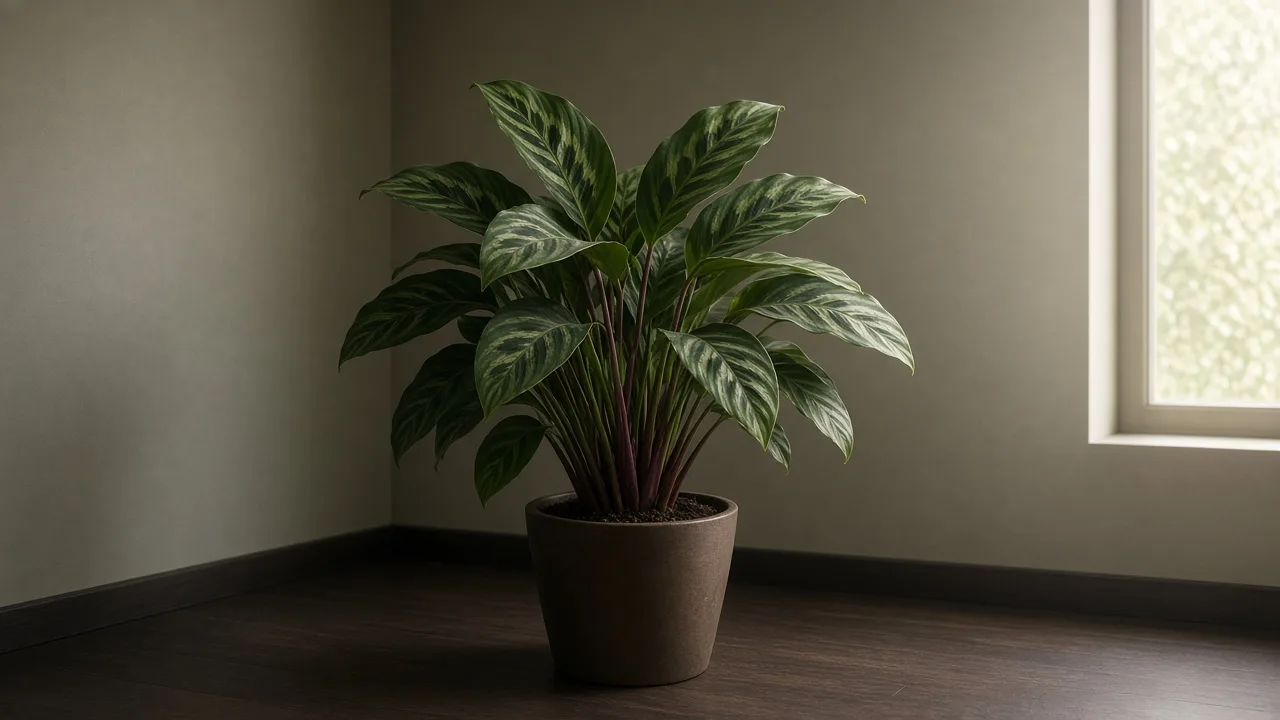
Not Enough Light on Calathea Warscewiczii: Causes, Checks & Fixes
This guide covers not enough light on Calathea Warscewiczii. See also the general Not Enough Light guide, watering, and light pages for this plant.
Not Enough Light on Calathea Warscewiczii: Causes, Checks & Fixes
Quick answer
Calathea Warscewiczii (Goeppertia warszewiczii, jungle velvet) is a large Marantaceae prayer plant grown for soft velvety lance-shaped leaves with peacock-feather light-green lines on deep green tissue and purple woolly undersides—not for surviving a dim hallway. When light falls below what the species needs, new unfurls lose midrib contrast, nightly leaf folding weakens, growth stalls, and potting mix stays wet because photosynthesis cannot keep up with routine watering.
For how chronic low light limits houseplant growth in general, see our not enough light hub. On Warscewiczii, the decisive read is feather-pattern sharpness on the newest velvety spear—not whether older lower blades still look bold enough to hide the problem.
First step: move the pot to bright, filtered light at the plant itself—within one to three feet of an east- or north-facing window in the Northern Hemisphere, or add a full-spectrum LED grow light if natural brightness is insufficient. Do not reach for fertilizer, Calathea Warscewiczii repotting, or extra water until you have corrected light and watched how fast the mix dries in the new spot.
What not enough light looks like on Calathea Warscewiczii
Low light on jungle velvet reads differently than on a snake plant because Calathea Warscewiczii overview is judged by peacock-feather banding on new velvety unfurls and upright clump shape, not just whether foliage stays green.
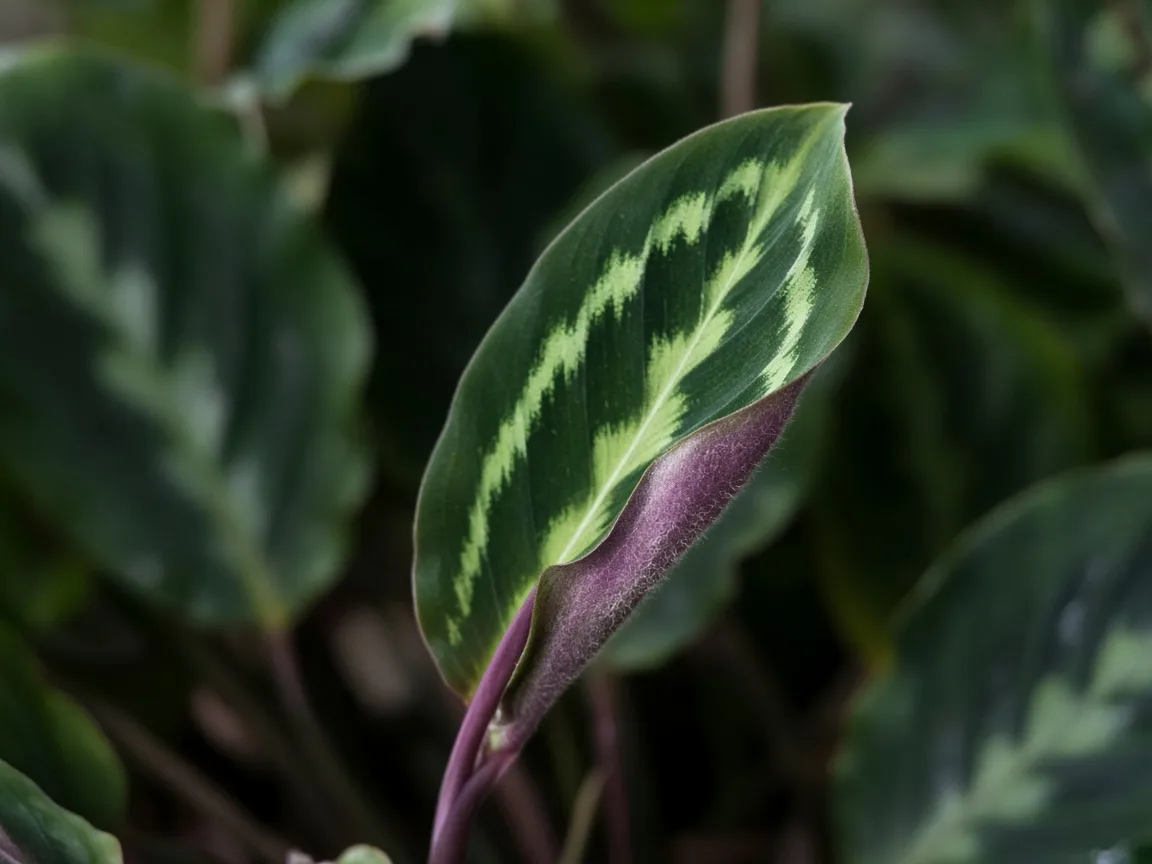
Muddy midrib feather lines on a fresh jungle velvet leaf—older blades may still show pattern while the crown quietly stalls.
Typical signs:
- Soft or blurry light-green feather lines radiating from the midrib on new velvety leaves, while older lower blades may still show sharper banding
- Beginning petiole stretch—purplish-green stems lengthen slightly between neighbors before the clump looks dramatically tall (classic etiolation on an upright Marantaceae habit)
- Strong one-sided leaning toward the nearest window or lamp
- Slow or absent new spears through spring and summer when warmth and humidity should drive unfurling
- Soil that stays wet for ten days or more because large velvety leaves transpire less in dim conditions
- Dull purple undersides and weak nightly prayer movement—leaves that no longer fold up noticeably at night like healthy prayer plants
Warscewiczii nightly fold vs daytime wilt
Healthy jungle velvet raises velvety blades at night and reopens by morning, flashing purple woolly undersides. In chronic shade, that prayer movement weakens—leaves stay flatter or droop more by day. That pattern is easy to confuse with thirst or low humidity on Calathea Warscewiczii curl.
Low-light fold loss usually pairs with fading feather banding on new growth and slightly longer petioles. Daytime curl with dry top soil points to underwatering on Calathea Warscewiczii first. Compare fold rhythm at dusk and dawn for three days before changing water.
Velvety leaf dust stealing borderline light
Jungle velvet’s fuzzy surface holds moisture and shows humidity stress quickly—but dust also blocks photons. NC State Extension notes that dust can slow photosynthesis on this species, and Clemson HGIC recommends dusting hairy or velvety leaves with a soft dry brush rather than rubbing with a wet cloth that mats the fuzz. In a marginal dim spot, a dusty crown can push Warscewiczii into pattern fade even when window placement looks acceptable on paper.
How Warscewiczii differs from generic low-light symptoms
Unlike white-variegated calatheas that bleach toward cream, jungle velvet’s all-green pattern muddies toward uniform pale green velvet before leaves yellow. You may see acceptable older peacock banding above a crown that has not pushed a new spear in months. That split between old and new tissue is characteristic of light starvation on this species, not a sudden nutrient crash. If petioles are already dramatically long with wide gaps, you are in the leggy growth on Calathea Warscewiczii phase—fix light there with pruning guidance after relighting.
Why Calathea Warscewiczii runs out of light indoors
NC State Extension recommends bright, indirect light for jungle velvet indoors—filtered brightness at the leaf surface, not ambient room glow three meters from glass. The same profile states that leaf patterns can fade from inadequate light, while too much direct sun scorches velvety tissue. The RHS Calathea guide lists poor, weak growth from low light—especially on Goeppertia species—as a common houseplant problem.
Several home conditions push Warscewiczii below that threshold:
- Decorative placement on interior shelves or hallway tables far from windows—spots that look bright to you often deliver less than 100 foot-candles at the plant
- Distance from glass—light intensity drops sharply with every foot; a pot six feet from an east window is not the same as one on the sill
- Winter short days when the same north or east sill that worked in June delivers marginal brightness in December
- Filtered or obstructed windows—sheers, tint, porch roofs, and dirty panes cut usable light
- Dust on velvety leaves, which reduces absorption even when placement is otherwise correct
Warscewiczii is often grouped with genuinely low-light-tolerant species in shops. Unlike cast iron plants or ZZ plants, it will linger in shade without thriving—producing smaller velvety leaves and weaker rhizomes while appearing superficially fine until yellowing or wet soil exposes the light deficit.
Low light also slows water use. Growers who keep the same five-to-seven-day Calathea Warscewiczii watering rhythm from a brighter season end up with chronically wet compost—a direct path to yellow leaves on Calathea Warscewiczii and overwatering on Calathea Warscewiczii in shade.
How to confirm the cause
Work through these checks before repotting, fertilizing, or ramping up humidity:
- Window distance and direction — Measure how far the pot sits from the nearest window. More than three feet from east or north glass, or more than five feet from filtered south or west glass, is commonly insufficient for strong jungle velvet growth.
- Hand-shadow test at midday — Hold your hand between the plant and the window an inch above the foliage. A soft, faint shadow matches the Calathea Warscewiczii light guide. Almost no shadow means too dim. A sharp dark shadow means direct sun is hitting leaves—a different problem.
- New-growth read — The newest rolled spear tells the truth. If the latest velvety leaf opened with sharp peacock-feather lines and a vivid purple underside, current light is probably adequate. If new leaves are smaller, paler, or absent for months, light is limiting growth.
- Soil dry-down speed — Press the top two centimeters. In dim light, Warscewiczii uses water slowly; soil wet two weeks after watering while growth is stalled points to low metabolism—not necessarily a heavy watering hand.
- Lean direction — Persistent tilt toward one window confirms phototropism from insufficient even brightness.
- Rule out lookalikes — Brown crisp tips on otherwise compact leaves suggest low humidity or tap water, not light. Yellowing with sour wet soil may be root rot on Calathea Warscewiczii. Curling with dry soil suggests underwatering. Slow growth on Calathea Warscewiczii overlaps when stalled spears trace to light, temperature, or roots.
If four or more checks point to dim placement—and leaves are not receiving harsh direct sun that could also fade banding—you have enough evidence to fix light first.
The first fix to try
Move the pot to bright, filtered light within one to three feet of an east- or north-facing window, or to the brightest filtered spot you can provide without direct midday sun on velvety tissue.
East exposure is the default for jungle velvet: gentle morning sun through glass, then bright indirect light the rest of the day. North windows work when unobstructed. If only south or west glass is available, sit the plant three to five feet back or behind a sheer curtain so velvety blades never sit in a harsh beam.
Increase brightness gradually over seven to ten days if the plant has lived in deep shade for months—move halfway to the target window first, watch for bleaching or curl, then advance. Warscewiczii moving from dim to bright indirect usually tolerates a careful step-up better than a jump into unfiltered south sun.
Do not change watering, fertilizer, or pot size on the same day. Wait at least two weeks after the light move, then adjust watering to match how fast the mix dries in the brighter spot—often every five to seven days in active growth rather than every ten to fourteen in shade.
If windows cannot deliver enough brightness
Add a full-spectrum LED grow light positioned 12 to 18 inches (30 to 45 cm) above the tallest velvety leaf, run 12 to 14 hours daily on a timer, and combine it with the best natural window you have. Foliage houseplants in the 150 to 200 foot-candle range maintain stronger growth than those stuck in deep interior shade.
Step-by-step recovery after increasing light
Once the pot is in brighter filtered exposure:
- Hold watering until the top two centimeters of soil begin to dry—the plant will start using water faster as photosynthesis increases.
- Rotate the pot a quarter turn every week so the clump does not lean permanently toward one source.
- Dust velvety leaves with a soft dry brush so tissue absorbs maximum light.
- Watch the next rolled spear. Firm unfurling with sharp peacock-feather boundaries means the new placement is working.
- Trim only fully brown or dead leaves if they are unsightly. Do not prune healthy slightly stretched petioles until new compact growth confirms the fix.
If no healthy new leaf appears after six weeks in improved light during the warm season, reassess whether the spot still falls below bright indirect at the canopy, or whether wet soil and root damage need separate attention.
Recovery timeline
Expect three to six weeks before you can judge whether light correction worked, measured by new growth from the crown, not by old leaves improving.
- Weeks 1–2: The plant may look unchanged. Soil should dry slightly faster. Avoid fertilizing.
- Weeks 3–4: A new spear may appear or an existing rolled leaf may unfurl with stronger feather contrast than the previous leaf.
- Weeks 5–8: Two compact new leaves with vivid peacock banding confirm recovery. Stretched older petioles remain long—they will not shorten.
Winter recovery takes longer because day length is short. A grow light often outperforms window light alone from November through February.
Lookalike symptoms to rule out
| What you see | Likely cause | Why it is not pure low light |
|---|---|---|
| Brown crisp tips on otherwise compact leaves | Low humidity or tap water minerals | Petioles are not stretched; feather contrast may still be strong on new leaves |
| Yellow leaves with constantly wet, sour soil | Overwatering / root stress in shade | Light is upstream, but roots need drying and inspection if rot is advanced |
| Bleached bands on window-facing leaves only | Too much direct sun | Damage is one-sided toward glass; petioles are often compact, not stretched |
| Curling leaves with dry, light pot | Underwatering | Soil pulls away from pot sides; stretch toward light is secondary |
| Uniform stickiness and speckled undersides | Spider mites | Inspect with a hand lens; pests can weaken growth in otherwise adequate light |
| Long petioles, wide gaps, hard window lean | Advanced leggy growth | See leggy growth for rhizome pruning after relighting |
Yellow leaves in a dim corner with wet soil are a common overlap: low light slows water use, chronic wetness stresses roots, and foliage yellows. Fix light and reduce watering frequency together.
Mistakes to avoid
- Assuming jungle velvet tolerates dim corners because it is labeled a prayer plant or grouped with low-light displays in shops
- Moving straight into unfiltered south or west sun to “fix” fading—direct sun bleaches peacock banding and crisps velvety margins faster than it solves etiolation
- Over-fertilizing to force growth in a dim spot—nutrients cannot replace missing photons
- Watering on a bright-window schedule while the plant still sits in shade
- Repotting on day one when the real issue is placement
- Judging success by old leaves—washed-out mature velvety foliage does not revert; only new crown growth tells you the fix worked
- Wiping velvety leaves with a wet cloth when dust is the issue—brush dry instead to protect the fuzz
Calathea Warscewiczii care cross-check
Light drives how fast Warscewiczii uses water and how cleanly new velvety leaves unfurl. After improving brightness:
- Watering: Check the top two centimeters before every pour. Brighter filtered light usually means faster dry-down.
- Humidity: Brighter placement increases transpiration; keep humidity at about 60 percent or higher so new spears do not crisp while unfurling.
- Water quality: Continue filtered or rainwater—tap minerals cause brown tips on Calathea Warscewiczii independent of light.
- Temperature: Maintain 18°C to 24°C (65–75°F) per extension guidance; cold drafts near windows in winter can stall growth even when light is adequate.
Make one change at a time so you can read the plant’s response. Light comes first; adjust watering second after dry-down speed changes.
How to prevent not enough light next time
- Place for the velvety leaves, not the room—if the pot looks best on a shelf but foliage receives no usable brightness, the placement is wrong for Warscewiczii
- Reassess seasonally—move closer to glass or add a grow light before winter; pull back from intensifying west or south beams in late spring
- Rotate weekly and dust fuzzy leaves monthly
- Read the next new spear after any move—pale unfurls mean adjust light before touching fertilizer
- Pair light with realistic watering—a brighter Warscewiczii dries faster; a dim one needs less water, not more attention in the wrong form
When to worry
Low light alone is rarely fatal quickly, but months in deep shade with wet soil can weaken rhizomes beyond what a simple window move fixes. Escalate if:
- The crown feels soft or collapses
- Yellowing spreads to most of the clump while soil stays waterlogged and smells sour
- No new growth appears through an entire warm season despite corrected placement and a grow light
- Fungus gnats on Calathea Warscewiczii persist because the mix never dries
In those cases, inspect roots after correcting light and drying the soil. Soft brown roots need trimmed and fresh well-draining mix—not another round of fertilizer in the same dim corner.
Conclusion
Calathea Warscewiczii rewards bright filtered light at the plant itself with the crisp peacock-feather banding that justifies its jungle velvet reputation. Too little light produces dull midrib lines on new velvety unfurls, weak prayer movement, and wet soil that never quite dries—but the fix is straightforward: move to an east or north window within one to three feet of the glass, or add a grow light, then adjust watering to match faster metabolism.
Judge recovery by the next one or two leaves from the crown, not by whether old washed-out tissue regains its pattern. Get light right and humidity, water quality, and Calathea Warscewiczii soil become easier to manage; leave jungle velvet in a decorative dark corner and no amount of misting will restore the bold feather lines you bought the plant to enjoy.
When to use this page vs other Calathea Warscewiczii guides
- Calathea Warscewiczii light — Use for routine window placement and grow-light setup before assuming a problem page is needed.
- Calathea Warscewiczii problems hub — Browse common issues on this plant.
- Leggy growth on Calathea Warscewiczii — Overlapping entry when stretch and long petioles are already obvious.
- Slow growth on Calathea Warscewiczii — When stalled spears may trace to light, temperature, or roots.
- Yellow leaves on Calathea Warscewiczii — When yellowing pairs with wet soil in a dim corner.
Related Calathea Warscewiczii guides
- Calathea Warscewiczii overview
- Calathea Warscewiczii watering
- Calathea Warscewiczii light
- Calathea Warscewiczii soil
- Leggy growth on Calathea Warscewiczii
- Slow growth on Calathea Warscewiczii
- Yellow leaves on Calathea Warscewiczii
- Calathea Warscewiczii problems
Related tool
Use the Plant Problem Diagnosis Tool to narrow causes for not enough light on this plant before changing multiple variables at once.