Low Humidity on Neem: Causes, Dry Air Signs & Fixes
Quick answer
Neem (Azadirachta indica) is adapted to semi-arid tropical climates and tolerates dry soil once established, but dry indoor air (<35% relative humidity)—especially from winter forced-air heating—desiccates its delicate compound leaflets. Symptoms include crispy brown leaflet margins, upward cupping, premature leaflet drop, and heightened spider mite vulnerability. First step: Move the container at least 6–8 feet away from forced-air heating vents or radiators, verify root-zone moisture so you do not drown the roots, and run an ultrasonic or evaporative room humidifier to maintain 40–50% relative humidity.
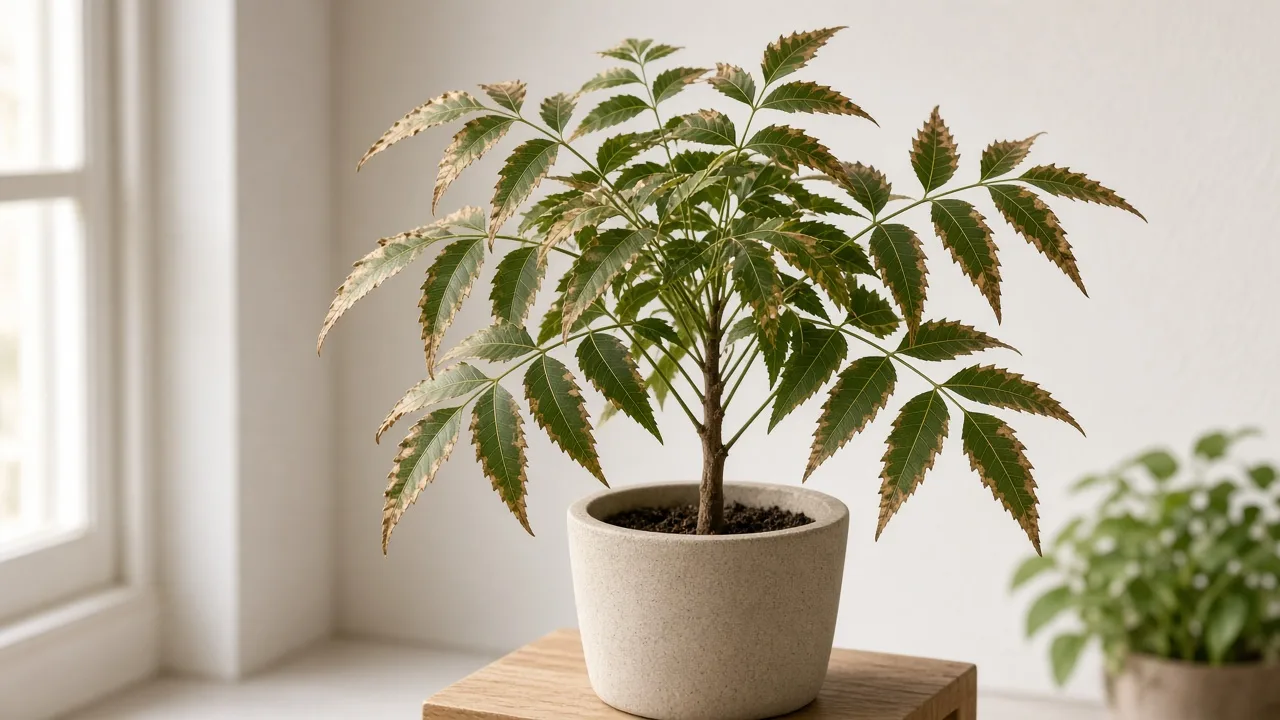
Low Humidity on Neem: Crispy Leaflet Margins, Dry Air Stress & Fixes
This guide covers low humidity on Neem. See also the general Low Humidity guide, watering, and light pages for this plant.
Low Humidity on Neem: Crispy Leaflet Margins, Dry Air Stress & Fixes
Quick answer
Neem (Azadirachta indica) presents a fascinating paradox for indoor and container gardeners. Celebrated across the globe as an exceptionally rugged, drought-tolerant subtropical tree, Neem can withstand prolonged dry spells in open soil. However, many growers are surprised when their potted Neem develops brittle, curled, paper-thin leaflet margins, sheds leaves unexpectedly, or succumbs to spider mites during the winter months. The culprit is almost always atmospheric aridity—specifically, low indoor relative humidity (RH).
In centrally heated homes or air-conditioned apartments, indoor humidity routinely plummets below 20% to 30% RH. This extreme dryness creates a steep Vapor Pressure Deficit (VPD) that siphons moisture out of the plant’s delicate compound foliage faster than the root system can deliver it. For the foundational mechanics of how dry ambient air affects indoor greenery in general, explore our comprehensive low humidity environmental hub. On Neem, however, managing dry air requires understanding how its specialized pinnate foliage interacts with container confinement.
First step: Immediately relocate your potted Neem at least 6 to 8 feet away from any forced-air heating register, baseboard radiator, or cold draft. Next, verify root-zone moisture so you do not mistakenly overwater damp soil, and set up an ultrasonic cool-mist humidifier nearby to stabilize ambient humidity between 40% and 50% RH.
When to use this guide vs other Neem guides
Because Neem sheds foliage when under stress, low humidity symptoms are frequently mistaken for root rot, underwatering, or light starvation. Use this diagnostic matrix to verify what your plant is experiencing before changing its care routine:
| Symptom Pattern | Primary Foliage Location | Pot Moisture & Environment | Read Next |
|---|---|---|---|
| Brittle, crispy brown leaflet edges; upward curling leaflets; turgid main petioles; premature leaflet drop | Outer leaflet margins on mid and upper compound leaves | Potting mix appropriately moist 3–5 cm down; digital hygrometer reads <35% RH | Stay on this guide |
| Entire compound leaves wilt limp; petioles droop downward; pot feels feather-light; soil shrinks from rim | Whole canopy wilting simultaneously from bottom to top | Root ball completely desiccated throughout; dry to the bottom | Underwatering on Neem |
| Leaflet tips bleach pale yellow then scorch brown; white crusty mineral deposits on soil surface | Tips of older leaflets; newest flush stunted | Soil fertilized recently with synthetic salts; pot dries normally | Brown Tips on Neem |
| Yellow stippling, bronze speckling, and fine silken webs under serrated leaflets | Undersides of leaflets and leaflet axils along the rachis | Warm room with dry air (<30% RH); tiny mites visible under 10x lens | Spider Mites on Neem |
| Lower leaves turn uniformly yellow and drop mushy; potting mix smells sour; pot feels heavy | Oldest lower compound leaves; base of the stem | Soil remains saturated for over 10 days; poor drainage | Overwatering on Neem / Root Rot |
Botanical context: Soil drought tolerance vs. atmospheric humidity stress
To properly diagnose and treat low humidity distress on Neem, growers must understand the tree’s natural ecological adaptations. According to taxonomic records from the Royal Botanic Gardens Kew, Azadirachta indica is native to the dry tropical and subtropical forests of the Indian subcontinent, thriving across India, Myanmar, Sri Lanka, Bangladesh, and Pakistan. The tree is classified within the mahogany family (Meliaceae) by the Department of Horticulture at Oregon State University, which characterizes it as a semi-evergreen species adapted to sub-arid and sub-humid climates.
In its native outdoor environment, Neem withstands extended seasonal droughts that would kill many temperate or rainforest species. As documented by the National Research Council in their definitive botanical monograph, established Neem trees survive semi-arid dry seasons by driving an exceptionally deep, vigorous taproot meters into permeable sandy subsoils to extract subterranean moisture. Furthermore, even during hot outdoor dry seasons in the tropics, ambient humidity fluctuates with nocturnal temperature drops, allowing dew formation and brief periods of atmospheric recovery.
When a Neem tree is cultivated in a container indoors—especially when brought inside to protect it from freezing temperatures, given that the Missouri Botanical Garden notes Neem cannot tolerate temperatures below 40°F (4°C)—that natural ecological balance is broken. A potted Neem tree cannot produce a multi-meter taproot; its root volume is strictly confined to the dimensions of the nursery pot.
More critically, winter indoor environments bear no resemblance to tropical outdoor dry seasons. Research from Penn State Extension emphasizes that active residential heating systems (forced-air furnaces, electric baseboards, and radiators) frequently drop indoor relative humidity down to 10% to 20% RH—drier than many desert ecosystems. In this environment, the evaporative pull of the air (Vapor Pressure Deficit) exerts relentless suction on the plant’s compound foliage. While an established Neem tree possesses drought adaptations in its root system, its individual leaflets are delicate structures that lose water through cuticular transpiration far faster than confined container roots can replenish it.
What low humidity looks like on Neem
Neem foliage is distinctly bipinnate to once-pinnately compound, consisting of an elongated central rachis bearing 20 to 30+ lanceolate leaflets with sharply serrated margins. Because these leaflets have thin epidermal layers compared to waxy succulents or rubber trees, they act as immediate barometers of atmospheric moisture.
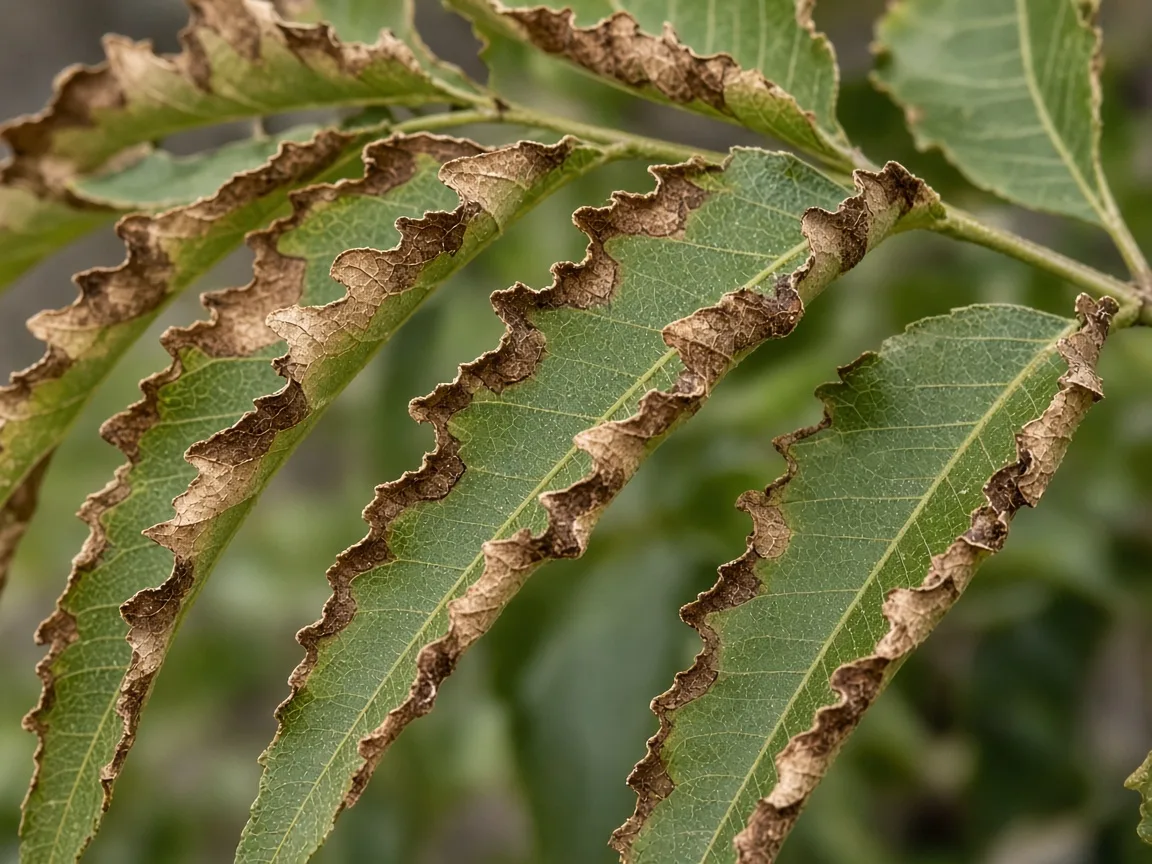 Close-up of serrated Neem leaflets exhibiting brittle brown marginal necrosis and inward curling under low ambient relative humidity.
When relative humidity drops below Neem’s physiological tolerance threshold (<35% RH), symptoms progress through characteristic stages:
- Marginal Leaflet Crisping: The outermost serrated tips and edges of the leaflets turn dry, brittle, and tan-to-brown. This marginal necrosis occurs because the terminal vein endings at the leaflet periphery cannot supply water as fast as the dry surrounding air pulls it away.
- Upward Cupping and Leaflet Rolling: In an attempt to reduce the surface area exposed to dry drafts, the leaflets curl upward along their midrib, taking on a canoe-like appearance.
- Premature Leaflet Abscission (Wire-Stemming): As cuticular desiccation continues, the plant forms abscission layers at the base of individual leaflet petiolules. The leaflets drop to the floor while the central rachis remains attached to the branch for several days, creating an unsightly “bare wire” appearance.
- Stalled and Distorted Terminal Flushes: Emerging new leaf buds at branch tips become stunted, blackened at the margins, or fail to unfurl cleanly.
- Dry, Dusty Foliage Texture: Healthy Neem foliage has a vibrant, glossy sheen. Under chronic low humidity, the foliage loses its luster, feeling rough, papery, and brittle to the touch.
Unlike symptoms of overwatering or bacterial blight, foliage damaged purely by low humidity remains dry and crisp. You will not observe yellow water-soaked halos, soggy black lesions, or unpleasant odors from the root zone.
The waterlogging trap: Why watering more will not fix dry air
The single most destructive mistake indoor gardeners make when facing low humidity on Neem is confusing atmospheric drought with soil drought.
When growers notice crispy brown leaflet edges and shedding leaves, their immediate instinct is to grab the watering can and drench the soil. However, if the potting mix is already moist 3 to 5 cm below the surface, adding more water does nothing to increase the relative humidity surrounding the canopy.
Neem is exquisitely sensitive to waterlogging. The species evolved in well-draining, sandy loam soils and requires plenty of oxygen in the root zone. When a container is saturated repeatedly in an indoor room—where light intensity is lower and temperatures are cooler than outdoors—the soil remains soggy for extended periods. The pore spaces between soil particles fill with stagnant water, starving the roots of oxygen. Within one to two weeks, the fine root hairs rot, followed by secondary root rot pathogen attacks (Pythium or Phytophthora).
Ironically, once root rot sets in, the plant loses its remaining ability to take up water, causing catastrophic canopy wilt and complete defoliation. Always inspect the soil before watering: use a wooden chopstick or your finger to probe 3 to 5 cm into the mix. If the soil is cool and damp, leave the watering can alone. Address the air, not the substrate. For detailed root-zone care, review our Neem watering guide and Neem soil guide.
Low-humidity spider mite outbreaks on Neem foliage
Low relative humidity does not simply stress Neem tissue directly; it also rolls out the welcome mat for the plant’s most devastating indoor pest: the two-spotted spider mite (Tetranychus urticae).
Horticultural research from the University of Maryland Extension demonstrates that spider mites reproduce with alarming speed in warm, dry indoor environments where relative humidity drops below 30%. Under optimal dry conditions, a spider mite can complete its life cycle from egg to reproductive adult in fewer than seven days, leading to exponential population explosions.
On a Neem tree stressed by dry air, spider mites thrive on the undersides of the serrated leaflets:
- Micro-Punctures and Stippling: Mites use their piercing-sucking mouthparts to puncture epidermal plant cells and suck out cell contents, including chlorophyll. This appears as thousands of tiny, pale yellow or silver specks (stippling) across the upper surface of the leaflets.
- Bronzing and Desiccation: As hundreds of mites feed simultaneously, entire leaflets lose their green color, turning a dull bronze or grayish-brown before dropping prematurely.
- Silken Webbing: In advanced infestations, fine silken webbing drapes between leaflets, across petiole axils, and around branch tips.
Because Neem oil is an acclaimed botanical insecticide, many growers mistakenly assume their living Neem tree is naturally immune to spider mites. In reality, while cold-pressed neem seed oil contains high concentrations of azadirachtin (which disrupts insect hormone systems), the living foliage of a containerized Neem tree possesses far lower chemical concentrations. A dry, stressed Neem tree is just as vulnerable to spider mites as an indoor fig or palm. If you spot stippling or webbing, immediately cross-check our dedicated guide on spider mites on Neem.
Diagnostic steps: Confirming dry air at home
Before executing fixes, systematically confirm that low humidity is indeed the primary driver of your Neem’s symptoms. Follow this four-step diagnostic procedure:
flowchart TD
    A["Inspect Neem Foliage"] --> B{"Are leaflet edges crispy & dry?"}
    B -- No --> C["Check for root rot, pests, or cold injury"]
    B -- Yes --> D["Measure Ambient RH with Hygrometer"]
    D --> E{"Is RH < 40%?"}
    E -- No --> F["Investigate fertilizer salts or underwatering"]
    E -- Yes --> G["Check Root-Zone Soil Moisture"]
    G --> H{"Is soil damp 3-5 cm deep?"}
    H -- Yes --> I["CONFIRMED: Atmospheric Low Humidity Stress"]
    H -- No --> J["Dual Stress: Water deeply, then raise humidity"]
Step 1: Measure ambient relative humidity with a digital hygrometer
Do not guess how humid your home is based on personal comfort. Humans typically perceive 30% to 40% RH as comfortable, but a tropical plant experiencing forced heating may experience localized humidity below 20%. Place a calibrated digital hygrometer right at the level of your Neem’s canopy. If the reading sits below 35% RH during heating cycles, your plant is under severe evaporative strain.
Step 2: Probe the soil depth
Insert a clean wooden skewer or your finger 3 to 5 cm into the potting mix.
- If the skewer emerges with damp soil particles clinging to it, the root zone is adequately hydrated; the crispy leaf margins are purely an atmospheric issue.
- If the skewer comes out bone-dry and clean, the tree is suffering from both dry air and dry soil, requiring a thorough drench followed by atmospheric adjustments.
Step 3: Inspect heat sources and air currents
Observe the physical placement of the pot. Is the foliage sitting directly in the convective air stream of an HVAC floor vent, a radiator, or a space heater? Hot, moving air strips the boundary layer of moisture from the leaflet surfaces exponentially faster than still air.
Step 4: Examine leaflet undersides under magnification
Turn several affected compound leaves over and examine the undersides of the leaflets using a 10x jeweler’s loupe or hand lens. Look for tiny, eight-legged arachnids, translucent spherical eggs, and fine webbing along the midrib. Confirming whether spider mites have capitalized on the dry air determines whether you need pest sanitation alongside humidity correction.
First fix: The immediate response
When you confirm low humidity stress on your Neem tree, take one clear first action before introducing complex equipment:
Primary Action: Immediately move your Neem container at least 6 to 8 feet away from any active heating vent, radiator, duct register, or drafty exterior door, placing it in a well-lit location with stable, still air.
Eliminating direct forced-air drafts halts the rapid mechanical desiccation of the foliage boundary layer. This single relocation removes the immediate threat of acute leaflet scorching and buys the plant time while you implement secondary environmental improvements.
Secondary corrections: Restoring healthy ambient humidity
Once the tree is shielded from direct heat blasts, implement sustainable secondary measures to elevate the ambient environment into Neem’s target comfort zone of 40% to 50% relative humidity.
1. Run an ultrasonic or evaporative room humidifier
The most reliable method for maintaining stable indoor humidity is an automated room humidifier. Position an ultrasonic cool-mist or evaporative humidifier 3 to 6 feet away from the tree.
- Do not point the mist nozzle directly at the Neem’s foliage; cold, concentrated vapor settling on leaves can encourage foliar fungal spores.
- Set the built-in humidistat to maintain 45% to 50% RH. This provides continuous physiological relief during both daytime heating cycles and cold nights.
- You can learn more about general requirements in our dedicated Neem humidity guide.
2. Deploy wide pebble humidity trays
If a mechanical humidifier is impractical, set up a heavy-duty pebble tray:
- Select a wide, shallow plastic or metal tray that is at least 5 to 10 cm wider than the base of the container.
- Fill the tray with a layer of smooth gravel, river pebbles, or expanded clay pebbles (LECA).
- Add water until it reaches halfway up the pebbles.
- Place the potted Neem firmly on top of the stones.
- Crucial rule: Ensure the bottom of the pot sits entirely above the water level. The nursery pot must never make contact with the standing reservoir, as capillary action will pull water up into the drainage holes, creating saturated lower soil and causing root hypoxia.
3. Cluster container plants to form a microclimate
In nature, plants do not grow as isolated specimens. Every living plant continuously releases water vapor through stomatal transpiration. By grouping your potted Neem alongside other indoor houseplants (such as ficus, palms, or aroids), you create a localized communal microclimate. The combined transpirational output raises the relative humidity within the canopy canopy zone by 5% to 15% compared to the rest of the room. Ensure pots have at least 10 to 15 cm of space between their foliage to maintain adequate air circulation and prevent fungal stagnation.
What NOT to do: Harmful dry-air myths
When treating a humidity-stressed Neem, avoiding counterproductive practices is just as vital as providing proper care:
- Do NOT mist the foliage with a spray bottle: Misting is the most persistent myth in indoor plant care. Misting elevates local relative humidity for only 10 to 15 minutes before the moisture evaporates into the dry room. More dangerously, leaving droplets of standing tap water on the compound leaflets in stagnant indoor air creates an ideal environment for foliar fungal pathogens such as Pseudocercospora subsessilis and anthracnose (Colletotrichum).
- Do NOT overcompensate with excessive watering: Never soak the soil just because the leaf tips feel dry. If the top 3 to 5 cm of soil is not dry, additional watering will rot the roots without easing foliar transpiration stress.
- Do NOT apply synthetic fertilizer to a stressed tree: When leaflets are crisping and dropping, the tree is under metabolic strain. Applying nitrogen-rich fertilizers introduces mineral salts into the root zone, increasing osmotic pressure and making it even harder for roots to absorb water. Hold all feeding until humidity is corrected and the tree initiates active, healthy new growth. Learn more in our Neem fertilizer guide.
- Do NOT rip or tear damaged leaflets from the rachis: Ripping off dried leaflets tears the tender epidermis of the central rachis and leaves open wounds that invite bacterial infection. If a compound leaf is mostly brown, prune the entire petiole cleanly near the branch collar with sterilized shears, or allow the leaflets to naturally abscise and fall.
- Do NOT place containers on heated floors without insulation: Radiant in-floor heating warms the bottom of the pot, rapidly baking the lower root ball and driving soil moisture upward while drying out the root zone. Elevate the pot on a wheeled plant caddy or wooden stand.
Recovery timeline and realistic expectations
Recovering from low humidity stress requires patience, as woody subtropical trees operate on seasonal vegetative cycles:
- Days 1 to 5 (Stabilization): After relocating the plant away from heat vents and establishing 40% to 50% RH, further leaflet crisping should cease. Previously desiccated, yellowed leaflets may continue to drop as the plant finishes shedding compromised tissue.
- Days 7 to 14 (Canopy Equilibrium): Leaflet drop halts completely. The remaining green foliage stabilizes, feels more supple, and regains a healthy sheen.
- Weeks 3 to 6 (New Vegetative Flush): Provided the plant receives adequate sunlight—at least 6 hours of bright light, as outlined in our Neem light guide—dormant apical and axillary buds will swell. Fresh, tender, lime-green pinnate leaf clusters will unfurl without crispy margins or distortion.
- Long-Term Canopy Recovery (Months 2 to 3): To balance the canopy shape after foliage shed, you can perform light structural pruning in early spring. Consult our Neem pruning guide for proper branching techniques.
Remember: Damaged tissue will not un-crisp. Brown leaflet edges will remain brown until those leaves eventually age out and shed naturally. Judge your success entirely by the cessation of leaflet drop and the vigor of emerging new growth.
Related Neem guides
Explore our full library of species-specific care guides and problem-solving diagnostics for Azadirachta indica:
- Neem Care Overview — Complete profile covering light, potting, soil, and seasonal outdoor-indoor transitions.
- Neem Humidity Needs — Ideal environmental ranges, seasonal adjustments, and microclimate setups.
- Neem Watering Guide — How to deep-water container Neem and avoid waterlogged roots.
- Neem Light Requirements — Meeting high foot-candle and full-sun demands in indoor spaces.
- Neem Soil & Potting Mix Guide — Lean, sandy, fast-draining substrate recipes for healthy roots.
- Neem Pruning Guide — Shaping container trees, managing size, and cleaning up damaged stems.
- Neem Fertilizer Guide — Organic feeding schedules that support steady growth without mineral burn.
- Neem Problems Hub — Complete diagnostic index for pests, leaf discolorations, and physiological disorders.
- Spider Mites on Neem — Identifying, washing, and eradicating mites in dry indoor air.
- Brown Tips on Neem — Separating fertilizer salt toxicity from atmospheric humidity burn.
- Underwatering on Neem — Recognizing true root-zone dehydration and restoring moisture safely.
Related tool
Use our interactive Humidity Calculator to calculate the exact Vapor Pressure Deficit (VPD) and target relative humidity for your specific room temperature and growing setup before modifying your environment.