Low Humidity on Panda Plant: Xerophytic Adaptations & Care
Quick answer
Panda Plant (Kalanchoe tomentosa) does not suffer from low humidity. Native to arid granite hillsides in Madagascar, it is a xerophytic succulent equipped with dense felted trichomes and Crassulacean Acid Metabolism (CAM) designed specifically to thrive in dry air (30% to 40% RH). In fact, high humidity and foliar misting are dangerous, trapping moisture in velvety leaf hairs and causing fungal rot. The only risk in dry indoor air is opportunistic spider mites. First step: never mist this plant; keep humidity moderate-to-low and ensure strong air circulation.
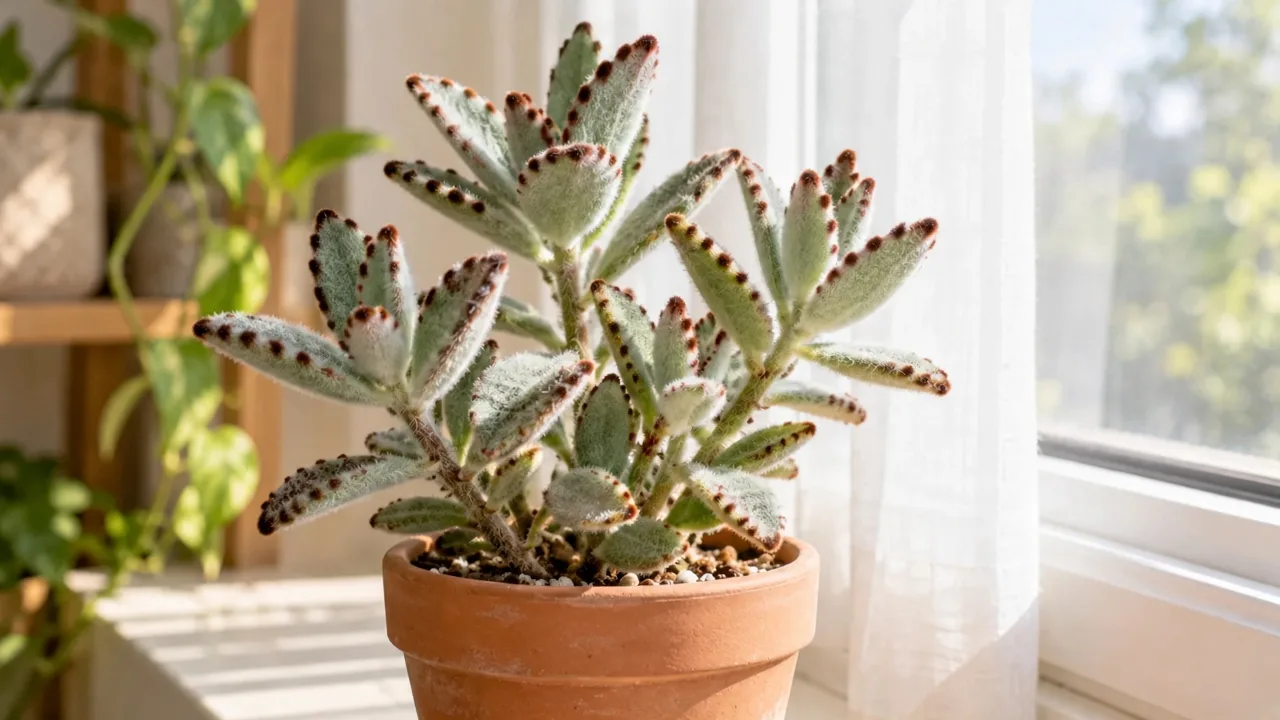
Low Humidity on Panda Plant: Xerophytic Adaptations & Care Truths
This guide covers low humidity on Panda Plant. See also the general Low Humidity guide, watering, and light pages for this plant.
Low Humidity on Panda Plant: Xerophytic Adaptations & Care Truths
Quick answer
Panda Plant (Kalanchoe tomentosa) is a true xerophytic succulent that naturally thrives in dry, low-humidity air. Unlike moisture-craving tropical houseplants that develop crispy leaf margins when indoor relative humidity dips below 50%, the panda plant was engineered by evolution to flourish in arid, sun-drenched environments.
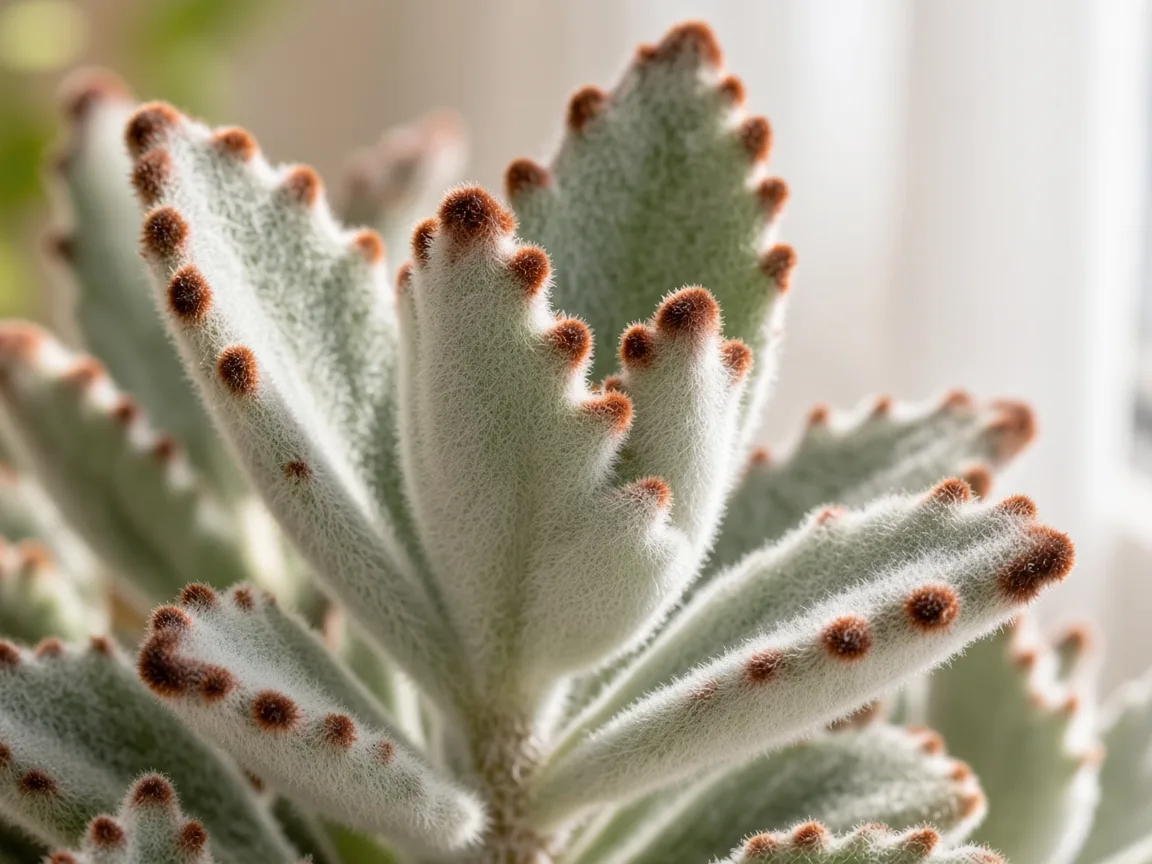
Dense velvety trichomes and crisp chocolate margins on Panda Plant — this succulent thrives in dry household humidity. The most common care mistake indoor gardeners make is assuming all houseplants need humidifiers or daily misting. On Kalanchoe tomentosa, adding artificial humidity or misting is actively harmful: the plant’s signature silver-white velvet is made of millions of microscopic hairs (trichomes) that trap moisture droplets against the epidermis, predisposing the foliage to fungal rot and tissue collapse.
If your panda plant is displaying dry, deflated, or wrinkled leaves, the culprit is soil root dehydration (underwatering) or root suffocation (root rot), never dry household air. The only legitimate danger of low indoor humidity is opportunistic spider mites. For universal environmental humidity principles across all houseplants, explore our comprehensive guide on low humidity.
Why Panda Plant is immune to low humidity stress
In the rocky granite hills and dry thorn scrub of east-central Madagascar, Kalanchoe tomentosa experiences long periods of drought, baking sun, and low ambient humidity, as documented by NC State Extension and the Royal Horticultural Society.
To survive and flourish in dry air, the plant utilizes three extraordinary physiological adaptations:
1. The velvety trichome boundary layer
The dense, silvery-white fuzz that gives the plant its name consists of branched, multi-cellular hairs called trichomes. These hairs create a microscopic, undisturbed boundary layer of air right against the leaf surface. This layer dramatically slows the rate of evaporative water loss caused by dry ambient breezes, reflecting intense solar radiation and keeping the leaf surface up to 5°F cooler than the surrounding air.
2. Crassulacean Acid Metabolism (CAM)
Panda plants do not open their stomata (breathing pores) during the dry, warm daylight hours. Instead, they utilize CAM photosynthesis, opening stomata strictly at night when ambient air is cooler and vapor pressure deficit is lowest. They absorb carbon dioxide at night, convert it into malic acid, and process it into sugars during the day with closed pores, virtually eliminating daytime transpirational water loss.
3. Fleshy internal water storage parenchyma
Each spoon-shaped leaf consists of specialized internal water-storage tissue capable of sustaining basal cellular respiration for months without external precipitation.
What growers mistake for low humidity damage
When indoor gardeners see symptoms typically associated with dry air on other plants, they often misdiagnose Kalanchoe tomentosa:
| Observed Symptom | Misinterpreted As | Real Underlying Cause |
|---|---|---|
| Thin, wrinkled, flexible leaves | Low atmospheric humidity | Severe soil underwatering (depleted leaf vacuoles) |
| Crispy, dark chocolate tips | Low humidity leaf scorch | Natural, healthy UV-protective trichome pigmentation |
| Lower leaves drying and dropping | Dry air leaf drop | Normal basal stem lignification and leaf senescence |
| Soft, mushy, translucent leaves | Humidity shock | Root rot from overwatering and poor container drainage |
| Fine webbing with dusty stippling | Air dryness leaf stress | Two-spotted spider mite infestation |
The real risk of low humidity: Two-spotted spider mites
While dry indoor air does not harm the panda plant’s tissues, relative humidity below 30% combined with warm room heating accelerates the reproduction cycle of spider mites (Tetranychus urticae).
Spider mites pierce individual succulent cells on the undersides of leaves and in stem crevices, sucking out sap and chlorophyll.
How to inspect and treat:
- Look for fine webbing: Examine branch axils and terminal leaf clusters under bright light for gossamer silk threads.
- Check for stippling: Infested leaves lose their silvery luster, showing tiny yellowish or bronzed pinprick feeding spots beneath the trichome layer.
- Wipe down with isopropyl alcohol: If mites are detected, dip a soft cotton swab in 70% isopropyl alcohol and dab directly on active webs and mites. Avoid saturating the entire leaf surface to protect delicate trichomes.
- Targeted horticultural soap: In severe cases, apply a light, fine mist of potassium salts of fatty acids (insecticidal soap) specifically to leaf undersides on an overcast day, ensuring rapid air drying.
Safe environmental guidelines for Panda Plant
Maintain optimum vigor by providing environmental conditions that respect its xerophytic heritage:
- Ideal relative humidity: 30% to 45% (standard household air). No misting, no humidifiers, and no pebble trays, matching benchmarks from the Missouri Botanical Garden.
- Ventilation and air flow: Provide gentle, constant air circulation around the pot. Stagnant air coupled with even moderate humidity fosters fungal spores like powdery mildew and mold on soil.
- Light exposure: 4 to 6 hours of bright direct or filtered sunlight daily. Generous light keeps leaf hairs dense and margin spots dark, preventing weak leggy growth.
- Strict soak-and-dry watering: Water deeply until runoff streams freely from the drainage hole, then allow the entire root zone to dry 100% before applying water again, as recommended by Clemson Cooperative Extension.
Related tool
Track your indoor vapor pressure deficit and atmospheric drying rates with our Humidity Calculator.
Related panda-plant problems: