FlowerFull Hydrangea: Care, Size, Zones, Sourcing
FlowerFull is Bailey Nurseries' new smooth hydrangea, sold as 'BAIful'. Here is what the plant patent actually says about size, zones, and stems.
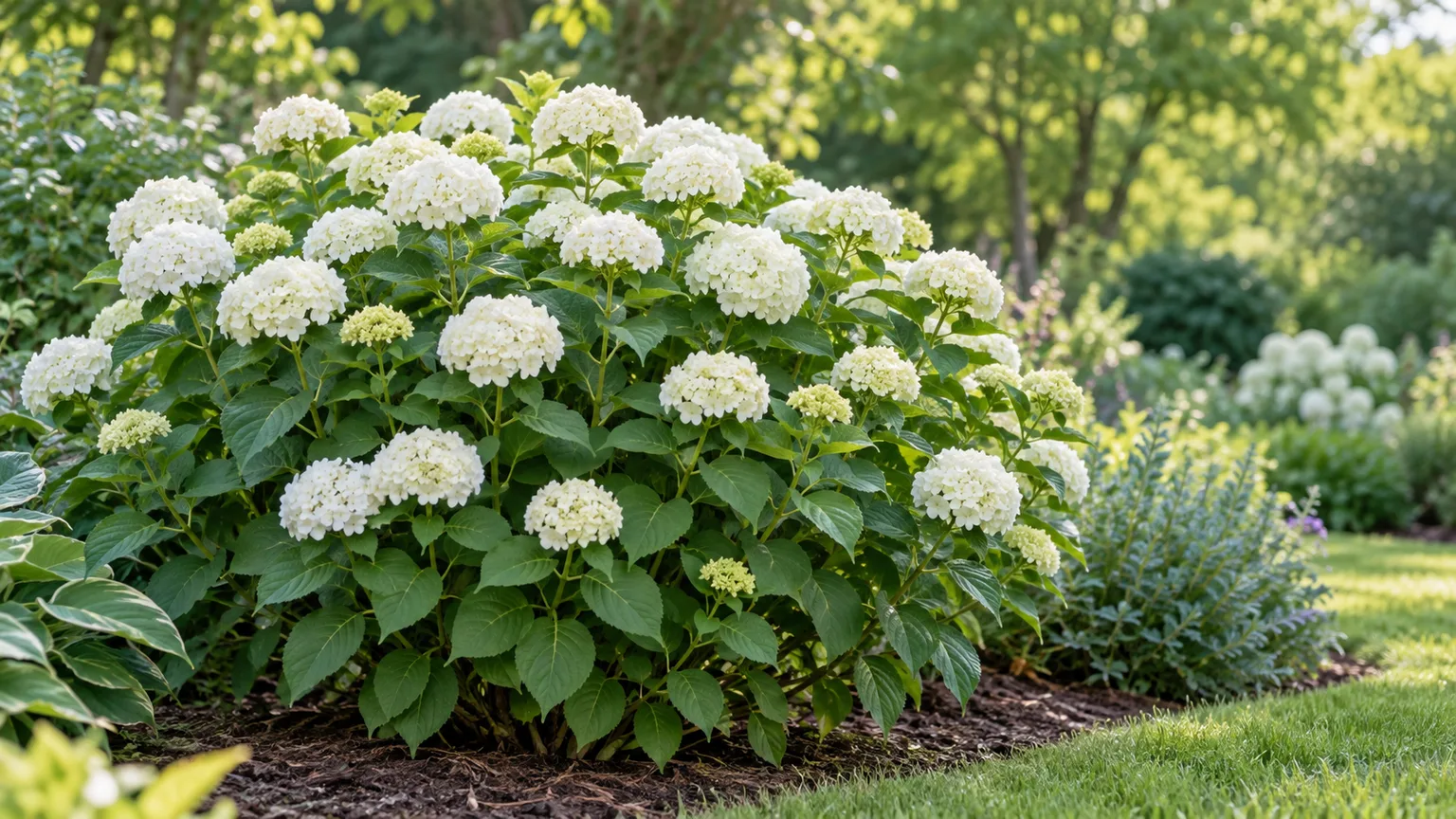
FlowerFull is a new smooth hydrangea — Hydrangea arborescens ‘BAIful’ — introduced by Bailey Nurseries under its First Editions Shrubs & Trees brand. It arrived with an unusually specific promise: two to three times more flower heads than other smooth hydrangeas, on stems strong enough to stay upright through wind and heavy rain. Those claims come from the breeder, not from independent trials, and there is still no long-term garden record for a cultivar that reached retail in 2024. So the useful question is not whether FlowerFull sounds good. It is what the plant actually is, what the paperwork says, and how to grow it.
The good news is that this cultivar came with a public record attached. Unlike almost every “new plant for 2025” announcement, FlowerFull was described in a granted United States plant patent, which specifies the breeding method, parentage, mature dimensions, hardiness floor and flower counts in unusual detail. Everything below traces back to that patent, to the breeder’s own product pages, or to independent horticultural references.
What FlowerFull Actually Is
FlowerFull is a deciduous perennial shrub in the smooth hydrangea group — the group that also includes ‘Annabelle’ and ‘Incrediball’. Smooth hydrangeas flower on new growth rather than on wood formed the previous summer, which is why they shrug off cold winters and still bloom. Unlike bigleaf hydrangeas, they will not change flower colour with soil pH. Their blooms open white or greenish-white, mature to pure white, then fade through green to brown and hold that structure into winter.
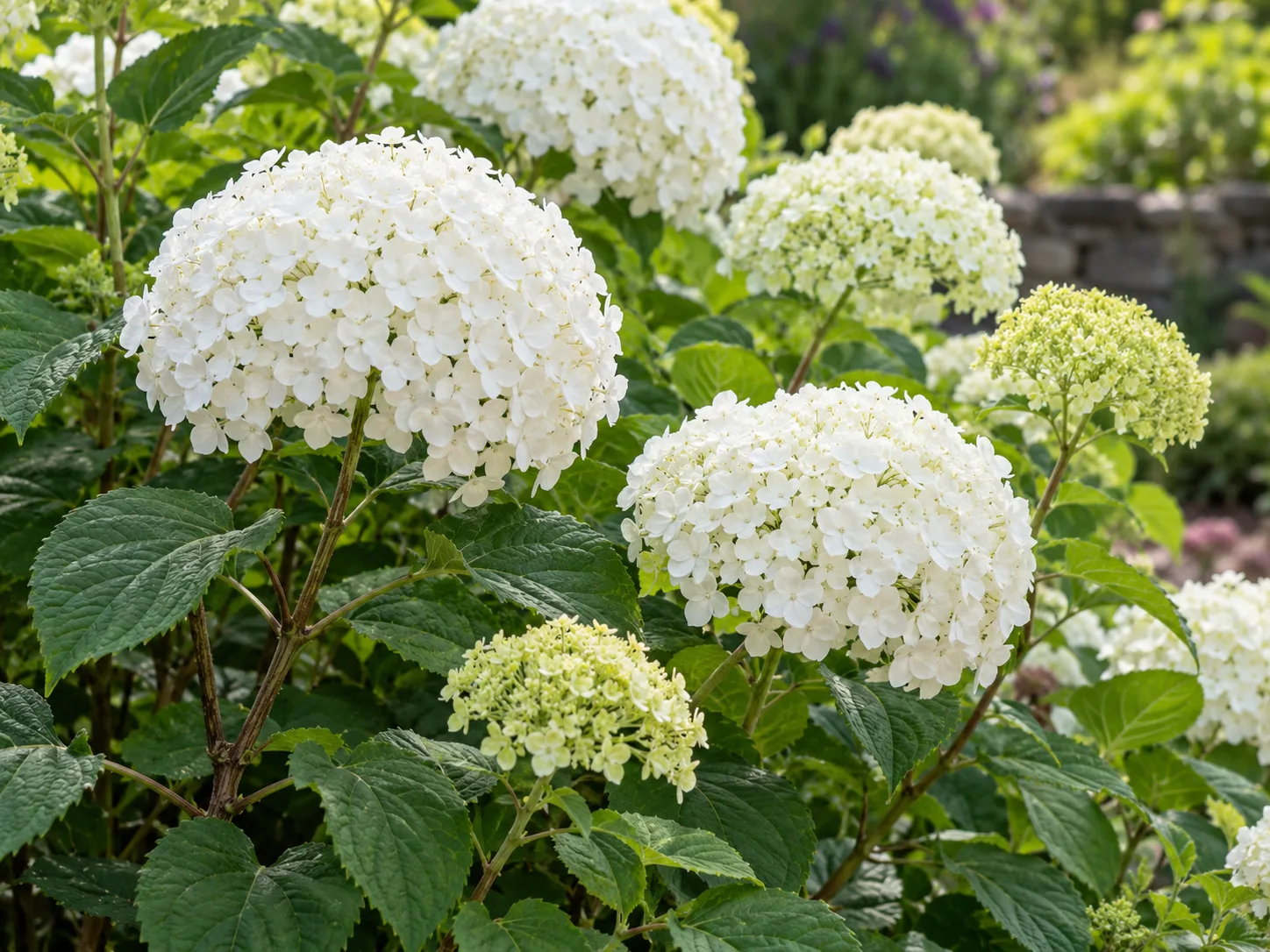
That much is species-level background rather than cultivar novelty. The interesting part is that FlowerFull is the first H. arborescens released by First Editions, a brand that had concentrated on panicle and bigleaf hydrangeas until Bailey Nurseries handed it the smooth group.
The name, the trademark, and the plant patent
Three identifiers matter when you are standing in a garden centre, and confusing them causes real problems. The trademarked marketing name is FlowerFull Smooth Hydrangea. The legal cultivar name is ‘BAIful’. The plant patent is US PP35,613, granted as USPP35613P2 on 30 January 2024. First Editions lists the plant under all three in its product specifications, which is the clearest confirmation that FlowerFull and ‘BAIful’ are the same shrub.
The patent names inventors David Charles Zlesak and Gail Katherine Soens, assigns the rights to Bailey Nurseries Inc., and describes the plant as a new smooth hydrangea grown for landscape use. Because a plant patent is a legal rather than a promotional document, it is unusually useful for checking a breeder’s claims — and, as it turns out, for finding the gaps between the claims and the measurements.
Was It Really New in 2025?
Yes, and it is worth being precise about why, because the “coming in 2025” framing has a traceable origin. Bailey Nurseries announced FlowerFull publicly in July 2024 as new for 2025, and the trade press carried that framing through 2024 and 2025, as Greenhouse Management and Birds & Blooms both reported. Plants went to First Editions licensees across North America for sale from autumn 2024, with the wide retail push landing in the 2025 growing season.
So the introduction is real rather than speculation, but the headline year describes the retail wave, not the moment of origin. The cultivar itself is considerably older than 2025: it was selected in 2015 and patented in 2024. Anyone writing in 2026 or later should treat FlowerFull as a young established introduction rather than a future one, and the meaningful question now is what the plant does in a real garden after a few seasons.
From a 2015 seedling to a licensed introduction
The breeding story explains the plant’s character. According to the patent, ‘BAIful’ originated from open-pollinated seedlings of Hydrangea arborescens ‘Bounty’ treated with trifluralin as a mutagen in 2015, under a breeding programme run in Cottage Grove, Minnesota. Trifluralin is a dinitroaniline herbicide used in plant breeding to disrupt cell division and generate genetic variation. The resulting seedlings were highly variable, and ‘BAIful’ was the one that stood out.
The patent is careful about what this did and did not produce. It notes that typical polyploidisation effects — reduced branching, brittle stems, oversized organs — were not observed, and that guard-cell measurements suggest the plant is likely not polyploid at all. What it cannot say is how much the mutagen actually contributed to the desirable traits. A separate account puts the formal start of the collaboration at 2016 under Debbie Lonnee with Dr Zlesak as long-standing breeding partner Greenhouse Management. That one-year gap against the patent’s own account is a small reminder that even a well-documented introduction carries some internal inconsistency.
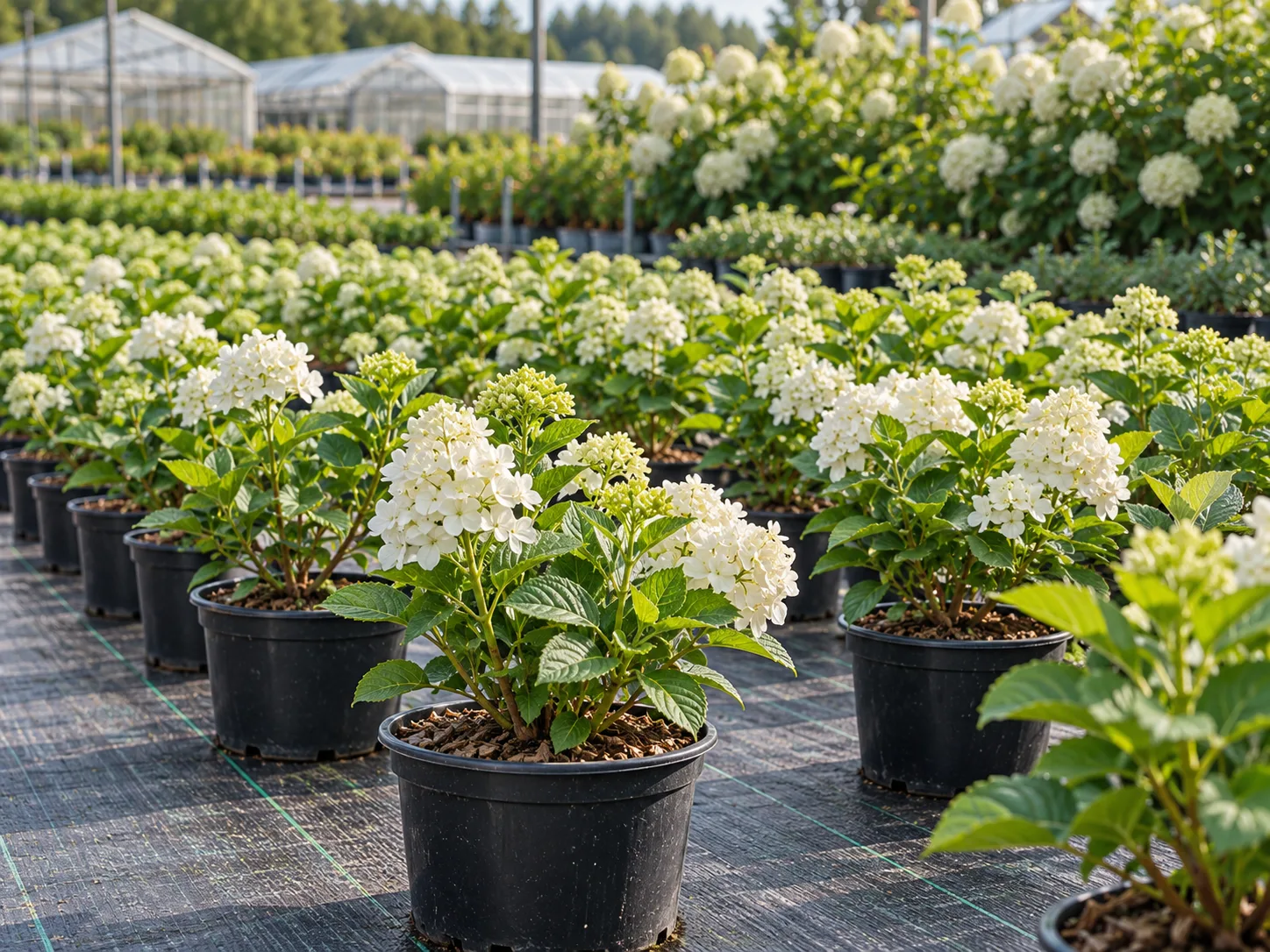
First asexual propagation was by softwood stem cuttings in summer 2016, and the cultivar has since been propagated by softwood, semi-hardwood and hardwood cuttings with stable, true-to-type results across generations. That detail matters commercially: it is why licensed growers can produce a uniform crop, and why a plant sold in 2024 behaves like the plant described in 2026.
FlowerFull at a Glance
The table separates what the breeder markets from what the patent records. Where the two disagree, both are shown.
| Feature | Marketed by First Editions | Recorded in the patent |
|---|---|---|
| Botanical name | Hydrangea arborescens ‘BAIful’ | Hydrangea arborescens, cultivar ‘BAIful’ |
| Mature height | 3–4 ft | 86 cm (about 2.8 ft) on a 4-year-old plant |
| Mature spread | 4–5 ft | 1 m (about 3.3 ft) on a 4-year-old plant |
| Hardiness zone | 3–8 | ”At least to U.S.D.A. Zone 4” |
| Heat zone | 8 | Not recorded |
| Light | Full sun to part shade | Not recorded |
| Flower size | Not stated | 15 cm (about 6 in) diameter, 5 cm deep |
| Flower count | Two to three times other smooth hydrangeas | About 500 sterile florets plus 250 fertile buds per head |
| Bloom window | Summer into fall | Mid-June to mid-July main flush in Minnesota, with possible continuation to fall |
| Flower duration | Not stated | About 4 weeks per head |
| Habit | Rounded | Rounded, compact, well-branched; about 35 lateral branches |
| Disease response | Disease-resistant foliage | Good resistance to bacterial leaf spot caused by Xanthomonas campestris |
Three conflicts are worth dwelling on, because each changes a decision you would otherwise make differently.
The zone figures are the biggest. First Editions markets zones 3–8, which is generous. The patent, describing plants actually grown in Cottage Grove, Minnesota and River Falls, Wisconsin, records hardiness “at least to” zone 4, and a European novelty record lists zone 4 as well. The wording deliberately stops at “at least,” so zone 4 is not a floor either. But a zone 3 claim is far less well supported than a zone 4 one, and in a zone 3 garden you should expect to mulch the crown rather than trust the label.
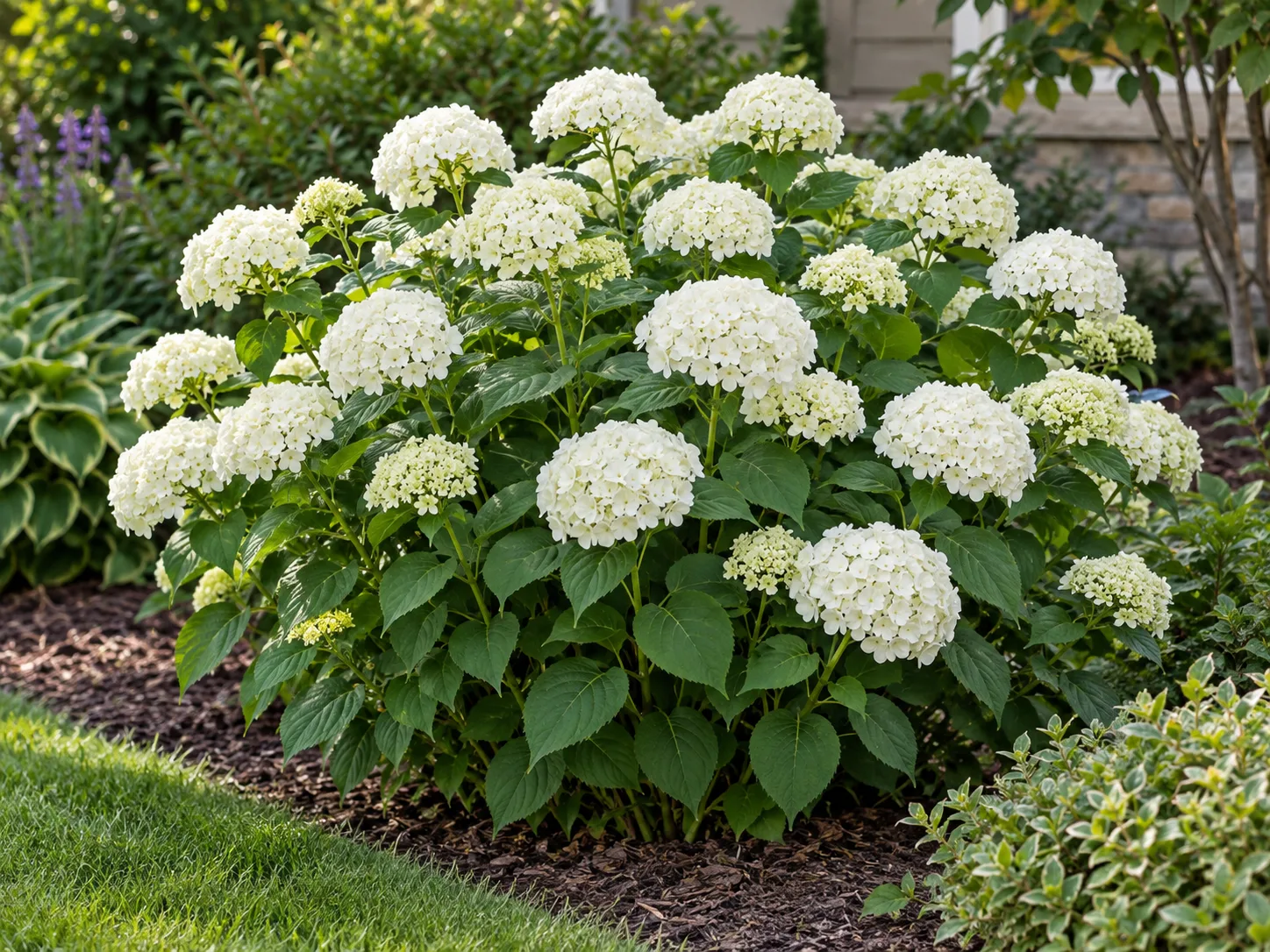
The spread matters for layout. Marketed at 4–5 feet wide, but roughly 1 metre on a four-year-old plant in the patent’s own trial conditions. Plan the site on the smaller number. A plant that ends up a foot wider than you allowed will be pressing against a path or a neighbour’s fence by year four, and moving a mature H. arborescens is unpleasant work.
The flower size is what most directly undercuts the marketing tone. Individual heads are about 6 inches across, where ‘Annabelle’ typically produces 8–12 inch heads Missouri Botanical Garden. FlowerFull is not a plant with bigger flowers. It is a plant with many more of them.
The Marketing Claims, Checked Against the Record
Four claims carry the whole launch: more blooms, stronger stems, disease-resistant leaves, and low maintenance. Each can be checked.
Stem strength, flower count, and flower size
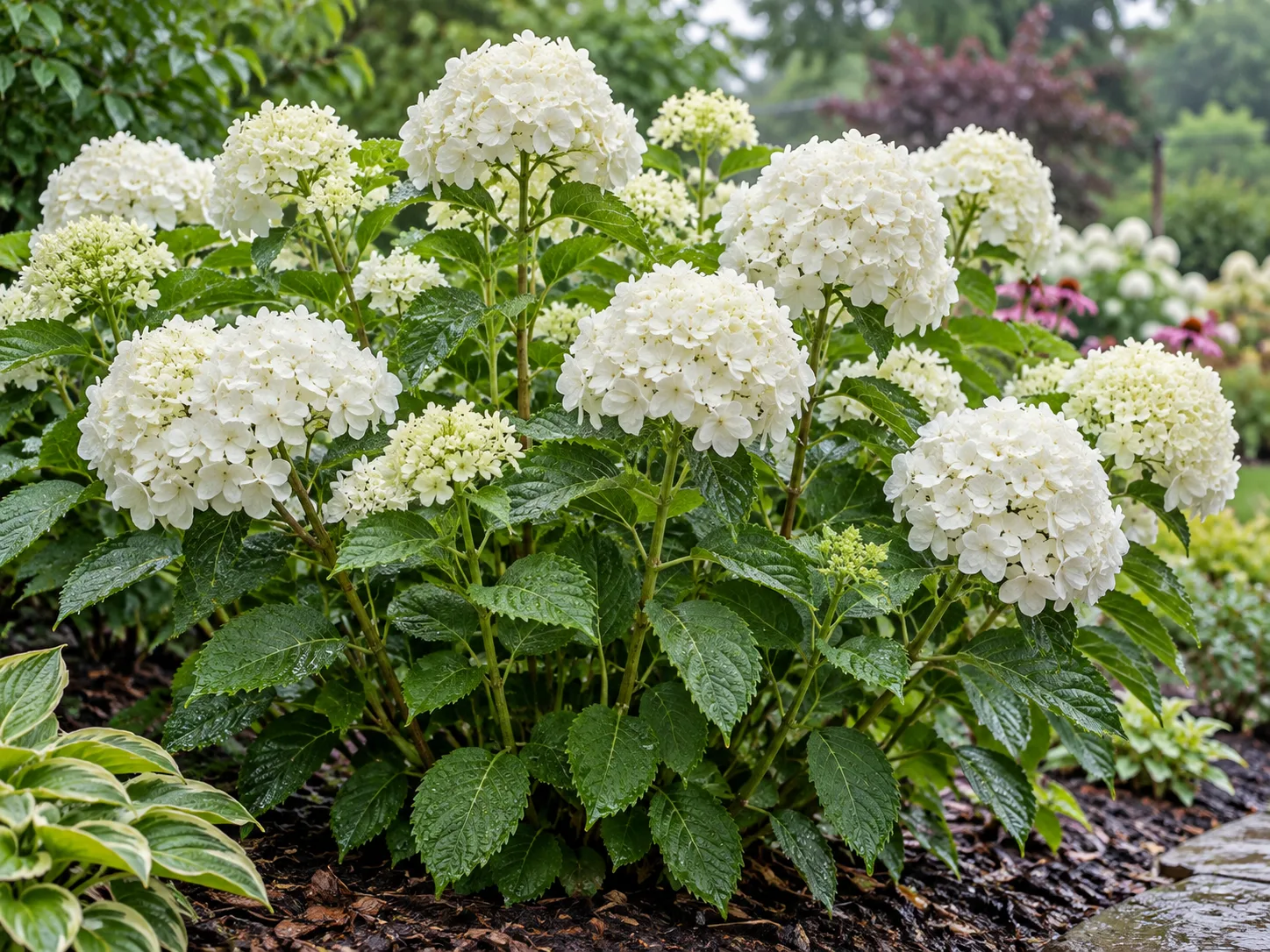
The stem claim is the best supported. The patent describes sturdy, straight, rounded stems that are “strong, do not lodge,” held upright to slightly outward, on a compact and well-branched habit averaging 35 lateral branches per plant, with peduncles held upright and moderately strong. Bailey’s own account confirms that plants were distributed for production trials and in-ground trials across the country, plus to secure trial partners and First Editions licensees, and that feedback confirmed performance at the Bailey Innovations breeding facility in Athens, Georgia Greenhouse Management. That is a real multi-site evaluation, and it underpins the anti-flopping claim.
The bloom-count claim is genuine but narrower than it sounds. Bailey states two to three times more blooms per season than other H. arborescens, while trade coverage has rendered the same idea as “double the blooms of industry standards” Greenhouse Management. The patent makes no comparative flower-count claim at all; it records approximately 500 sterile florets and 250 fertile buds per inflorescence, one head per lateral stem, across roughly 35 lateral branches. Multiply that out and you get a genuinely heavy display. But “two to three times” is a breeder’s trial observation, not a figure from an independent published comparison.
Read the three claims together and the picture sharpens. The patent explicitly compares ‘BAIful’ to ‘Abetwo’ and ‘Annabelle’, stating that both have larger flowers but are less floriferous, less compact and less dense, and are prone to stems bending and falling in wind and storms. Against its own maternal parent ‘Bounty’, ‘BAIful’ is more compact, better branched, earlier and freer in bloom, with stronger stems that do not splay. This is a plant engineered for density and rigour, not for individual head size. If you loved Annabelle’s enormous single globes, FlowerFull will not replace that look. If you wanted a massed white display that survives a storm, it is a different and better-suited proposition.
Disease resistance, and what “resistant” does not mean
The disease claim needs the most care. The patent states good resistance to bacterial leaf spot caused by Xanthomonas campestris, and Bailey’s marketing generalises this to disease-resistant foliage that “stays clean late in the season.” That is a genuine breeding achievement on a species that does get leaf spot.
But resistance is not immunity, and the disease landscape has moved since the plant was selected. The Pacific Northwest Pest Management Handbooks, revised in March 2026, note that in warmer parts of the United States X. campestris can also cause leaf spot, that Xanthomonas hydrangeae was described on oakleaf hydrangeas and other species in Belgium, and — critically — that this bacterium was found on nursery-grown hydrangea in Michigan in 2025, prompting a quarantine on infected plants across the United States. The same handbook notes that cool wet spring weather favours disease, and that wounds, frost damage, incorrect soil pH and poor nutrition all predispose plants to infection.
That is a landscape where a well-bred resistance trait is both valuable and limited. The practical controls remain the ones the handbook lists: space and prune bushes to permit good air circulation, and avoid overhead irrigation that keeps leaves wet. Buying resistant genetics lowers your risk. It does not remove it, and it does not substitute for watering at the soil line.
Where FlowerFull Sits Among Smooth Hydrangeas
If you already grow ‘Annabelle’, the honest comparison is about habit and reliability rather than beauty. Both are Hydrangea arborescens, both flower on new wood, both need late-winter or early-spring pruning, and both open white and age to green and tan. NC State Extension describes the classic smooth-hydrangea problem plainly: treated like an herbaceous perennial, new shoots produce very large flower clusters, but after heavy rain the stems supporting them bend and droop, and weak or damaged stems should be removed in early spring.
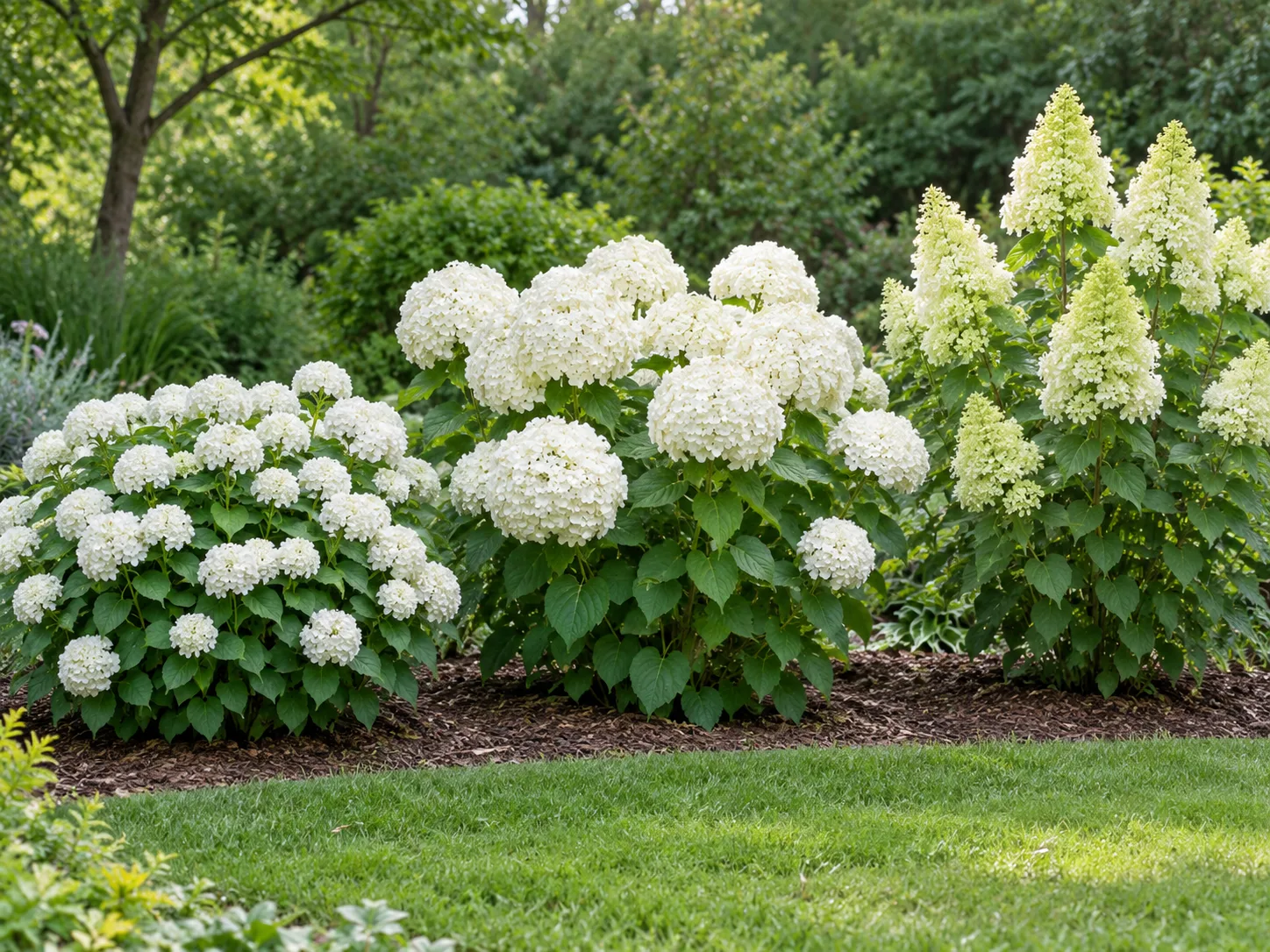
The difference is that ‘BAIful’ was selected specifically against those two failure points. Missouri Botanical Garden and NC State both describe ‘Annabelle’ as having weak, floppy stems that need staking or support, and the patent is explicit that ‘Annabelle’ and ‘Abetwo’ are prone to stems bending and falling while ‘BAIful’ was chosen to differ. So if your Annabelle flops every year and you have stopped enjoying it, FlowerFull is a reasoned upgrade. If your Annabelle is fine, the improvement is real but incremental.
Two other comparisons are worth keeping in mind. Against ‘Incrediball’, which already solved much of the flopping problem at 4–5 feet, FlowerFull’s advantages are compactness, a denser branching habit and heavier flower production. Against smaller pink cultivars such as ‘Invincibelle Spirit II’, it trades colour for mass and scale. Our guide to the best hydrangea varieties sorts the main groups, and the Annabelle care guide covers the flopping problem in more depth if that is the cultivar you are replacing.
Choosing a Site: Light, Soil, and Spacing
FlowerFull is marketed for full sun to part shade, and First Editions rates watering as medium to high. Missouri Botanical Garden gives the species-level guidance that smooth hydrangea grows best in part shade and tolerates full sun only when grown with consistent moisture, noting that foliage declines considerably in dry conditions and that the plant is intolerant of drought. NC State Extension is more prescriptive still, recommending neutral to acidic, well-drained soils in partial shade.
Treat part shade as the default and full sun as a conditional choice. Morning sun with afternoon shade is the reliable arrangement in hot climates, and it is the arrangement that keeps stems standing. Full sun works in cooler regions and anywhere you can guarantee steady soil moisture, but it raises water demand and leaf scorch risk precisely when flower heads are heaviest. Check your USDA hardiness zone before anything else — if you sit at the cold edge of the plant’s range, site choice matters less than drainage and crown protection.
On soil, the species is unusually accommodating. Missouri Botanical Garden lists tolerance for clay, wet soil, dry soil, shallow-rocky soil, erosion and black walnut. That is a description of what it survives, not what it prefers: it grows best in average, medium-moisture, well-drained soil amended with organic matter, and it will not colour-shift with pH in any case. One Canadian nursery’s guidance for the cultivar is a useful sanity check — loose, well-draining soil, consistent watering of at least an inch a week, and part shade to full sun with four or more hours of direct light the nursery listing.
Spacing deserves more attention than it usually gets, precisely because of the width discrepancy. The patent’s roughly 1 m spread at four years supports planning at 4 to 5 feet between centres for a mass or hedge planting, rather than the tighter spacing used for dwarf smooth cultivars. Our guide to how far apart to plant hydrangeas covers the arithmetic for mixed groups. If you want a single specimen against a wall or in a courtyard, this is a well-behaved size; if you want a fast screen, it is not the route — panicle hydrangeas get there sooner.
Planting and First-Year Care
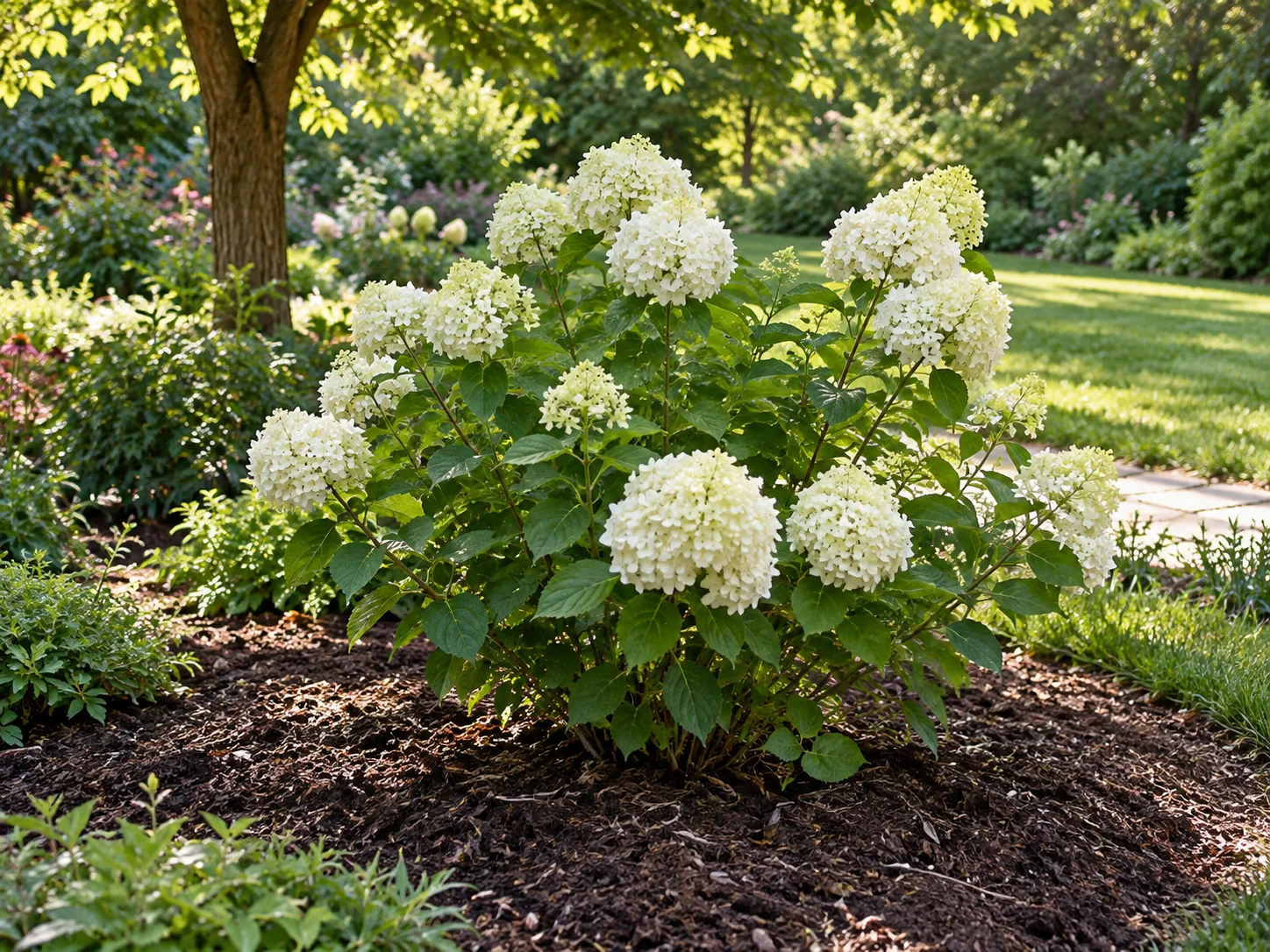
Plant container-grown specimens in spring or early autumn, with autumn planting giving roots a full season before the first flush. Set the root ball at the same depth it sat in the pot, and do not bury the crown, which is the part most vulnerable to winter injury in cold zones. If you are moving an established hydrangea rather than setting out a new one, our guide to when to transplant hydrangeas covers the timing rules that apply.
The first season is about roots, not flowers. Even though the patent notes that overwintered liners propagated the previous season flower reliably the following year, a plant newly set out in spring is still establishing. Water deeply and consistently, mulch to hold moisture, and resist the urge to feed heavily. A 5 to 8 cm layer of organic mulch over the root zone, kept clear of the crown, does more for first-year survival than any fertiliser bag.
For planting combinations, smooth hydrangea sits well among perennials that share its moisture preference and bloom window. Our hydrangea companion plants guide covers the pairing options in more detail than fits here.
Pruning: What New-Wood Blooming Changes
This is the most important cultural fact about the plant, and it works in your favour. Smooth hydrangea sets its flower buds in spring on growth made that same season, so pruning in winter costs you nothing in bloom. Missouri Botanical Garden recommends cutting plants back close to the ground in late winter to revitalise them and encourage vigorous stem growth, and removing weakened or damaged stems in early spring if you have not cut back. NC State gives the same instruction, and First Editions lists late winter as the plant’s preferred timing.
What the new cultivar changes is how hard you can prune without consequence. Because ‘BAIful’ is described as compact and densely branched with strong, non-lodging stems, a harder cut produces a shorter, better-branched plant that is far less dependent on support than the same cut on ‘Annabelle’. That is the practical expression of the breeding goal.
The one caution is that a rejuvenation cut still means a smaller first-year display, because you are removing flowering wood. Decide whether you are managing height or maximising a single season’s flowers, and prune accordingly rather than defaulting to the ground every year without thinking. Full timing by hydrangea type is in our when to prune hydrangeas guide, and the summer deadheading question is covered separately in deadheading hydrangeas in summer.
Watering, Mulch, and Feeding
Consistent moisture is the deciding factor for this species, and it is worth being blunt about that. Smooth hydrangea has large, thin leaves that lose water quickly, and a plant that dries out repeatedly produces smaller flower heads and browned foliage without recovering well that season Mossfield. Missouri Botanical Garden states plainly that the foliage declines considerably in dry conditions and the plant is intolerant of drought.
Water at the soil line rather than overhead. The PNW handbook’s disease guidance is that overhead irrigation keeps leaves wet and should be avoided the PNW handbook, which means your watering habits protect against leaf spot as well as drought stress. Deep, less frequent watering beats a daily sprinkle, and a thick mulch layer extends the interval. Our guide to how often to water hydrangeas covers scheduling by climate and soil.
On feeding, First Editions specifies a balanced NPK fertiliser. The general rule for flowering shrubs is to feed lightly in spring and avoid heavy nitrogen, which pushes vegetative growth at the expense of flowers and can produce the soft, sappy stems that flop. If your soil is decent, a compost top-dress in spring is sufficient and safer than a fertiliser bag. For the general reasoning, see hydrangea care tips.
Bloom, Cut Flowers, and Pollinator Value
The bloom window recorded in the patent is mid-June through mid-July for the main flush in Minnesota, with some continued flowering possible into fall. Individual heads last about four weeks, with sterile florets persisting and fertile florets self-cleaning. Birds & Blooms describes two or three rounds of white bloom through summer, fading to green with age, on dark green spade-shaped leaves. In warmer zones expect the whole sequence earlier; in cool zones, later and possibly compressed. Our guide to when hydrangeas bloom puts this in context with the other types.
Cut flowers are a legitimate use rather than a bonus. First Editions lists the plant as good for cut flowers, and the persistent sterile florets are exactly what you want in a harvested head. One caution: because heads are smaller than Annabelle’s, a mixed bouquet will read as texture and filler rather than as focal points.
The pollinator claim needs a fair hearing, because it is routinely overstated for this group. One Canadian grower’s guidance is blunt: the sterile mophead flowers of cultivated smooth hydrangeas offer pollinators nothing, unlike the fertile lacecap flowers of the wild species Mossfield. That is largely true of ‘Annabelle’, which is almost entirely sterile. It is less true of FlowerFull, whose patent records a substantial minority of fertile buds — roughly 250 per head alongside about 500 sterile florets. NC State also notes that H. arborescens is a larval host plant for the hydrangea sphinx moth, and recommends the species for pollinator, native and wildlife gardens.
So the accurate version is: FlowerFull supports insects, but treat it as a secondary nectar source within a mixed planting rather than building a pollinator scheme around it alone.
Where to Buy It, and What to Do With a Bad Label
Availability has moved past the novelty stage. It reached First Editions licensees across North America for autumn 2024 sale, with broad retail distribution through 2025, and it is now carried by independent nurseries in both the United States and Canada, including a Canadian retail listing that documents current pot size and price. Expect to pay a premium over standard Annabelle while supply is still building — one such retailer lists it at $69.99 in a larger pot. Check how far apart to plant hydrangeas before you buy, because the eventual footprint is not the pot size.
Buy by the botanical name, not the marketing name. The tag should read Hydrangea arborescens ‘BAIful’, or at minimum Hydrangea arborescens. This is not fussiness — it is the only way to guarantee you are getting the cultivar rather than another white smooth hydrangea that happens to be on the bench.
Retail descriptions are not reliably accurate, and this one contains a specific error worth knowing about. At least one nursery listing describes FlowerFull as producing flowers on both old and new wood the nursery listing. That is wrong for this species, and it is contradicted by the patent’s own bloom window, which describes flowering in mid-June to mid-July on the current season’s growth, and by every extension reference for H. arborescens, from Missouri Botanical Garden to NC State Extension. The same listing gives a mature size of 30–36 inches in both height and spread, against a marketed 4–5 ft width, and contradicts itself about deer resistance on the same page.
Treat retailer copy as marketing and treat the patent plus extension references as the record. If a label contradicts this article, check the patent.
Problems and Failure Modes to Watch For
Flopping after rain. This is the problem FlowerFull was bred to solve, and it can still happen in extreme conditions. Its most common triggers are not the cultivar but the site: drought stress weakens stems, and so does heavy nitrogen, as both Missouri Botanical Garden and Mossfield make clear. If heads go down, check water first, then feed, then site. Our guide to drooping hydrangeas walks through the diagnostic order.
Leaf spot. Watch for angular, darkening spots that begin on lower leaves, which the PNW handbook describes as typical of Xanthomonas leaf spot the PNW handbook. Improve airflow, avoid overhead watering, and clear away badly affected fallen foliage. Resistance reduces incidence; it does not prevent it.
Winter damage in cold zones. The patent’s tested hardiness is “at least to zone 4,” below the marketed zone 3. In colder regions the top may die back to the ground. That is not fatal for a new-wood bloomer — it regrows and flowers the same year — but mulch over the crown after freeze-up if snow cover is unreliable, as Mossfield recommends for zone 3.
Fewer blooms than promised. The usual cause is a pruning mistake in the wrong window, particularly autumn pruning, which removes the current season’s flowering stems. Prune in late winter instead, as First Editions and Missouri Botanical Garden both specify.
Pet exposure. Hydrangea is toxic to dogs, cats and horses because it contains cyanogenic glycosides; the ASPCA lists the clinical signs as vomiting, depression and diarrhoea, and notes that cyanide intoxication is rare and usually produces more of a gastrointestinal disturbance. This is a species-level trait, so FlowerFull is no safer than Annabelle.

Who Should Plant FlowerFull, and Who Should Skip It
FlowerFull suits gardeners who have already been disappointed by ‘Annabelle’ flopping, who want a compact white hydrangea that will not need staking, or who are in a colder zone and want a smooth hydrangea that flowers reliably without their buds needing winter protection. It is particularly sensible in a small garden, where the compact, densely branched habit and roughly 3 to 5 foot footprint are genuine advantages over a 6-foot panicle.
It is a poor fit if you are shopping for the biggest possible individual flower heads — these are about 6 inches across, smaller than Annabelle’s. It is a poor fit if you want pink or blue colour, or a plant that turns pink as it ages, which some newer smooth cultivars do. And it is a poor fit if you are in zone 3 and want the marketed cold-hardiness claim to hold without winter protection.
It is also worth being honest about the evidence base. The strongest claims — stem strength and bloom density — are well documented in the patent and in the national trial network described by Greenhouse Management. The weakest are the comparative ones, which come from the breeder’s own trials rather than an independent published comparison. Buying it on a nursery tag is a reasonable bet; buying it because a patent exists is not the same thing. A three-season-old plant in your garden will tell you more than either.
Conclusion
FlowerFull is a real, verifiable cultivar: Hydrangea arborescens ‘BAIful’, patented as US PP35,613 and introduced by Bailey Nurseries for the 2025 retail season after selection in 2015. What makes it interesting is not that it is new. It is that the plant behind the launch is unusually well documented, and that the documentation is more interesting than the marketing.
Read honestly, the patent describes a cultivar with smaller flower heads than ‘Annabelle’ and many more of them, on stems selected specifically not to lodge, across a compact, densely branched habit. Read honestly, it also records hardiness of “at least to zone 4” against a marketed zone 3, and a spread closer to 3 feet than to the advertised 5. Those are not disqualifications. They are the details that let you plant it in the right place, space it correctly and protect it properly.
The practical summary is short. Give it part shade or morning sun and consistent deep water, mulch the root zone, prune in late winter to early spring, and leave room for airflow. Expect the main flush in early to midsummer, with the possibility of lighter flowering later. Check the botanical name on the tag, and believe the patent over the label when they disagree. Then judge it yourself in year three, which is when this plant finally has an opinion worth having.