Terrace Gardening in India: Heat, Containers, Watering
Practical terrace gardening for Indian roofs: waterproofing and weight caveats, heat and wind, grow bags vs pots, and summer watering that keeps containers alive.
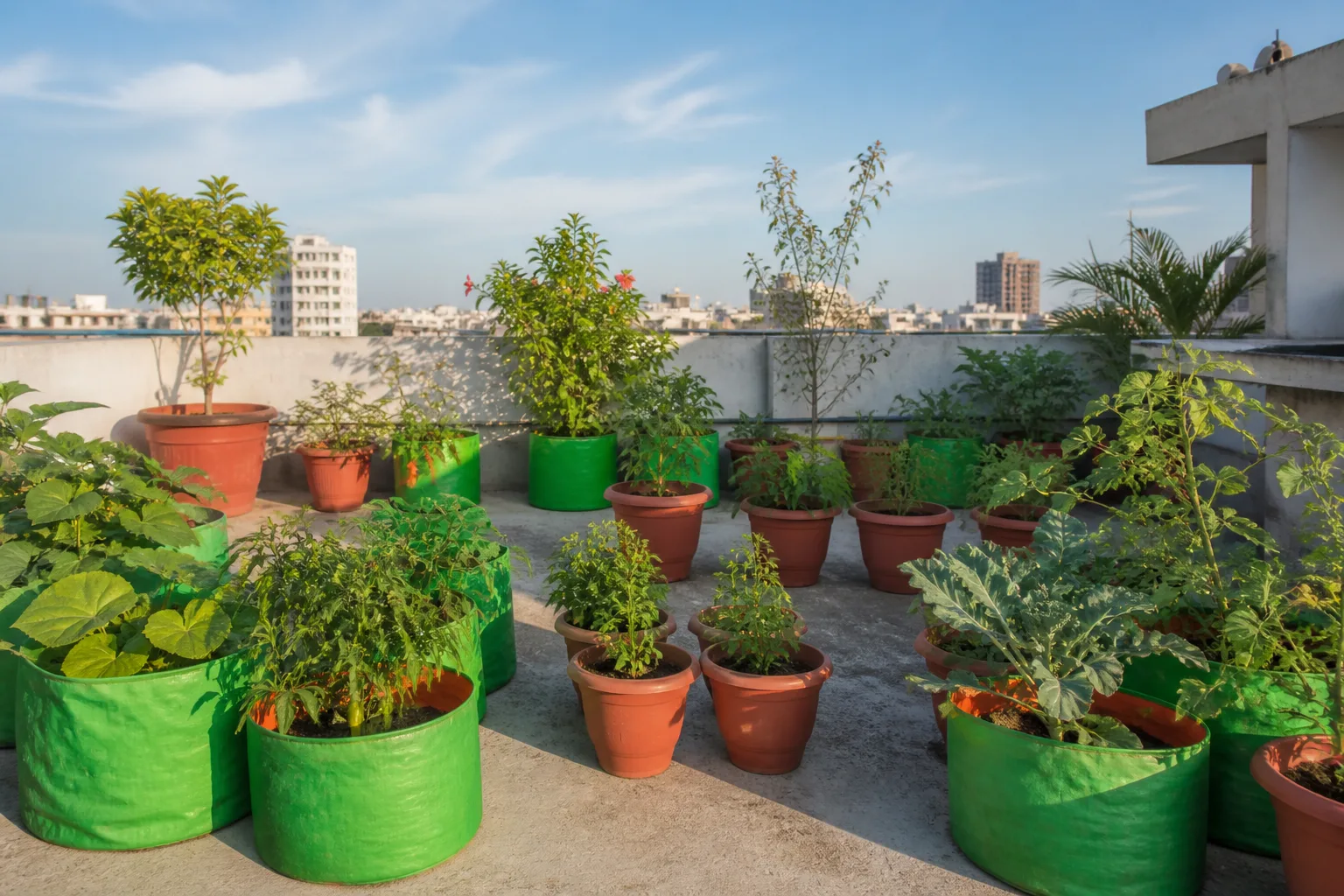
An Indian terrace is not a mild patio with garden beds. It is a hot, windy, reflective platform where every plant lives in a limited pot of mix, every litre of water has somewhere to go, and every wet kilogram sits on a slab built for people — not for a forest of cement planters. Treat terrace gardening like “more sunlight equals more growth,” and you get crispy leaves by April, tipped pots by May, and seepage complaints by the first monsoon.
This is the operations manual for that reality: waterproofing and weight caveats (not structural engineering advice), heat and wind management, containers that survive Indian summers, and watering that keeps roots oxygenated instead of cooked or drowned. Plant picks that already handle open summer exposure live in balcony plants for Indian summers. When soft houseplants need cool-first triage under cover, use houseplant heat stress.
What This Guide Covers (and What It Hands Off)
This guide owns: terrace and rooftop infrastructure decisions for Indian apartments and houses — waterproofing checks, wet-weight caution, heat–wind microclimate, container materials, light media, peak-summer watering, shade-net starting ranges, setup sequence, and the summer→monsoon habit flip.
This guide does not own: full vegetable crop calendars, pest and fertility troubleshooting, society-approved structural certificates, or engineered green-roof membrane specs. For heat-tolerant plant shortlists, use balcony plants for Indian summers and aspect pages such as west-facing balcony plants. For wet-season dry-down collapse, hand off to monsoon houseplant care in India. For deep watering mechanics that still apply in pots, see how to water indoor plants the right way and hot-weather plant watering.
If you came here for “benefits of terrace gardens” essays, you are in the wrong room. The goal is a roof that stays dry below you and plants that stay alive above you.
What Terrace Gardening Really Means in Indian Cities
Terrace gardening — also called rooftop or roof gardening — means growing flowers, herbs, vegetables, or ornamentals on a roof, terrace, or open balcony floor instead of in ground beds. Tamil Nadu Agricultural University’s Agritech materials describe roof gardens as multilayer systems that must tolerate extreme rooftop conditions, with waterproofing, drainage, growing media, irrigation, and plant choice working together (TNAU Agritech roof garden overview). Their rooftop FAQ frames the home-grower version: you transfer garden work onto an existing floor — apartment terrace, single-storey house roof, or office terrace — without buying new land (TNAU rooftop gardening FAQ).
In Indian cities that usually means container culture first: grow bags, plastic pots, recycled drums, and troughs. Full intensive green-roof builds with drain cells and engineered substrates exist — TNAU even contrasts extensive systems under about 15 cm of media with intensive roof gardens deeper than that, and notes saturated weights that climb steeply as depth rises (TNAU Agritech). Most apartment growers should start with movable containers. Containers let you start small, shift plants for shade, and avoid permanently loading one corner of the slab with saturated soil.
What changes versus a garden plot is the physics. There is no deep soil reservoir. Concrete and tiles store and radiate heat. Wind strips moisture from leaves and mix. Rain either floods trays or never arrives for weeks. Your job is to design for that microclimate, not fight it with daily misting and hope.
Waterproofing and Weight: Practical Caveats Before You Start
Skip this section and the rest of the guide becomes expensive plant shopping on a leak risk. Before you stack pots, treat the floor as infrastructure.
Waterproofing Is Not Optional DIY Guesswork
TNAU’s rooftop FAQ is blunt about the first step: waterproof the terrace floor so it does not leak or bleed before you garden on it (TNAU rooftop gardening FAQ). The Agritech roof-garden page goes further on engineered systems: waterproofing is the area responsible for the most litigation, the building structure determines waterproofing design, and some membranes include root retardants that act as a root barrier (TNAU Agritech).
For a home terrace, translate that into practical rules — not DIY membrane engineering:
- Confirm the terrace already has a sound waterproof finish and clear slopes toward drains. If you see damp patches below, blistered paint, or standing puddles after rain, pause planting and get a waterproofing or building professional involved.
- Prefer containers and grow bags over open soil beds poured directly on the slab until waterproofing and drainage are verified.
- Keep overflow paths clear. Drainage systems exist to move water off the roof so plants do not drown and the structure does not hold water (TNAU Agritech).
- Avoid planting true trees with aggressive woody roots in thin terrace media. TNAU’s FAQ warns that tree roots can threaten walls and roofs, and that volunteer seedlings should be removed early (TNAU rooftop gardening FAQ).
- Check apartment society rules on runoff onto neighbours below, hose points near wet floors, and parapet safety for children or pets — brief household logistics, not legal advice.
This is practical caution, not a structural certificate. If you are unsure about slab condition, waterproofing age, or drain capacity, ask the building society or a licensed professional before you scale up.
Weight, Wet Soil, and Load-Bearing Caution
Wet potting mix is heavy. Saturation — not the dry bag weight — is what the slab feels after you water or after a storm. TNAU lists load-bearing capacity among the critical growing-medium selection factors and notes that lightweight amendments reduce substrate weight while still supporting plants (TNAU Agritech). Their FAQ also prefers cocopeat-based mixes and geotextile grow bags that drain without “affecting the base,” specifically to avoid excess weight (TNAU rooftop gardening FAQ).
Practical weight habits for apartment terraces:
- Start with fewer, well-placed containers instead of lining every edge with large cement pots.
- Favour lighter media (coir/cocopeat blends, perlite or similar aerators) over dense field soil hauled upstairs.
- Spread weight; do not park every heavy pot on one balcony corner or above a single span if you can avoid it.
- Empty saucers and trays after watering so you are not storing an extra water tank under every plant.
- As a rough editorial caution — not a load calculation — a 14-inch pot of wet mix can feel shockingly heavy when you lift it; if you cannot safely move a container after watering, you have already chosen something the roof and your back will both feel. When in doubt about load limits, treat this guide as horticultural practice only and get building advice before adding raised beds, water tanks, or dozens of large planters.
Heat, Wind, and Roof Microclimates
Open terraces in Indian summers combine high air temperature, intense radiation from sun and concrete, and drying wind. That stack is why a plant that looked fine on a sheltered east balcony can collapse on a west terrace by 3 p.m.
Dry-Down Speed, Heat Wilt, and Wet Wilt
Container plants already need more frequent watering than in-ground plants because root volume and compost volume are limited (RHS container growing). On a terrace, three extras accelerate dry-down: full sun for longer hours, reflective heat from the floor, and wind across an unobstructed roof. Small pots lose moisture even faster than large ones — RHS notes that large containers with more compost dry out more slowly and are easier to maintain (RHS).
Heat stress shows up as limp, curling leaves when plants lose water faster than roots can replace it, plus scorch or bleached patches under intense light (NC State Extension). Temporary afternoon wilt can firm overnight if roots are healthy and moisture is available; lasting limp on wet soil is a different problem — often root decline — and more water makes it worse. Clemson Extension stresses that overwatering is the main cause of death in potted plants because roots need oxygen as well as water (Clemson HGIC watering).
Those heat and watering physics come from temperate extension sheets; on Indian roofs they still describe container behaviour, but your placement and schedule are local synthesis. Coastal Mumbai humidity and dry Delhi heat do not share the same dry-down speed even in the same calendar month.
Wind, Tip-Over Risk, and High-Rise Parapets
TNAU notes that shrubs in exposed roof positions must withstand wind (TNAU Agritech). On a real Indian terrace that means tall, top-heavy pots tip, grow bags flap, and thin-leaved tropicals shred. Use wider bases, group pots to shelter each other, stake tall stems, and keep the windiest parapet for tough sun plants rather than soft ferns or tender houseplants.
High-rise west and south corners add tip-over and leaf shred. Avoid tall, top-heavy ornamentals in narrow parapet pots; put soft tropicals under a shade bay or move them indoors. If a plant needs stillness and humidity, it belongs under a shade structure or indoors — not on the open west rail.
Choosing Containers That Survive Indian Summers
UF/IFAS reminds growers that container size must match the plant, and that light, water, and fertilizer needs must align when plants share a pot (UF/IFAS container gardening). On Indian terraces, material choice is equally about heat and weight.
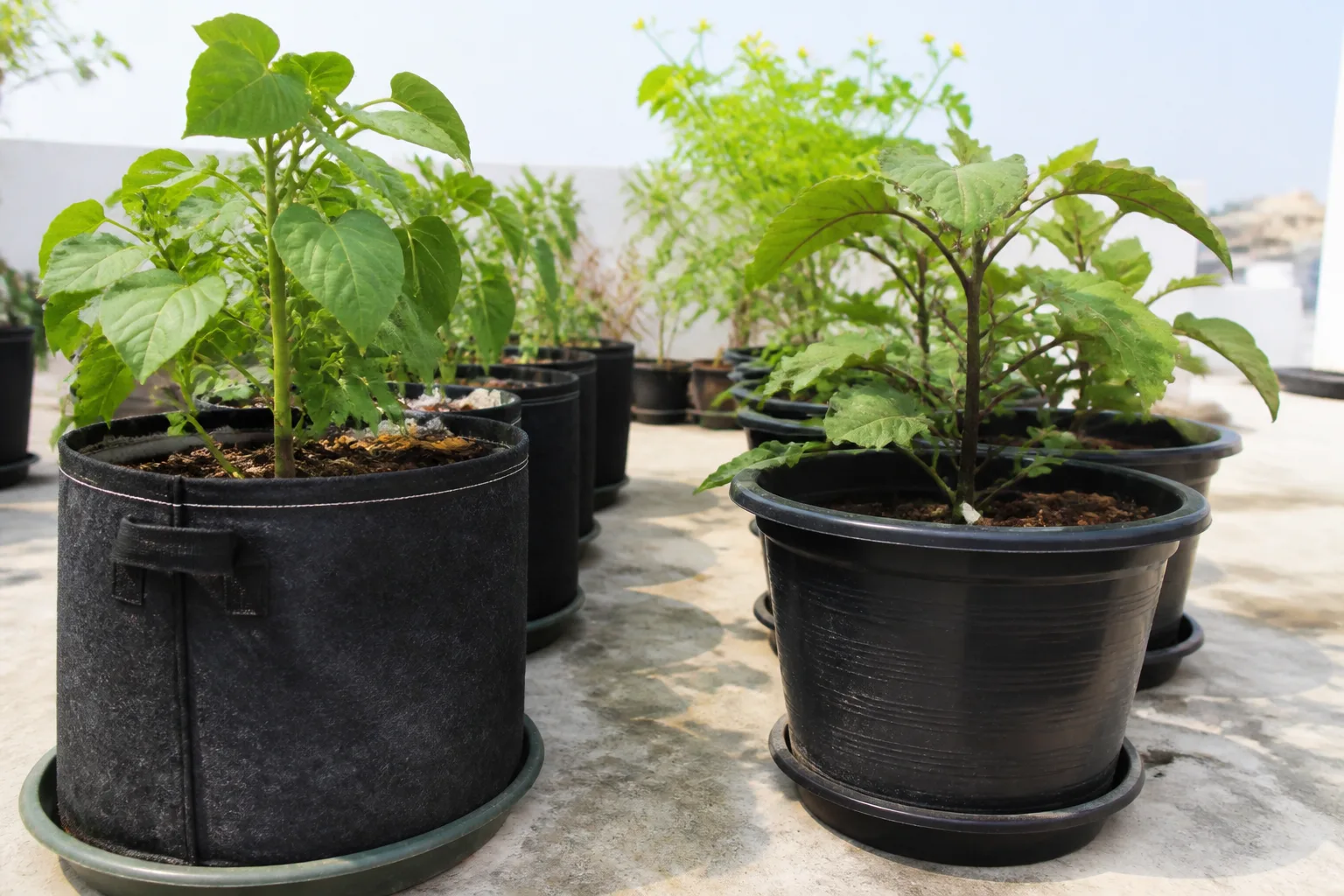
Grow Bags, Plastic, Terracotta, and Metal Compared
| Material | Weight | Dry-down on hot roof | Heat risk | Practical role |
|---|---|---|---|---|
| Fabric / geotextile grow bags | Light | Fast | Low root bake | Default workhorse; TNAU FAQ favours bags + cocopeat to limit base load |
| UV-stable plastic pots | Light–medium | Medium (holds moisture longer) | Low–medium | Thirsty veg and reduced daily watering |
| Terracotta / unglazed clay | Heavier | Fastest (porous) | Medium | Looks good; plan more checks in April–May |
| Metal planters | Medium–heavy | Variable | High — metal heats quickly in summer (RHS) | Cachepot only, or shaded with inner plastic pot |
Grow bags: Light, drain well, and are the practical default for many Indian terraces. TNAU’s FAQ repeatedly points growers toward grow bags and cocopeat so excess water exits without loading the base (TNAU rooftop gardening FAQ). They dry faster than glazed pots in peak heat — plan watering accordingly.
Plastic pots: Lighter than terracotta and hold moisture longer because they are not porous (RHS). Choose UV-stable pots when you can; cheap thin plastic can become brittle under years of roof sun.
Terracotta: Attractive and breathable, but porous pots dry faster (RHS). On a hot terrace that can mean daily checks in April–May for small clay pots. For a deeper material comparison, see terracotta vs plastic pots.
Metal: Durable looks, but RHS notes metal heats up quickly in summer (RHS). On an Indian roof that can cook root zones. If you love the look, use them as cachepots with a plastic nursery pot inside, or keep them off reflective floors with feet and afternoon shade.
Drainage holes are non-negotiable. RHS states it is essential to have drainage holes in the base of a container (RHS). No holes means a bathtub after every watering or storm.
Size, Drainage Holes, and Saucer Discipline
Favour fewer large containers over dozens of tiny ones. Larger volume buffers heat and watering mistakes (RHS). Match pot size to the rootball — oversized pots hold wet compost that can rot roots (RHS).
Saucers catch overflow so neighbours below do not get dripped on, but they become root killers if pots sit in hot standing water. Clemson’s rule is clear: water until runoff appears, then empty the saucer — do not let the pot sit in the runoff (Clemson HGIC). On terraces, use raised pot feet, drill overflow notches in trays, or water over a drain and return pots to dry trays. Colorado State PlantTalk likewise stresses drainage holes and not leaving pots in standing water (Colorado State PlantTalk).
Potting Mix for Hot Roofs
Do not haul random garden soil upstairs. Dense field soil compacts, stays heavy when wet, and drains poorly in pots. TNAU’s FAQ recommends equal-parts approaches with coir, sand, and vermicompost for terrace planting, and explicitly prefers cocopeat so the garden is not overweight (TNAU rooftop gardening FAQ). Agritech lists sand, pumice, perlite, vermiculite, and composts among roof-garden substrate components, with target air content and water storage capacity both high enough to support roots (TNAU Agritech).
A practical terrace mix goal: light enough to carry, open enough for oxygen after watering, and moisture-retentive enough that you are not watering three times a day in every pot. Coir-based mixes with compost and a mineral aerator fit that brief for most vegetables and ornamentals. Succulents and desert plants need a grit-heavier mix and less frequent water even in heat.
Watering Terrace Plants in Peak Heat
Watering is the job that decides whether a terrace garden thrives or becomes a weekly funeral for new plants. RHS calls watering one of the most important container jobs because restricted root area means plants rely on you for moisture — and for not staying too wet (RHS container maintenance).
There is no universal “water every day” answer. Clemson lists species, growth stage, location, pot type and size, soil mix, and weather as the variables that set frequency (Clemson HGIC). A plant in a warm, dry, sunny spot needs more frequent water than one in cool shade — exactly the terrace vs sheltered balcony split.
Use tactile checks: finger into the mix to the first joint; hollow tap on clay pots when dry; lighter pot weight; lighter mix colour as it dries (Clemson HGIC). When it is time, water thoroughly until runoff appears so the lower root zone — not only the top crust — gets wet, then drain (Clemson HGIC). A dry top centimetre with a still-wet core is common on hot afternoons; that is heat crust, not an automatic green light for another full soak. For absences, a well-built DIY self-watering system or simple drip line beats asking a neighbour to “give everything a little water.”
Morning Deep Watering vs Afternoon Panic Misting
NC State recommends slow, deep watering in cooler hours and shade protection during the hottest part of the day (NC State Extension). On Indian terraces, early morning is usually the best deep-water window: cooler air, less immediate evaporation, and time for leaves to dry. Evening watering can work if nights are warm and airflow is good, but trays that stay wet overnight invite fungus gnats and soft growth going into monsoon.
Skip the afternoon mist-as-strategy. A light sprinkle on hot leaves evaporates before it recharges the root zone, and wet foliage in humid weeks invites leaf problems. If a plant is in temporary heat wilt with moist soil, move it into shade first — do not drown already-wet roots. If the pot is light and the mix is dry deep down, water thoroughly, then shade.
Shade Nets, Mulch, and Heat-Stress First Aid
Shade cloth is not cheating. NC State lists shade cloth among the practical heat-stress tools for protecting plants from direct sun in the hottest hours (NC State Extension). On west and south Indian terraces, an editorial starting range of about 35–50% green or white shade net over the hottest zone often means the difference between daily survival watering and a manageable routine — treat that band as a field starting point from Indian terrace practice, not a cited India trial percentage. Leave enough light for sun crops; park soft tropicals under denser shade or move them to an east strip.
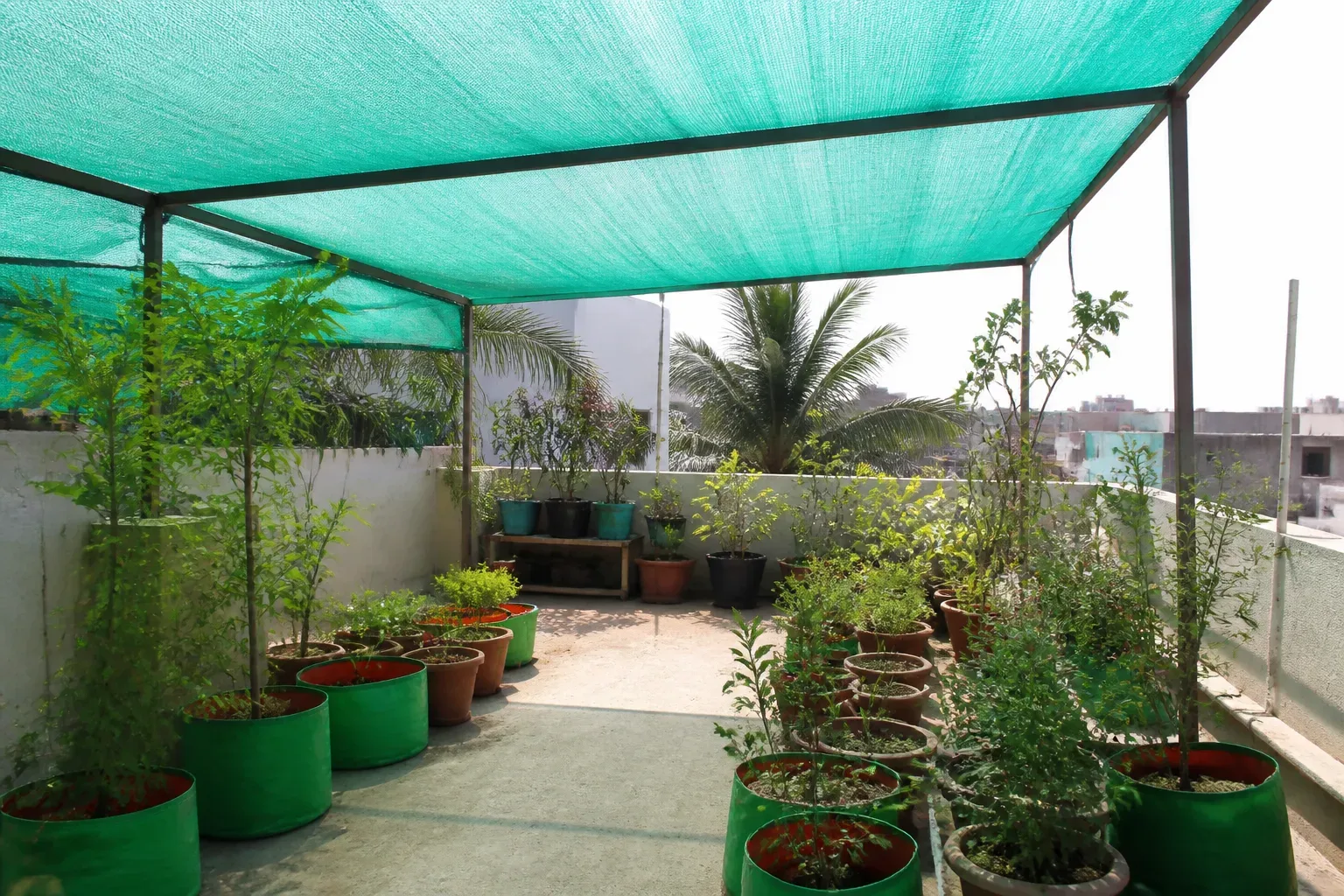
Surface mulch (dry leaves, cocopeat chip, or similar) slows evaporation from the mix surface. Keep mulch off soft stems. Lift pots onto bricks or stands so air moves under containers and hot floor heat has less direct contact. Avoid heavy fertiliser pushes during extreme heat spells — NC State notes fertilising in intense heat can push tender growth that needs more care (NC State Extension).
Heat-stress first aid: shade immediately, check soil moisture before watering, empty saucers, and accept that bleached scorched patches will not turn green again. New growth is your recovery signal.
Observed on Indian Terraces
These notes are editorial observations from Indian apartment roofs — not controlled trials. Use them as starting hypotheses, then trust your own pot weight and finger checks.
West-rail dry-down contrast (May, Delhi NCR editorial note): An 8-inch unglazed terracotta pot of basil on an open west rail often needed a thorough morning soak every day in peak heat, sometimes a second check by late afternoon if wind was strong. A 14-inch UV plastic pot / fabric grow bag of the same mix on the same rail usually held overnight moisture and returned to a light “needs water” weight closer to every other morning. Same sun, same week — material and volume changed the labour.
Coastal humidity buffer (Mumbai editorial note): In late May sticky weeks, a 12-inch plastic chilli pot on a partly shaded Mumbai terrace stayed heavy a day longer than a similar pot on a dry inland roof the same week. Humidity did not remove the need for morning checks; it just punished anyone who kept the summer daily soak after the air turned sticky.
Monsoon tray near-miss (Bengaluru editorial note): After the first heavy July storm, a row of grow bags left in deep saucers sat in hot rainwater overnight. By morning the mix smelled sour and one plant did not recover. The fix was boring and permanent: pot feet, trays with overflow notches, and emptying after every downpour — the same wet-soil discipline as monsoon houseplant care in India.
Metal cachepot bake: A decorative metal planter used as the only pot (no inner nursery pot) on reflective tile cooked the outer root zone even when the top mix looked moist. Switching to metal-as-cachepot with a drained plastic inner pot stopped the afternoon collapse.
A Simple Setup Sequence for First-Time Terrace Gardens
- Inspect the floor and drains. Confirm waterproofing condition, slope, and clear outlets. Fix leaks before buying plants (TNAU rooftop gardening FAQ).
- Decide container-first. Grow bags and plastic pots with drainage holes beat improvised soil mounds on an unproven slab.
- Map sun and wind. Mark west/south bake zones, morning-only strips, and windy parapets. Put tough sun plants in the hard spots; soft plants under shade net.
- Mix light media. Coir/compost/mineral blend; avoid dense raw soil (TNAU FAQ).
- Install shade and water logistics. Shade net over the hottest bay; hose reach or drip; trays that can drain. Confirm runoff will not soak a neighbour’s ceiling or electrical points.
- Plant in phases. Start with ten well-managed containers, not fifty neglected ones. UF/IFAS’s reminder still holds: match container size and shared-pot requirements (UF/IFAS).
- Build a check routine. Morning weight/finger checks in summer; empty trays; watch for heat wilt vs wet wilt.
Common Mistakes and Seasonal Hand-Offs
Mistakes that kill terrace gardens: skipping waterproofing checks (TNAU); tiny pots for thirsty plants; leaving pots in full saucers (Clemson HGIC); metal pots baking on reflective floors (RHS); watering on limp leaves without checking soil; heavy soil and oversized cement collections; ignoring the monsoon flip.
Peak summer (typically March–June, region-dependent): Prioritise morning deep watering, shade nets on west exposures, larger containers, and heat-tolerant plant placement. Expect the fastest dry-down of the year. Species-level summer choices live in the Indian summer balcony guide.
Monsoon: Rain plus humidity slows evaporation. Move soft pots under cover or tilt trays so storms do not leave plants swimming. Stretch intervals; empty trays after every downpour. Use the same wet-soil logic as monsoon houseplant care in India.
Coastal vs dry inland checklist: Coastal sticky air (Mumbai, Chennai, Kochi) — stretch intervals sooner as humidity rises; watch trays and mildew. Dry inland heat (Delhi, Jaipur, inland Deccan) — expect faster May dry-down, more shade-net value on west rails, and larger plastic/grow-bag volumes. Region still beats calendar.
Post-monsoon / winter (north India especially): Dry air and cooler nights change the schedule again. Water less often than summer, but do not assume weekly habits fit every pot. Protect tender tropicals from cold wind on exposed terraces; north Indian winters can shock plants that thrived in May heat — see winter houseplant care for north India.
Related guides
- Balcony plants for Indian summers — heat- and sun-tolerant plant picks once the roof ops are sound
- West-facing balcony plants for India — aspect shortlist for the hardest afternoon bake
- Hot-weather plant watering — peak-heat watering habits beyond the terrace
- Monsoon houseplant care in India — wet-season flip after terrace summer
- Houseplant heat stress — limp leaves, glass bake, and cool-first triage
Conclusion
Successful terrace gardening in India is less about romantic roof farms and more about three operational truths: protect the floor (waterproofing and sensible weight), respect the microclimate (heat, wind, shade), and water containers like containers — deep when dry, never left sitting in runoff. Start container-first with light media, put the right plant in the right exposure, and flip your habits when monsoon humidity arrives. Do that, and a terrace becomes a productive growing space instead of a summer plant graveyard.