Hot-Weather Plant Watering Guide for Homes and Balconies
Hot-weather plant watering: morning soaks, moisture tests, mulch, and India dry-down notes so you stop drowning heat-wilted pots.
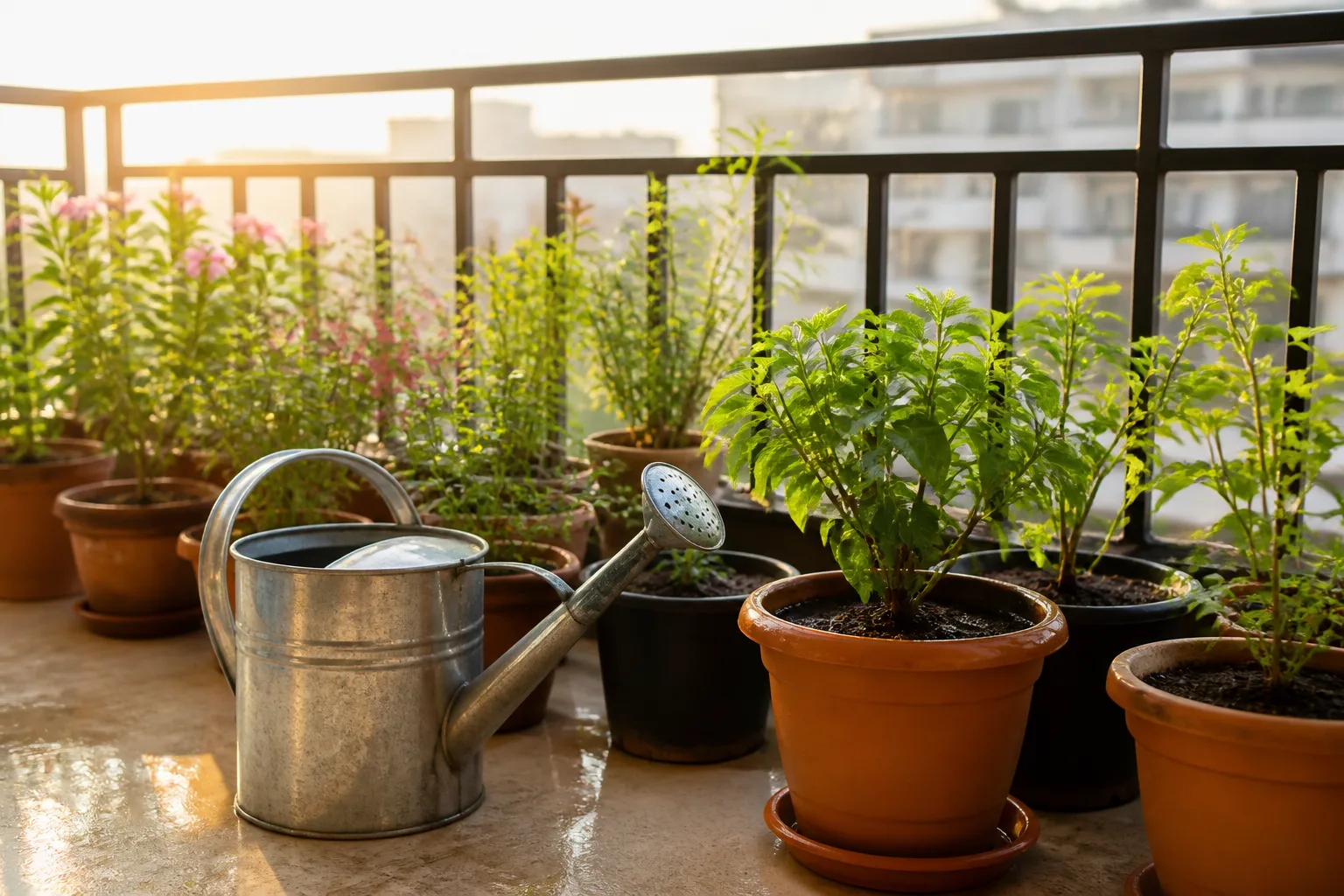
Hot weather does not ask plants to drink on a calendar. It asks them to keep up with transpiration — water leaving the leaves — while roots pull replacement moisture from a pot that is also drying, heating, and sometimes sitting in a saucer of leftover water. That mismatch is why a peace lily can flop at 3 p.m., a hibiscus on a west balcony can need a deep soak every morning in May, and a snake plant can still rot if you “help” it with daily sips.
This guide is the hot-season watering playbook for Indian apartments and balconies: heat wilt vs drought wilt, cool-hour soaking, pot size and material, mulch, hydrophobic mix rescue, and a heat-week routine you can run when temperatures spike. Use it alongside how to water indoor plants the right way for year-round basics and houseplant heat stress when leaves stay limp after you cool the placement. Plant picking belongs on balcony plants for Indian summers — this URL stays watering triage.
By Sai Ananth (author profile), LeafyPixels lead writer — B.Pharmacy (Andhra University) with long-running apartment and balcony growing in Indian heat. Reviewed for India container accuracy by Dr. Priya Menon (Botanist and Indoor Plant Specialist). Watering physics cite extension and botanical sources; India dry-down timings below are observed practice from specific pots and aspects, not universal rules or a substitute for your local forecast.
Dawn checklist (print or save)
- Lift or finger-test every balcony pot and every indoor plant near hot glass.
- Water only pots that are dry at the depth that species prefers — deep soak until drain, then empty saucers.
- If leaves are limp but the pot is still heavy/moist, move out of hot sun first; do not add water yet.
- Hold fertilizer. Skip midday “panic watering.” Log which pots empty in one day vs three.
Why Heat Changes Water Demand
Plants stand up because cells stay pressurized with water. Roots absorb moisture, stems move it upward, and leaves release water vapor as they cool and exchange gases. When air gets hotter and drier, leaves can lose water faster than roots replace it — even if the mix still feels damp at the surface.
University of Georgia Extension illustrates the physics plainly: at the same temperature, a leaf in very dry air loses more water than one in moderate humidity; at the same humidity, a leaf in hotter air loses more water than one in cooler air. That is why an AC room at 24°C and a west balcony rail at 40°C+ are different watering worlds on the same calendar day.
Clemson’s indoor watering factsheet stresses that there is no single “how often” answer. Species, growth stage, pot type and size, mix, light, and weather all change demand. Heat simply amplifies those variables. Thin-leaved tropicals and flowering balcony plants usually drink faster than succulents and drought-adapted foliage plants.
Microclimates Beat the Calendar
In extreme heat, two supply problems stack. Leaves demand more water. Root zones may also become less efficient if the pot soil itself runs hot — a pattern UF/IFAS notes when soil temperatures climb in warm months. The plant may wilt as a temporary water-balance response, not because you “forgot” it for a week.
Indoors, the trigger is often a microclimate: hot glass, a closed sunroom, or a plant pressed against a west window while the hallway thermostat still looks comfortable. On a balcony, black plastic pots, metal railings, and reflected concrete multiply the same effect. Watering alone will not fix a placement that cooks the canopy every afternoon.
Heat Wilt vs Drought Wilt vs Wet Wilt
This is the decision that saves plants in May and June. UF/IFAS separates temporary heat wilt from permanent wilt. Heat wilt happens when water loss exceeds absorption for a stretch of the day, or when the plant reduces leaf exposure to conserve moisture. If moisture is still available in the root zone, the plant can firm again as temperatures drop. Permanent wilt is different: roots cannot extract usable water from the mix, and prolonged deficit can end in tissue death.
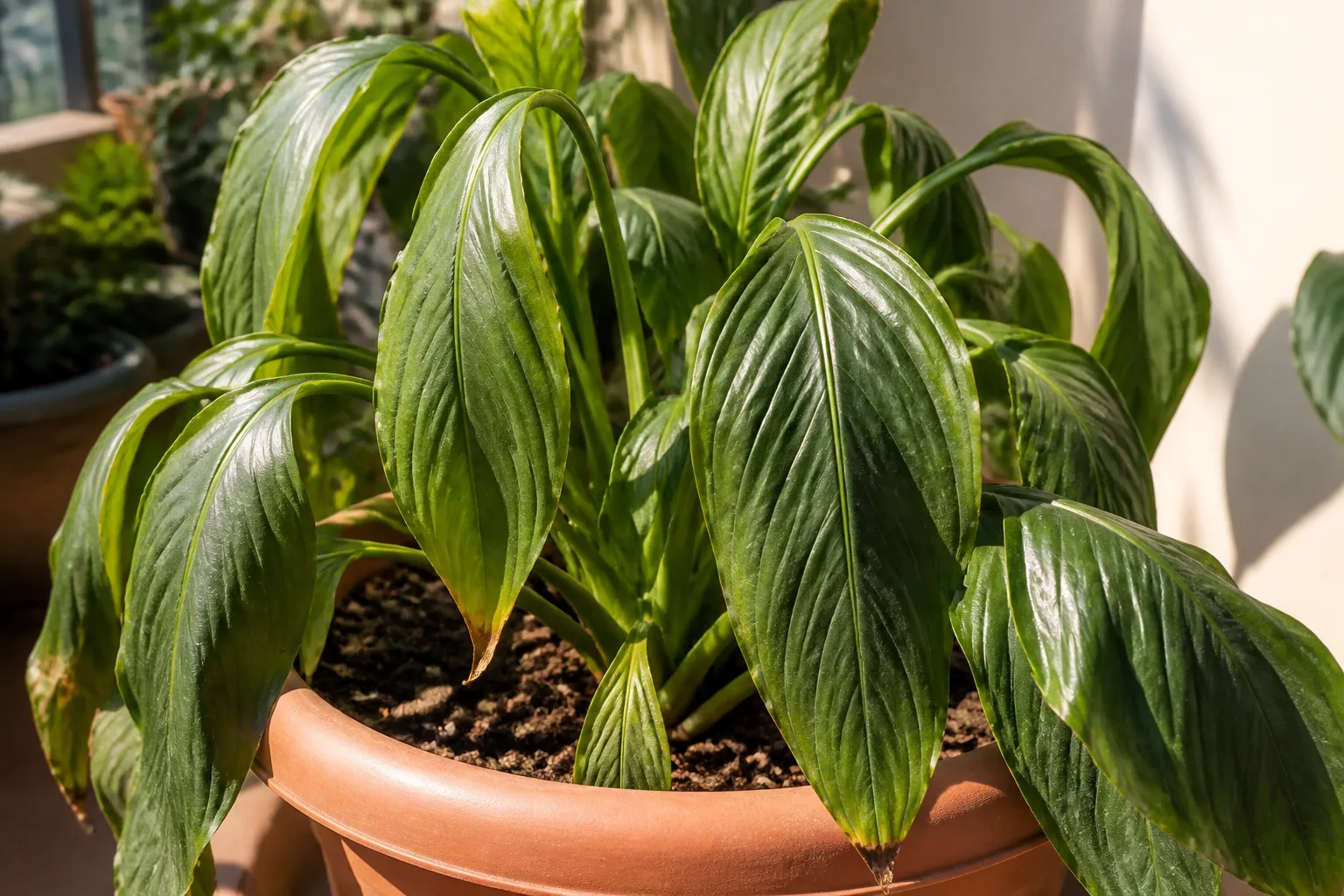
Clemson adds the trap most people fall into: wilt is not always a cue to water. Root injury from chronic overwatering also blocks uptake, so the plant looks thirsty while the pot stays heavy and sour. Adding more water then makes the problem worse.
The RHS lists wilting, rolling, bleaching, and crispy tissue as heat-stress signs in very hot indoor spaces such as conservatories in midsummer. Pair that with a soil check before you flood anything. For a broader limp-leaf decision tree, see wilting houseplants and water stress.
| Sign | Heat wilt (temporary) | Drought / permanent wilt risk | Wet wilt (root injury) |
|---|---|---|---|
| Pot weight | Heavy or normal | Light | Heavy, often with sour smell |
| Mix at knuckle depth | Moist | Dry / dusty / hydrophobic | Wet, muddy, or swampy |
| Afternoon limpness | Common in hot sun | Common | Can happen any time |
| Overnight recovery | Often firms if shade + moisture available | Stays soft until watered (if recoverable) | Stays soft; may worsen after more water |
| First action | Shade / cooler spot; confirm moisture | Deep soak + drain + empty saucer | Stop watering; check roots/drainage |
The 60-Second Wilt Test
- Lift the pot or press a finger into the mix to the first knuckle or deeper.
- If the pot is still heavy and the mix feels moist, treat limp leaves as heat demand first: move the plant out of direct hot glass or west sun, wait for evening recovery, and only water if the mix is actually drying at depth.
- If the pot is light, the mix is dry, and leaves stay soft into the night, you are looking at water deficit — soak thoroughly, drain, and empty the saucer.
- Soft crowns, foul smell, or mushy brown roots point to wet damage, not a heat-wave rescue with more water.
Overnight firming on moist soil is a strong heat-wilt clue. Overnight limpness on dry soil is a drought clue.
Cool-Hour Timing: Morning First, Evening If Needed
Water when plants can absorb moisture before peak heat, and when less water flashes off the surface unused. NC State Extension recommends slow, deep watering during cooler hours — roughly evening through early morning — to cut evaporative loss and support deeper rooting outdoors. For balcony pots and houseplants, early morning is usually the cleanest habit in Indian summers: you finish before the rail turns into a griddle, and foliage has time to dry if a few drops land on leaves.
Penn State Extension’s summer-heat watering guidance notes that containers benefit from a consistent check time. If you water at dawn one day and skip until late evening the next, a small pot may endure two full heat cycles on one soak. Aim for the same morning window during heat-wave weeks, then adjust volume based on the finger test — not a fixed millilitre schedule.
Evening watering can still work if mornings are impossible, especially for pots that dry hard by late afternoon. Avoid soaking foliage in still, humid nights when fungal leaf spot is already a risk, and never leave pots standing in hot water trays through the next day’s peak. Midday hose blasts on sun-baked leaves waste water and can scorch soft tissue without fixing a dry root ball.
Moisture Checks Before You Pour
Heat makes people water on panic. The antidote is still the boring methods that work year-round. Clemson recommends touching the mix (finger to the first joint), tapping clay pots for a hollow vs dull sound, estimating weight loss, and watching color change from dark to light as media dry. When it is time, water thoroughly until water exits the drainage holes, then empty the saucer so roots are not sitting in runoff.
That thorough soak matters more in heat than frequent teaspoons. Light surface wetting encourages shallow roots and salt buildup at the top of the pot. For a method comparison, see top watering vs bottom watering. A moisture meter vs finger test can help on deep patio pots if you still confirm with weight.
Use room-temperature water when you can. Very cold or hot water stresses roots; softened water adds sodium that can accumulate in containers. In heat weeks you water more often, so hard water and fluoride tip-burn on sensitive foliage show up faster — letting tap water stand does not remove hardness minerals, and RO or rainwater choices are a quality decision separate from timing.
Rewetting Bone-Dry Peat Mixes
Peat-heavy nursery mixes often become hydrophobic after a hard dry-down: water beads and runs down the sides while the core stays dusty. Clemson notes that fully dried peat is hard to rewet and holds less water afterward. Penn State’s rescue approach for dehydrated containers matches what works on Indian balconies: move the plant out of sun, give a small amount of water to wet the surface, then water again (or bottom-soak) so the sponge-like mix can absorb.
Practical rescue strip:
- Move the pot to shade immediately.
- Water once lightly; wait 20–30 minutes.
- Water again until drainage runs, or set the pot in a tray of water until the surface moistens, then drain fully.
- Empty the saucer. Resume morning deep watering only after the mix rewets evenly.
- Do not blast scorched foliage at midday — see sunburn and scorched leaves for canopy damage that watering will not reverse.
Pot Size, Material, Color, and Dry-Down Speed
Container geometry is half of hot-weather watering. Clemson is explicit: a large plant in a small pot needs water more often than a small plant in a large pot; porous clay loses moisture through the walls and dries faster than glazed or plastic pots; peat-heavy mixes hold more water than bark–sand–perlite blends. Penn State adds that edible and ornamental containers under about 10 inches across need especially frequent checks in summer sun.
Small West-Rail Pots vs Large Patio Containers
Small pots have less buffered moisture and heat up faster. On a west balcony in a dry inland city, a 4–6 inch nursery pot of petunia or coleus may need a full morning soak daily in peak heat, while a 12–14 inch hibiscus or bougainvillea in a deep pot may stretch longer between deep waterings if the mix is free-draining but moisture-retentive.
Upsizing helps only when the mix still drains. A plant jammed into a huge, peat-soggy tub can stay wet at the core while the surface crusts — classic wet wilt. Match pot volume to root mass, keep drainage holes clear, and check mid-pot moisture, not only the top centimetre.
Terracotta breathes. That is a gift in humid monsoon weeks and a liability in a Rajasthan or Delhi heat wave, when wall evaporation plus sun can empty a pot by afternoon. Plastic and glazed ceramic hold moisture longer, which is useful for thirsty flowerers — and dangerous for snake plant, ZZ plant, and adenium if you keep a daily May schedule after skies cloud over. For a full material comparison, see terracotta vs plastic pots.
Color matters too. Dark plastic on bare concrete absorbs heat. Raising pots on feet, using light-colored containers where practical, and shading the root zone can cut dry-down spikes without changing how much you pour. On open terraces, Tamil Nadu Agricultural University’s Agritech roof-garden guidance frames irrigation as a regular need in rooftop systems — hose, drip, or automated — because limited media cannot buffer heat the way ground soil can. Most apartment growers still succeed with hand watering if drainage and morning timing are disciplined; see terrace gardening in India for waterproofing and weight caveats.
Mulch and Surface Cover for Containers
Mulch is not only for garden beds. Clemson’s mulch guidance lists core benefits that transfer to large patio and balcony pots: reduced evaporation, cooler and more even soil temperature in summer, less crusting so water actually enters the mix, and fewer splash-related issues. Penn State and NC State both treat mulch as a heat-and-drought tool for conserving moisture and moderating soil temperature. RHS heatwave community guidance likewise puts mulch and cooler-hour deep watering ahead of little-and-often sips.
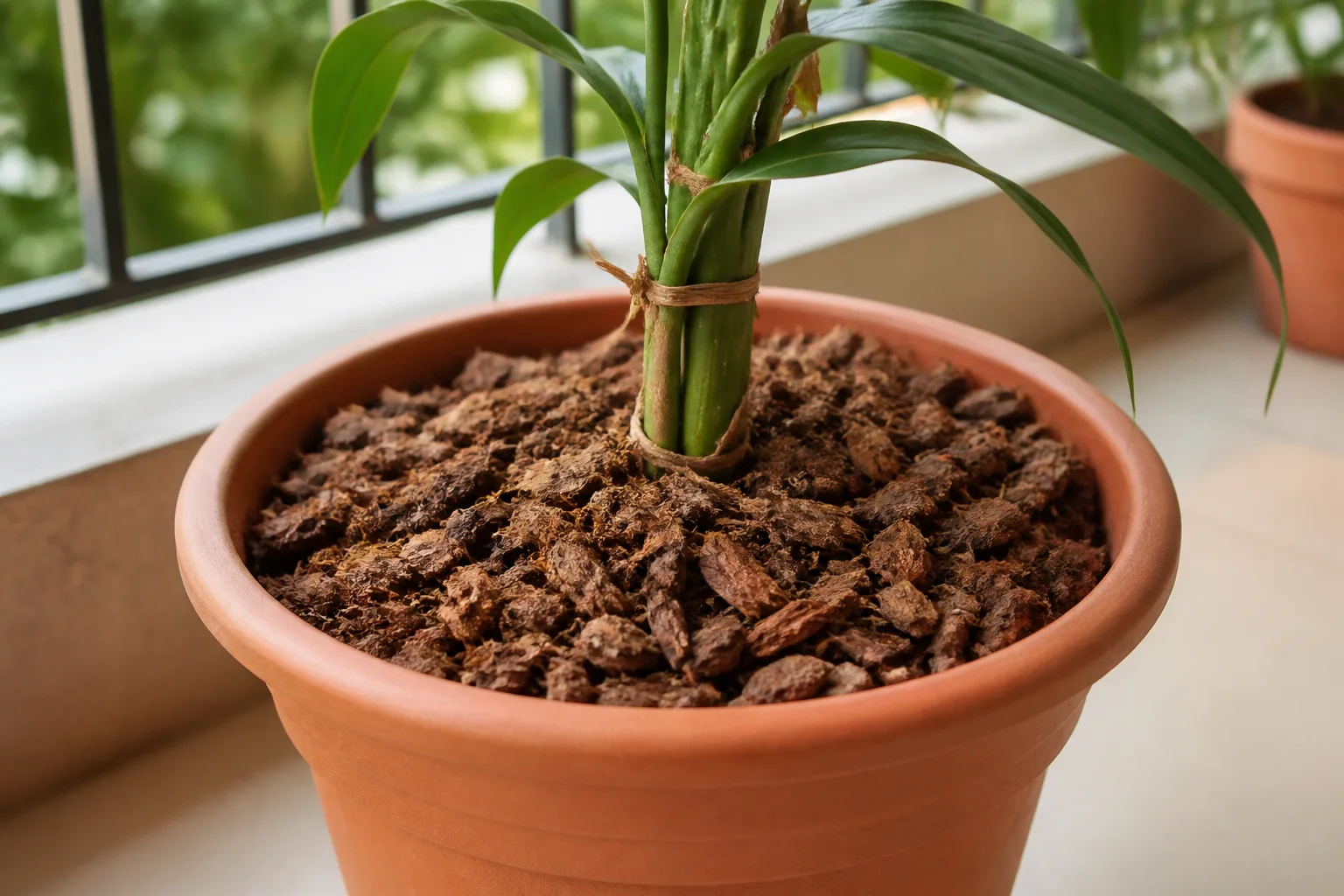
For containers, use a thin, airy layer — roughly 1–2 cm of shredded bark, coco chips, or dried leaves — pulled slightly back from soft stems. Do not pack a dense mat that blocks water into a small nursery pot. Skip solid plastic sheet as a “mulch” over potting mix; Clemson warns that impermeable plastic can create anaerobic root conditions. Inorganic gravel can reflect heat and cook the surface in full sun, so keep rock mulches thoughtful on west rails.
Mulch slows drying. It does not replace drainage, and it does not mean you can water on autopilot. Still check pot weight during heat-wave weeks.
Indoors During Heat Waves
Indoors, the watering mistake is usually overcorrecting. A plant limp beside hot west glass may need relocation more than another litre of water. Cool the placement first, then verify moisture. Grouping plants and using pebble trays can slightly buffer local humidity, but Penn State’s humidity notes remind growers that misting is fleeting — and in sticky coastal heat, wet leaves can invite leaf spot without fixing root-zone drought.
Hold fertilizer during intense heat. Penn State, NC State, and RHS heatwave tips all caution that feeding (and often pruning) push soft new growth when plants already struggle to keep up with water demand. Fertilizer salts can further stress unevenly moist pots. Resume dilute feeding when nights ease and new growth looks steady.
AC rooms can dry the air even when the thermostat feels mild. Check pots near vents and glass more often than pots in the room centre. If a plant recovers overnight after you move it one metre off the sill, you diagnosed heat demand without a product purchase.
Indian Summers: Dry Inland vs Humid Coastal Balconies
Indian heat is not one climate. Dry inland flats (Delhi NCR, interior Deccan, Rajasthan cities) combine high temperature with low humidity, so pots can go from heavy at dawn to light by late afternoon. Humid coastal summers (Mumbai, Chennai stretches, Konkan) still push leaf demand on west rails, but mixes may dry slower between showers of sticky air — until a clear heat spike arrives.
Watch local dry-down, not a national slogan. When the India Meteorological Department issues heat-wave guidance for your region via mausam.imd.gov.in, treat that week as a plant emergency protocol: morning checks, shade for soft species, deeper soaks for thirsty pots, and no fertilizer. The forecast page is a human health and weather product; your pots still need finger tests. IMD heat-wave week ≠ skip moisture checks.
Heat-tolerant balcony plant lists help you choose survivors; this page tells you how to water whatever is already on the rail. Pair plant selection with watering discipline rather than expecting daily misting to substitute for root-zone moisture.
West Rails, Shade Nets, Saucers, and Self-Watering Traps
West-facing balconies get the longest harsh afternoon load. Shade net (often in the 30–50% range for mixed ornamentals, adjusted to your species) reduces leaf demand so watering can keep up — prefer closer to 50% for soft tropicals on open west rails, and lighter shade for sun-hungry flowerers that stall in deep gloom. Move soft tropicals behind a taller pot or temporary screen during declared heat spikes. High-rise wind accelerates dry-down on the same west rail; pots on windy floors often need morning checks even when a sheltered east balcony does not.
Empty saucers within 30 minutes of watering. Standing water heats in the sun, cooks roots from below, and invites mosquitoes — a household safety issue if pets or children are near trays. If you use trays to catch drips on a shared balcony, tip them after the pot finishes draining.
Self-watering reservoirs can help vacation weeks, but in peak heat verify the reservoir has not gone dry — or stayed stagnant and hot. Reservoir water can cook in black plastic reservoirs on west rails; many drought-adapted plants also stay too wet at the wick if you never let the upper mix dry. For setup trade-offs, see self-watering pots for houseplants and DIY self-watering systems.
Observed Dry-Down Notes from Indian Homes
These notes are observed practice from apartment and balcony growing during peak pre-monsoon heat (typically April–June in the northern plains; timing shifts by city). They are not lab trials. Use them as calibration, then log your own pots.
Dry inland west rail (Delhi NCR–style dry heat, May observation window): A 5-inch black plastic nursery pot of coleus on an unshaded west rail often went from heavy after a dawn soak to distinctly light by late afternoon; daily morning deep soaks were required, and afternoon limpness on still-moist mid-mix recovered overnight once the pot moved one rail bay into partial shade. A 12-inch terracotta hibiscus on a brighter east-facing ledge dried slower at depth but still needed every-other-morning soaks in the same heat spell when winds were high — terracotta wall evaporation was obvious compared with a similar-size plastic pot beside it.
Humid coastal balcony (Mumbai-style sticky heat, late May observation window): A 6-inch plastic pothos near a west sliding door stayed heavier mid-afternoon than inland counterparts, yet still showed temporary afternoon limpness on moist mix during clear heat spikes; overwatering after every wilt episode produced sour mix within a week. Coastal growers often needed fewer litres than inland neighbours — but still needed the 60-second wilt test, because humidity does not cancel hot-glass demand.
Indoor hot glass (shared pattern): Peace lilies against west glass flopped hardest between 2–4 p.m. with moist soil; recovery after a one-metre pullback was more reliable than an extra litre. Snake plant and ZZ plant in plastic stayed too wet when kept on the hibiscus daily schedule.
If you photograph your own west-rail setups, saucer emptying, and limp-on-moist-soil moments during the next heat spell, those images will make this playbook easier to share — and they are the evidence this topic deserves beyond text notes.
Heat-Week Routine Checklist
Use this as a heat-wave week template, then tune to your pots:
- Dawn check (or before 8 a.m.): Lift or finger-test every balcony pot and every indoor plant near hot glass. Water only those that are dry at the depth that species prefers.
- Deep soak: Water until drainage runs clear. Empty saucers. Mulch large patio pots if the surface is bare and crusting.
- Midday: Do not water for sport. If a plant collapses in sun, move it to shade first; check moisture second.
- Late afternoon spot-check: Small terracotta and west-rail flowerers may need a second light-to-moderate soak in extreme dry heat — only if the mix has actually dried.
- Hold fertilizer until the heat spell breaks and growth resumes.
- Log dry-down: Note which pots empty in one day vs three. That list becomes your monsoon and winter schedule later.
Species still win arguments. Succulents and desert rose want longer dry intervals even in May. Hibiscus, coleus, and thin tropicals usually do not. When in doubt, trust pot weight over the calendar.
What Not to Do in Extreme Heat
- Do not water on leaf limpness alone — confirm mix moisture first.
- Do not give frequent shallow sips that wet only the top crust.
- Do not fertilize hard during peak heat-wave days.
- Do not leave soft foliage plants in full west sun in black nursery pots with no shade.
- Do not assume misting replaces a soak.
- Do not leave standing water in saucers through peak heat (root cooking + mosquitoes).
- Do not transplant or heavily prune in the middle of a heat spike unless the plant is already failing and you can nurse it in shade afterward — NC State advises delaying planting and transplant stress until cooler conditions return.
- Do not treat every wilt as drought when the pot is still heavy — that is how wet wilt starts.
If a plant is bone-dry and hydrophobic, use the rescue strip above: shade, staged water or bottom-soak, then resume morning deep watering once the mix rewets evenly.
Related Guides and How This Was Reviewed
- Houseplant heat stress — diagnose limp leaves on moist soil, hot glass, and vents before you add water.
- Best balcony plants for Indian summers — heat- and sun-tolerant species picks for west and east rails.
- How to water indoor plants the right way — year-round soil checks, drainage, and method basics.
- Monsoon houseplant care in India — flip to the opposite wet-season schedule after heat waves break.
- Terracotta vs plastic pots — how pot material changes dry-down speed in summer.
How this guide was built: Claims about watering physics, heat wilt, cool-hour timing, mulch, and humidity limits were checked against extension and botanical references (UGA, Clemson, UF/IFAS, Penn State, NC State, RHS) plus IMD as a heat-week timing cue and TNAU Agritech for rooftop irrigation context. India balcony dry-down intervals are observed practice from apartment growing, labeled as such. Authored by Sai Ananth; botanical review by Dr. Priya Menon for India container and heat-wave protocol clarity.
Conclusion
Hot-weather watering is a triage skill, not a daily ritual. Cool-hour deep soaks, honest moisture checks, smarter pot choices, and a thin mulch layer keep roots supplied while heat drives leaf demand. Learn the difference between afternoon heat wilt on moist soil and true drought wilt on a light pot, and you will stop drowning plants that only needed shade. In Indian heat-wave weeks, watch your own dry-down times, empty hot saucers, rewet hydrophobic mixes in stages, and pause fertilizer until nights ease.
Tomorrow morning: run the dawn checklist, log two pots that empty fastest, and move one heat-wilting plant off hot glass before you reach for the watering can. Master that rhythm now, and monsoon’s opposite problem — too much wet — will be easier to reverse later.



