Underwatering on Turmeric: Causes, Checks & Fixes
Quick answer
Underwatered turmeric shows inward-curling, papery leaf edges, limp midday foliage, and stalled new shoots while the mix sits powder-dry. First step: give the pot one slow, deep soak until water drains freely, then confirm the whole root ball actually rewetted before changing anything else.
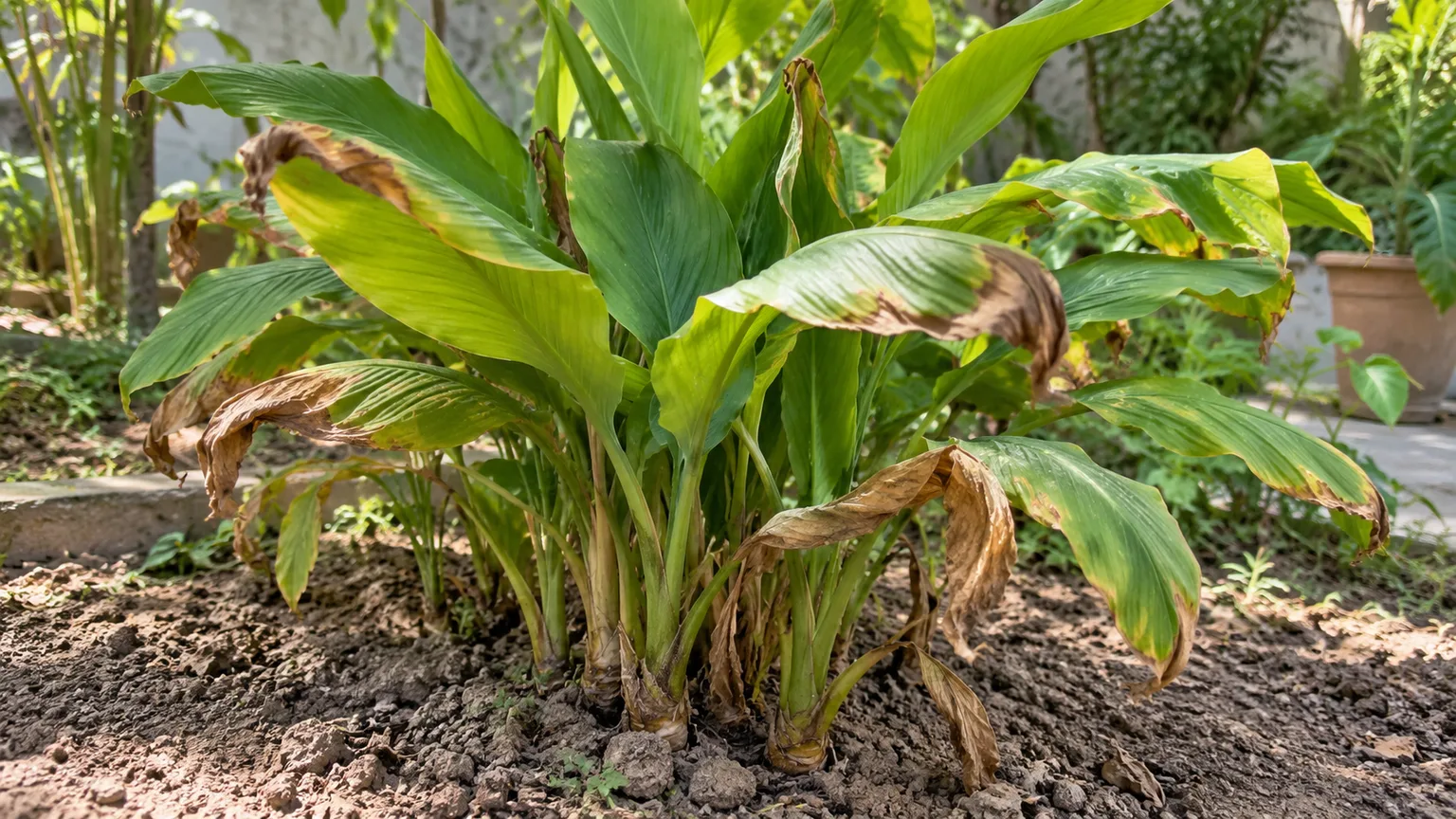
Underwatering on Turmeric: Causes, Checks & Fixes
This guide covers underwatering on Turmeric. See also the general Underwatering guide, watering, and light pages for this plant.
Underwatering on Turmeric: Causes, Checks & Fixes
Quick answer
Turmeric (Curcuma longa, Haldi) is a monsoon rhizome, not a drought plant. When the mix dries out during active summer growth, the big canna-like leaves lose water faster than the roots can supply it, so blades curl inward, edges turn papery and brown, midday foliage goes limp, and new shoots stall. For how chronic dryness damages roots in general, see our underwatering guide. On turmeric, the giveaway is timing: thirst strikes while the plant should be pushing lush growth, in a pot that feels suspiciously light.
First step: give the pot one slow, deep soak until water runs freely from the drainage holes. Then check that the whole root ball actually rewetted (see the confirmation checks below) before you change light, fertilizer, or anything else. Most turmeric perks up within hours; the rest of this guide covers what to do when it does not.
When to use this page vs other Turmeric guides
This page is the drought-first entry for turmeric: dry mix, curling leaves, light pot, growing season. Use it to confirm thirst and rehydrate correctly.
- Overwatering — go here when the mix stays wet, the pot feels heavy, or bases soften in cool weather. Soggy rhizomes rot; thirsty ones just need a drink.
- Root rot — go here when a soak does not revive the plant, the mix smells sour, or rhizomes feel soft and brown inside.
- Wilting — go here when foliage collapses but the moisture picture is unclear; that page separates heat wilt, thirst, and root failure.
- Drooping leaves — go here for soft, hanging foliage with moist soil, which points away from simple drought.
- Brown tips — go here when only leaf margins crisp but growth otherwise continues; often the earliest drought signal.
- Spider mites — go here when stippled, dusty leaves and fine webbing appear on dry-stressed foliage.
- Watering guide — go here for the long-term monsoon rhythm once the current crisis is over.
What underwatering looks like on Turmeric
Turmeric announces thirst through its leaves first, because those broad blades transpire heavily on hot days. Early on, leaf margins curl inward and feel thin and papery, and the whole clump looks tired by afternoon but slightly better by morning. As dryness continues, edges and tips turn tan and crisp, lower leaves yellow and collapse, and the newest unfurling shoot stalls halfway out of its sheath instead of rising fast.
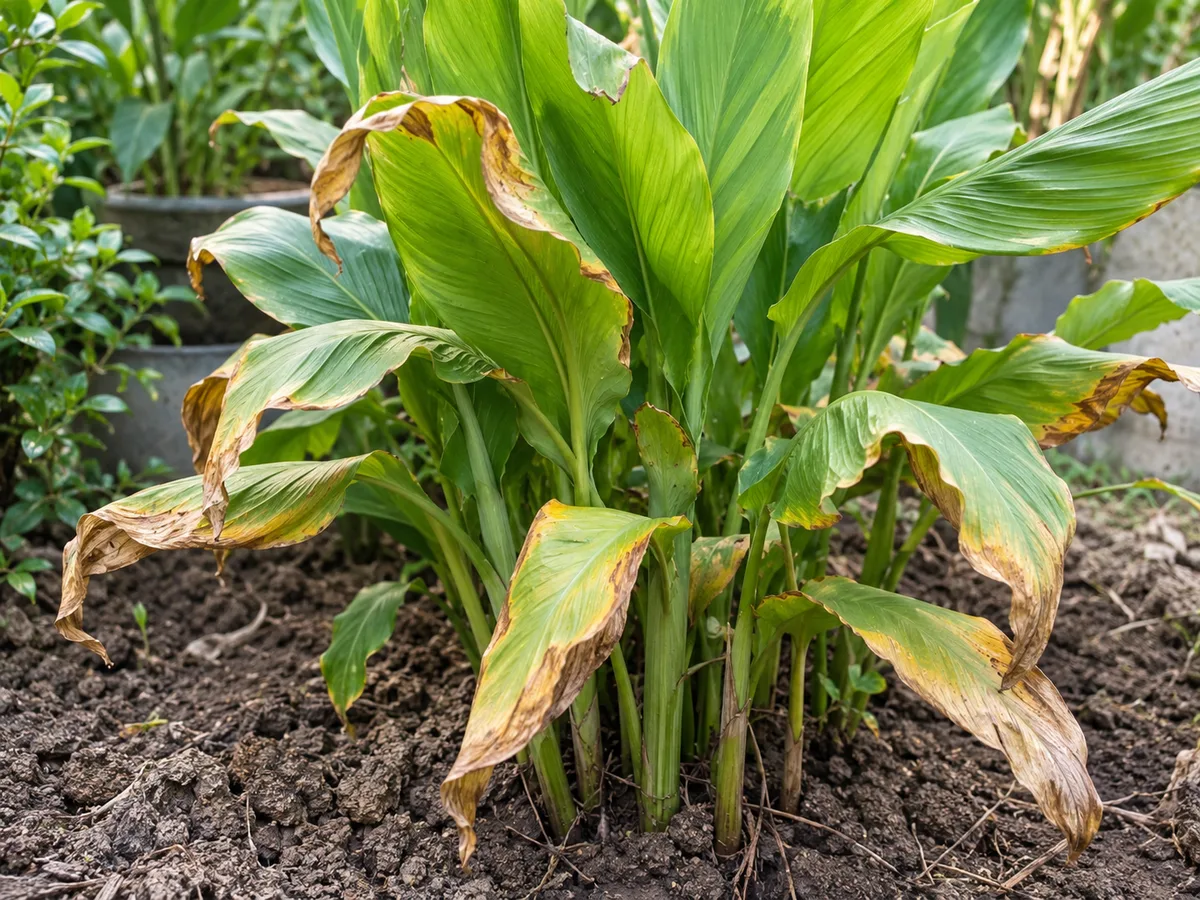
Underwatering on turmeric: inward-curling blade with papery brown margins on an otherwise green leaf. Compare with healthy new shoots on the same plant.
Below the surface, the mix pulls away from the pot wall and feels powder-dry 2 to 3 cm down, and the pot weighs noticeably less than after a watering. In severe cases water runs straight down the gap between shrunken mix and pot and out the drainage holes, leaving the center of the root ball still dry. Rhizomes themselves stay firm and orange-fleshed at this stage, which is exactly how you separate simple drought from root rot, where rhizomes turn soft and brown-fleshed.
Why Turmeric dries out so fast
Turmeric evolved for monsoon conditions: warm, wet, and well fed through summer, then cool and dry for winter rest. NC State Extension describes Curcuma longa as an upright ginger-family perennial that wants hot, humid weather, morning sun with afternoon shade, and rich, slightly acidic soil kept at medium to wet moisture while growing. A plant built for monsoon rain has no real drought gear, so a missed watering in July hurts more than the same miss would on a succulent.
Three turmeric-only traits make pots dry dangerously fast. First, the foliage: each shoot carries 8 to 12 large lance-shaped leaves that pump moisture into hot air all afternoon. Second, the feeding root system is dense and shallow around fast-thickening rhizomes, so a pot can go from moist to empty in a day or two of heat. Third, containers are the worst case: NC State notes the plant requires a lot of water if planted in a container, and rhizomes grow so thick they may split the pot open, leaving almost no mix to hold reserves. A root-bound turmeric in a small dark pot on a sunny balcony is the classic underwatering victim.
Heat and airflow multiply the problem. South- or west-facing terraces, grow lights, fans, and air-conditioner outflow all raise transpiration, while peat-heavy mix that has baked hard once can turn hydrophobic and shed the next watering down the pot sides. Potted specimens need lots of water, daily or even more frequently, when active and root-bound.
How to confirm the cause
Work through these checks in order before treating:
- Finger test at depth. Push a finger 2 to 3 cm into the mix near the clump, not just at the rim. Powder-dry and cool means thirst; damp means look elsewhere. If it feels dry at knuckle depth, the plant needs watering.
- Lift the pot. A thirsty pot feels strikingly light. Memorize the heavy-after-watering weight so the comparison is instant next time.
- Read the newest shoot. A stalled, curling spear plus dry mix confirms active-growth drought. A fully yellow, drying clump in fall with no new spears is dormancy, not an emergency.
- Watch a watering. Pour slowly and see whether water absorbs or races down the inside of the pot and out the bottom. Instant runoff means a shrunken, hydrophobic root ball that needs a soak, not just a sprinkle.
- Check the undersides. Dry-stressed turmeric invites pests: NC State warns that red spider mites can occur on older plants if the soil is too dry, and container growers also see mealybugs when soil stays too dry. Stippling plus fine webbing means treat spider mites alongside rehydration.
- Probe the rhizome only if recovery fails. If a deep soak does not revive the plant within a day, gently expose one rhizome edge. Firm and orange means roots are alive but the ball never rewetted; soft, brown-fleshed tissue means root rot instead.
The first fix to try
Soak the whole root ball slowly until water drains freely, then verify it worked. Set the pot in a basin of room-temperature water for 20 to 30 minutes, or water from the top in two or three passes spaced ten minutes apart so each dose absorbs instead of running off. When water finally exits the drainage holes steadily, lift the pot: it should feel clearly heavy again.
Recheck with your finger an hour later. If the center is still dry, repeat the basin soak with the pot sunk to just below the rim. Do not fertilize, repot, divide, or spray anything on day one. One thorough rehydration is the entire first fix; you are testing whether the plumbing still works before adjusting anything else.
Step-by-step recovery
Follow this sequence over the next one to two weeks:
- Day one: deep soak as above. Move the pot into bright partial shade for the afternoon so leaves lose less water while roots recover. UF/IFAS notes turmeric grows well in partial to full shade in soil amended with organic matter, so shade during recovery costs nothing.
- Days two to three: confirm revival. Leaves should uncurl and stand up within a day. Keep the mix evenly moist, not swampy; water again lightly the moment the top 2 to 3 cm starts drying.
- End of week one: read the new shoot. The stalled spear should resume rising. If it stays stuck while older leaves recover, check its base for trapped dry sheath or mite damage.
- Week two: tidy only the dead parts. Snip fully crisp brown margins and completely dead leaves, leaving every scrap of green tissue to photosynthesize. A leaf that is half green still feeds the rhizome.
- Ongoing: reset the rhythm. Shift from calendar watering to the finger test plus pot weight, and review the watering guide and soil guide so the mix holds monsoon moisture without staying sour.
If foliage collapses again within a day of soaking, the pot is likely root-bound with almost no mix left. That is the one case for prompt action beyond watering: slide the root ball out, and if rhizomes circle densely with mix falling away in sheets, move up one pot size into rich organic mix per the soil guide rather than watering a hopeless volume three times a day.
Recovery timeline
| Time after deep soak | What to expect |
|---|---|
| 2 to 6 hours | Leaves uncurl and lift; the plant looks awake again |
| 1 to 3 days | Color firms up; the stalled new shoot resumes rising |
| 1 to 2 weeks | A fresh spear emerges flat and fast; this is the real all-clear |
| Rest of season | Steady new shoots every week or two in heat; crisped edges remain as scars |
Brown edges never turn green again, and a leaf that fully yellowed will finish dying. That is normal triage, not failure. Worry only if no new spear appears within two weeks of consistent moisture, or if collapse repeats after every watering; both point to root damage or a pot with no room left, covered under slow growth and root rot.
Lookalike symptoms
| What you see | More likely | How to tell | Go to |
|---|---|---|---|
| Limp leaves, dry light pot, summer growth | Underwatering | Finger test dry; revives after soak | This page |
| Limp leaves, heavy wet pot, sour mix | Overwatering | Pot heavy days after watering; bases soften | Overwatering |
| No revival after soak; soft brown rhizomes | Root rot | Sour smell; brown flesh inside rhizome | Root rot |
| Whole clump yellows in fall, no new spears | Natural dormancy | Seasonal timing; foliage dries evenly | Yellow leaves |
| Only margins crisp, growth continuing | Early drought or low humidity | New shoots still emerging; check brown tips and low humidity | Brown tips |
| Stippled dusty leaves, fine webbing | Spider mites on dry foliage | Webbing at leaf joints; mites under magnification | Spider mites |
| Pale leggy shoots in dim corner | Not enough light | Stretched weak growth even with moist mix | Not enough light |
Mistakes to avoid
- Drowning the recovery. A second heavy watering on still-damp mix the next morning swings the rhizome from drought straight into rot risk. Water on the finger test, not on guilt.
- Feeding a thirsty plant. Fertilizer cannot fix drought and salts stress dry roots further. Resume the normal feed only after a fresh spear is clearly growing.
- Repotting on day one. Turmeric hates root disturbance mid-season. Rehydrate first; repot only if you confirm the pot is genuinely root-bound with no mix left.
- Cutting everything back. Stripping damaged-but-green leaves starves the rhizome that must fund regrowth. Remove only fully dead tissue.
- Mistaking fall dormancy for thirst. When foliage yellows in autumn, the plant is shutting down for its dry rest, a cycle triggered when dry weather follows the monsoon season. Watering harder then rots resting rhizomes instead of greening leaves.
Turmeric care cross-check
Drought rarely has a single cause, so audit the setup once the plant revives. Containers under about 30 cm dry out within a day in peak heat, and dark pots bake roots further; wide, light-colored pots hold the monsoon moisture turmeric expects. The mix should be roughly half potting soil, 30 percent compost, and 20 percent perlite or coarse sand so it stays moist yet drains, per the soil guide. Morning sun with afternoon shade keeps transpiration affordable; all-day scorch on a balcony forces a watering pace no routine can sustain, so review placement in the light guide and the overview.
Remember the seasonal contract: turmeric grows during the monsoon season and goes dormant once it ends, with harvest when foliage wilts and dries. Keep the mix consistently moist while spears are rising, then deliberately ease off as leaves yellow. UF/IFAS adds that the plant dies back in freezes and returns reliably in late spring, so bare winter soil is rest, not death.
How to prevent it next time
Build a routine around how fast your pot actually dries:
- Check the top 2 to 3 cm and pot weight every one to two days in hot weather; containers in full sun may need daily soaking at the peak.
- Water deeply enough that excess drains every time, and empty saucers so roots never sit in standing water between drinks.
- Mulch the surface lightly with compost to slow evaporation without sealing the mix.
- Give rhizomes room: repot every one to two years before thick rhizomes split the container and leave no moisture buffer.
- Group pots or set them where they catch morning sun only, cutting afternoon water loss.
- Mark your calendar for the seasonal switch: ease off as fall yellowing starts rather than chasing green leaves into dormancy.
When to worry
Treat it as urgent when foliage stays collapsed a full day after a verified deep soak, when water cannot penetrate the root ball at all, or when mite webbing spreads across new spears. Repeated wilt-and-rescue cycles across one summer also deserve attention, because each collapse costs stored rhizome energy and shrinks the fall harvest. Any sour smell, mushy base, or brown-fleshed rhizome stops being a watering problem and becomes root rot; switch guides immediately.
A single crisped edge in a heatwave, or one yellow older leaf while new spears keep coming, is routine summer wear on a big-leafed monsoon plant. Fix the rhythm and move on.
FAQs
How can I tell underwatering apart from natural dormancy on turmeric?
Drought stress hits in summer while the plant should be actively growing, with curling green leaves on dry mix. Dormancy arrives in fall as whole leaves yellow and dry from the tips down even though you are watering less on purpose. If shoots are still emerging and the mix is bone-dry, it is thirst, not rest.
What should I check first when my turmeric looks thirsty?
Push a finger 2 to 3 cm into the mix, lift the pot to feel its weight, and look at the newest unfurling leaf. Dry mix plus a light pot plus a stalled or curling new shoot confirms underwatering. If the pot still feels heavy, suspect drainage or root trouble instead and check the overwatering guide.
Will curled or brown-edged turmeric leaves recover after watering?
Leaves usually uncurl and stand back up within a day of a good soak, but crisped brown edges never turn green again. Judge recovery by the next new shoot: it should emerge fast, unfurl flat, and hold its color. Trim only fully dead tissue once fresh growth is clearly underway.
When is underwatering urgent on turmeric?
Act the same day when foliage collapses and does not revive after a deep soak, when the root ball repels water down the pot sides, or when fine webbing and stippled leaves signal spider mites moving onto drought-stressed foliage. Repeated rescue wilts in one summer can shrink the rhizome harvest, so fix the watering rhythm, not just the moment.
How do I prevent underwatering without overwatering into rot?
Water on the finger test, not the calendar: soak deeply whenever the top 2 to 3 cm feels barely dry while leaves are growing, then cut back sharply once foliage yellows for dormancy. Wide pots, organic-rich mix per the soil guide, and morning sun keep moisture even so you rarely swing between baked and soggy.
Related Turmeric guides
- Turmeric overview — care basics, placement, and the monsoon growth cycle
- All Turmeric problems — full symptom index when the diagnosis is unclear
- Watering — the long-term soak rhythm after this rescue
- Soil — moisture-retentive but draining organic mix for rhizomes
- Light — morning sun and afternoon shade to limit water loss
- Overwatering — the opposite failure: heavy pots and soft bases
- Root rot — when a soak fails and rhizomes soften
- Wilting — separating heat wilt, thirst, and root failure
- Drooping leaves — soft hanging foliage with moist soil
- Spider mites — the pest that follows dry-stressed foliage
- Brown tips — earliest margin-crisp signals
- Yellow leaves — normal dormancy yellowing vs problem yellowing
Related tool
Use the Plant Watering Calculator to narrow causes for underwatering on this plant before changing multiple variables at once.