Leggy Growth on Dragon Fruit: Causes, Checks & Fixes
Quick answer
Leggy dragon fruit shows long pale ribbed stem segments, weak tips that lean hard toward the brightest light, and floppy growth off a trellis—usually etiolation from too little usable sun indoors or on a shaded patio. First step: move the pot to full sun or your brightest frost-free exposure and tie the main stem to a sturdy post before pruning, repotting, or feeding.
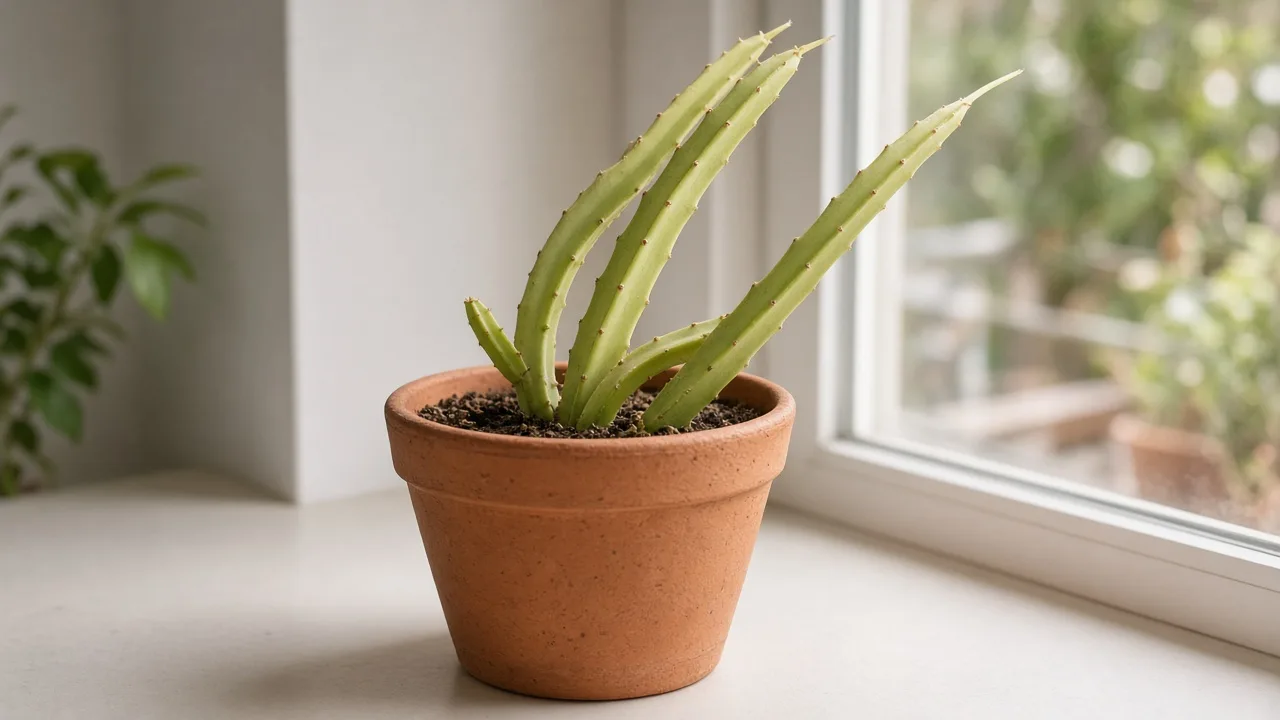
Leggy Growth on Dragon Fruit: Causes, Checks & Fixes
This guide covers leggy growth on Dragon Fruit. See also the general Leggy Growth guide, watering, and light pages for this plant.
Leggy Growth on Dragon Fruit: Causes, Checks & Fixes
Quick answer
Leggy growth on dragon fruit (pitaya) is usually etiolation on a fast-climbing cactus vine: three-sided ribbed stems lengthen, new segments stay pale or yellow-green, and the plant leans toward the brightest opening instead of building the firm, upright climb it needs for flowering and fruit.
For how stretch works across plants, see our leggy growth hub. On dragon fruit, the decisive pattern is thin pale ribs on the newest stem, a hard window-ward or sky-ward lean, and weak tips that cannot hold their own weight without a trellis—not the normal length of a mature stem already tied to a post in full sun.
First step: give the top of the plant more usable light the same day—move containers to your brightest frost-free exposure or lower grow lights to within about 30 cm (12 in) of the canopy—and lash the main stem to a sturdy post before repotting, heavy pruning, or fertilizer.
When to use this page vs other Dragon Fruit guides
| Pattern | Read next |
|---|---|
| Dim room but stems not yet stretched | Not enough light on dragon fruit |
| Vine stalled with tight ribs and few new areoles | Slow growth on dragon fruit |
| Lush soft shoots after heavy feed, little flowering | Dragon fruit fertilizer |
| Soft yellow ribs on wet, heavy mix | Overwatering or root rot |
| Ready to tip, branch, or remove long shoots after light fix | Pruning guide |
| Trellis height, sun hours, indoor limits | Light guide and overview |
What leggy growth looks like on dragon fruit
Healthy pitaya in season produces firm green ribbed stems that climb a support with relatively even spacing between areoles and small spine clusters. UF/IFAS notes that pitaya is a full-sunlight crop in its native range and should be planted in full or almost full sun for best growth and fruit. Weak light produces the opposite habit.
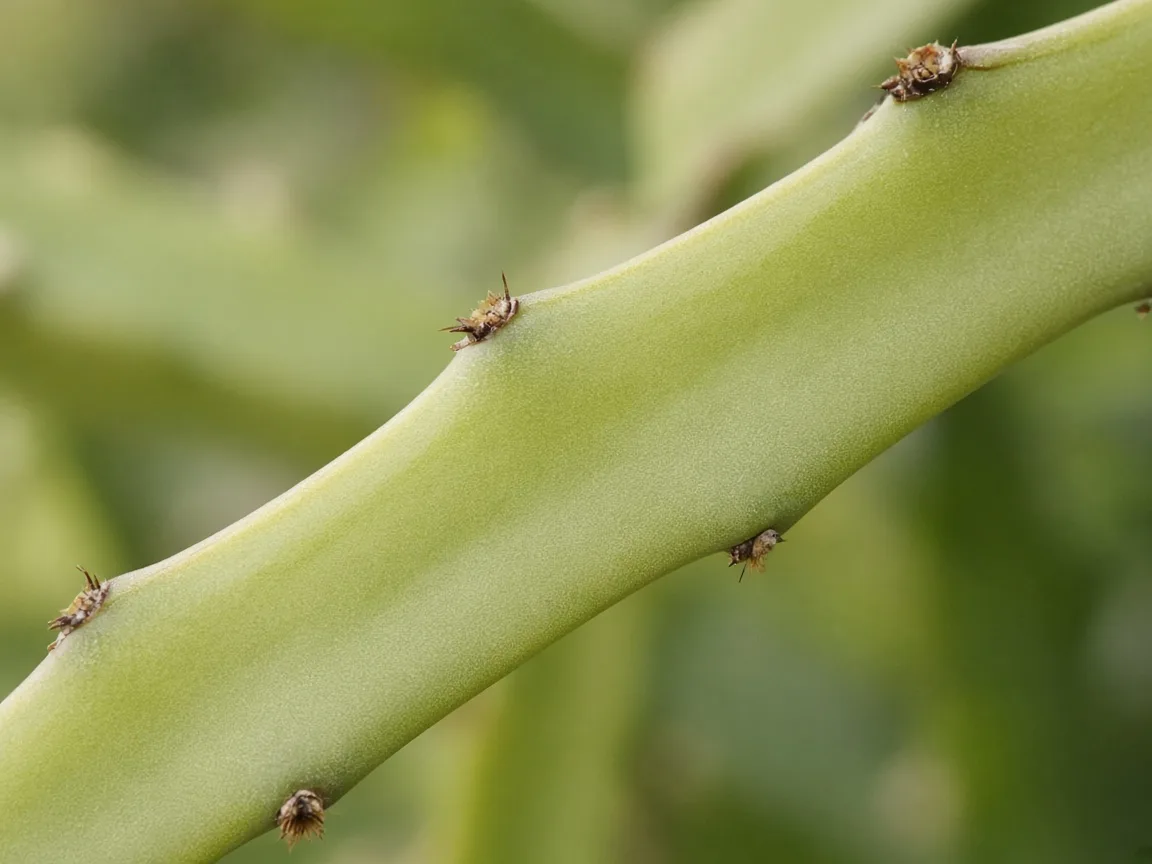
Long bare rib between undersized areoles on a dragon fruit stem—compare stretched newest segments with tighter spacing after light improves.
Classic etiolation markers on pitaya:
- Long gaps along the rib between areoles on the newest 30–60 cm of stem, often with smaller, paler tissue than older lower sections
- Thin, bendable ribs that sag off a pot rim or flop sideways without trellis ties
- Hard lean toward a window, skylight, or the only open patch of sky on a balcony
- Indoor or greenhouse starts that reach tall quickly but stay lime-green or yellow-green instead of deep green
- Container plants where only the tip escapes shade while the pot sits under an overhang—the middle stem stays sparse
- Stretch after cuttings root in a partially shaded holding spot and never move into stronger light
A mature dragon fruit on a pole trellis can look impressively long yet healthy when ribs are thick, colour is deep green, and side branches form after tipping at the top. Concern is when height comes with pale thin ribs, no flowering, and no firm attachment to support.
Vine length vs true legginess
Dragon fruit is a climbing cactus, not a compact rosette. UF/IFAS reports that rooted cuttings can grow about 3 cm per day under good conditions—fast vertical growth is normal when light and support match. Leggy growth is the combination of weak pale tissue, wide areole spacing on new growth, and phototropic lean, not merely owning a tall plant.
Why dragon fruit gets leggy growth
Insufficient light intensity or duration. Pitaya evolved for bright tropical sun. Indoors, on north-facing sills, or under deep patio shade, stems elongate toward the light source—the same etiolation response Gardening Know How describes on seedlings, where stems stretch and leaves stay small. PlantSolve notes that etiolated internode tissue does not shorten after you improve light; only new growth compacts.
Too much shade for production. UF/IFAS warns that excessive shade reduces yield and fruit quality even though young plants may need about 30% shade for the first three to four months in harsh sun. Keeping a plant under an overhang or tree canopy “to protect it” often triggers permanent stretch and weak flowering later.
Grow lights too high or too brief. Dragon fruit brought indoors for winter needs intense, close artificial light. A distant ceiling fixture or short photoperiod mimics dim winter conditions. Pitaya is a long-day plant that will not flower if day length stays below about twelve hours without supplementation (PMC pitaya lighting research); short dull days also encourage soft stretch before bloom failure shows.
Missing or weak trellis. Without a sturdy post and top frame, even reasonably lit stems bend and look leggy as weight accumulates. UF/IFAS recommends a strong trellis that can hold several hundred pounds of stem mass. Floppy growth from lack of ties is a support problem layered on top of—or instead of—pure etiolation.
Excess nitrogen in dim conditions. Heavy fertilizer near lawns or frequent high-nitrogen feeds can push soft leafy stem extension without the firm ribs sun-grown pitaya shows. Cross-check fertilizer timing if stretch followed a recent feed; UF/IFAS cautions that heavy lawn fertilization next to pitaya can reduce fruiting.
Heat without matching light. Warm rooms or heat mats under weak lamps can accelerate weak stem elongation similar to heat-stretch patterns on other crops—pair temperature with brighter light, not more water.
How to confirm the cause
- Midday shadow test — At the top ribs, your hand should cast a sharp, dark shadow in full outdoor sun. Indoors, a faint shadow at noon suggests the spot is too dim for stocky pitaya growth.
- Areole spacing comparison — Mark a rib segment today; if new growth adds clearly longer gaps between areoles for several nodes while colour pales, etiolation is active.
- Lean direction — Stretch toward glass or a lamp confirms phototropism; random flop on wet mix suggests watering or root issues.
- Trellis audit — Confirm the main stem is tied at least every 30–45 cm and that the post can hold swaying weight. Untied healthy stems can look leggy without low light.
- Age and placement — Newly planted cuttings in partial shade during rooting are expected to be soft; stretch is a problem if they never graduate to full-sun placement after hardening.
- Base firmness — Firm ribs with internode gaps point to light. Soft, yellowing bases on sour-smelling mix point to overwatering—fix drainage before blaming stretch alone.
First fix to try
Increase usable light at the stem tips today and secure the vine to support—do not start with fertilizer or hard pruning.
- Outdoor pots (frost-free): Move to full or almost full sun, matching light guidance. Remember young plants in scorching climates may still need brief partial shade for the first few months only (UF/IFAS shade guidance).
- Indoor or greenhouse: Lower grow lights to roughly 30 cm (12 in) above the canopy and run them long enough to mimic long days during short winter months.
- Balcony containers: Shift the pot so the whole rib length receives direct sun, not only the tip reaching over a railing.
Give one to two weeks under improved light and support before removing long segments so you can see whether new ribs darken and areole spacing tightens.
Pruning and training after light improves
Once light and trellis are corrected, reshape stretched pitaya using production-style pruning, not a single harsh chop on day one.
- Tie the leader — Continue training one main stem up the post until it reaches the trellis top, as UF/IFAS training guidance describes.
- Tip for branching — After the stem reaches the frame, cut the tip to induce side branches and tie new laterals horizontally.
- Remove the thinnest pale runs — Selectively cut damaged, dangling, or overly thin stems; UF/IFAS recommends pruning one to three times per year to maintain light penetration and reduce disease pressure.
- Root salvage cuttings — Leggy sections with healthy firm tissue can become new plants—see dragon fruit propagation after cuts callus in a dry shady spot for about a week.
Do not prune soft, rotting ribs at the base; that is a root-health emergency, not cosmetic etiolation.
Recovery on established container vines
Mature pitaya cannot shorten old elongated ribs, but new segments can firm and darken once light and support improve.
- Expect two to four weeks of warmer bright weather before you judge new areole spacing.
- Hold nitrogen until new ribs look sturdier; then resume modest feeding aligned with your fertilizer plan.
- Repot only if root-bound after growth stabilizes—see repotting—not as a first response to stretch.
First flower buds on recovered outdoor plants are a better success signal than older pale stem length.
Lookalike symptoms
| What you see | Likely cause | Where to go |
|---|---|---|
| Long pale ribs, lean to window | Etiolation | Stay on this page—fix light and trellis |
| Deep green long climb on a tied post | Normal vine habit | Pruning for canopy management |
| Wrinkled ribs, light pot | Drought stress | Underwatering |
| Soft yellow ribs, wet sour mix | Root stress | Overwatering |
| No stretch but no flowers indoors | Short days / dim winter | Light guide and long-day awareness |
Mistakes to avoid
- Feeding nitrogen to green up pale stretched stems before fixing light and support
- Leaving cuttings in rooting shade months after they establish
- Skipping trellis ties and blaming genetics when stems kink
- Hard pruning half the plant in dim conditions, removing photosynthetic area without brighter light
- Assuming all desert cacti want the same dim windowsill—pitaya needs sun-scale brightness for compact ribs
Prevention for next season
Site new plants in full sun with 15–25 ft (4.5–7.5 m) of clear space and a load-rated trellis from day one (UF/IFAS spacing guidance). Harden indoor starts gradually into outdoor sun. Plan winter grow lights before stretch appears on short days. Keep soil drainage excellent so dim-season watering does not pair stretch with rot.
Related Dragon Fruit guides
- Dragon fruit overview
- Dragon fruit light
- Dragon fruit watering
- Dragon fruit soil
- Dragon fruit propagation
- Not enough light
- Slow growth
Related tool
Use the Plant Problem Diagnosis Tool to narrow causes for leggy growth on this plant before changing multiple variables at once.