Potassium Deficiency in Houseplants: Symptoms and Correction
Spot potassium deficiency on older houseplant leaves, tell margin burn from fertilizer salts, and correct carefully without overfeeding.
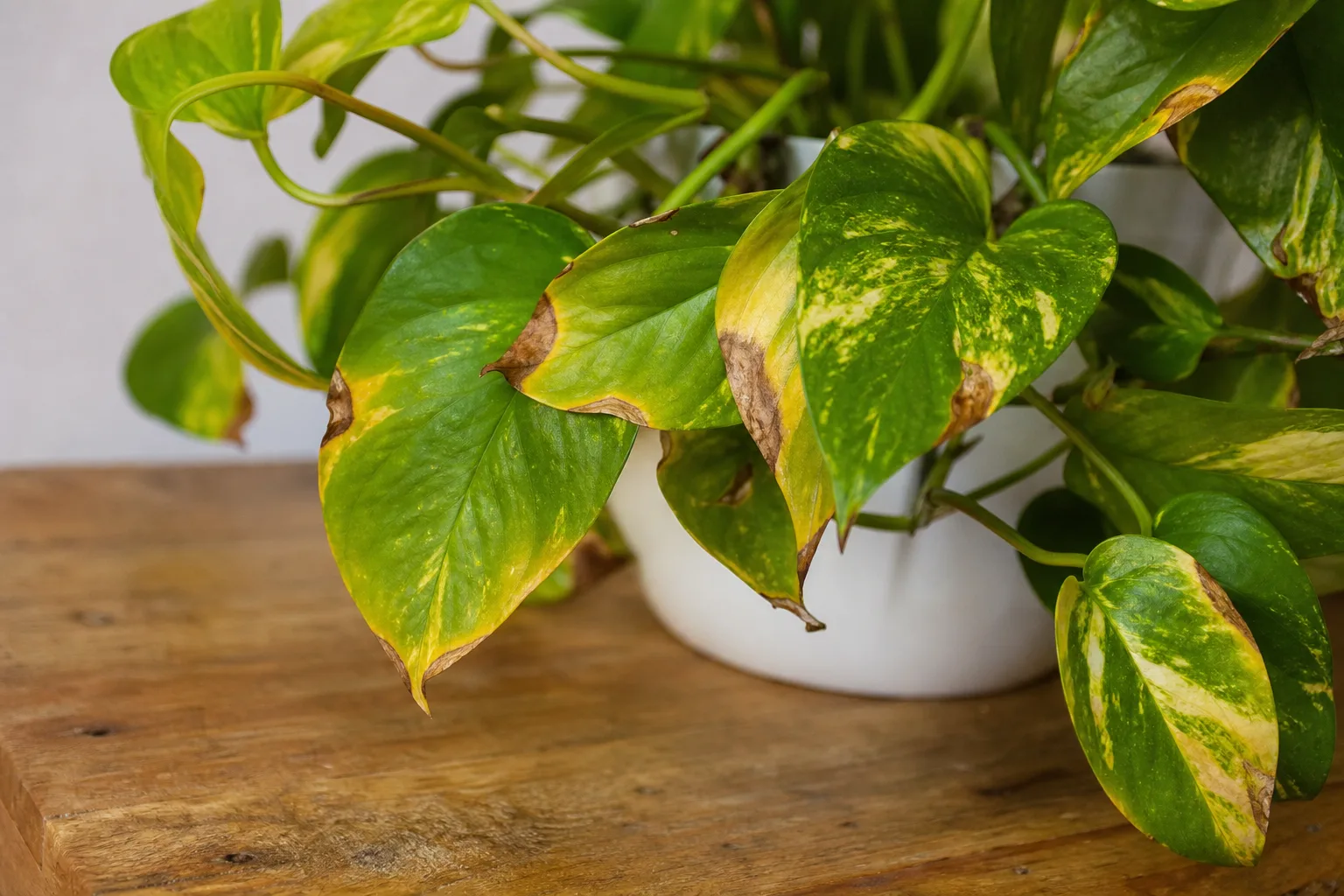
Brown leaf edges are one of the most over-diagnosed “nutrient” problems in indoor pots. Sometimes the plant truly is short on potassium. Often the same scorched margin is fertilizer burn, hard-water salts, dry air, or roots that cannot take up nutrients even when potassium is present. Feeding harder without checking those look-alikes is how a mild problem becomes a salt-injured root ball.
This guide focuses on houseplants in containers: what potassium deficiency usually looks like, how to separate it from salt injury and nutrient lockout, and how to correct carefully so you do not trade one brown edge for another.
First Fork: Deficiency, Salts, or Lockout?
Before any bottle comes off the shelf, pick one working theory:
| First clue | More likely | First move |
|---|---|---|
| Long underfeeding in active growth; older leaves edge-scorch first; no fresh white crust | True potassium shortage | Stabilize watering, then dilute complete fertilizer on moist mix |
| Recent strong or frequent feed; white crust on mix/rim; wilt while mix still moist | Fertilizer / salt burn | Stop fertilizer; leach or repot; hold feed |
| Wet sour mix, soft roots, or decline after overdose / chronic wetness | Lockout / root failure | Fix roots and moisture first — more potassium will not help |
True potassium shortage is real in long-lived, rarely fed containers that are watered often enough to leach mobile nutrients. It is also less common in regularly fertilized container substrates than many growers assume — UF/IFAS notes that potassium deficiency is less common in container substrates than in highly leached sandy landscape soils. Indoors, salt injury and failed uptake usually deserve equal or higher suspicion than “needs more K.”
Shelf Note: Same Margin Look, Opposite Histories
Shelf note (Bengaluru apartment, bright east sill, growing season 2026): Two plants on the same shelf developed brown margins in the same month — with opposite care histories.
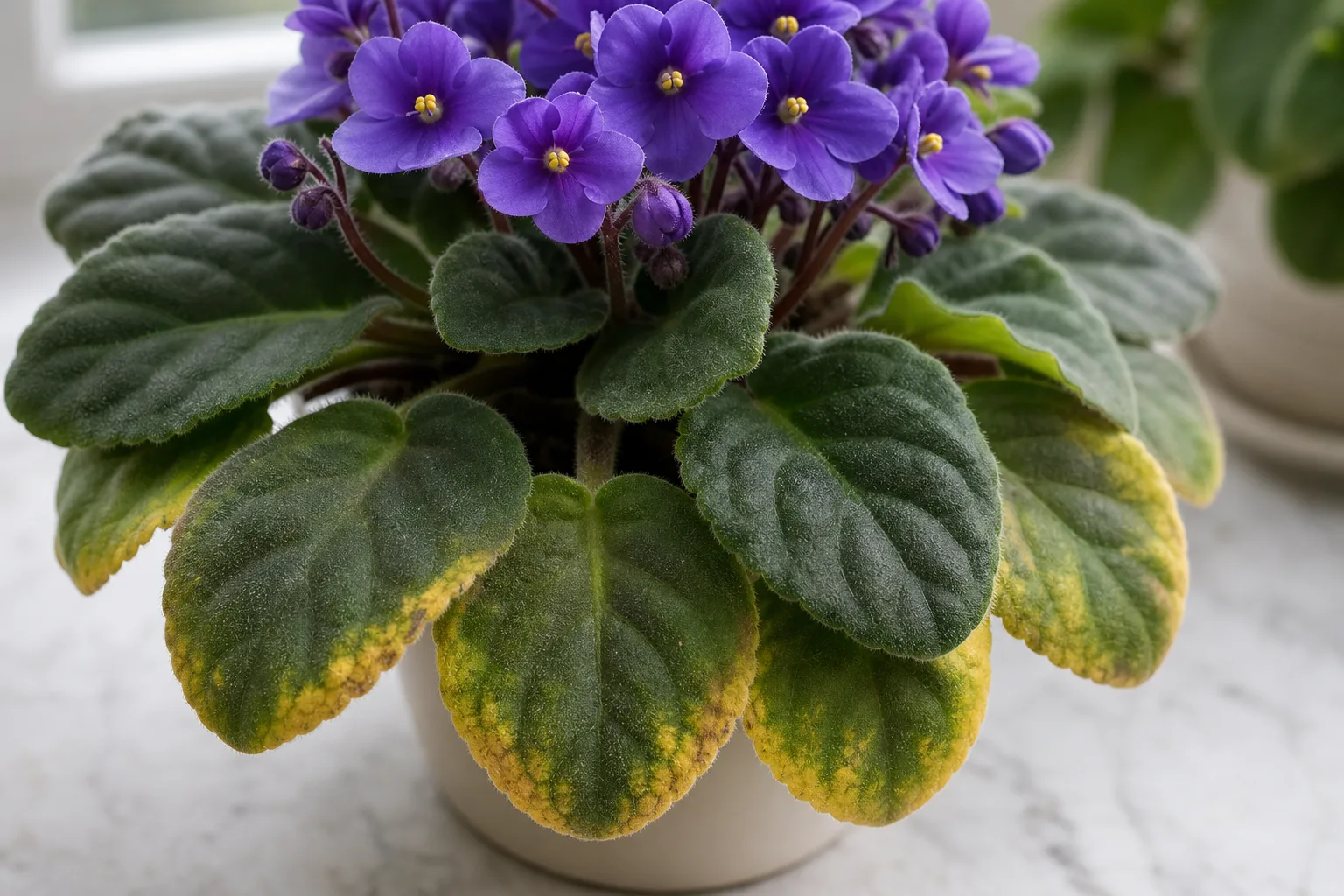
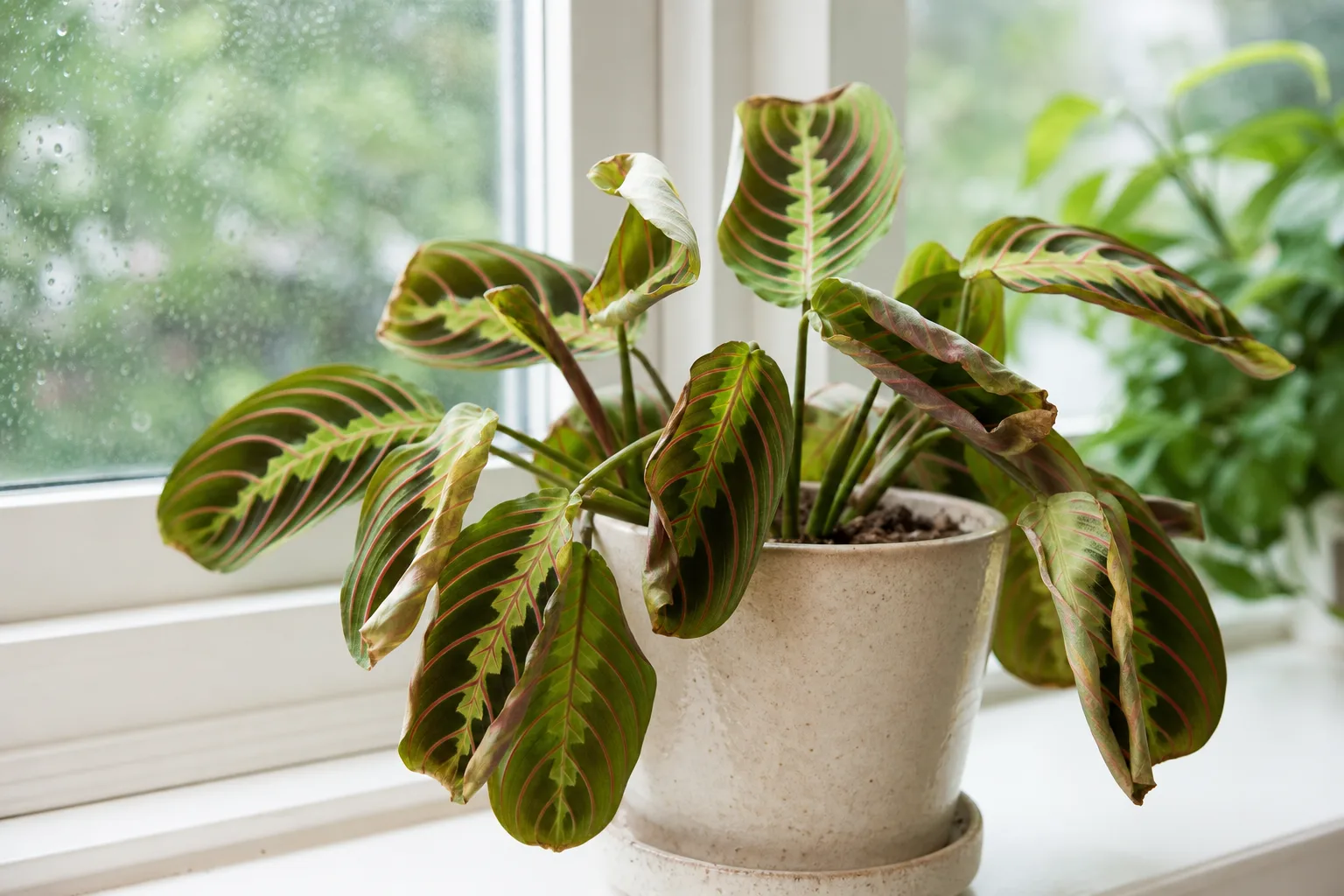
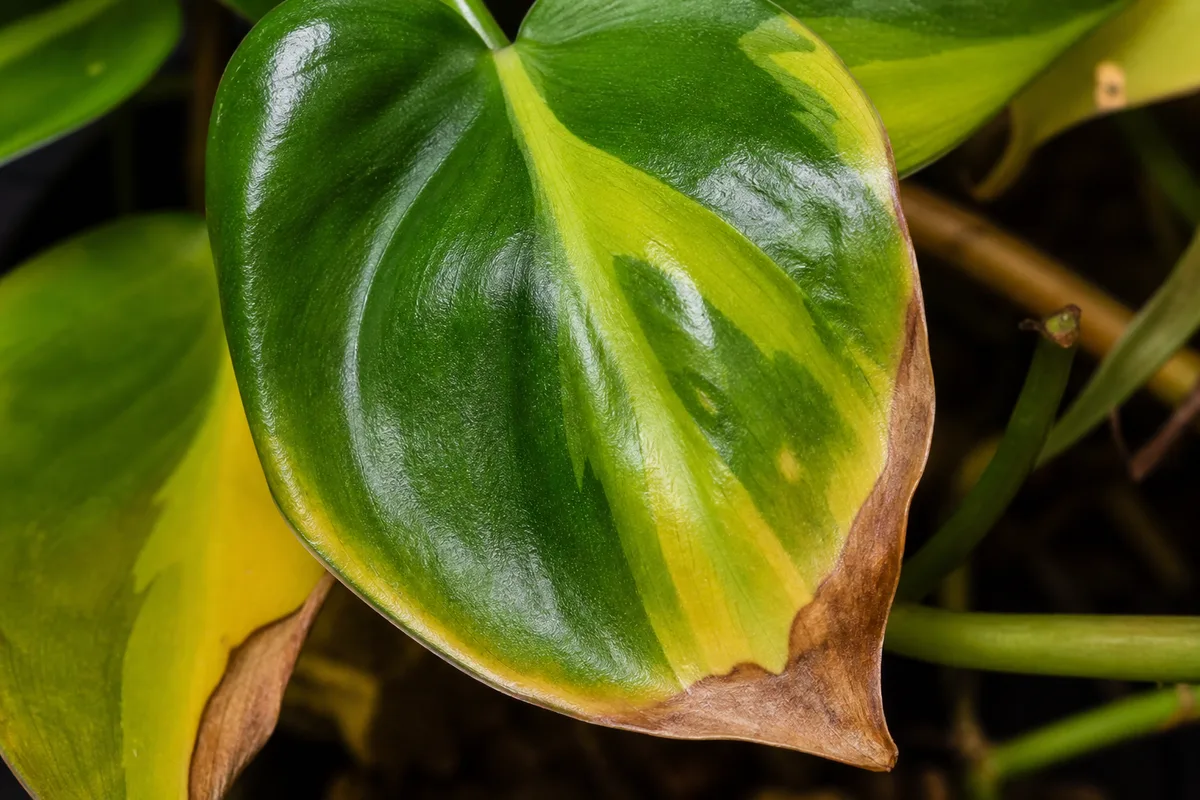
Illustrative older-leaf margin pattern similar to the underfed African violet case (species asset; not the Bengaluru plant itself).
- African violet — no fertilizer for about five months of active growth. Several outer mature leaves showed pale-to-tan margins; newest center leaves stayed cleaner (same older-leaf pattern as African violet potassium deficiency). On moist mix I used a complete liquid houseplant fertilizer at about one-quarter of the labeled indoor rate. Cleaner new center leaves were visible by week 3; old scorched margins stayed brown.
- Pothos — same room, hard tank water, fertilized nearly every watering for weeks. Tip burn plus white crust on the pot rim (salts path, not the underfed look-alike in pothos potassium deficiency). I stopped feed and leached until runoff ran clearer. Crust eased over the next two weeks; old burned tips did not re-green.
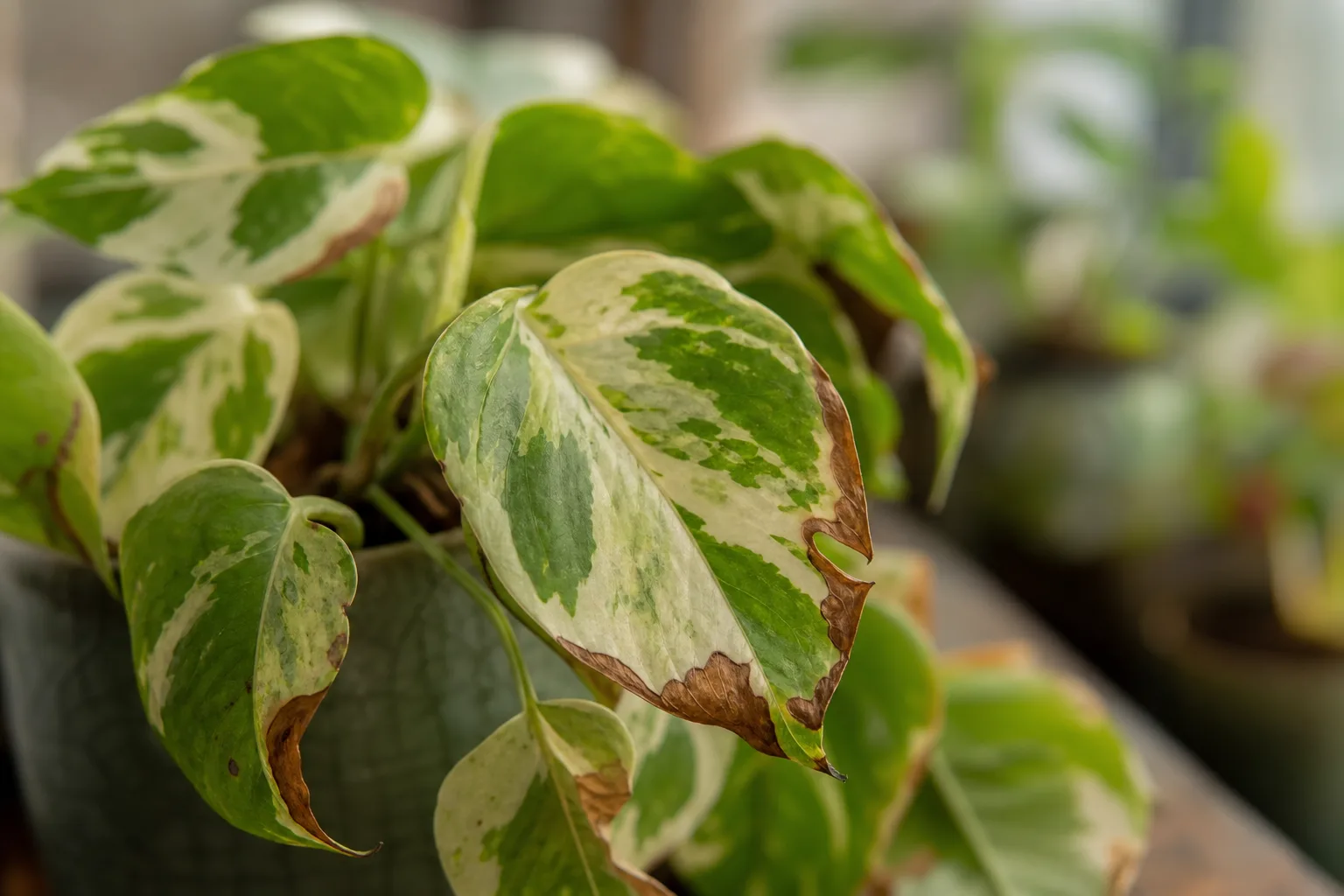
Illustrative fertilizer-burn / tip-scorch pattern similar to the hard-water, overfed pothos case (Manjula pothos asset used as the salt-injury visual pair).
Same symptom family, opposite histories. Single-home observation — not a lab confirmation. A fertilizer response on the violet supports the underfeeding theory; it does not prove potassium was the only missing ion.
What Potassium Does Inside a Houseplant
Potassium is the K in N-P-K fertilizer labels (listed as potash, K₂O). It is not built into proteins the way nitrogen is. It stays mobile as an ion and supports water regulation, stomatal function, enzyme activity, carbohydrate movement, and stress tolerance. University of Connecticut’s fertilizing guidance summarizes potassium’s role in stem strength and stress tolerance for houseplants, alongside nitrogen for leafy growth and phosphorus for flowering and roots.
North Carolina State Extension’s soils and plant nutrients handbook notes that potassium helps plants handle drought stress and is mobile in the plant while also leaching from soil. That combination matters indoors: soilless mixes hold a limited nutrient reserve, repeated watering washes mobile ions out, and a plant can redistribute potassium from older leaves toward new growth when supply falls short.
Potassium shortage can slow growth, weaken stress tolerance, and reduce flowering performance. None of those signs alone proves a potassium problem. Low light, root restriction, temperature stress, and several other nutrient issues produce the same general decline.
Classic Potassium Deficiency Symptoms
The pattern most consistent with low potassium starts on mature or older leaves. Tissue near the leaf edges pales or yellows, then turns tan or brown, creating a scorched margin that can move inward. Areas along major veins may stay greener longer. Advanced cases can show necrotic spots on older leaves, a tendency to wilt more readily, and weak overall growth.
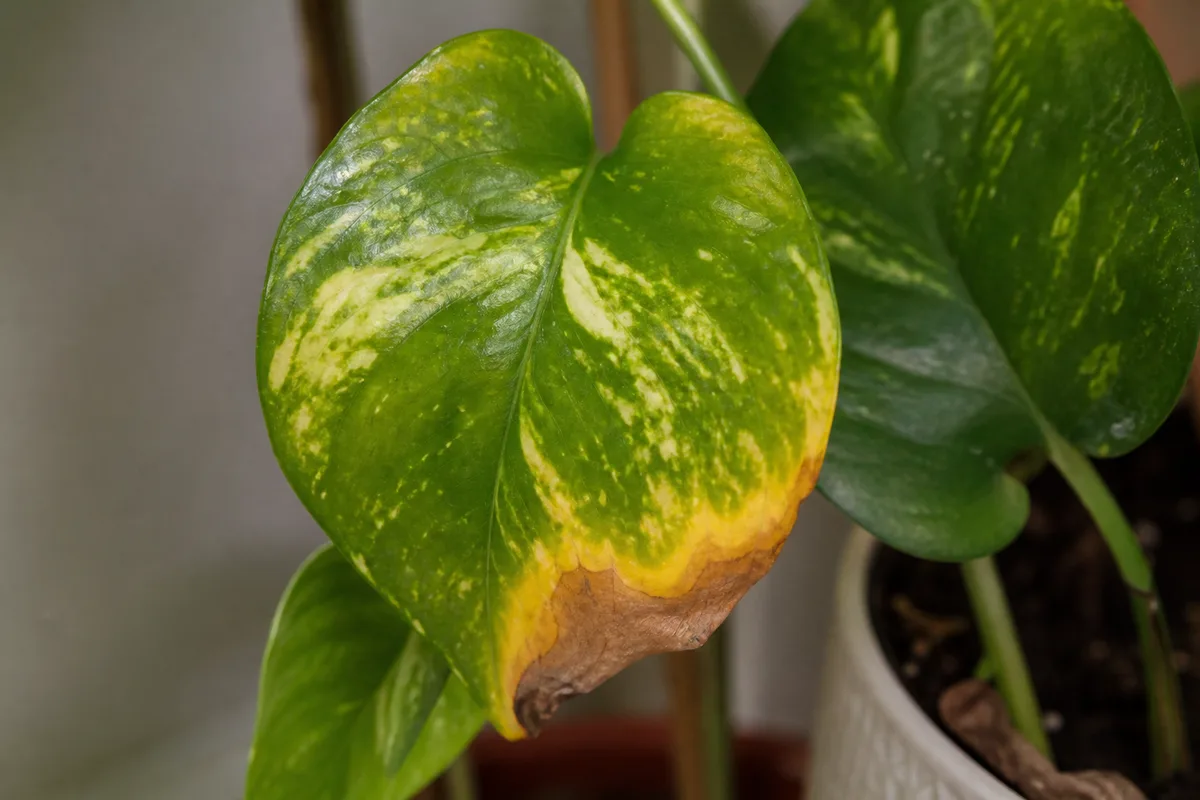
The Royal Horticultural Society describes potassium deficiency as yellow or purple-red leaf tints with browning that begins at the edges of mature leaves, plus poor flowering and fruiting. NC State’s nutrient table lists chlorotic and burned margins on older leaves, necrotic spots, shortened growth, and poorly developed root systems among potassium-deficiency signs. The Missouri Botanical Garden nutrient overview likewise associates potash shortage with stunted growth and yellowing older leaves with edges that may roll, and notes that container plants need regular complete fertilizer because soilless mixes hold fewer nutrients than garden soil.
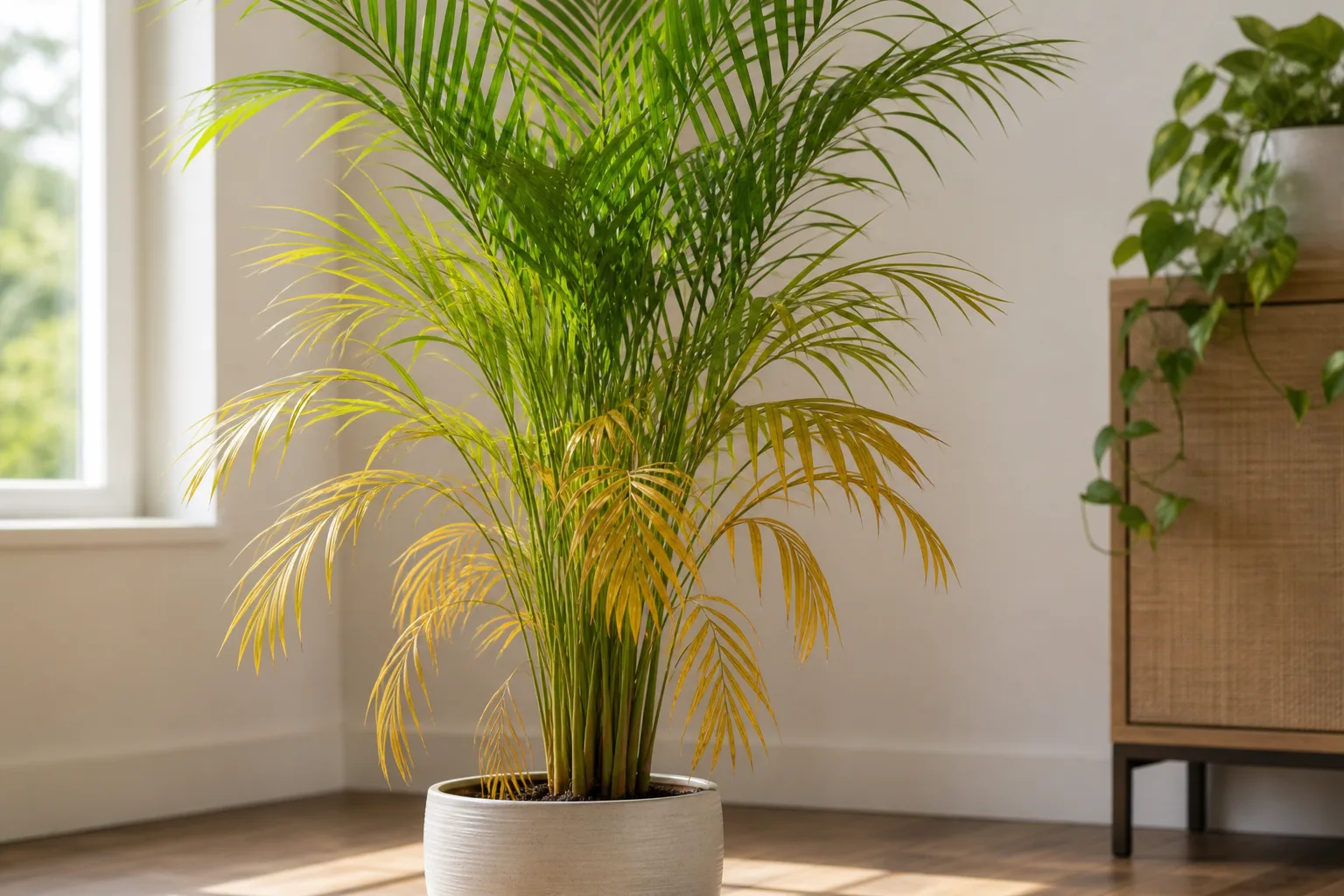
Species vary. UF/IFAS research on potassium deficiency in palms shows that symptoms always appear first on the oldest leaves and can range from translucent yellow-orange spotting to tip and marginal necrosis, depending on the palm. Indoor kentia, areca, and pygmy date palms follow that oldest-leaf rule even when the exact spotting pattern differs from a soft-leaved African violet or pothos. Palm canopy recovery timelines (often many months to a year or more as new leaves replace the canopy) are palm-specific — do not apply those recovery rates to a fast soft-leaved tropical.
Look for a repeatable distribution, not one imperfect tip. Potassium becomes more plausible when several older leaves share an edge-first pattern, newer leaves are comparatively cleaner, and the plant has a credible underfeeding or depleted-mix history.
Why Older Leaves Show Damage First
Because potassium is mobile inside the plant, a short supply often shows on tissue the plant can afford to reallocate from. Older leaves donate potassium toward active growing points. That is why true deficiency commonly appears as older-leaf marginal chlorosis and necrosis first.
Leaf age narrows the field; it does not finish the diagnosis. Nitrogen deficiency also begins on older foliage. Magnesium problems often produce interveinal yellowing on older leaves. Iron shortage, by contrast, usually hits the youngest growth because iron is relatively immobile. If only new leaves are pale between veins while old leaves look fine, potassium is a weaker explanation than iron or another immature-tissue issue.
| Nutrient | Typical leaf age | Pattern cue |
|---|---|---|
| Potassium (K) | Older first | Edge yellowing → brown margin scorch; may have purple-red tints |
| Nitrogen (N) | Older first | Overall pale/yellow; lower leaves drop |
| Magnesium (Mg) | Older first | Interveinal yellowing; veins stay greener longer |
| Iron (Fe) | Newest first | Interveinal chlorosis on young leaves |
Photograph the whole plant before you prune. If damage is one-sided toward glass, clustered after a recent strong feed, or shaped as discrete spots with halos, rethink nutrition before you reach for fertilizer.
Margin Burn vs Fertilizer Salts
This is the decision that saves most plants. Marginal scorch from potassium shortage and tip or edge burn from soluble salts can look nearly identical on a phone photo. The history and the pot surface usually separate them better than color alone.
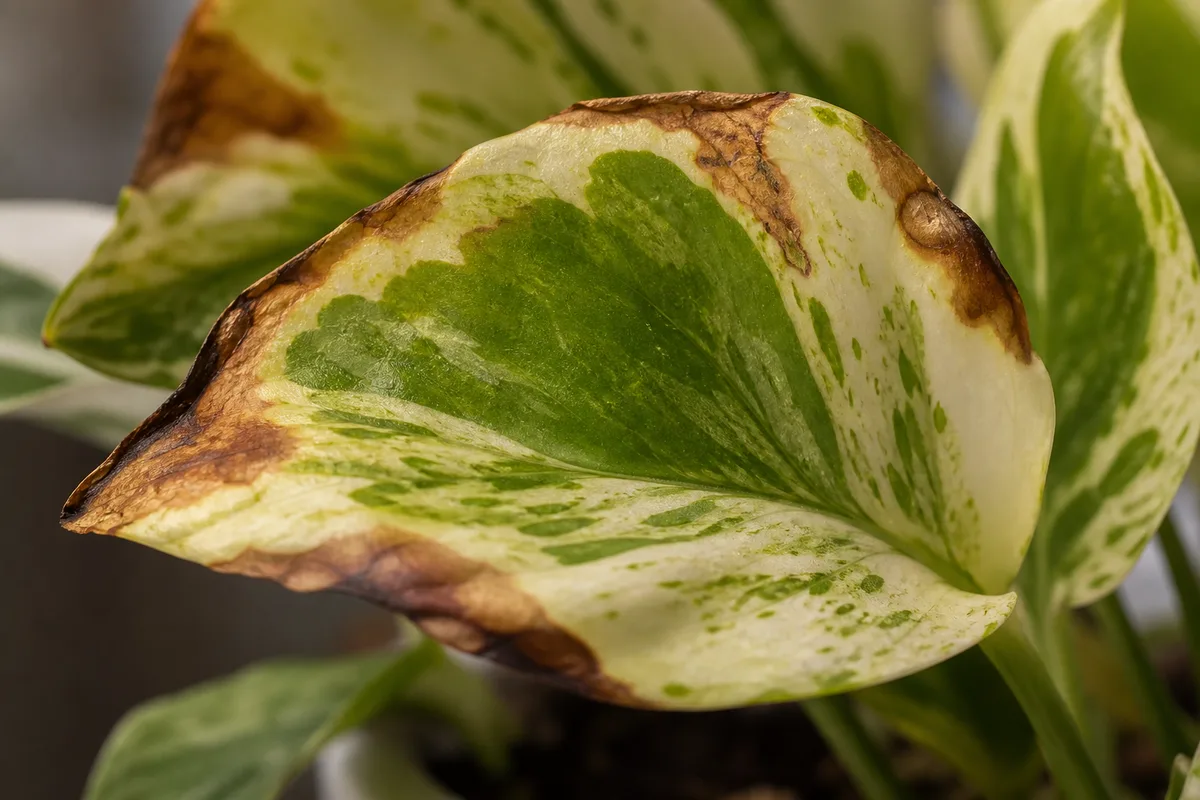
Clemson HGIC notes that brown leaf tips and margins can come from hot dry air, improper watering, insect feeding, and salt accumulation, and that white to grey crusty deposits on the soil or pot rim signal salt buildup. The same center warns not to confuse that crust with soft mold. Clemson’s fertilizing guidance adds that salt buildup can cause reduced growth, brown leaf tips, lower-leaf drop, and wilting, and that thorough watering with drainage emptied from the tray is the main prevention. UConn describes overfertilization as browning roots and leaf tips, wilting, and white crust on pot rims, with leaching or repotting as remedies.
Hard irrigation water stacks minerals on top of fertilizer salts. Softened water can add sodium stress on top of that load. If your pots grow chalky rims even when you feed lightly, read the hard water for houseplants guide before you assume the plant needs more potassium.
How to Tell Deficiency from Salt Injury
Use this comparison when the leaf edges look burned:
| Clue | More like potassium deficiency | More like fertilizer / salt burn |
|---|---|---|
| Timing | Gradual after long underfeeding or years in the same mix | Often within days of a strong feed or after weeks of frequent full-strength fertilizer |
| Leaf age | Older leaves first, newer leaves cleaner | Tips and margins can hit tender growth hard; pattern less strictly “old first” |
| Pot surface | Usually no fresh white crust from fertilizer | White or yellowish crust on mix, rim, or drain hole common |
| Watering feel | Plant may wilt more readily under drought stress | Plant may wilt even when the mix is still moist |
| Recent care | Long gap in feeding during bright active growth | Concentrated dose, outdoor-rate product, or feed on bone-dry roots |
| Next move | Stabilize roots, then dilute complete fertilizer | Stop fertilizer, leach or repot, hold feed |
If the history points to salts, treat it as fertilizer burn first. Adding more potassium “to fix the edges” on a salty pot is the wrong move.
Hard Water, Humidity, and Other Edge Scorch Causes
Not every brown margin is nutrition. Low humidity and hot dry air crisp tips on ferns, calatheas, and many tropicals. Inconsistent watering dehydrates margins. Cold glass can kill a sharply bounded patch overnight. Fluoride- or chlorine-sensitive plants can tip-burn from some tap waters. Insect feeding and some leaf diseases create browning that only looks nutritional from a distance.
Clemson’s indoor watering guidance and brown-tip notes emphasize thorough watering practices and salt management rather than endless tip trimming. For broader tip diagnostics, see brown tips on houseplants and indoor plant brown leaves. Crispy texture with dry mix points first to water and humidity, covered in crispy leaves on plants.
Nutrient Lockout vs True Shortage
A pot can contain potassium and still show deficiency-like margins if roots cannot absorb it. That is the practical meaning of nutrient lockout for houseplant growers: uptake failure from damaged roots, unsuitable pH, oxygen-starved wet mix, extreme dryness, cold roots, or high soluble-salt stress.
True shortage is more likely when the mix is old and repeatedly leached, the plant grew hard under bright light with little or no fertilizer, and roots still look firm and healthy. Lockout is more likely when the mix smells sour, roots are soft or sparse, the pot stays wet for days, salts crust the rim, or decline followed overwatering or a fertilizer overdose — patterns that often overlap root rot.
Correcting lockout by pouring on more fertilizer usually worsens salts and root stress. Fix drainage, moisture rhythm, and root health first. Only then consider a modest complete feed if the plant is actively growing and the substrate can support uptake.
Purple Leaves and Related Nutrient Confusion
Purple or reddish leaf tints get blamed on phosphorus first, and sometimes that is fair. RHS lists purple discoloration on older leaves among phosphorus-deficiency signs, especially on young plants in cool conditions. Potassium deficiency can also produce purple-red tints with marginal browning on mature leaves, so color alone is not a reliable lab result.
Cold nights, strong light on some cultivars, and genetic anthocyanin in ornamental foliage can purple leaves without any nutrient emergency. If purple tones appear mainly on new growth with stunting after a cold spell, environment may matter more than a phosphorus bottle. Use the purple leaves guide when color change is the main complaint, and keep potassium in the differential only when older-leaf edge scorch and feeding history support it.
Do not chase purple color with random high-phosphorus “bloom booster” doses indoors. Many foliage houseplants do fine on a balanced complete fertilizer once light, temperature, and watering are stable.
Diagnostic Checklist Before You Feed
Work through these steps before you change fertilizer strength.
1. Map leaf age. Confirm whether damage begins on older leaves with edge-first yellowing and scorch. Random one-sided patches or brand-new-leaf-only chlorosis weaken the potassium case.
2. Reconstruct fertilizer and water history. Note the last product, dilution, how dry the mix was at feeding, and whether you leach periodically. Also note hard water, softened water, or exclusive bottom watering that can stack salts.
3. Inspect the pot for salts and drainage. Look for crust on the rim or mix surface. Confirm the pot drains and the saucer is emptied. Probe moisture at root depth, not only the top centimeter.
4. Check roots if decline is serious. Firm, pale-to-tan roots with living tips support a nutrition trial. Soft, dark, foul roots mean you have a root-zone emergency first.
5. Rule in competing causes. Pests, cold glass, sun scorch, and leaf-spot patterns should be checked with bright light on both leaf surfaces.
6. Choose the lowest-risk next action. Long underfeeding + old-leaf margins + healthy roots → careful complete fertilizer. Recent overfeeding or crust → stop feed and leach. Wet soft roots → fix watering and consider fresh mix before any nutrient product.
When Testing Helps
Most home growers will not run a tissue test on a grocery-store pothos. Testing earns its keep for a valuable specimen, a collection-wide pattern, or a plant that keeps declining after careful cultural fixes. A lab familiar with soilless container media can report pH, soluble salts (EC), and extractable nutrients more usefully than a cheap garden probe claiming to read “N-P-K” from a wet stick.
Consumer meters that estimate moisture or approximate pH can still help you avoid watering mistakes. They do not confirm potassium deficiency by themselves.
How to Correct Potassium Deficiency Carefully
Correction starts with restraint. The goal is to restore a usable potassium supply without creating salt injury or knocking magnesium out of balance.
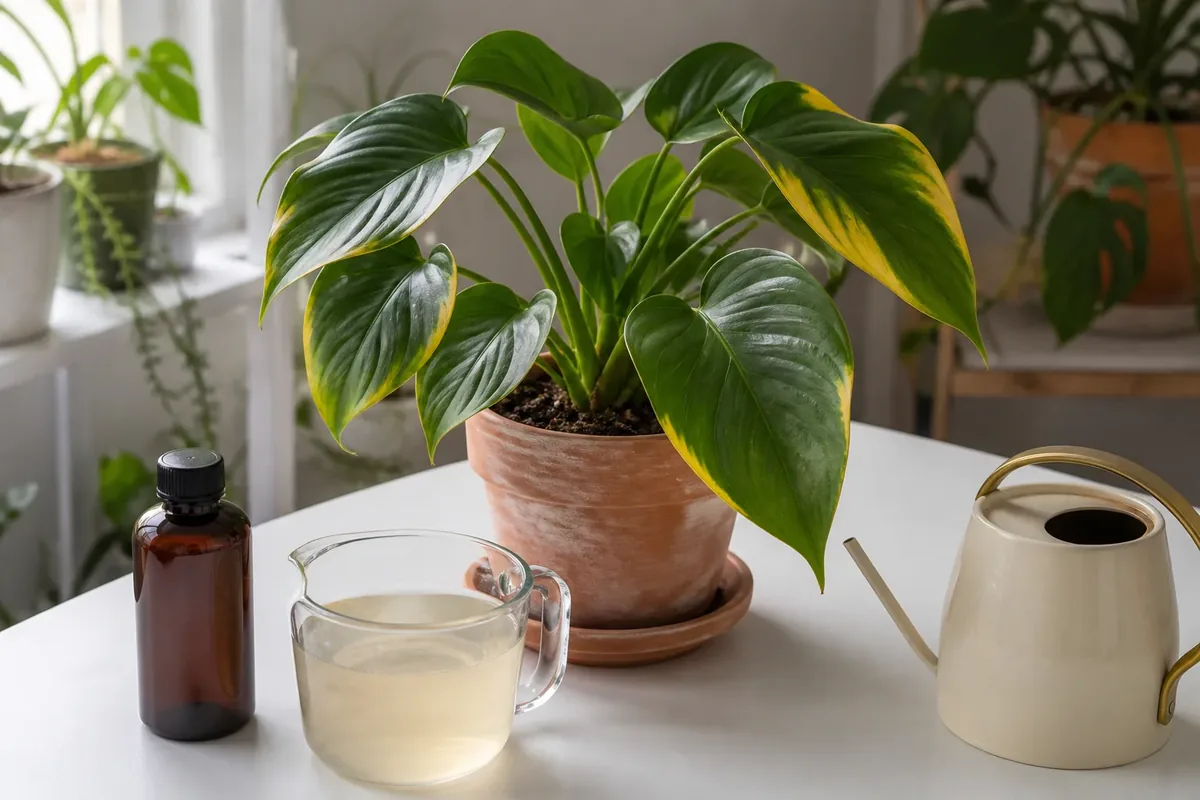
Stabilize light and watering for the species. Confirm drainage. If salts are plausible, handle that before any feed. If roots are compromised, restore the root zone before you expect fertilizer to work.
When evidence supports true underfeeding during active growth, use a complete houseplant fertilizer that includes potassium rather than a single-nutrient experiment. Clemson recommends complete fertilizers for indoor gardens and notes that water-soluble products used as dilute solutions reduce burn risk. Missouri Botanical Garden likewise points container growers toward regular complete formulas such as a balanced 20-20-20 style product when potting mixes run short.
Choose a Complete Fertilizer, Not a Kitchen Hack
Banana-peel water, wood ash, and leftover cooking water are poor correction tools. Homemade soaks have unknown potassium concentration, can add rot-prone organic sludge, and tell you nothing about whether the plant was salt-stressed. Wood ash is alkaline and can swing pH and salts sharply. Epsom salt supplies magnesium and sulfur, not potassium; using it “just in case” can muddy the diagnosis.
High-potassium tomato feeds have a place for some fruiting plants, but RHS nutrient guidance warns that overapplication of potassium fertilizers reduces magnesium uptake and can induce magnesium deficiency. For mixed foliage houseplants, a labeled complete indoor fertilizer is the safer default — often a balanced or foliage-leaning complete such as roughly equal N-P-K (for example 10-10-10 or 20-20-20 class products) used dilute. Match flowering plants to products suited to blooms if needed, still following the label rather than stacking concentrates.
Dose, Timing, and Root-Zone Prep
Apply fertilizer to an already moist root ball. UConn specifically advises moist potting soil to avoid root damage. Never pour concentrated liquid onto a bone-dry ball.
Use the product label for container plants. For a stressed plant, starting at the low end of the labeled indoor range — often about one-quarter to one-half strength — is prudent. Clemson describes common indoor approaches such as full label rate every two or three months during growth, or much more dilute solutions used more often, or feeding about every seventh watering. Pick one method and track it. Do not combine monthly full-strength liquid with fresh slow-release pellets unless you know the total load.
Feed during active growth, typically brighter spring through early fall for most temperate-home collections. Pause or sharply reduce feeding in low-light winter rest unless the plant is under strong grow lights and still producing new leaves. Clemson notes that indoor plants in low light have reduced fertilizer requirements and that winter rest usually means no fertilizer.
Empty drainage water from saucers. Standing fertilizer solution re-concentrates salts as water evaporates.
What to Do If Salts Are Already High
If crust, recent overfeeding, or salt-burn timing dominates the story, do not add potassium yet.
Stop fertilizer. If the pot drains freely and roots are not badly rotted, leach thoroughly: water until a generous volume runs out (aim for roughly the pot’s volume of water as a starting leach, discard the runoff, and repeat once if the plant tolerates it). Clemson recommends periodic drenching to leach salts, avoiding overfertilization, and removing surface crust when present. UConn likewise recommends leaching with copious water when drainage is free, or repotting into fresh medium when salt injury is advanced. For a dedicated flush protocol, use the fertilizer burn guide.
After leaching, wait for the plant to stabilize before any light feeding. If the mix is collapsed, hydrophobic, or foul, repotting into fresh mix in a pot sized to the healthy root mass is cleaner than endless flushing.
For palms and other plants with severe older-leaf potassium patterns, UF/IFAS notes that recovery can take a long time because the canopy must be replaced with new leaves, and that repeatedly removing symptomatic older leaves can accelerate decline. Trim only fully dead tissue when needed; do not strip every discolored leaf hoping for a quick cosmetic reset.
Recovery Timeline and What Will Not Heal
Necrotic brown margins will not turn green again. Chlorotic tissue may stabilize, but the real proof of correction is new growth that emerges with normal color and intact edges, plus a stop in the spread of edge damage onto additional older leaves.
On the Bengaluru violet, cleaner new center leaves showed by about three weeks after one dilute complete feed on moist mix, with light and watering held steady. Soft-leaved tropicals under bright active growth often show a readable new-leaf signal in 2–4 weeks. Slow growers and palms can take months because damaged canopy leaves are not repaired — they are replaced. Hold other major variables steady so concurrent changes do not confound the fertilizer trial. A positive response supports the diagnosis; it does not prove potassium was the only limiting nutrient.
Escalate if soft stems appear, roots collapse, lesions look infectious, or decline continues after salts and moisture are corrected. A diagnostic lab or local extension desk is appropriate for valuable plants.
Prevention in brief: use a complete fertilizer matched to growth and light; prefer dilute measured applications; water until some liquid drains, then empty the tray; leach periodically if you fertilize regularly with synthetics; repot when the mix is exhausted or crusted; track which bright-shelf plants need a feeding plan and which dim-corner plants need restraint.
Common mistakes: treating every brown edge as a potassium emergency; correcting with an unmeasured high-K tonic while salts are already high; feeding rotting roots; fertilizing dry mix; using outdoor lawn rates indoors; stacking liquid feed on fresh controlled-release fertilizer; stripping every symptomatic palm leaf; chasing purple color with phosphorus bombs.
Related Problem Guides
Next decisions when the pattern or history points elsewhere:
- Fertilizer burn on houseplants — tip/margin scorch after overfeeding, crust, or salty mix
- Nutrient lockout — nutrients present but roots cannot absorb them
- Purple leaves — purple or reddish foliage from phosphorus stress, cold, or cultivar color
- How often to fertilize indoor plants and best fertilizer for indoor plants — schedules and product choices once the diagnosis is clear
- Shorter card: potassium deficiency symptom overview
Conclusion
Judge success with a short checklist — not repaired dead edges:
- History matched the fix (underfed healthy roots got dilute complete feed; salty pots got a fertilizer holiday and leach).
- Scorch stopped spreading onto additional older leaves.
- New leaves open with clean margins (often 2–4 weeks on soft foliage; much longer on palms).
- No new white crust after you resume light feeding.
- Roots stay firm and the mix drains — lockout has not returned.
Potassium deficiency in houseplants is real, especially in long-lived containers that are rarely fed and frequently watered. The classic clue is older-leaf marginal yellowing that progresses to brown scorch. That pattern is useful only when you also weigh fertilizer history, salt crust, root health, water quality, and humidity — and remember that regularly fed containers are less often truly K-starved than salt-stressed.